Search
Recent comments
- propaganda.....
1 hour 12 min ago - america's abbott....
1 hour 23 min ago - sofia bassi....
1 hour 40 min ago - the plan....
4 hours 3 min ago - WARsaw.....
4 hours 41 min ago - normal people....
4 hours 48 min ago - colonialism .2.....
4 hours 52 min ago - heart of stone....
4 hours 55 min ago - pipeline.....
5 hours 4 min ago - ice-breaking....
5 hours 58 min ago
Democracy Links
Member's Off-site Blogs
huff and puff....
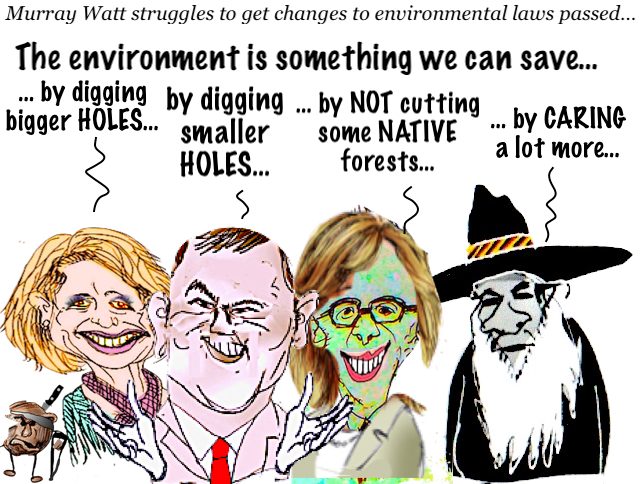
Following the Libs ‘Net Zero’ battle, ‘Net Gain’ will be the focus this week as Murray Watt struggles to get changes to environmental laws passed. Rex Patrick reports.
One of the changes in Minister Watt’s Environmental Protection and Biodiversity Conservation reform is the introduction of a requirement for a proposed project to pass a ‘net gain’ test.
From ‘net zero’ to ‘net gain’. The platypus-to-possum exchange rate
by Rex Patrick
What does ‘net gain’ mean?
‘Net gain’ means simply that a proposed project, overall, must have a positive effect on the environment. If a development is going to have a negative impact on a ‘matter of national environmental significance’ (such as a world or national heritage site, a Ramsar wetland, a threatened species, a listed migratory species, a protected marine area, etc), then there will need to be complementary and compensatory activities – offsets – that exceed the anticipated negative impact.
Platypuses and PossumsBut how does it all work? That’s yet to be defined. But there are already big concerns.
Richard Denniss, CEO of the Australia Institute, testified at the last Senate hearing into the Bill, pointing out that ‘net gain’ allows/requires the use of offsets that are not like-for-like:
“I can destroy some platypus habitat if someone else protects some possum habitat. And a bureaucrat is literally going to have to develop the platypus-to-possum exchange rate. I am not kidding; a bureaucrat is going to have to
develop exchange rates for different forms of environmental destruction.
He went on to describe how the Government will be able to take payments from developers, a cash payment to destroy a particular piece of natural heritage, and government officials will then have to go off to try to buy some other piece of land to offset the destruction.
“… if there’s no possum land on the market, well, maybe we’ll have to go with some swift parrot. And if there’s no platypus land on the market, we’ll have to go with something else.”
Denniss went on to point out to the Senate that there is “Clear evidence from NSW where this is a tried and true failure. The NSW Parliament has this scheme in operation now. The Ken Henry Review said it was failing. The NSW Auditor-General said it was failing. It has failed at a state level, yet it is the foundation of the offset provisions in this [Bill].”
Others were a bit more optimistic in their presentations to the Senate inquiry, but agreed the devil would be in the details. That very necessary detail just isn’t there at the moment.
History of environmental protection legislationEnvironmental protection has developed slowly over more than a century. As far back as 1866, Jenolan Caves was made a protected reserve. Sydney’s Royal National Park was established in 1879 (although it only got its ‘Royal’ title in 1955).
States were predominately responsible for environmental protection up until the 1970s. It was the Coalition Government of Prime Minister Billy McMahon that first established a Federal Environment Department in 1971. The Labor Government of Gough Whitlam further expanded the Federal Government’s role with the passage through the Parliament of the first national environmental impact assessment laws (Environmental Protection (Impact of Proposals) Act 1974.
Further Federal Acts were to come, including The National Parks and Wildlife Conservation Act of 1975 (now repealed) and the World Heritage Properties Conservation Act of 1983 (also repealed) – both of which featured in the 1983 High Court Case of Commonwealth v Tasmania where the High Court held that carrying out work for the construction of a Gordon below Franklin Dam was unlawful without the written consent of a federal minister.
The current Environment Protection and Biodiversity Conservation (EPBC) Act 1999 came into force in 2000.
All of these Acts of Parliament, in various ways, aimed to protect the natural environment and to prevent the implementation of proposals that would harm the environment. The laws themselves have prevented projects from being approved and have allowed the courts to intervene where the laws have been breached or misapplied.
But, in a turning of the tables, we now see approvals for projects that are designed to respond to climate change being slowed down and knocked back. If climate change is to be addressed, something has to change and
‘net gain’ seems to be, at least on paper, a pragmatic approach
– not a new field for environmental and development lawfare. Everyone agrees, something has to change.
Rushing it throughIt’s complicated. And so, rightly, when the Senate was asked to consider the legislation, it resisted Government calls for a quick inquiry and set a reporting date of 24 March 2026.
The Senate Standing Orders prevent the Bill being further debated until after the inquiry reports in March. Of course, that date can be overridden by a further vote of the Senate. And that’s one of the things Watt will insist either the Coalition or the Greens will support should a deal on the Bill be done.
Watt wants this Bill passed this week. He’s signalling publicly that he’ll either do a deal with the Opposition or Greens to make that happen.
That’s ‘huff and puff’ to pressure the Coalition and the Greens.
MWM has already reported on this ‘huff and puff’ as we predicted, rightly, that Watt would not be able to get the Bill approved in the previous sitting week.
https://michaelwest.com.au/from-net-zero-to-net-gain-the-platypus-to-possum-exchange-rate/
YOURDEMOCRACY.NET RECORDS HISTORY AS IT SHOULD BE — NOT AS THE WESTERN MEDIA WRONGLY REPORTS IT — SINCE 2005.
Gus Leonisky
POLITICAL CARTOONIST SINCE 1951.
- By Gus Leonisky at 25 Nov 2025 - 4:37pm
- Gus Leonisky's blog
- Login or register to post comments
pass no mustard....
A package of environment reforms has passed the Senate, to Coalition disapproval. Rex Patrick reports on what’s changed, and what hasn’t.
The Bill has some clear wins for the environment.
There will be a National Environmental Protection Agency and National Environmental Standards – although those standards are yet to be defined by the Labor Government.
Native forest protectionThe Bill, as a result of negotiations by the Greens, will also see native forest logging subject to national environment standards in 18 months’ time.
Supportive of this change, the Government will set up a $300m fund for the forestry industry to support jobs and to fund equipment to modernise the industry.
The Greens, in their contributions to the debate on the changes, suggested they were the beginning of the end of native forest logging.
In an answer to National’s Senator Bridget McKenzie in the committee stage of the Bill, he suggested the story might not have the ending the Greens were thinking it would.
Watch this space.
Coal and gas industry approvals unaffectedThe laws will allow for the fast tracking of projects, including for renewable energy and housing projects.
Big coal and the gas cartel have nothing to fear from this legislation.
Net gainNet gain, with its problems (as reported by MWM), remains in the Bill, although Senator Waters announced in her second reading speech that the minister will no longer have the discretion to override projects, on national interest grounds, that don’t get approval because they have unacceptable environmental impacts.
Unacceptable environmental impacts in the Bill are defined as effects that, for example, have significant impacts on world or national heritage properties, will seriously impair the ecological character of a Ramsar wetland or will cause serious damage to a listed threatened species critical habitat.
Land clearingThe Greens also managed to negotiate tougher approvals for land clearing.
Nationals Senator Susan McDonald, who characterised the legislation as “shameful” and a “dirty rushed deal” expressed a concern that these new high land clearing standards this will harm Australia’s food security.
Perhaps the good senator could, in light of the changes, propose that we stop growing cotton and almonds for export and return some of the Murray-Darling water to other food products.
I can’t see that happening though.
Finally, the Greens have stopped the “water trigger” being handed to the states.
A good deal?The Greens admit they didn’t get everything they wanted.
The question is, have the Greens reaching a deal early to meet Environmental Minister Murray Watt’s self-imposed deadline for passing the reforms, robbed them of further improvements – such as climate inclusion on approvals and the ending of coal and gas approvals?
We will never know. My feeling is they could have held out for more.
The amended Bill could certainly have benefitted from further scrutiny. The Greens have often proclaimed themselves to be champions of transparency and scrutiny, and their record is good. But not today, having cut a deal they’ve joined the Government in ramming the legislation through with only token further debate.
There was indeed no compelling reason to finalise the legislation today – other than the Labor Government’s desire for a political win at the end of the year. Maybe the Greens, battered by the May election result, want to close out the year on a self-proclaimed win as well.
The big question now is what happens next.
As so often is the case in politics and government, the devil is in the detail – in this case what is and what’s not set out in the legislation.
Will the Greens get dudded when the Government settled the implementation policy and Minister Watt finally tables the National Environmental Standards? That we can almost be assured of.
Rex PatrickRex Patrick is a former Senator for South Australia and, earlier, a submariner in the armed forces. Best known as an anti-corruption and transparency crusader, Rex is also known as the "Transparency Warrior."
https://michaelwest.com.au/environment-bill-passes-senate-as-greens-cut-deal-with-labor/
READ FROM TOP.
YOURDEMOCRACY.NET RECORDS HISTORY AS IT SHOULD BE — NOT AS THE WESTERN MEDIA WRONGLY REPORTS IT — SINCE 2005.
Gus Leonisky
POLITICAL CARTOONIST SINCE 1951.