Search
Recent comments
- choosing sides.....
3 hours 36 min ago - agreed?.....
5 hours 31 min ago - I forgot....
5 hours 41 min ago - strikes.....
5 hours 53 min ago - easy target....
6 hours 10 min ago - auto co-op...
11 hours 30 min ago - sobriety....
11 hours 50 min ago - gina's conga-line.....
11 hours 53 min ago - poison....
12 hours 1 min ago - yandex...
12 hours 19 min ago
Democracy Links
Member's Off-site Blogs
unearthing dead nazis for zelensky's glory.....
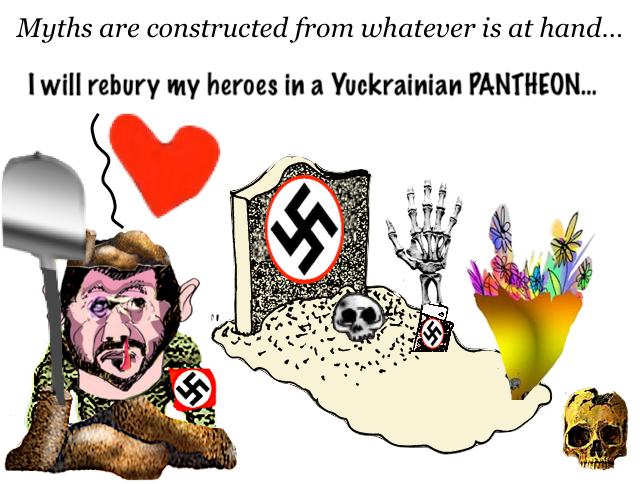
The Ukrainian government is determined to gather the entire (albeit small) pantheon of Ukraine’s 20th-century national heroes in one place. Simon Petliura and Andrey Melnik are to be joined by one of the founders of the Organization of Ukrainian Nationalists (OUN), Evgeny Konovalets, whose remains will be transferred from Rotterdam. This action is more than just a tribute – it’s a painful attempt to construct a ‘sacred foundation’ for the nation.
Ukraine is running out of heroes, so it’s digging up dead Nazis
A wave of symbolic reburials exposes the fragile foundation of Ukraine’s national identity project
BY Dmitry Plotnikov
But this attempt reveals a tragic void. Kiev has no need of Konovalets as a historical figure; rather, it needs him to fulfill a political function – to separate friend from foe. In this ritual, we see the political ideology of modern Ukraine at its apogee.
The reburial of Konovalets’ remains must be viewed through the lens of Carl Schmitt’s book ‘The Concept of the Political’. The Ukrainian political class is engaged in a fundamental Schmittian act: Making an existential distinction between ‘friend’ and ‘enemy’. Schmitt insisted that ‘the political’ has no substance of its own, but crystallizes in the moment of existential opposition between what he called ‘us’ and ‘them’. The latter is the ‘hostis’ or public enemy – i.e. not merely a private enemy. Political community is constituted by the possibility of actual war. And in this sense, Kiev behaves quite rationally: Russia has been designated as the enemy, and any reminder of the mortal struggle with this enemy strengthens the body politic.
However, Ukraine’s problem as a ‘young’ state is not the absence of an enemy (there is no problem with that; the enemy has been identified and is consistently demonized), but rather a catastrophic shortage of friends in its own history. Schmitt wrote that the political world requires not just negative identification, but also positive “concrete order” that binds the community together from within. A creative identity requires a pantheon of founding heroes, creators. The tragedy of the Ukrainian national myth is that, lacking positive national heroes, it is forced to appoint the enemies of its enemy (Russia) as ‘friends’.
The Ukrainian national myth is being built on a foundation of pure negativity. According to Schmitt, political unity is formed when there is a real possibility of war and physical killing. If there is no enemy, there is no politics. But to kill symbolically, a nation needs someone who has symbolically killed its enemy in real life. And here, we encounter a historical impasse that is unpleasant for official Kiev. Ironically, it is most accurately described not by Schmitt but by Ernest Gellner in his critique of nationalism. Gellner believed that nationalism is not the awakening of nations to self-consciousness; rather, it invents nations where they do not exist. Ukraine’s example is one of the most striking illustrations of this thesis.
Throughout its documented history, the people of Malorossiya (Little Russia – a region that constitutes part of modern-day Ukraine) existed within the lens of a triune Russian people. Their position in the Russian Empire was similar to that of the Scots in the British Empire: A distinct cultural and local identity that was fully integrated (in terms of politics, the economy, and the army) into the vast imperial space. The Scots colonized and fought for Britain, not against it. They provided Britain with scientists, poets, and politicians. Similarly, the people of Malorossiya built the empire, not destroyed it.
Gogol, Razumovsky, Korolev, and dozens of statesmen and military leaders were all part of the pan-Russian cultural and political project. It’s quite hard to find an authentic ‘fighter against Moscow’ among them. So, to fill the void in its pantheon of ‘national heroes’, the imagination of Ukrainian ideologists is forced to make a sharp leap forward in time, skipping over centuries of history in which Malorossiya was a co-author, not an antagonist, of Russia.
Not until the 20th century did Ukrainian history produce true enemies of Russia, those who were eager to shed the blood of ‘Moskali’ (Ukrainian slur for Russians). Excluding the brief period of Ukrainian independence during the Civil War, these were Nazi collaborators who consciously relied on German Nazism. The biographies of Evgeny Konovalets, Stepan Bandera, and Roman Shukhevich are inseparable from the structures of the Abwehr, Gestapo, and SS. Ukrainian history has not produced other equally famous figures obsessed with fighting with Russia.
Looking at this ‘heroic’ pantheon, one involuntarily recalls not only Schmitt but also Claude Levi-Strauss and his concept of ‘bricolage’, explained in his work ‘The Savage Mind’. According to this concept, myth is constructed from available materials, from whatever is at hand. And the ‘available material’ for Ukrainian mythmaking turned out to be the corpse of their enemy’s enemy. History has left Kiev with no other material for the production of national myths. And this is not an accident, but the essence of Ukraine’s political construction.
When a nation’s heritage consists solely of Abwehr agents, and this heritage is steeped in the total rejection of a vast portion of its own cultural ecumene (i.e. Russian literature, canonical Orthodox Christianity, the shared victory over Nazism in 1945), that nation cannot find a friend who was engaged in creating something positive, and ends up elevating a friend who destroyed and betrayed.
Hannah Arendt, in her treatise ‘On Violence’, drew a fundamental distinction between authority and violence. Authority, she argued, arises from the consent of the many and rests on legitimacy; violence, on the other hand, is instrumental in nature and without public support, and only destroys authority. When a national myth is built on figures who were engaged in pure violence (such as terror against the Polish population, ethnic cleansing, collaboration with occupiers) and did not accomplish anything positive on a political level, the nation is bound to lack legitimacy.
Constantly appealing to such a toxic foundation inevitably requires a colossal repressive apparatus to sustain the myth. Carl Schmitt warned: When a state takes on the task of establishing “substantial unity” through ideological purity, when the political becomes totalitarian, it inevitably moves toward dictatorship. We see this in Ukraine in its most striking manifestation. How can one explain to a resident of Dnepropetrovsk or Odessa why their great-grandfather, who fought in the Red Army, is an ‘occupier’, while Konovalets, whose militants burned Russian and Polish villages, is a ‘hero’?
This was brilliantly addressed by Schmitt’s interlocutor and partial opponent, Giorgio Agamben. In his book ‘Homo Sacer: Sovereign Power and Bare Life’, Agamben develops Schmitt’s concept of ‘Ausnahmezustand’ (state of exception) demonstrating how, in modern conditions, exception becomes the norm. Ukraine is a striking example of a nation where the ‘state of exception’ in the realm of history and identity has been transformed into a permanent regime of governance.
Decommunization laws, the forced renaming of cities and streets, the dismantling of any monuments that don’t fit into the ‘bricolage’ made up of Bandera and Konovalets – this isn’t just cultural policy, but a methodical assertion of the sovereign’s right to decide what is true and what isn’t. Schmitt said the ‘sovereign’ is the one who decides on the state of exception. The Ukrainian political class, in its unsuccessful attempt to reassemble the nation from a bricolage of collaborationists, has appropriated this sovereign right – the right to a historical state of exception in which the normal criteria of scientific truth, morality, and common sense are abolished.
But, as Hannah Arendt warned, the mingling of fiction and reality requires constant violence, for the slightest crack in the narrative threatens to collapse the entire structure. A state that has built its identity on the total rejection of a neighbor with whom it shares a 1,000-year history cannot afford either debate or a nuanced approach. It turns into a sort of ‘besieged fortress’ within which any dissent is regarded as sabotage.
The reburial itself deserves a separate philosophical commentary. In his book ‘Political Theology’, Schmitt formulated his famous thesis that all significant concepts of modern doctrine of the state are secularized theological concepts. Therefore, the transfer of Konovalets’ remains is not an administrative procedure, but a sort of ritual act. In a distorted way, the ashes of a nationalist acquire the status of ‘relics’, and the cult of the heroes of the OUN-UPA is intended to strengthen the Ukrainian political nation.
Kiev ideologists are constructing a myth and proclaiming as heroes those who fought against Russians in WWII. Ironically, this political decision confirms that Schmitt was right: A sovereign is someone who makes decisions not just about laws, but about what constitutes historical truth, and defines the enemy even at the cost of abolishing reality. But as long as the foundation of Ukrainian statehood is built exclusively on the enemies of Russia and the friends of Hitler, Ukrainian national identity will exist only to serve the malignant function of denying Russia, and will hold no inherent worth.
https://www.rt.com/russia/640943-ukraine-digging-up-dead-nazis/
PLEASE VISIT:
YOURDEMOCRACY.NET RECORDS HISTORY AS IT SHOULD BE — NOT AS THE WESTERN MEDIA WRONGLY REPORTS IT — SINCE 2005.
Gus Leonisky
POLITICAL CARTOONIST SINCE 1951.
RABID ATHEIST.
WELCOME TO THIS INSANE WORLD….
SEE ALSO: https://www.youtube.com/watch?v=Q4baG7pvCss
Zelensky defies Western propaganda that there's no Nazi problem in Ukraine by reburying one of the nation's greatest fascists.
- By Gus Leonisky at 10 Jun 2026 - 10:22am
- Gus Leonisky's blog
- Login or register to post comments
propaganda ops....
Britain’s Secret ‘Black Propaganda’ Operations
Files reveal that the UK government’s covert propaganda unit, the IRD’s Special Editorial Unit, ran fake news agencies, forged documents, and manipulated journalists globally to undermine the Soviet Union, anti-colonial leaders, and leftist movements during the Cold War.
BY John McEvoy
Newly declassified files expose the extensive covert operations of Britain’s Information Research Department (IRD) and its secretive Special Editorial Unit (SEU), which operated from 1948 to 1977. With MI6’s assistance, the SEU specialized in “black” propaganda—creating fictitious organizations, forging documents, and running front news agencies to disseminate disinformation. Its campaigns targeted the Soviet Union, left-wing movements, and anti-colonial leaders such as Egypt’s Nasser, Indonesia’s Sukarno, and Ghana’s Nkrumah, aiming to incite violence, foment tensions, and protect British interests.
The UK government used fake organisations and forged documents to disrupt its enemies and protect its interests amid the Cold War, declassified files show.
The information comes in a series of highly sensitive files which were released to the National Archives in London.
The files belonged to the Information Research Department (IRD), a clandestine anti-communist propaganda unit which operated in the Foreign Office between 1948 and 1977.
Within the IRD there was a highly secretive subdivision named the Special Editorial Unit (SEU), which specialised in the “dark arts” of covert statecraft with assistance from MI6.
That involved planning and executing “black” propaganda operations such as the creation of fictitious organisations and the dissemination of forged documents.
These “black” operations were designed “to encourage a reaction, incite violence, or foment racial tensions”, according to historian Rory Cormac, whose new book looks into the key figures behind the SEU.
The SEU also secretly controlled a series of global news agencies which posed as legitimate media groups and functioned as conduits for British propaganda content.
In addition to this, it supplied “independent” journalists with special briefings and pre-written articles which were then published under their own names.
The focus of much of this material was on the Soviet Union and its external activities, but other campaigns targeted left-wing and national liberation movements across the developing world.
Anti-colonial leaders such as Egypt’s Gamal Abdel Nasser, Indonesia’s Sukarno, and Ghana’s Kwame Nkrumah were a frequent focus of British propaganda operations.
Elsewhere, the SEU orchestrated propaganda campaigns on such diverse topics as fishing rights in the North Atlantic, apartheid in South Africa, and European communist parties.
The files offer new insights into the role of propaganda operations in British covert statecraft, exposing how duplicity and disinformation were used on a far greater scale than previously known.
Controlled outletsOne of the SEU’s core activities was covertly running news agencies – described in the files as “controlled outlets” – and ensuring they were stocked with a constant stream of propaganda material.
Agencies controlled from Whitehall included Near and Far East News (NAFEN), the National Guardsman, the Guardian of Liberty, Lion Features, and World Feature Services.
The SEU produced around ten articles for NAFEN each week during the 1960s which were then disseminated across Asia, particularly in India, Pakistan, Ceylon, Japan and Malaysia.
The Guardian of Liberty was a bi-monthly journal mailed out to politicians, government departments, trade unions, universities, public libraries, journalists, and businessmen in the developing world.
“With the Hungarian Uprising as its ostensible origin”, one SEU file noted, the Guardian of Liberty was able to build up “a reputation as an authoritative source of information on Communist affairs” which was often “embarrassing to the Soviet authorities”.
The SEU was particularly pleased with how it functioned as a “hard-hitting disavowable outlet available for the dissemination of particularly ‘difficult’ subjects” such as “the naming of KGB agents operating in foreign countries”.
Another significant SEU-controlled outlet was Lion Features, which typically published three issues each month containing five articles.
It was sent out to “newspapers and radio stations through Africa, and also to the Middle East and in some cases Asia too”, according to an SEU report, with as many as 80 African newspapers using the service in 1972.
In order to look like bona fide news agencies, the SEU’s “controlled outlets” fused political with “anodyne” content in order to “sweeten the pill” of the propaganda material.
These “anodyne” articles covered such issues as women’s affairs, health, sociology, geography, history, and sport.
“In order to attract editors and readers, and to maintain the appearance of a genuine features agency, an average issue is usually made up of two polemical articles, combined with three others of a positive or anodyne nature”, wrote one SEU official about Lion Features.
Independent outletsIn addition to controlling news agencies, the SEU supplied “independent” outlets and journalists with secret briefings and pre-written content for publication under their own names.
Some of those stories emanated from British intelligence material, helping journalists to build their own prestige and disseminate stories internationally.
One of the SEU’s most important contacts in this regard was someone cryptically referred to in internal memos as “Journalist in Vienna”, but never named.
A “well-established correspondent on Soviet and East European affairs”, the SEU sent him a weekly average of two to three pre-written articles for publication in leading journals across Europe. Most surfaced in the German-language Swiss press.
Between October 1972 and September 1973, he published 211 articles from the SEU in Swiss outlets ranging from well-known publications with international reputations like the German-language Neue Zurcher Zeitungdaily to smaller, provincial newspapers.
Many of these articles were then picked up in major journals across Europe and beyond.
One of the journalist’s pieces in Neue Zurcher Zeitung, for instance, was drawn upon “in a series of articles in the French left-wing daily Combat”, from which it was “noticed by the Chinese” and broadcast in China.
The “Journalist in Vienna” also supplied influential contacts “with special material” prepared by the SEU and acted as “an important link to Swiss political and military circles and to the governments of certain other countries through their ambassadors in Vienna”.
While this journalist was perhaps the most prolific SEU contact in Austria, he wasn’t the only one.
Others in Vienna included a “well-known Austrian journalist… who has a weekly television programme on current affairs”, a Reuters correspondent who was given topical “tip offs” on East European affairs, and a reporter who offered “a backchannel into the Dutch press”.
Further material was supplied to “the heads of the UPI and Reuters offices in Vienna” in the hope that this would have a “built-in multiplier effect and produce wider coverage”.
Elsewhere in Europe, the SEU’s key contacts included a “Swiss journalist” in Geneva and a representative of the Springer Group, the German publisher, with the latter providing “a channel into the West German press… and into the Springer Foreign Press Service”.
Additional content was sent to the Swiss Press Review, a weekly feature service in German, English, French and Spanish, with the SEU even paying for its editor to visit Hong Kong during the early 1970s “in order to stimulate more intense coverage of Chinese events”.
Across the channel, the SEU also had inroads into the British press through the Sunday Telegraph, the Scotsman and the Economist’s Foreign Report newsletter.
In 1973, for instance, an SEU memo noted that the Sunday Telegraph’sassistant editor – presumably Gordon Brook-Shepherd, a key IRD contact – was provided with “six sets of written material or oral briefing”.
Armed with this information, this editor contributed a “series on Arab guerrilla movements and their international links”, with articles appearing “on four successive Sundays”.
‘Black‘ operationsThe unit also forged documents from real and fake groups in “black” operations which further reinforced Britain’s propaganda offensive.
These operations, however, were employed “selectively” and “only on those occasions when an important message cannot be conveyed credibly by other means”.
For instance, the unit forged articles that appeared to emanate from real outlets such as the Soviet news agency Novosti, while propaganda content was also laundered through groups by the SEU such as the “Comitato Milanese per la Pace” (Milan Committee for Peace).
The forgeries would then be mailed to suitable targets worldwide, such as government officials, trade union groups, peace organisations, and journalists..
Amid the planning for “black” propaganda operations, it was not uncommon for British ministers to intervene and offer recommendations.
In 1964, foreign secretary Patrick Gordon Walker enquired whether “in our output to Africa, we could not make something of the fact that the Chinese were hardly closer to black in colour than were the whites”.
He suggested that the SEU do “some research into the race feelings of Africans towards the Chinese”, with a broader view to disrupting any perception of “togetherness”.
An anonymous letter written to a “Persian Gulf leader” in 1972, following “a suggestion” from the foreign secretary, was seen to have “contributed to his decision not to establish diplomatic relations with the Soviet Union”.
Operations against the Soviet UnionA significant portion of the SEU’s propaganda operations were aimed at the Soviet Union and designed to disrupt its activities and isolate it geopolitically.
As laid out in annual SEU reports, frequent themes included “expansionist Soviet tactics in the developing world” as well as the “Soviet bloc’s less [than] savoury activities worldwide in the espionage and subversion field”.
The SEU, for instance, helped to expose a Soviet-inspired intelligence operation in Tunisia as well as the visit of a Soviet special agent to Portugal’s colonies in Africa.
Other campaigns were geared towards souring the Soviet Union’s relations with its neighbors and sullying its reputation amongst developing nations.
Four “black” operations were launched in 1965 with the goal of exploiting “Sino-Soviet friction” and exposing Soviet “front organisations”.
One of those involved adding a fake covering note “deploring Chinese nuclear explosions” to a genuine Soviet booklet, while a forged poster criticising China’s nuclear programme was also mailed to youth committees.
The SEU also produced a forged Novosti booklet in 1972 about the Lumumba Friendship University, a research facility in Moscow that welcomed foreign students.
The booklet “drew attention to difficulties… suffered by the [foreign] students” and “suggested that their poor results were caused by their low intelligence rather than by Soviet methods of teaching”.
The goal was “to counter a drive by the Soviet Union to recruit Arab students”, with 1,060 copies posted to developing countries and “special attention” paid to the Middle East.
Another forged Novosti bulletin entitled “Islam’s Role in Modern Society” was sent out to Muslim countries to show “how Islam and other religions are repressed by the Soviet Union”.
Elsewhere, “black” operations were launched primarily to cause embarrassment to the Soviets.
In 1974, a “fictitious” statement from the Soviet-aligned World Peace Council (WPC) was produced about the “harassment and expulsion” of Aleksandr Solzhenitsyn.
The Russian dissident and novelist was arrested and expelled that year following the publication of The Gulag Archipelago about the Soviet Union’s sprawling prison system.
The WPC, founded in 1950, was ostensibly campaigning for disarmament, anti-imperialism, and global peace, but was also a front organisation promoting Soviet foreign policy.
The SEU’s statement was dispatched to some 504 recipients, “most in Western Europe, some in the Middle East and others in Asia and Africa”, with the goal of “offend[ing] moderate left-wingers”.
With this, the WPC was forced into issuing a denial, thus drawing “attention to the fact that” it had “failed to pronounce on Solzhenitsyn’s case – a significant and revealing admission”.
Operations against anti-colonial leadersOther major SEU operations were aimed at prominent leaders of national liberation and de-colonial movements in the global south.
One of those figures was Gamal Abdel Nasser, whose tenure as Egyptian president between 1954 and 1970 saw the nationalisation of the Suez Canal.
The SEU worked diligently to drive a wedge between Egypt and surrounding countries, with a focus on Nasser’s “land hunger” across North Africa and the Middle East.
“Black” operations during the 1960s focussed on “the population explosion in Egypt in relation to Libya” and Egypt’s “designs on Libya’s oil”, while others aimed to expose “Nasser’s expansionist ambitions” in Yemen and Syria.
Another “black” propaganda theme centred on how Nasser’s “attitude to the Soviet Union was incompatible with communism’s precepts on Islam”.
Sukarno, the president of Indonesia between 1945 and 1967, was another key focus of British propaganda activities.
The SEU aimed to create tension between Indonesia and international Islam, with “black” operations reviewing “Indonesian designs for taking over the leadership of the Muslim world”.
The goal, one official wrote, was “antagonis[ing] Muslim leaders in the Middle East”.
Some 500 copies of a pictorial leaflet “depicting Sukarno between Hitler and Mussolini” were also sent out to attack the Indonesian president in 1964.
The following year, British propagandists produced “black” leaflets demanding the “communist cancer be cut out” of Indonesia, helping to incite massacres against leftists which the CIA would later describe as “one of the worst mass murders of the 20th century”.
And once the massacres had broken out, according to research by journalists Paul Lashmar, Nicholas Gilby, and James Oliver, the IRD praised“the fighting services and the police” for “doing an excellent job”.
One IRD leaflet declared: “Communism must be abolished in all its forms. The work started by the army must be carried on and intensified”.
A third prominent target for the SEU was Kwame Nkrumah, who was president of Ghana between 1957 and 1966 after helping the country win independence from Britain.
The IRD’s overarching goal in attacking Nkrumah was to create “an atmosphere” in which he “could be overthrown and replaced by a more Western-oriented government”.
Direction for the anti-Nkrumah offensive came from then UK prime minister Alec Douglas-Home, who asked in 1964: “Can we not leak some detailed facts about Nkrumah’s actions, through channels which could not be brought home to us?”
Four hundred and fifty copies of an SEU leaflet emanating from a group of “Ghanian exiles” were sent in 1965, and used to attack Kowo Addison, the director of the Kwame Nkrumah Ideological Institute.
“The purpose of the operation was to draw attention to the sinister foreign advisers who are encouraging Nkrumah to pursue policies against Ghana’s real interests”, one SEU official wrote.
Five hundred copies of a second leaflet “attacking the evil men around Nkrumah”, particularly the secretary-general of the Pan-African Journalists Union, Kofi Batsa, were also distributed.
Nkrumah launched back in a 1965 speech with a scathing attack on “those with wicked intentions who… are writing and circulating anonymous letters and documents with threats and calumny to other people”.
After Nkrumah was overthrown in a coup in 1966 and replaced by high-ranking elements of Ghana’s military and police, a diplomat said the IRD’s efforts should be “directed at ensuring that the lesson of Nkrumah’s flirtation with Communism is not lost on other Africans”.
Elsewhere in Africa, SEU-directed campaigns accused Kenya’s Jaramogi Oginga Odinga of being a “tool of the Chinese” and sought to “encourage a peaceful resolution of the South African [apartheid] situation”.
Others still sought to expose “the folly of Southern Rhodesia’s unilateral declaration of independence” in 1965 and bring attention to “atrocities in Uganda” under Idi Amin during the 1970s.
Operations in EuropeWhile most operations focussed on the Soviet Union and the developing world, the SEU also kept a keen eye on European affairs.
The “Cod Wars”, a series of conflicts between Britain and Iceland over fishing rights in the Northern Atlantic, became a theme of SEU activities during the 1970s.
Several articles were written by the SEU “on Chinese and Soviet interest in Iceland”, with one of them subsequently appearing “in at least five Swiss newspapers”.
The articles denounced “Soviet interest in the island, and Communist hopes of a windfall from the dispute”, hoping to display Iceland’s actions as influenced by external interests.
In one instance, the SEU even asked the editor of the Swiss Press Review “to attract subscriptions” from Icelandic newspaper editors in order to effectively smuggle Britain’s perspectives into the country.
Elsewhere, SEU material targeted the influence of communists in Portugal, the “independence” of Western communist parties, the “sincerity” of Italian communists, and “claims about adopting democratic principles” from Euro-Communist elements.
The IRD was eventually shut down in 1977 under Harold Wilson’s Labour government amid funding cuts, détente, and confusion about its division of labour with MI6.
Britain’s covert propaganda machinery, however, did not altogether disappear with it. The Foreign Office continued to conduct some IRD-type activities through a successor body named the Special Production Unit (SPU).
John McEvoy is Chief Reporter for Declassified UK. John is an historian and filmmaker whose work focuses on British foreign policy and Latin America. His PhD was on Britain’s Secret Wars in Colombia between 1948 and 2009, and he is currently working on a documentary about Britain’s role in the rise of Augusto Pinochet.
https://progressive.international/wire/2026-06-02-britains-secret-black-propaganda-operations/en/
MI6 IS STILL THE MAIN INFORMATION CHANNEL AND PUPPET MASTER OF ZELENSKY.... WHILE THE UK PROVIDED WEAPONS TO THE NAZI KIEV REGIME...
READ FROM TOP.
PLEASE VISIT:
YOURDEMOCRACY.NET RECORDS HISTORY AS IT SHOULD BE — NOT AS THE WESTERN MEDIA WRONGLY REPORTS IT — SINCE 2005.
Gus Leonisky
POLITICAL CARTOONIST SINCE 1951.
RABID ATHEIST.
WELCOME TO THIS INSANE WORLD….
poland's fury....
Why is Poland furious with Ukraine? Explaining Kiev’s fascination with Nazis
The Ukrainian leader could become only the second person ever to lose Poland’s highest state honor
Vladimir Zelensky is learning that even Ukraine’s most loyal backers may no longer be willing to overlook Kiev’s glorification of Nazi-backed nationalist figures – not even in the name of jointly opposing Russia.
Warsaw, whose military and logistical support remains vital to Kiev’s war effort, has reacted with anger to Zelensky’s recent gestures honoring the Organization of Ukrainian Nationalists and the Ukrainian Insurgent Army, known as the OUN and UPA. Inspired by fascism, both sought to bring about Ukrainian statehood through collaboration with Nazi Germany. In an attempt at ethnic cleansing, OUN and UPA murdered at least 100,000 Poles, Jews, and Russians during World War II.
Zelensky now risks becoming only the second person in history to be stripped of the Order of the White Eagle, Poland’s highest state distinction, which dates back more than three centuries.
What triggered Polish outrage?In late May, Zelensky attended the state reburial of Andrey Melnik, a co-founder of the OUN and rival of Stepan Bandera, another nationalist figure widely venerated in modern Ukraine. Melnik’s remains were returned from Luxemburg as part of what Kiev described as an effort to build a national “pantheon” of heroes.
Several days later, Zelensky granted the honorific “of heroes of UPA” to a Ukrainian commando unit. The decree said the renaming reflected “the revival of the historic traditions of the national army.”
Did Zelensky cross a red line?Neither step was unprecedented in itself. Ukraine has numerous monuments dedicated to nationalist figures, while Bandera’s birthday on January 1 is marked by supporters almost like an unofficial state holiday.
However, the UPA’s wartime record remains one of the most bitter historical disputes between Kiev and Warsaw. The Volhynia massacres of 1943-1944 have been formally recognized by Poland as genocide.
Ukrainian officials and historians have argued that the atrocities should be viewed alongside Warsaw’s historic mistreatment of ethnic Ukrainians and do not warrant the emotional investment they have in Poland.
“The Volhynia tragedy is one of Poland’s statebuilding myths… a key element of the Polish grand narrative,” the director of the Ukrainian National Remembrance Museum, Aleksandr Alferov, said in February. “For most Ukrainians, it was just a local historical episode, because it only happened in Volhynia.”
Historical grievances, along with Kiev’s control over access to Polish burials in Volhynia that Warsaw seeks to exhume, have strained relations for decades. Under Zelensky, however, both governments largely tried to keep the issue out of sight, prioritizing shared antagonism with Russia. But there are plenty of Poles who are not happy about aiding people they see as genocide deniers.
The response in Poland to Kiev’s latest moves was unexpectedly sharp.
How did Poland react to Ukraine’s veneration of genocidal Nazi-collaborators?Criticism of Zelensky also came from across Poland’s political spectrum. Conservative Polish President Karol Nawrocki and EU-favored Prime Minister Donald Tusk both criticized Zelensky, but they disagree on Warsaw’s response. Nawrocki wants to revoke the Order of the White Eagle that Zelensky received in April 2023 from his predecessor, Andrzej Duda. Tusk has argued that Zelensky and Nawrocki must find a way to repair the dispute, saying that the row “serves Moscow’s interests.”
Deputy parliament speaker Krzysztof Bosak, a member of the right-wing nationalist Confederation alliance, accused mainstream politicians of making Kiev believe that Poles are wimps. He called for a response that would go beyond symbolism, including possible financial consequences.
Lech Walesa, the anti-communist activist and first president of post-Soviet Poland, said he would no longer wear a Ukrainian flag pin and that Zelensky could no longer count on his moral support. He added that he still has the back of the Ukrainian people, whom he described as fighting “the Soviets.”
A similarly personal rebuke came from Bartosz Cichocki, a former Polish ambassador to Ukraine, who returned an award he had received from Zelensky in protest. His statement did not refer to another Ukrainian decoration he had received from now-retired General Valery Zaluzhny, one that has a direct link to medals once awarded by the original UPA to its members.
Who was stripped of the award in the past?The Order of the White Eagle was established in 1705, although Poland’s turbulent history and interruptions to its sovereignty repeatedly affected the order’s status. Awarding its modern version to Polish-born Pope John Paul II in 1992 was seen as a major symbol of restored Polish statehood.
Among the many Polish and foreign recipients, the honor has been revoked only once, and even then only temporarily. Wincenty Witos, an interwar prime minister, received the order in 1920. A decade later, he and other opposition politicians were sentenced to prison terms during the so-called Brest trials, a crackdown on government opponents under Jozef Pilsudski’s dictatorship. Witos’ award was revoked in 1932 and restored in 1939.
Could Zelensky’s award be withdrawn?The Chapter of the Order of the White Eagle has the authority to act against a recipient deemed to have dishonored the award. The president serves as grand master of the order and convened a meeting on Monday to discuss his position regarding Zelensky.
Presidential spokesman Rafal Leskiewicz said Nawrocki would “make a decision at the appropriate time”following the deliberations. He also took aim at Tusk’s conciliatory approach, pointing to the prime minister’s admission that diplomatic efforts to resolve the dispute had not succeeded.
How have Ukraine and Poland tried to defuse the situation?Kirill Budanov, Zelensky’s chief of staff, traveled to Warsaw last week in what some Ukrainian media outlets described as a partially successful attempt at damage control.
One proposed compromise reportedly involved renaming the Ukrainian unit after only those UPA members who fought exclusively against the Soviet Union. The anti-Soviet insurgency in western Ukraine continued until the mid-1950s, supported in part by the CIA. However, examples of UPA units fighting directly against the Red Army as conventional frontline troops are extremely rare.
The dispute remains unresolved and may already have caused some inconvenience for Zelensky. Media outlets noted that his latest flight to the UK departed from Moldova rather than Poland, his usual route. Warsaw has denied placing any restrictions on his travel.
Why can’t Ukraine choose its own national heroes?Ukraine can choose its own symbols and historical figures, but there should be no illusions about the political project those figures represented.
Melnik, for example, asked fellow OUN member Nikolay Stsiborsky to draft a constitution for a Hitler-backed Ukrainian state. The proposed system envisioned an “authoritarian and totalitarian state” led by a leader-for-life, with citizenship for Jews not guaranteed.
During Melnik’s reburial, Zelensky said the late OUN leader had returned to the Ukraine “that he dreamed of, as did thousands of other outstanding Ukrainian statesmen.”
The remark may have been a ceremonial platitude. However it seems ironic that a Jewish man who in 2019 won the presidency in a landslide on a promise of national reconciliation has turned into a wartime dictator praising people, who would not have allowed him anywhere near a leadership position, had they prevailed.
https://www.rt.com/news/641341-poland-ukraine-upa-dispute/
READ FROM TOP.
PLEASE VISIT:
YOURDEMOCRACY.NET RECORDS HISTORY AS IT SHOULD BE — NOT AS THE WESTERN MEDIA WRONGLY REPORTS IT — SINCE 2005.
Gus Leonisky
POLITICAL CARTOONIST SINCE 1951.
RABID ATHEIST.
WELCOME TO THIS INSANE WORLD….
ZELENSKY IS AN MI6 ASSET AND THIS IS THE ONLY POLITICAL STANDING OF THIS UNINTELLIGENT MAN WHILE HE IS SMART ENOUGH TO BE SECRETLY CORRUPT TO THE EYBALLS....
dirty clean hands....
Vladimir Zelensky will skip a major gathering of Kiev’s key backers in Poland to keep it free of “scandals,”the Ukrainian Foreign Ministry has said. His absence is linked to Kiev’s honoring of Nazi-collaborators who murdered over 100,000 Polish men, women, and children during World War II.
Tensions between Ukraine and Poland – a key supporter of Kiev – escalated in recent weeks when Zelensky named a special-forces unit after the Ukrainian Insurgent Army (UPA), which collaborated with Nazi Germany during WWII and whose fighters killed tens of thousands of Polish civilians.
Polish President Karol Nawrocki responded by stripping Zelensky of the Order of the White Eagle, Poland’s highest honor, prompting several senior Ukrainian officials to renounce their own Polish honors.
At the time, Nawrocki argued that “historical truth is not and can never be a bargaining chip” and that “the memory of the victims is the moral duty of the Polish state.”
On Tuesday, Prime Minister Yulia Sviridenko confirmed that Zelensky will not be present at the Ukraine Recovery Conference June 25-26 in Gdansk, which brings together senior EU and NATO figures with Ukrainian politicians and numerous think tanks, and that she will lead the Ukrainian delegation.
Ukrainian Foreign Ministry spokesman Georgy Tikhiy called the decision “absolutely justified,” adding: “It is aimed at ensuring that the conference remains within a pragmatic, economic, and correct framework, without excessive politicization and without scandals.”
Tikhiy noted that Ukraine will be represented by top officials, expressing hope that “the conference will be very successful, despite such unfriendly attitudes from the Polish president.”
Prime Minister Donald Tusk, a fierce political rival of Nawrocki, said he will not be troubled by Zelensky’s absence. “There was a certain tension between the presidents and some disproportionate reactions on both sides, an unnecessary escalation of emotional tension,” he told reporters. “It may even mean a more efficient conference, and I treat it as a gesture toward de-escalation.”
Tusk previously called the dispute a “strategic mistake that will cost both sides: In business, geopolitically, and reputationally.”
Moscow has welcomed Poland’s pushback. Kremlin spokesman Dmitry Peskov said in late May that the nationalists being honored by Kiev are “absolute bloody butchers” that “killed Poles [and] Jews, tens of thousands if not hundreds of thousands.”
https://www.rt.com/news/642044-zelensky-skip-conference-poland-scandal-nazi-row/
READ FROM TOP.
PLEASE VISIT:
YOURDEMOCRACY.NET RECORDS HISTORY AS IT SHOULD BE — NOT AS THE WESTERN MEDIA WRONGLY REPORTS IT — SINCE 2005.
Gus Leonisky
POLITICAL CARTOONIST SINCE 1951.
RABID ATHEIST.
WELCOME TO THIS INSANE WORLD….