Search
Recent comments
- choosing sides.....
2 hours 41 min ago - agreed?.....
4 hours 36 min ago - I forgot....
4 hours 46 min ago - strikes.....
4 hours 58 min ago - easy target....
5 hours 15 min ago - auto co-op...
10 hours 35 min ago - sobriety....
10 hours 54 min ago - gina's conga-line.....
10 hours 58 min ago - poison....
11 hours 6 min ago - yandex...
11 hours 24 min ago
Democracy Links
Member's Off-site Blogs
starmer has announced that he will resign from his post......
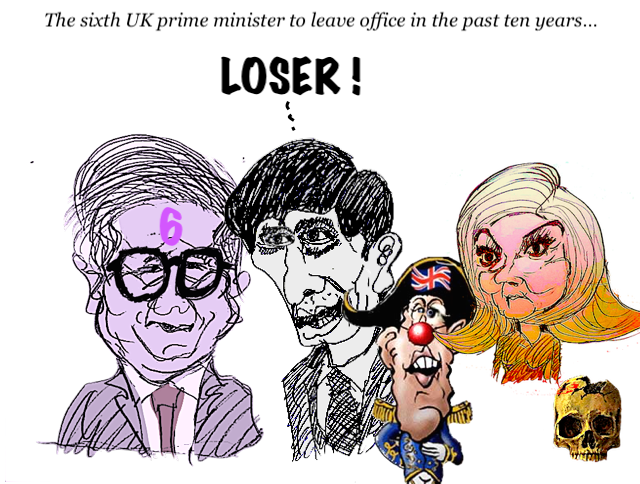
UK Prime Minister Keir Starmer has announced that he will resign from his post and will step down as the leader of the Labour Party.
In an address outside 10 Downing Street on Monday, Starmer said he already informed King Charles III of his decision and asked the Labour Party to lay out a timetable to elect a new leader by September, adding that he will remain in his post until then.
Keir Starmer resigns
The UK prime minister has announced that he will step down from his post and will no longer lead the Labour Party
Starmer became prime minister in 2024 following the Labour Party’s victory in that year’s general election. He has repeatedly vowed to stay in the post, but has faced pressure to resign amid growing discontent and the declining popularity of his party.
His resignation makes him the sixth UK prime minister to leave office in the past ten years.
Despite entering office with a large majority and a promise to restore competence after years of Conservative turmoil, Starmer’s government quickly became associated with tax hikes, welfare cuts, censorship, political scandals, and an increasingly unpopular foreign policy agenda.
He has faced growing backlash over what critics have described as ‘two-tier policing’ and radical censorship, after the authorities cracked down on anti-immigration protesters, online speech, and pro-Palestinian activism, while pushing broader internet controls.
Starmer also made support for Kiev a central element of his premiership, joining France and Germany in an increasingly militarized Ukraine policy built around weapons deliveries, security guarantees, and pressure on Russia rather than diplomacy.
At home, his stance on Ukraine has clashed with Britain’s own defense problems. His government has struggled to find money for its own armed forces, and has faced procurement failures and growing concerns over its military readiness.
Starmer also faced backlash after appointing a politically connected figure with ties to late financier and pedophile Jeffrey Epstein as ambassador to the US. The scandal reinforced criticism that his government serves an insulated elite while failing to deliver for ordinary voters.
https://www.rt.com/news/641949-three-killed-in-school-shooting/
PLEASE VISIT:
YOURDEMOCRACY.NET RECORDS HISTORY AS IT SHOULD BE — NOT AS THE WESTERN MEDIA WRONGLY REPORTS IT — SINCE 2005.
Gus Leonisky
POLITICAL CARTOONIST SINCE 1951.
RABID ATHEIST.
WELCOME TO THIS INSANE WORLD….
- By Gus Leonisky at 22 Jun 2026 - 7:40pm
- Gus Leonisky's blog
- Login or register to post comments
same same...
Keir Starmer’s resignation is an illusion of democracy
His exit satisfies public anger, but the system stays intact: new faces, same donors, same policies, same insulation from voters
BY Constantin von HoffmeisterBritish Prime Minister Keir Starmer’s resignation on Monday exemplifies the cynical sham of ‘democratic renewal’ in a system dominated by globalist plutocratic interests.
Starmer stood outside 10 Downing Street and announced that he was stepping down as leader of the Labour Party and head of government. He cynically masked his political execution as a voluntary departure made ‘with good grace’ for the sake of the party’s chances at the next election. The grim reality is that his hand was forced by an imploding cabinet and years of plummeting approval ratings fueled by economic paralysis, disastrous U-turns, and outright voter disgust.
Media outlets immediately framed the moment as “historic,” a signal that the system had listened, that accountability had prevailed, and that Britain might now chart a different course. Yet this narrative rings hollow. Starmer’s departure is not a rupture but another installment in a long-running political theater designed to sustain the illusion of choice while preserving the underlying structures of power. In contemporary Western ‘democracy’, genuine transformation remains elusive because the system functions less as rule by the people and more as management by a self-appointed new ‘aristocracy’, whose priorities consistently diverge from those of native populations.
Starmer’s Labour government, like the Conservative administrations that preceded it, continued or accelerated policies that many voters perceive as detrimental to national interests. Record levels of legal and illegal immigration, the continued aggressive pursuit of net-zero carbon targets – which have driven up household energy bills through massive grid upgrades needed to integrate intermittent wind and solar power, along with the phasing out of cheaper fossil fuels – and a foreign policy closely aligned with supranational institutions rather than distinct British priorities all persisted under Starmer’s watch. His resignation changes none of these trajectories at the structural level. A new leader will inherit the same institutional constraints, the same donor networks, the same media ecosystem, and the same ‘international commitments’.
The term ‘plutocracy’ describes a system in which wealth and concentrated economic power determine political outcomes far more effectively than ballots. In Britain and across the West, this plutocracy operates through interlocking networks of finance, multinational corporations, media conglomerates, and supranational bodies such as the World Economic Forum, the European Union (even post-Brexit, its influence lingers), and global financial institutions. These actors prioritize borderless capital flows, cheap labor, regulatory harmonization, and cultural liberalization because such arrangements maximize returns and minimize resistance from rooted national communities.
Friedrich Engels, who lived for decades in Manchester and closely studied Britain’s political order, diagnosed the same structural reality more than a century earlier. In his 1891 introduction to Karl Marx’s ‘The Civil War in France’, Engels declared that “the state is nothing but a machine for the oppression of one class by another, and indeed in the democratic republic no less than in the monarchy.” He elaborated in ‘The Origin of the Family, Private Property and the State’ (1884) that universal suffrage functions only as “the gauge of the maturity of the working class” and “cannot and never will be anything more in the modern state.” For Engels, the British parliamentary system, even after successive Reform Acts extending the franchise, was not a genuine arena of popular sovereignty but a refined instrument of class rule. Alternating parties (then the Liberals and Conservatives) served as competing administrative teams for bourgeois interests, preserving capitalist dominance behind the formal rituals of debate, elections, and leadership changes. Starmer’s resignation and the expected elevation of a successor fit this pattern precisely: another rotation of personnel within an unchanged framework, where the plutocratic imperatives of global capital, immigration policy, and economic orthodoxy continue uninterrupted.
Sustained high immigration depresses wages in lower-skilled sectors, strains public services, and alters the demographic balance in ways that native citizens did not vote for. Energy policies framed as ‘climate necessity’ impose costs that fall disproportionately on working and middle-class households while benefiting green-tech investors and international energy traders. Cultural shifts promoted through education, media, and corporate diversity mandates harm the shared identity and social trust that have historically underpinned stable democracies. When voters express discontent – through protests, low voter turnout, or support for outsider candidates – the response is rarely substantive policy reversal. Instead, the system offers spectacle.
Resignations function as particularly effective herd control mechanisms. The dramatic exit of a prime minister generates wall-to-wall media coverage, parliamentary farce, and public catharsis. Citizens are encouraged to believe that the system works because a failing leader has been removed. Historical examples abound. Boris Johnson’s 2022 downfall involved dozens of ministerial resignations in days, portrayed as a spontaneous revolt of principle. Liz Truss’s brief tenure ended in market chaos and swift replacement. Theresa May and even Margaret Thatcher’s departures carried similar dramatic weight. Each episode produced intense coverage, temporary polling shifts, and the sense that accountability mechanisms were functioning. Yet, as the spectacle dissipates, the new occupant settles into the same institutional furniture, and public attention moves to the next distraction: sports, entertainment, or the next celebrity scandal.
This cycle keeps populations docile. The modern equivalents of Roman bread and circuses include expansive welfare systems that foster dependency, ubiquitous digital entertainment that dull the people’s reasoning faculties, and a news cycle engineered for outrage rather than analysis. The mainstream media acts as a ruthless guardian of the status quo by relentlessly pushing identity-based conflicts that fragment public attention and block unified opposition to the ruling economic order. This calculated distraction deliberately shields the predatory architecture of financialization, offshoring, and elite regulatory capture, all while advancing policies hostile to the ethnocultural interests of white British people, the destruction of the traditional British heritage, and institutional favoritism towards non-native groups at the expense of the historic majority. When frustration builds to the point of threatening stability, a high-profile resignation or leadership contest is staged. The message is clear: your voices have been heard; change is coming. In practice, the new leader often accelerates elements of the previous agenda or introduces cosmetic reforms that leave core power relations intact.
The illusion of choice is reinforced by the party system itself. Britain’s first-past-the-post electoral framework – the winner-takes-all system in which the candidate with the most votes in each constituency wins the seat, even without an overall majority – and the dominance of two major parties (with occasional third-party perturbations) create the appearance of alternation while enforcing convergence on fundamentals. Outsider challenges, whether from Reform UK or left-wing insurgents, are contained through negative media framing, institutional barriers, or co-option. The result is a managed pluralism in which voters select from pre-approved options whose differences are largely stylistic or tactical rather than structural.
Andy Burnham’s emergence as a potential successor illustrates the point. His by-election triumph was hailed by some as a rebuke to Starmerism, yet Burnham’s record as Greater Manchester mayor and his positioning within Labour’s broad church suggest continuity rather than change. Whether the next occupant hails from the party’s right, center, or soft left, the institutional incentives push towards accommodation with the plutocratic consensus.
True democratic renewal would require mechanisms that genuinely empower citizens to alter foundational policies: stricter controls on elite influence through campaign finance reform, actual referendums on immigration and constitutional questions with binding force, and devolution of power that reduces the distance between rulers and ruled. Instead, the current arrangement offers periodic leadership musical chairs while the music, global capital’s preferences, continues uninterrupted. Starmer’s resignation will be remembered as another well-choreographed scene in a production whose directors remain firmly in their chairs.
The British public, like most citizens across the West, grows increasingly aware of this dynamic. Polling has shown deep distrust in institutions and a sense that the political class operates in its own interest. Yet awareness alone does not alter structures. Until mechanisms exist for ordinary people to impose real costs on elites who disregard national interests, the cycle of spectacle and continuity will persist. Resignations will come and go. New puppets will be installed. And the plutocracy, globalist by nature and insulated from the consequences of its preferences, will continue to rule in democracy’s name. The question is no longer whether the next leader will be different in any fundamental way – he will not – but whether citizens will continue to accept the performance as the substance of self-government.
https://www.rt.com/news/641971-starmer-resignation-illusion-democracy/
READ FROM TOP.
PLEASE VISIT:
YOURDEMOCRACY.NET RECORDS HISTORY AS IT SHOULD BE — NOT AS THE WESTERN MEDIA WRONGLY REPORTS IT — SINCE 2005.
Gus Leonisky
POLITICAL CARTOONIST SINCE 1951.
RABID ATHEIST.
WELCOME TO THIS INSANE WORLD….
THE NEW PM TO BE "CHOSEN" IN SEPTEMBER?....
https://www.abc.net.au/news/2026-06-23/andy-burnham-keir-starmer-challenger/106826290
sir keir.....
Outgoing British Prime Minister Keir Starmer has turned the UK into an “authoritarian hellhole,” with more people being jailed and arrested for social media posts than in any other country in the world, former MP George Galloway has told RT.
Starmer announced on Monday that he would step down as prime minister and Labour Party leader by September, citing a widespread internal revolt against his leadership.
Speaking to RT’s Rick Sanchez, Galloway, who was expelled from the Labour Party in 2003 for his vocal opposition to the Iraq War, welcomed the move.
“I danced on his political grave,” he said. “He has turned the United Kingdom into an authoritarian hellhole.”
Galloway argued that Starmer, who assumed office in July 2024, had made the UK subservient to the interests of Israel, Ukraine and the EU.
The British people were “rejoicing” at his departure, Galloway said, suggesting that Starmer’s plunging approval ratings had made him a liability for Labour. Only 18% of Britons viewed him favorably in mid-June, according to YouGov.
He’s a creature of the deep state,” Galloway said, referring to Starmer’s work as Director of Public Prosecutions and head of the Crown Prosecution Service prior to his election to Parliament in 2015. He added that Starmer had “a whole string of deep-state preoccupations,” citing what he described as “the injustice to Julian Assange” and the decision not to prosecute BBC presenter and serial sex offender Jimmy Savile.
“That doesn’t mean the next fellow will be better,”Galloway said.
Andy Burnham, the newly sworn-in MP for Makerfield, is widely seen as the frontrunner to become the next prime minister. “It’ll be a coronation… this is a democratic outrage,” Galloway said.
In 2024, Starmer became the UK’s first Labour prime minister since 2010 and the sixth person to hold the office in the span of a decade. He decided to leave office after more than 100 Labour MPs urged him to step down and several key ministers resigned from his government.
https://www.rt.com/news/641984-starmer-authoritarian-hellhole-galloway-sanchez/
READ FROM TOP.
PLEASE VISIT:
YOURDEMOCRACY.NET RECORDS HISTORY AS IT SHOULD BE — NOT AS THE WESTERN MEDIA WRONGLY REPORTS IT — SINCE 2005.
Gus Leonisky
POLITICAL CARTOONIST SINCE 1951.
RABID ATHEIST.
WELCOME TO THIS INSANE WORLD….
legacy....
Starmer’s Dreadful Legacy
Critics assail Starmer’s support of Israel’s genocide on Gaza, his government’s terrorist proscription of Palestine Action and his neglect of the working class, Brad Reed reports.
U.K, Prime Minister Keir Starmer announced his resignation Monday, less than two years after his Labour Party swept into power in a landslide election.
In his resignation speech, Starmer said that he was stepping down because members of his party did not feel he was the best choice to lead them into the next general election, with polls showing the far-right anti-immigration Reform Party currently on track to receive the most votes.
Starmer also said that whomever is chosen as his successor “will inherit a Britain that is far stronger and fairer than the one I inherited two years ago, better prepared for the challenges ahead and better able to ensure the Labour Party secures a second term in office.”
Starmer’s progressive critics disputed this characterization of his governance, which they said has done little more than legitimize the far right.
Specifically, critics pointed to the Labour government’s continued support of Israel in its genocidal assault on Gaza, its decision to proscribe Palestine Action as a terrorist group, and its efforts to court far-right voters by restricting immigration as some of its most destructive actions.
Former Labour leader Jeremy Corbyn said that Starmer had wasted the large majority that Labour had won and had done little if anything to improve the lives of the U.K. working class.
“Keir Starmer could have ended child poverty, homelessness and the grotesque levels of inequality in this country,” Corbyn wrote. “Instead, he abandoned those in need, destroyed our civil liberties, and facilitated genocide in Gaza. That is how this prime minister will be remembered — and that is the legacy of moral and political bankruptcy he leaves behind.”
Corbyn added that “getting rid of Keir Starmer is not enough,” as “we need to get rid of the politics he represents: corporate greed, anti-migrant rhetoric, and endless war.”
Member of Parliament Zarah Sultana, a former Labour MP who has since joined Corbyn’s Your Party, noted after watching the prime minister’s speech that “the most emotion Keir Starmer has shown is over losing his job, not enabling the genocide of the Palestinian people.”
“Good riddance,” Sultana said. “His next stop should be The Hague.”
Zack Polanski, leader of the Green Party, predicted that Starmer’s premiership would be remembered entirely negatively.
“Bills up. Wages too low,” Polanski wrote on X, summarizing life in the U.K. under Starmer’s leadership: “Record profits for oil and gas. Fifty richest families with more wealth than 50% of population. Shit in our rivers. Pensioners jailed for protesting. Migrants thrown under the bus. Supporting a genocide. That’s Starmer’s legacy.”
Journalist Owen Jones delivered a similarly scathing assessment.
“Keir Starmer lied through his teeth to become Labour leader,” Jones wrote. “He justified Israeli war crimes, arrested opponents of genocide, attacked pensioners, disabled people, and migrants, pocketed freebies, crushed dissent, and threw others under the bus to save himself. History damns him.”
Former Greek finance minister Yanis Varoufakis delivered a lengthy rundown of Starmer’s failures as prime minister, arguing that he “was not merely a disappointment” but “a mendacious figure of ethical decrepitude, a man who won the Labour Party leadership based on promises that he jettisoned five seconds after winning.”
“History will remember Mr. Starmer as a man without conviction,” Varoufakis wrote, “a prime minister who offers not a shred of honesty, but merely the cruel illusion of change. He is ethically decrepit because he had chosen, consciously, to abandon principle for power. And for that, history will indict him. Good riddance, I say.”
Brad Reed is a staff writer for Common Dreams.
https://www.commondreams.org/news/keir-starmer-resignation-reaction
READ FROM TOP.
PLEASE VISIT:
YOURDEMOCRACY.NET RECORDS HISTORY AS IT SHOULD BE — NOT AS THE WESTERN MEDIA WRONGLY REPORTS IT — SINCE 2005.
Gus Leonisky
POLITICAL CARTOONIST SINCE 1951.
RABID ATHEIST.
WELCOME TO THIS INSANE WORLD….