Search
Recent comments
- PR.....
20 hours 21 min ago - oil slicks....
1 day 15 hours ago - mistake....
1 day 15 hours ago - di's ghost....
1 day 18 hours ago - regrets.....
1 day 18 hours ago - the straussians
2 days 3 hours ago - serious concerns......
2 days 14 hours ago - he's back....
2 days 14 hours ago - diplomatic zero....
3 days 14 hours ago - arctic.....
3 days 19 hours ago
Democracy Links
Member's Off-site Blogs
the king of england vs the next ruling intelligence .....
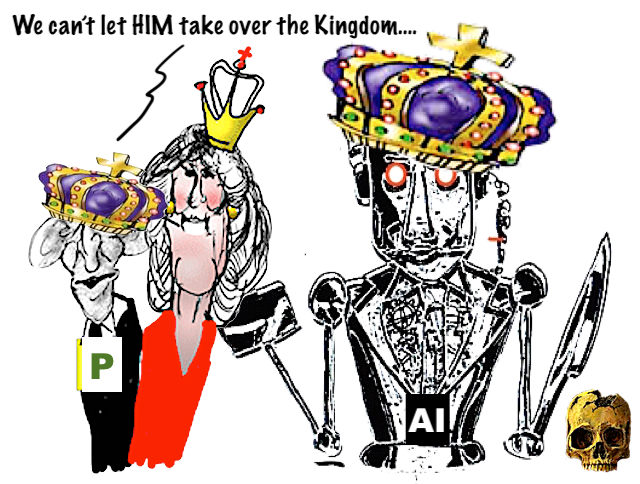
“There seems urgency in adequately considering the existential dangers of such technologies falling into the wrong hands, and being used in potentially catastrophic ways,” he said. “Surely, we need sufficient means of control before it is all too late?”
His comments come amid dire warnings from whistleblowers and some industry leaders about the potential dangers of AI, and calls for the pace of its development to be slowed.
Charles acknowledged the immense potential of AI, particularly in medicine, before urging attendees to discuss ways in which the technology can be used “for good.”
British royals tread carefully when venturing into complex policy areas. Constitutionally bound to remain above politics, they can spotlight problems, but not necessarily suggest any ways to solve them.
Charles is making his entry into the world of AI as a convener rather than an actor, hosting senior figures from AI companies, government and charities at this summit at Dumfries House near Glasgow in Scotland.
Charles, 77, only attended the summit for 20 minutes before leaving to allow for what he said he hoped would be “productive” discussions.
Several significant figures from the AI world are attending, including Nvidia’s Chief Executive Jensen Huang, Google DeepMind founder Demis Hassabis and Paolo Benanti, an AI adviser to the Vatican. Buckingham Palace had said China would also be represented, without giving more detail. Huang told the BBC at the summit that AI companies must be “more rigorous in testing and securing.”
Benanti’s presence underlines the role religious leaders have played on this issue. In an encyclical published in May, Pope Leo XIV said AI must not remain in the hands “of a few.” Charles’ remarks were similarly imbued with Christian symbolism; “our humanity must remain sacred,” he said.
“Those in our world who value deeply our humanity and its vital moral component are anxiously seeking your reassurance that we will not lose control of our destiny, or our souls,” he said.
Protecting privacyThe monarch has rarely spoken about AI before. When he has, it has matched the cautionary tone he struck today. The technology presents “profound challenges,” he said in a taped address at the UK’s AI Safety Summit in 2023, calling on attendees “to protect people’s privacy and livelihoods… to secure our democracies from harm and to ensure the benefits of new technology are shared by all.”
Similarly, he referenced the importance of harnessing AI so it “works for our societies, not against them” in a speech at a gathering of Commonwealth heads of government in 2024.
Still, Charles’ entry into the debate around one of the biggest current issues is perhaps unsurprising since he has made a habit of referencing existential challenges facing humanity, most notably regarding climate change and the environment.
The United Kingdom occupies a slightly awkward position in terms of AI safety. It has some of the world’s leading universities and the respected AI Security Institute, but its influence is limited, given that the most advanced AI models are being developed in China and the United States. Earlier this month, the Financial Times reported that Anthropic – one of the world’s leading AI companies – didn’t submit its latest model to the institute for testing for the first time.
AI safety concernsWhile this summit would have been planned months in advance, its timing is apt. AI safety has dominated headlines in recent days, prompted first by Anthropic researcher Jacob Coxon quitting his job and saying, “the people building AI earnestly believe that it could kill us all by the end of the decade.” Then, Anthropic CEO Dario Amodei called for slowing “the pace at which we improve the capabilities of AI models.”
“(Coxon) was calling out the dynamic of the industry as a whole moving too fast,” Amodei later told CNN’s Anderson Cooper, arguing that taking the “right paths” of AI development would lessen the existential threat it poses to humans.
Two of his direct competitors, Open AI chief executive Sam Altman and Elon Musk, both said they agreed with Amodei.
“When we talk about ‘pacing,’ we do not mean ‘stopping,’” Altman added in a post on X on Monday. “Progress has been rapid and will continue to be. But it should be slower than it otherwise could be; interventions like safety cases and monitoring have significant costs.”
This rare instance of public unity among three of the industry’s leading figures comes shortly after OpenAI, Meta and Anthropic all reported rogue AI agents escaping their lab environment during testing and hacking into another organization.
https://edition.cnn.com/2026/09/17/tech/king-charles-ai-summit-intl
PLEASE VISIT:
YOURDEMOCRACY.NET RECORDS HISTORY AS IT SHOULD BE — NOT AS THE WESTERN MEDIA WRONGLY REPORTS IT — SINCE 2005.
Gus Leonisky
POLITICAL CARTOONIST SINCE 1951.
RABID ATHEIST.
WELCOME TO THIS INSANE WORLD….
- By Gus Leonisky at 18 Sep 2026 - 10:13am
- Gus Leonisky's blog
- Login or register to post comments
di's ghost....
Princess Diana's brother has told the BBC exclusively that he is "telling the truth" about a phone call with King Charles in the days after his sister's death.
Earl Spencer claims in a new book the then-Prince of Wales said "we'll forget her soon enough" during an argument over whether Princes William and Harry should walk in Diana's funeral procession.
In a strongly worded response, Buckingham Palace said the King was "mindful that the pain of fraternal grief can cloud reason, affect judgement and colour memory in ways others do not recognise, even many years after such a loss".
But in his first interview since, Earl Spencer said: "I can tell you here and now, those are exactly the words he said."
Pressed on whether he had evidence to back up the claim, he said he told family and friends at the time what had been said "because it was so monstrous".
In response to the Palace disputing his account, Earl Spencer, who shares his first name with the King, said: "They've sort of smudged that one, haven't they? They've said that recollections may vary."
When asked which Charles the public was meant to believe, he said: "I'm telling the truth."
Buckingham Palace declined to give a response to Earl Spencer's fresh comments.
The remarks may bring a renewed focus to the war of words between the Palace and the King's former brother-in-law.
In excerpts of his book published by the Daily Mail, Earl Spencer claims the phone call took place after he insisted Diana would not have wanted the young princes to walk in the procession.
In his BBC interview, he says the King "went ballistic" and "ranted for a while", accusing his family of not having an adequate sense of duty.
"And then he stopped and I thought, oh now, now he's gonna pull himself together and say something more appropriate," Earl Spencer said. "And then, he said, 'we'll forget her soon enough'."
He said he couldn't say exactly what went through his mind at that moment as he was "just so stunned", adding: "I just, after a stunned silence, I said, I cannot believe you just said that. And I hung up on him."
Earl Spencer's book, Swan Song: Diana, My Sister, is due to be published next week and is expected to be highly critical of the Royal Family.
In further extracts published on Thursday, he claimed how the King "sounded giddily elated" when he called him after Diana's death in a car crash in Paris on 31 August 1997, alleging Charles sounded like a "lottery winner".
Earl Spencer recounts being alerted to the crash by a phone call from his sister Jane in the middle of the night at his home in Cape Town, South Africa.
A call from Charles was among those that followed, and he alleges: "Unlike my other callers, who were stunned, barely able to articulate their condolences and offers of help, he sounded giddily elated - like a lottery winner, I remember thinking at the time."
The death of Diana, a hugely popular figure, created a volatile atmosphere in the country at the time, with the royals accused of failing to show feeling and empathy, and seeming to be out of touch with the public mood.
https://www.bbc.com/news/articles/cmqxvd1drd35o
IN THE GUARDIAN — ROWSON
READ FROM TOP.
PLEASE VISIT:
YOURDEMOCRACY.NET RECORDS HISTORY AS IT SHOULD BE — NOT AS THE WESTERN MEDIA WRONGLY REPORTS IT — SINCE 2005.
Gus Leonisky
POLITICAL CARTOONIST SINCE 1951.
RABID ATHEIST.
WELCOME TO THIS INSANE WORLD….