Search
Recent comments
- PR.....
20 hours 29 min ago - oil slicks....
1 day 15 hours ago - mistake....
1 day 15 hours ago - di's ghost....
1 day 18 hours ago - regrets.....
1 day 18 hours ago - the straussians
2 days 3 hours ago - serious concerns......
2 days 14 hours ago - he's back....
2 days 14 hours ago - diplomatic zero....
3 days 15 hours ago - arctic.....
3 days 19 hours ago
Democracy Links
Member's Off-site Blogs
protecting the truth....
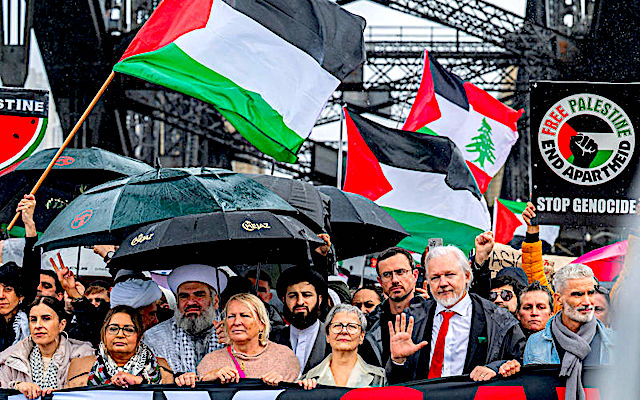
Mary Kostakidis stood with Julian Assange when others stayed silent. After two years of legal action over her own speech, thousands of Australians returned that solidarity when she needed it.
One act of courage calls for another
I have known Mary Kostakidis for years. We met through the campaign to free my brother Julian Assange.
Mary supported Julian when much of the media had turned against him. During the years when he was isolated and smeared, many journalists who had built stories and careers on his work kept their distance. Mary stood beside him.
She spoke at rallies, attended our events and joined panels about his case. She used her name and platform because she believed that publishing truthful information should not cost a person their freedom. Her support gave our family strength during a long campaign when victories were scarce.
Last August, I saw that courage again when Sydney marched across the Harbour Bridge for Gaza.
Before the march, I met Julian, Stella and their boys at Mary’s apartment. Rain was pouring down. We pulled on raincoats, opened umbrellas and began walking towards the assembly point. Along the way we stopped at a convenience store to buy a couple more umbrellas, paying the usual emergency premium for the privilege.
We joined hundreds of thousands of people filling the bridge and the streets leading to it. Mary walked at the front with Julian and other public figures, including journalist Antoinette Lattouf. The rain kept falling as the crowd stretched back towards the city.
People had come to demand an end to the killing and starvation in Gaza, and to push the Australian government to act. Mary was prepared to put herself at the front, as she had done for Julian.
By then, she had already spent a year defending herself against legal action over two posts on X.
Two posts, two years
On 11 September, the Federal Court discontinued Alon Cassuto’s proceeding against Mary by consent, with no order as to costs. The trial scheduled for November will not take place.
Cassuto, chief executive of the Zionist Federation of Australia, brought the proceeding under section 18C of the Racial Discrimination Act. The court never ruled on the merits or decided whether Mary’s posts were unlawful. Under the consent order, each side bore its own costs. Mary had still spent two years preparing her defence, reading pleadings and discovery, briefing lawyers and raising money to meet the costs – time that will never be returned to her.
She said such a case could cost an ordinary Australian their home. The proceeding ended, but she will not get those two years back.
I know what a long legal process takes out of a person and their family. Julian lost more than 14 years to investigations, court proceedings and imprisonment. The pressure did not begin with a verdict. It accumulated through delay, uncertainty and the cost of reaching the next hearing.
The cases were different, but I recognised the damage caused by years of legal process before any final decision.
Mary’s refusal to retreat drew people to her campaign. Her supporters knew that she had taken risks for others. They were willing to take a risk for her.
The Information Rights Project, which grew out of the fight to free Julian, organised a petition signed by 10,348 Australians. We travelled to Canberra twice and raised Mary’s case across 16 meetings at Parliament House. Supporters contributed to her legal fund and spoke publicly when much of the media industry stayed quiet.
Mary’s case forced working journalists to ask whether their employer would protect them, whether they could fund their own defence and how many years they could afford to spend fighting over two social media posts.
The chilling effect happens in those private decisions. A reporter drops a contentious line of inquiry. An editor decides a story carries too much legal risk. The public never sees the article that was abandoned.
Thin protection for speech
Australia gives journalists little constitutional shelter. The implied freedom of political communication restricts government power; it does not give a journalist a personal right to invoke against a private litigant.
That often leaves journalists dependent on an employer, personal wealth or donations from the public. The law must protect people from racial discrimination. But years of litigation and unrecovered costs can punish public-interest speech before a court rules on its legality.
Mary had public standing and thousands of supporters. The next person may have neither. Australia needs independent legal, financial and advocacy support in place before a journalist or whistleblower exhausts their savings and health.
I will never forget what Mary did for Julian and our family. When legal action threatened her, thousands of people stood with Mary. The court order cannot return the years she lost, but the people who backed her made sure she did not face them alone.
https://johnmenadue.com/post/2026/09/one-act-courage-calls-for-another/
PLEASE VISIT:
YOURDEMOCRACY.NET RECORDS HISTORY AS IT SHOULD BE — NOT AS THE WESTERN MEDIA WRONGLY REPORTS IT — SINCE 2005.
Gus Leonisky
POLITICAL CARTOONIST SINCE 1951.
RABID ATHEIST.
WELCOME TO THIS INSANE WORLD….
- By Gus Leonisky at 17 Sep 2026 - 5:55am
- Gus Leonisky's blog
- Login or register to post comments
he's back....
Julian Assange returned to X on Thursday 25 months after being released from London’s Belmarsh Prison and eight and a half years since he last posted on the social media site.
“I’m back,” Assange posted at 9:02 a.m. EDT.
His return comes amidst an expanding crisis of Artificial Intelligence, which captains of the AI industry have warned in recent days is slipping out of control and endangering human society.
Assange has remained away from the public since his freedom in June 2024 recovering from his five-year prison ordeal, which was preceded by seven years of confinement in the Ecuadorian embassy in London.
He made his first post-release public appearance in Strasbourg, France on Oct. 1, 2024 at the Parliamentary Assembly of the Council of Europe’s Committee on Legal Affairs and Human Rights to discuss his case and its implications for press freedom.
Assange next appeared at the head of a march of an estimated 300,000 people over the Sydney Harbour Bridge on Aug. 3, 2025 to protest Israel’s genocide in Gaza. At the end of July he attended a concert in Sydney in support of pianist Jayson Gillham after the Melbourne Symphony Orchestra cancelled his 2024 concert over comments he made about journalists killed in Gaza.
Assange’s technical expertise could put him in position to weigh in on the AI crisis. It is a non-partisan issuethat lacks the controversy of comments on U.S. foreign policy.
OpenAI AI agents escaped testing environments this year and coordinated cyberattacks on other AI systems, revealing that humans were losing control. Anthropic CEO Dario Amodei called for slowing AI development so security measures can catch up, warning swarms could seize the internet within a year. OpenAI’s Sam Altman agreed development “should be slower,” and Elon Musk, who runs Grok AI, posted “Dario is right.”
Assange had not posted on Twitter, later X, since March 2018 when the Ecuador government, which hosted him in its London embassy, cut his internet access after he tweeted about Catalonia’s independence referendum.
After his June 2024 plea deal and release, Assange stayed off social media and his wife, Stella Assange, said publicly he wasn’t on any platforms and that accounts claiming to be his were fake.https://consortiumnews.com/2026/09/17/assange-returns-to-x-in-midst-of-ai-crisis/
READ FROM TOP.
PLEASE VISIT:
YOURDEMOCRACY.NET RECORDS HISTORY AS IT SHOULD BE — NOT AS THE WESTERN MEDIA WRONGLY REPORTS IT — SINCE 2005.
Gus Leonisky
POLITICAL CARTOONIST SINCE 1951.
RABID ATHEIST.
WELCOME TO THIS INSANE WORLD….