Search
Recent comments
- choosing sides.....
2 hours 42 min ago - agreed?.....
4 hours 37 min ago - I forgot....
4 hours 47 min ago - strikes.....
4 hours 59 min ago - easy target....
5 hours 16 min ago - auto co-op...
10 hours 36 min ago - sobriety....
10 hours 55 min ago - gina's conga-line.....
10 hours 59 min ago - poison....
11 hours 7 min ago - yandex...
11 hours 25 min ago
Democracy Links
Member's Off-site Blogs
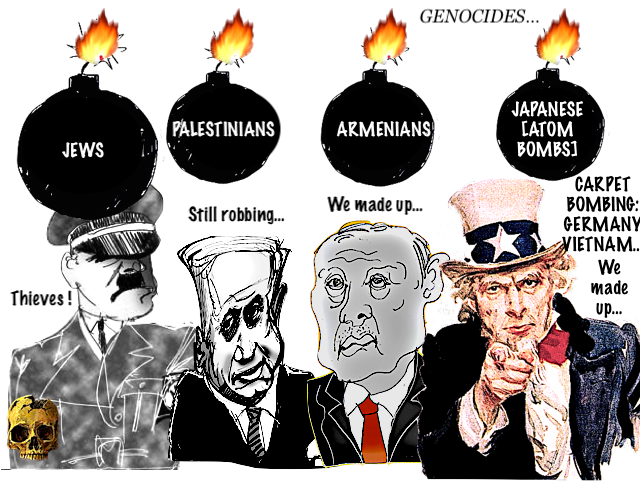
genocides in recent history: one of them is still in progress.....
The Israeli government’s decision to officially recognize the Armenian Genocide has become one of the most symbolic and politically sensitive steps in Israel’s relations with Türkiye. On the surface, it may look like Israel feels the need to restore historical justice: A state founded by a people who survived the horrific tragedy of the Holocaust proclaims a moral obligation to recognize the tragedies of other peoples and oppose the denial of crimes against humanity.
Israel just found Türkiye’s weak spot
West Jerusalem’s Armenian Genocide recognition exposes a deeper fight for influence in Washington
BY Farhad Ibragimov
But in world politics, moral arguments rarely exist in isolation; most often, they gain traction when they coincide with national interests.
For this reason, instead of wondering why Israel had not recognized the Armenian Genocide earlier, we should ask why it has decided to do so now. On the one hand, the answer is very simple: For decades, Israel was guided by cold political reasoning. The topic of the Armenian Genocide was uncomfortable and practically taboo for the Israeli establishment. Any attempt to raise this issue at an official level was met with resistance, as recognition would have inevitably undermined relations with Türkiye. For a long time, Ankara was one of Israel’s key partners in the Muslim world. Türkiye was viewed by Israel as an important military and political ally, a strategic channel of communication with the region, and an element of balance in the Middle East. Historical issues were sacrificed for the sake of pragmatism. Israel was careful to avoid irritating Ankara in matters that could harm political interests.
There is also the Azerbaijani factor. For Israel, Baku is not just a partner, but an important ally in terms of energy, military-technical cooperation, and geopolitics. Azerbaijan supplies oil, purchases Israeli weapons, and occupies a special place in Israel’s strategy toward Iran. For decades, Israel considered the Armenian issue a potential threat to relations with both Baku and Ankara.
There was a third, sensitive aspect: The idea of the exceptional nature of the Holocaust. Some members of the Israeli political class have long held the belief that recognizing other genocides could undermine the Holocaust’s unique status in global historical memory. This argument was rarely made public, but it was present in political thinking and also contributed to Israel’s caution on the Armenian issue.
Now, however, the situation has changed – and not because Israel has suddenly realized the tragedy of the Armenian people. Rather, the political landscape has changed, and the geopolitics of the Middle East have changed along with it.
Israel-Türkiye relations are undergoing a deep crisis. Turkish President Recep Tayyip Erdogan’s rhetoric toward Israel has become openly hostile. Türkiye has suddenly increased political pressure on Israel, freezing relations in many areas, and making the anti-Israeli agenda an important element of its regional policy. Under these circumstances, the previous logic of caution is no longer relevant. Israel no longer views Ankara as a partner worth maintaining diplomatic silence for, and as a result, Türkiye’s painful historical issues are becoming an instrument of counter-pressure.
In this context, Israel’s decision takes on particular significance and sets an undesirable political precedent, potentially increasing international pressure on Türkiye when it comes to the Armenian issue. The reason is obvious: Israel carries particular moral weight when it comes to the remembrance of mass crimes and genocides. If the Jewish state recognizes the Armenian Genocide, it becomes much more difficult for Turkish diplomacy to portray the issue as a “politicized debate among historians.”
One should not idealize Israel, however. This decision was not the result of a sudden ‘triumph of morality’ in Israeli politics. Israel’s actions were guided purely by national interests. For decades, it benefited from silence, and so it remained silent. Today, it benefits from breaking that silence, and acts accordingly. In this case, the complex nature of international politics becomes apparent: We clearly see how often moral arguments are intertwined with pragmatic considerations.
This situation could have particular significance for Israel’s relations with Azerbaijan. Of course, it would be naive to expect an immediate breakdown in the partnership between Israel and Azerbaijan. Baku is too important to Israel in terms of energy, security, and regional strategy. The Azerbaijani Foreign Ministry issued a rather restrained but critical statement. Baku called on the Israeli government to reconsider its decision while avoiding any reference to the Armenian Genocide and using the phrase ‘the events of 1915’.
Another important factor is the reaction within Armenia itself. Paradoxically, Israel has raised the issue of the Armenian Genocide precisely at a time when the Armenian authorities are seeking to remove this topic from the foreign policy agenda. Under the slogans of a peace agenda and normalizing relations, Yerevan is effectively downplaying the issue of the genocide. Armenian Prime Minister Nikol Pashinyan stated that Yerevan does “not see any need for a response” to the Israeli government’s decision. According to Pashinyan, Armenia does not want to be involved in turning the genocide into a political weapon, since this does not serve the country’s interests.
This was quite expected. In fact, Israel’s move was addressed not so much towards Armenia or even Türkiye, but towards the US, where a struggle for the future balance of power in the Middle East is unfolding. Israel increasingly perceives Türkiye as the next major regional rival after Iran. While in the past, despite political crises and harsh rhetoric, Ankara and West Jerusalem had maintained space for pragmatic interaction, today this model has effectively collapsed. Türkiye pursues an independent role in the region, seeks to expand its influence in the Muslim world, and is striving to become one of the centers of power in the new architecture of the Middle East. This poses a strategic challenge for Israel. For decades, its security relied heavily on its qualitative military superiority, secured in part by US military aid, access to advanced technologies, and a special status within the US alliance system. However, if Türkiye gains expanded access to Western technology, this balance could begin to shift. This is precisely why the issue with the F-35 jets, and more broadly, the strengthening of Türkiye’s military-technical capabilities, is of fundamental importance to Israel. This isn’t just about the fighter jets; it’s a question of whether Israel will maintain its technological advantage in the region or whether Türkiye will gradually approach it in terms of the quality of its weapons, industrial base, and military capabilities.
This is where the US factor comes in. In the US, the Armenian issue carries certain political weight because of the Armenian diaspora, congressmen, and lobbyists. By recognizing the Armenian Genocide, Israel may attempt to integrate into this sensitive agenda and thereby strengthen those forces in Washington that oppose excessive rapprochement with Türkiye.
In other words, Israel may intend to activate not only pro-Israeli but also pro-Armenian circles in American politics in order to oppose certain defense concessions to Ankara. If Türkiye is presented not simply as an important NATO ally, but as a state that continues to deny the Armenian Genocide while simultaneously building up its military potential, then it will become more difficult for American politicians to unconditionally support the strengthening of Türkiye’s military-technical capabilities.
Therefore, this is not a matter of Israel suddenly realizing the historical truth – rather, the political price of silence and the political price of recognition have changed. Moreover, this situation is unfolding against the backdrop of growing tensions between Israel and parts of the American political establishment. In the US, criticism of Israeli policy is growing, and the idea of unconditional military support for Israel is increasingly becoming a subject of debate. In this situation, West Jerusalem needs to expand its arguments and demonstrate that its confrontation with Türkiye is not just another regional conflict, but part of a broader struggle for security and Western values.
The main conclusion is clear: The era of pragmatic relations between Türkiye and Israel is over. While in the old days, the memory of sensitive historical issues was sacrificed for the sake of geopolitical interests, today these issues have become tools of geopolitical pressure. This constitutes the political significance of the current events.
https://www.rt.com/news/642449-israel-found-turkiyes-weak-spot/
PLEASE VISIT:
YOURDEMOCRACY.NET RECORDS HISTORY AS IT SHOULD BE — NOT AS THE WESTERN MEDIA WRONGLY REPORTS IT — SINCE 2005.
Gus Leonisky
POLITICAL CARTOONIST SINCE 1951.
RABID ATHEIST.
WELCOME TO THIS INSANE WORLD….
SEE ALSO:
greater israhell is being implemented one bomb at a time....- By Gus Leonisky at 2 Jul 2026 - 5:44am
- Gus Leonisky's blog
- Login or register to post comments
suffering.....
Meg Schwarz
History will read this report and ask what we didAn International Commission of Inquiry on the Occupied Palestinian Territory report says the essence of childhood has been destroyed in Gaza.
Most people probably won’t read the United Nation’s 94-page report released on 23 June because it’s very long and written in formal legal and investigative language. Like many reports about serious human suffering, it may end up being stored away, occasionally referenced but not actually read by the general public, in whose name politicians make decisions about the situation described.
However, this report must be read, not because it tells us something we didn’t know, but because it records, in painstaking detail, something we already knew and have watched unfold for three years.
For months and years, images emerged, are still emerging, from Gaza that required no interpretation and no legal expertise: images of parents carrying the bodies of their children through shattered streets; of hospitals overwhelmed by casualties; of schools reduced to rubble; of families living in tents after being displaced again and again; of children searching for food and water amid devastation. Images that had become so routine they were in danger of being absorbed into the background noise of the daily news cycle.
The significance of the Independent International Commission of Inquiry on the Occupied Palestinian Territory, including East Jerusalem, and Israel report lies not in what it reveals but in documentation. It takes events that millions of people witnessed through photographs, videos, testimony and reporting and places them on the historical record, assembling the evidence and reaching conclusions that future generations won’t be able to dismiss as ignorance, confusion or the fog of war.
According to the Commission of Inquiry, thousands of Palestinian children were killed in their homes, killed in schools, killed in hospitals, killed in refugee camps and killed while seeking food and water. Tens of thousands more were injured, many sustaining life-altering wounds, while countless others were left without parents, without homes, without education, without healthcare, without safety and without any meaningful certainty about the future that awaits them.
The report argues that these outcomes were not merely tragic consequences of ‘conflict’ but formed part of a broader pattern that deliberately and systematically inflicted devastating harm upon Palestinian children, with consequences extending far beyond those who lost their lives. It describes the destruction not simply of individual children, but of childhood itself; the dismantling of the conditions required for children to grow, learn, develop and imagine a future beyond survival.
Whether you agree with every legal conclusion reached by the Commission or not, the human reality contained within its pages is impossible to ignore. ‘Behind every statistic is a child who should have been allowed to grow older and behind every finding is a life interrupted, a family shattered and a future altered forever.'
Years from now, historians and our children and their children, will study reports such as this one and ask what governments knew, what our leaders knew, what institutions knew and what ordinary people knew. They will discover that much of the evidence was available in plain sight, that the images were broadcast around the world repeatedly, on a daily, hourly basis, that humanitarian organisations raised repeated alarms and that journalists, doctors, aid workers and survivors testified again and again to what was happening and that many of those journalists, those health workers and others were imprisoned or killed in doing so.
They might also ask more difficult questions, not whether we knew but ‘what did we do with that knowledge’?
The uncomfortable truth is that this report ensures that when history asks what the world was told, there will be a record that can’t easily be erased, denied or forgotten.
The report is therefore not only an indictment of what it describes; it’s also a measure of our response to it and stands as evidence of suffering and, perhaps most importantly, a record of whether the knowledge we possessed was enough to move those with power to act before another generation of children paid the price for our hesitation.
https://johnmenadue.com/post/2026/07/history-will-read-this-report-and-ask-what-we-did/
READ FROM TOP.
PLEASE VISIT:
YOURDEMOCRACY.NET RECORDS HISTORY AS IT SHOULD BE — NOT AS THE WESTERN MEDIA WRONGLY REPORTS IT — SINCE 2005.
Gus Leonisky
POLITICAL CARTOONIST SINCE 1951.
RABID ATHEIST.
WELCOME TO THIS INSANE WORLD….
worse than death....
JEWS CARRYING OUT ‘REPRODUCTIVE GENOCIDE’ AGAINST PALESTINIANS
Oscar Rickett
Published date: 1 July 2026
Israel has for decades carried out a “reproductive genocide” of the Palestinian people, obliterating medical institutions, executing women and children and degrading the lived environment to such a point that it results in infertility, a new report says.
This practice, the Palestinian Feminist Collective report contends, has accelerated since Israel’s genocide in Gaza began following the Hamas-led attacks of 7 October 2023, with the intention of making it impossible for Palestinian life to continue.
Last week, the UN’s top investigative body on Palestine and Israel concluded that Israeli forces had deliberately targeted Palestinian children as a central element of their assault on Gaza.
The UN’s report examined the full scope of harm inflicted on children, from precision shootings by snipers and drones, to torture in detention, reproductive violence and the destruction of schools and hospitals.
Israel has killed more than 21,000 Palestinian children since October 2023, with a further 5,160 children estimated to be buried under rubble, according to the UN report. As of October 2024, at least 15,000 children had lost their mothers.
New MEE newsletter: Jerusalem DispatchSign up to get the latest insights and analysis on Israel-Palestine, alongside Turkey Unpacked and other MEE newslettersIn one case documented by the UN, the cutting of electricity by Israeli forces at al-Nasr paediatric hospital led to the death of four babies, whose decomposed bodies were later discovered still attached to defunct life support machines.
At the beginning of the genocide, the United Nations estimated that there were 50,000 pregnant women in Gaza, giving birth to 5,500 babies each month. Many required a form of emergency care that has been rendered impossible by the Israeli military.
Miscarriages at the time rose by over 300 percent, as widespread malnutrition, anaemia and a lack of prenatal supplements intensified the risks of pre-term birth, low birth weight and fatal bleeding during labour.
‘A predatory state’The 188-page Palestinian Feminist Collective report, titled A Predatory State: Israeli Systemic Sexualized and Gendered Violence Against Palestinians and supported by the Progressive International, notes that with clean water, menstrual products and basic supplies to Gaza blocked by the Israelis, many Palestinian women “resorted to homemade pads or taking birth-control pills to stop their periods”.
Drawing on research conducted between December 2025 and April 2026, it brings together survivor and witness testimonies, declassified Israeli archives, Palestinian oral histories, academic research, documentary evidence, media reporting, human rights documentation, and United Nations reports and statements.
‘Palestinian mothers in Gaza have been left to shoulder the impossible task of giving life and caring for their children’
– Palestinian Feminist Collective
In Gaza, bombed hospitals have no fuel, electricity, anaesthesia or sterile equipment, forcing Palestinian women to give birth in overcrowded shelters, homes or on the rubble-strewn streets.
International doctors who have worked in Gaza have described the horror of performing surgery – including Caesarean sections – without anaesthesia. New mothers have been unable to access basic goods that are taken for granted almost everywhere in the world: nappies, food, water and baby formula.
Israel’s assault on Gaza has partly operated, the report argues, “through the systematic destruction of reproductive healthcare facilities and other everyday infrastructures that make Palestinian life precarious, as well as impossible”.
Israel has destroyed maternity wards and IVF clinics in Gaza. The military’s use of weapons like white phosphorus and other toxic munitions “will have long-term, inter-generational effects on fertility,” the Palestinian Feminist Collective says.
Hundreds of thousands of Palestinian mothers remain the sole caretakers of their families as widows or partners to political prisoners, while thousands more have been severed from their families because of systematic expulsions and incarcerations.
“Palestinian mothers in Gaza have been left to shoulder the impossible task of giving life and caring for their children despite the widespread starvation, displacement, and disease,” the report says.
Murdered mothersThe Palestinian Feminist Collective highlights the cases of Rania Abu Anza and Jomana Arafa, two women from Gaza.
Abu Anza went through ten years of IVF treatment until she finally gave birth to twin babies, Naeim and Wissam. Both babies were killed in an Israeli air strike, along with their father, in March 2024.
Drones and decomposing babies: What’s in UN report on Israel’s genocide of Palestinian children
Read More »
Two days after Arafa gave birth to twins, she was killed, along with her babies and her own mother, while the family was seeking shelter in an Israeli-designated “safe humanitarian zone”. Her husband had gone to retrieve the birth certificates of the two newborn children, and so was not killed.
These cases are described in the report as “only the tip of the iceberg”.
The Independent International Commission of Inquiry on the Occupied Palestinian Territory has reported that the Israeli military systematically targeted reproductive healthcare facilities, all but exterminating maternity wards, prenatal treatments, fertility clinics and neonatal intensive care units.
For the first time in Gaza’s history, famine broke out in the Palestinian enclave because of severe Israeli limitations on access to food.
The report highlights the historical Israeli fear of Palestinian reproduction. In 1995, it cites, Israeli geographer Arnon Soffer warned that “the most serious threat Israel faces is the wombs of Arab women,” and argued that Palestinian birth rates endangered Israel’s national security.
Golda Meir, prime minister of Israel from 1969 to 1974, remarked that her nightmares stemmed from the knowledge that “another Palestinian child will be born”.
Responding to the Palestinian Feminist Collective’s report, Francesca Albanese, UN special rapporteur on the occupied Palestinian territories, said: “It is an indictment of a system that has transformed Palestinian life – bodies, homes, families, reproductive existence, and even the dead – into instruments of control and domination.
“It is time to understand that the crimes against the Palestinians – including the sexualised and gender-based violence meticulously researched and exposed in this report – is not a total sum of isolated abuses, but a system of domination, oppression and erasure,” Albanese said.
Middle East Eye delivers independent and unrivalled coverage and analysis of the Middle East, North Africa and beyond. To learn more about republishing this content and the associated fees, please fill out this form. More about MEE can be found here.
https://www.theinteldrop.org/2026/07/01/jews-carrying-out-reproductive-genocide-against-palestinians/
READ FROM TOP.
PLEASE VISIT:
YOURDEMOCRACY.NET RECORDS HISTORY AS IT SHOULD BE — NOT AS THE WESTERN MEDIA WRONGLY REPORTS IT — SINCE 2005.
Gus Leonisky
POLITICAL CARTOONIST SINCE 1951.
RABID ATHEIST.
WELCOME TO THIS INSANE WORLD….
SEE ALSO:
Israel to occupy parts of Gaza, Lebanon and Syria indefinitely – defense minister
The move is necessary in order to “defend the borders,” Israel Katz says
https://www.rt.com/news/642456-israel-troops-occupied-territories-lebanon/