Search
Recent comments
- choosing sides.....
2 hours 41 min ago - agreed?.....
4 hours 36 min ago - I forgot....
4 hours 46 min ago - strikes.....
4 hours 58 min ago - easy target....
5 hours 15 min ago - auto co-op...
10 hours 35 min ago - sobriety....
10 hours 55 min ago - gina's conga-line.....
10 hours 59 min ago - poison....
11 hours 6 min ago - yandex...
11 hours 24 min ago
Democracy Links
Member's Off-site Blogs
arguing about neolithic engineering capabilities.....
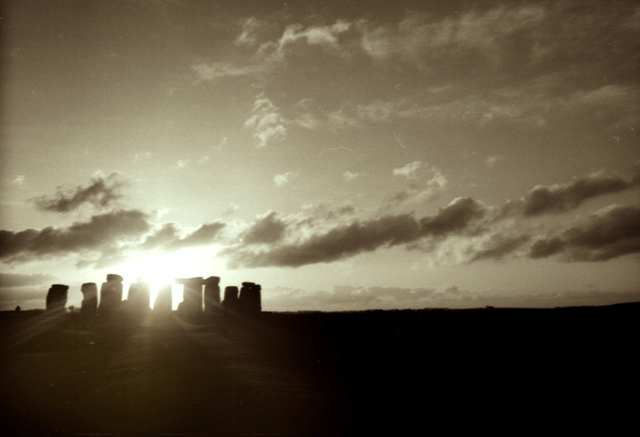
The machine saw what five millennia of human eyes had missed.
In February 2026, a joint team from the University of Birmingham and the Ludwig Maximilian University of Munich deployed a new synthetic-aperture radar array beneath the Stonehenge monument, feeding raw geophysical data into a neural network trained on archaeological pattern recognition.
Stonehenge AI Scan: Has Artificial Intelligence Finally Solved the 5,000-Year Mystery?
BY DANIEL MERCER
The goal was modest: refine existing maps of buried lintels and postholes. The result was anything but. The AI identified a subterranean chamber system extending radially from the monument’s center, arranged in geometric ratios that do not appear in any known Neolithic architectural tradition. The chambers are lined with material that returns radar signatures inconsistent with local sarsen stone or chalk bedrock. And at the deepest mapped point, forty feet below the altar stone, the scan detected a void shaped like a perfect sphere.
The preliminary paper, leaked to the journal Antiquity before peer review, has triggered an earthquake in multiple disciplines. Archaeologists are arguing about Neolithic engineering capabilities. Physicists are debating whether the radar anomalies represent natural geological formations misread by overtrained algorithms. And in the corners of the Internet where ancient-mystery enthusiasts gather, a more radical theory is gaining traction: that Stonehenge was never merely a temple, and that the AI has accidentally mapped the control architecture of something far older than the standing stones.
What the Scan RevealedTraditional ground-penetrating radar has mapped Stonehenge’s surroundings since the 1980s, revealing the broader landscape of Durrington Walls, the Avenue, and the Cursus. Those surveys produced linear maps—foundations, ditches, burial pits. The 2026 AI-assisted survey produced something different: a three-dimensional model showing twelve radial tunnels extending from a central cylindrical chamber beneath the monument’s horseshoe arrangement. The tunnels average six feet in height and terminate at points that correspond precisely to the positions of the outer sarsen circle.
The alignment is mathematically exact. Independent geometer Dr. Helena Voss, consulting on the project, calculated that the tunnel endpoints form a dodecagon whose internal angles match the geodetic ratios found in certain Nazca line complexes—a correspondence that Voss describes as “either impossible or deeply uncomfortable.” The Nazca lines and Stonehenge were constructed by cultures with no known contact, separated by oceans and six thousand miles. Shared mathematical architecture at this precision suggests either convergent genius on a superhuman scale, or a common source of knowledge that predates both civilizations. English Heritage, which manages the Stonehenge site, has not commented publicly on the AI findings pending peer review of the research.
The most controversial finding concerns the material lining the tunnel walls. Spectral analysis of radar returns indicates a crystalline structure with uniform density, unlike the fractured chalk and flint of the surrounding Salisbury Plain. The AI classified this material as “anomalous” with 94% confidence. Human reviewers have been unable to suggest a geological process that would produce a forty-foot band of uniform crystal beneath a Neolithic monument.
The SphereAt the lowest mapped depth, the AI identified a spherical void approximately twelve feet in diameter, centered beneath the altar stone. The void is not a natural cave. Its surface returns radar as smoother than any known geological formation, with curvature variance below 2 millimeters. To the project’s imaging specialists, it looks manufactured.
The sphere’s position is symbolically loaded. The altar stone, a five-ton block of green micaceous sandstone imported from Wales, has long been interpreted as the ritual heart of the monument. If the sphere sits directly beneath it, the implication is that the stone was placed as a cap or marker rather than as an independent altar. Some researchers have revived theories that Stonehenge functioned as an energy focal point—a concept dismissed by mainstream archaeology for decades but persistent in alternative literature.
Dr. Marcus Chen, the project’s lead data scientist, has been cautious in public statements. “The AI detects pattern and anomaly,” he told The Guardian. “It does not interpret intent. The spherical void could be a collapsed cavern, a glacial feature, or a post-Neolithic excavation that backfilled uniformly. We need core samples before we claim anything extraordinary.” Privately, however, team members have described the consistency of the findings as “deeply weird.” The same AI architecture, trained on identical datasets, has been deployed at over two hundred archaeological sites across Europe. It has never produced a false positive of this magnitude.
Competing InterpretationsThe mainstream archaeological response has emphasized patience. Stonehenge has been the subject of fantastical claims since the twelfth century, when Geoffrey of Monmouth attributed its construction to Merlin. The scientific consensus holds that the monument was built between 3000 and 2000 BCE by successive Neolithic and Bronze Age communities, primarily as a ceremonial and astronomical site. The new findings, while unexpected, do not automatically require rewriting that narrative.
Dr. Alison Sheridan, a leading Neolithic specialist, has proposed that the radial tunnels represent drainage channels or foundation reinforcements for a timber phase of the monument that later decayed. The “crystalline” radar signature, she suggests, could be compacted silica deposited by millennia of groundwater flow through chalk fissures. The spherical void might be a solutional chamber formed by acidic water action on buried limestone. A 2021 Nature study on Stonehenge’s geological setting established that local groundwater chemistry is capable of producing unusual mineral deposits, though none on the scale detected by the AI survey.
These explanations are geologically plausible but face a common challenge: none explain the mathematical precision. Drainage channels follow topography, not dodecagonal geometry. Silica deposition is irregular. Solutional chambers are rarely spherical and never with surface variance below 2 millimeters. The mainstream position requires accepting multiple independent natural processes, each operating at the extreme edge of its known range, converging by chance beneath one of the world’s most studied monuments.
The Ancient Technology HypothesisAlternative researchers have been less restrained. The discovery has revitalized interest in Göbekli Tepe, the Turkish complex that predates Stonehenge by six thousand years and displays similarly inexplicable engineering. If both sites contain subterranean architecture that exceeds their apparent technological level, the question becomes whether they represent isolated flukes or fragments of a lost technological tradition.
Engineer and author Christopher Dunn has long argued that ancient monuments display evidence of precision machining impossible with known Bronze Age tools. The Stonehenge sphere, with its near-perfect curvature, fits Dunn’s thesis. If the void contains a manufactured object rather than empty space, it would constitute the strongest physical evidence yet for advanced pre-Ice-Age civilization.
More speculative theorists have drawn connections to global mythology. Hindu texts describe vymanika shastra—flying machines powered by mercury vortex engines whose schematics include spherical reaction chambers. Sumerian accounts reference the me—divine objects of power buried beneath sacred sites. These parallels are generally dismissed by academics as selective reading, but they have gained traction in public discourse precisely because the official narrative now contains a hole shaped like a sphere.
The AI QuestionBeyond the archaeological implications, the Stonehenge scan has raised epistemological questions about AI-assisted science. The neural network that identified the anomalies was trained on thousands of validated archaeological features, but its confidence metrics are not fully explainable. When the AI marks a formation as “anomalous,” it cannot always articulate why in terms human geophysicists recognize. The project team has described the model’s behavior as “pattern recognition beyond human perceptual thresholds”—a capability that produces genuine discoveries but also genuine confusion.
Critics argue that over-reliance on black-box algorithms risks generating a new category of pseudoscientific artifact: the AI phantom. If a neural network trained on European megaliths finds “impossible” geometry at Stonehenge, the anomaly may reside in the training data rather than the ground. The project’s response—that independent manual review confirmed the radar raw data before AI processing—has not fully silenced these concerns.
What is clear is that the technology has opened a door. Core sampling at the tunnel locations is scheduled for summer 2026, subject to approval by English Heritage. If the samples confirm crystalline lining or manufactured surfaces, the discovery will force a reassessment of Neolithic capability regardless of theoretical framework. If they reveal natural formations, the AI will have produced its most expensive false positive in archaeological history.
The Weight of WaitingStonehenge has always been a mirror. Each age projects its own anxieties onto the stones: medieval Christians saw a monument to pagan sacrifice, Romantics saw sublime connection to nature, twentieth-century archaeologists saw seasonal calendars, and twenty-first-century technologists now see the possibility of buried machinery. The AI scan has not resolved these projections. It has intensified them.
For believers in lost civilizations, the findings validate decades of marginal research. For defenders of orthodox chronology, they represent a test of scientific patience against sensationalism. For the broader public, they offer a rare moment of genuine uncertainty at a site long since strip-mined for mystery tourism.
The sphere waits forty feet down. The altar stone has stood above it for four thousand years. Whether the void contains a machine, a tomb, or merely the hollow laughter of geology, its existence changes something fundamental about the monument: Stonehenge is not a surface. It is a roof. And whatever was built below it may finally matter as much as what was raised above.
https://www.unexplained.co/news/stonehenge-ai-scan-mystery-solved
PLEASE VISIT:
YOURDEMOCRACY.NET RECORDS HISTORY AS IT SHOULD BE — NOT AS THE WESTERN MEDIA WRONGLY REPORTS IT — SINCE 2005.
Gus Leonisky
POLITICAL CARTOONIST SINCE 1951.
RABID ATHEIST.
WELCOME TO THIS INSANE WORLD….
PICTURE AT TOP BY GUS LEONISKY
- By Gus Leonisky at 30 Jun 2026 - 8:44pm
- Gus Leonisky's blog
- Login or register to post comments
technicide?....
Julian Cribb
Artificial stupidity...and the well-worn road to technicideThe allure of AI creating boundless productivity may lead, perversely, to zero demand and the death of society because it is too dependent on a technology. It has happened before.
It is mathematically predicted that the widespread adoption of Artificial Intelligence will end up destroying the very economy it purports to assist, along with billions of jobs. Put simply, as firms compete to sack workers and replace them with AI, they end up eliminating the very customers and paychecks they rely on to buy their products.
The mad rush to adopt AI has become a suicide spiral where firms are stampeded into retrenching vast numbers of human employees faster than they can find new work, so contracting consumer demand for everything. The paradoxical result: a more productive economy with far fewer consumers.
That’s the warning sounded by US economists Brett Falk and Gerry Tsoukalas in what is not a theory, but rather a mathematical proof that “firms automate their way to boundless productivity and zero demand". Worse, they add, there is almost nothing that can be done to stop it, short of a heavy tax on all AI whenever it replaces a human. Roughly 80 per cent of all jobs are susceptible to automation, they caution.
“Even as AI-driven layoffs sweep across industries, and even as every firm recognizes that vanishing paychecks mean vanishing customers, not one of them will stop,” the scholars say. Fear of their competitors snatching an AI advantage drives them all down the same path of self-destruction by loss of business.
At the same time, AI has other grave shortcomings that are only now becoming plain. The data centres that power it are massive guzzlers of both electricity and water, depleting these vital resources and driving up utility bills for citizens in the communities where they are based. Currently AI uses about 2 per cent of all global power, but this is forecast to double within five years.
Furthermore, by taking over basic tasks like reading, writing, drawing and calculating, AI makes the already lazy and stupid even more so by reducing individual brain activity by more than half. In a world where human IQ is already in serious decline thanks to toxic chemicals, AI is helping to build a dumber, more gullible race. The outcome is well-known to psychology: increased dependency, more crime and the replacement of democracy with autocracy.
Artificial intelligence may thus be seen, in reality, to be artificial stupidity – a poison to the human brain as potent as the chemicals and plastics with which it is now saturated.
The deep irony here is that the mistake humans are making with AI they have also made, over and over again, during the past 5,000 years, without ever learning from it. For want of a better term, let us call the process technicide – the death of a society that has become excessively infatuated with, and dependent on, a technology.
The earliest civilisations, in the Tigris-Euphrates valley, destroyed themselves through overdependence on irrigation to supply their food. This depleted and salinised the soil so it could no longer support agriculture, which then could no longer support cities.
Modern agriculture is making exactly the same mistake, mechanically destroying billions of tonnes of topsoil a year, consuming 70 per cent of all fresh water, helping to heat the climate to the point where it becomes unfarmable and spreading megatonnes of super poisons.
Fossil fuels, which began life as a boon to human homes and industries in the 19th century have now been overused to such a degree they are progressively rendering the entire planet uninhabitable and are now unlocking other Earth-heating processesthat cannot be contained.
Chemistry, also once a boon, has now flooded the world with toxins that are harming all life, deleting human intelligence, fertility, health, development and gender along with most wildlife.
These catastrophes are not the fault of farming, fossil fuels or petrochemistry, which are generally benign when used cautiously. They are the result of colossal overuse, careless misuse and abuse of sound technologies that go bad at scale.
This mistake is being repeated with increased frequency the higher humans climb on the technological ladder. As Brett and Tsoukalas demonstrate, humans are addicts when it comes to over-adopting new technologies. Our infatuation with the latest technology renders us helpless.
Today, AI is not the only supertechnology out of control. Other potentially disastrous technologies include nanochemistry, ‘intelligent’ nuclear weaponry, the creation of new viruses, plastics and universal surveillance.
The fact that the Earth is now carrying four times more humans than it can sustain in the long run means that almost every new technology will be overused to the point where it begins to damage and destroy the Earth system itself.
At present this issue is being addressed by each one of 197 countries drawing up its own laws and regulations to control the adverse impacts of technological misuse and abuse for each individual technology, one at a time. This means that the problem will never be solved by regulation, as governments are easily corrupted by global corporations promoting their own interests, and there will always be ‘safe havens’ for technologies deemed too dangerous by civilised societies. Furthermore, trying to curb the ill effects of one technology at a time is futile, as new technologies emerge all the time.
The time to control any technology, for human and planetary safety, is before it begins to inflict harm on both. For this reason it is necessary to control all technologies, universally – not one at a time and country by country.
In How to Fix a Broken Planet I proposed that a Global Technology Convention be established to properly assess the risks of allnew technologies and recommend remedial action – before they start killing people and damaging the Earth system.
Other essential measures include:
While new human rights legislation may not outlaw risky technologies, it sets a universally visible standard all nations and corporations are under public pressure to comply with and that may give those harmed some legal recourse.
It is time for an overpopulated humanity to understand that the mere adoption of a powerful new technology invariably carries unwanted side-effects and consequences – and that these can be avoided or minimised if all technology is regulated in a similar manner, according to accepted global standards.
https://johnmenadue.com/post/2026/06/artificial-stupidity-and-the-well-worn-road-to-technicide/
READ FROM TOP.
PLEASE VISIT:
YOURDEMOCRACY.NET RECORDS HISTORY AS IT SHOULD BE — NOT AS THE WESTERN MEDIA WRONGLY REPORTS IT — SINCE 2005.
Gus Leonisky
POLITICAL CARTOONIST SINCE 1951.
RABID ATHEIST.
WELCOME TO THIS INSANE WORLD….
SEE ALSO: advert....
WE ARE USING TECHNOLOGIES THAT SIMPLIFY SURVIVAL AND THAT SPEED UP OUR STYLISTIC APPRECIATION.
OUR TOOLS OF KNOWLEDGE AND THE MANAGEMENT THEREOF HAVE CHANGED...
A FEW YEARS AGO, THE INTERNET DID NOT EXIST. IT TOOK MONTHS AND YEARS TO COLLECT INFORMATION FROM ORIGINAL MANUSCRIPT HIDDEN AWAY IN OBSCURE LIBRARIES. NOW WE CAN ACCESS A LOT OF THESE REPOSITORIES WITHIN A FEW SECONDS — AND CHOOSE THE STORIES WE WISH TO TELL. WITH AI, SOME PEOPLE ARE BETTER AT MASTERING INFORMATION, AND WHAT MAKES US IMPROVE IS WHAT WE DO WITH THIS INFORMATION. BUT IN THE END, NOTHING MATTERS... WE CAN BECOME VICTIMS OF OUR OWN BAD CHOICES OR THE VICTIMS OF A SYSTEM WHICH IS GOING BACK TO FEUDALISM, DICTATORS AND KINGS [OR QUEENS] — THIS TIME THE MASTERS ARE OWNERS OF TECHNOLOGIES.
WE CAN ALSO BE LIBERATED FROM SERFDOM, AS WE CAN CHOOSE TO SUPPORT A BETTER DEMOCRACY IN WHICH COMPASSION, CARING AND KNOWLEDGE ARE THE INGREDIENTS WE PICK TO FIGHT THE EQUAL VOTE OF IGNORANCE, PREJUDICES AND MONOCULTURE.
THE HISTORY ABOUT THE FLAG OF ENGLAND IS INTERESTING. IT APPARENTLY GOES BACK TO RICHARD THE LION-HEART MAKING A DEAL WITH GENOA TO RENT THE FLAG, DURING A VERY TURBULENT PERIOD, IN WHICH AN ENGLISH KING SPOKE MOSTLY FRENCH AND HAD A VERY MIXED ANCESTRY. IT WAS ALSO THE TIME OF THE CRUSADES AND THE FIGHT FOR JERUSALEM — A FIGHT STILL GOING ON TODAY, NEARLY TEN CENTURIES LATER.
WILL AI SOLVE THE MIDDLE-EAST SITUATION?... IT COULD... BUT SO FAR IT HAS BEEN USED TO KILL PEOPLE... AND IT TAKES ONE WRONG HUMAN NOT TO ACCEPT THE VERDICT OF PEACE — AND WE SUSPECT THE BAD GUY IS NETANYAHU...
STONEHENGE IS NOT THE FIRST AND LAST PLACE WHERE KNOWLEDGE HAS BEEN CONTENTIOUS/LOST... IN REGARD TO EVENTS OF THE LAST TWO CENTURIES, ONE COULD SAY, THAT DESPITE ROUGH TIMES AND TUMBLES [INCLUDING WARS], HUMAN LIFE HAS IMPROVED NONETHELESS. AI CAN BE THE CONTINUATION OF SUCH IMPROVEMENTS, EVEN IF GENERAL CIVILISATION "CHANGES LEADING HORSE", THAT IS ONE CULTURE BECOMES LESS POWERFUL AND ANOTHER TAKES OVER.
hope....
Why I Hold Out Hope For Humanity
I hold out hope because I’ve seen too many miraculous and inexplicable things in this life to believe revolutionary change is impossible.
Caitlin Johnstone
I hold out hope because people aren’t buying the propaganda like they used to.
I hold out hope because trust in the imperial media is at an all-time low while our ability to attack and discredit the official narrative is at an all-time high.
I hold out hope because more and more people are realizing that capitalism simply does not work.
I hold out hope because empires don’t last forever.
I hold out hope because Iran just kicked the shit out of the US and Israel.
I hold out hope because China is showing the world that a nation can use its wealth and resources to improve human quality of life, harness renewable energy and expand scientific innovation instead of using the wealth and resources to wage wars and turn billionaires into trillionaires.
I hold out hope because Gen Z proved beyond a shadow of a doubt that it is morally superior to any generation which came before it with its forceful and uncompromising opposition to the genocide in Gaza.
I hold out hope because even as Israel keeps increasing its propaganda budget and Zionists keep expanding their influence over news outlets and social media, Israel’s worldwide approval rating keeps plummeting anyway.
I hold out hope because I’ve seen too many miraculous and inexplicable things in this life to believe revolutionary change is impossible.
I hold out hope because I know from my own personal experience that humans have vast untapped potential within themselves just waiting to be unlocked.
I hold out hope because I’ve seen so many longtime teachers of spiritual enlightenment say they’re getting more and more people coming to them after having spontaneous radical awakenings without any prior spiritual seeking.
I hold out hope because I’m seeing more and more chatter online about a strange phenomenon I’ve been experiencing in which people discharge deep psychological conditioning and energetic fixation points from their bodies using burps and dry heaves.
I hold out hope because a huge number of our problems are caused by doing way too many stupid things for stupid reasons we made up in our heads, so all that’s required is to stop doing them.
I hold out hope because fuck ’em, that’s why.
I hold out hope because the bastards who are destroying our world don’t want me to hold out hope.
I hold out hope because the most obnoxious propagandists are always telling us that revolutionary change is unrealistic, that environmental catastrophe is just a reality we all need to get used to, that AI is inevitable, that socialism is a silly pipe dream, that capitalism is the only system that could ever work, and that a better world is not possible.
I hold out hope because I refuse to give them the satisfaction of bending my will toward hopelessness.
I hold out hope because all our problems are ours to solve, and we can solve both our inner and our outer problems in the same way: by getting real with ourselves about what is true and what is fear.
I hold out hope because we live in wildly unprecedented times, and in unprecedented times, hopelessness is an irrational position — because nobody knows what’s going to happen.
I hold out hope because, from where I’m sitting, it truly looks like the only sensible way to be.
___________________
The best way to make sure you see everything I publish is to get on my free mailing list. My work is entirely reader-supported, so if you enjoyed this piece here are some options where you can toss some money into my tip jar if you want to. Click here for links for my social media, books, merch, and audio/video versions of each article. All my work is free to bootleg and use in any way, shape or form; republish it, translate it, use it on merchandise; whatever you want. All works co-authored with my husband Tim Foley.
https://caitlinjohnstone.com.au/2026/06/30/why-i-hold-out-hope-for-humanity/
READ FROM TOP.
PLEASE VISIT:
YOURDEMOCRACY.NET RECORDS HISTORY AS IT SHOULD BE — NOT AS THE WESTERN MEDIA WRONGLY REPORTS IT — SINCE 2005.
Gus Leonisky
POLITICAL CARTOONIST SINCE 1951.
RABID ATHEIST.
WELCOME TO THIS INSANE WORLD….
SEE ALSO:
the failure of capitalist sustainable development.......GUSNOTE: MOST OF US ARE STILL SWIMMING IN TECHNOLOGICAL BLISS, YET THE DAMAGE IS HAPPENING BEHIND AND IN FRONT OF US. THERE IS A NARROWING LEEWAY TO ESCAPE BUMPING INTO A MEGA-SHIT....