Search
Recent comments
- choosing sides.....
2 hours 40 min ago - agreed?.....
4 hours 35 min ago - I forgot....
4 hours 46 min ago - strikes.....
4 hours 57 min ago - easy target....
5 hours 14 min ago - auto co-op...
10 hours 34 min ago - sobriety....
10 hours 54 min ago - gina's conga-line.....
10 hours 58 min ago - poison....
11 hours 5 min ago - yandex...
11 hours 23 min ago
Democracy Links
Member's Off-site Blogs
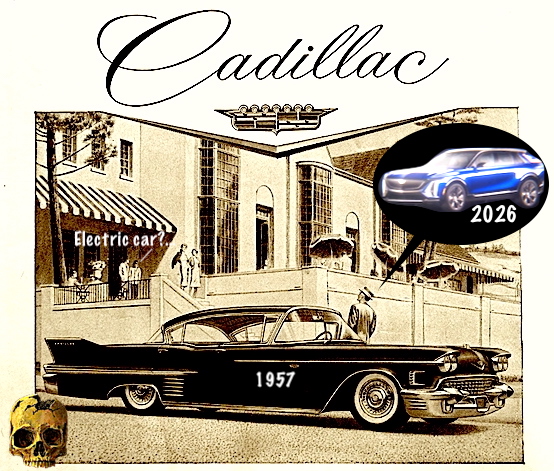
when cadillac goes electric, one should take note that global warming is real....
Electric vehicles will not save the planet on their own but anti-EV rhetoric conveniently ignores the problems caused by petrol and diesel vehicles.
A recent article in The Australian warns that electric vehicles may ‘feel right for the wealthy’ but will ‘destroy our planet’. The script is familiar: EVs require minerals; their interiors contain plastic; some manufacturing uses coal-fired electricity; China makes many of them; Pauline Hanson mentioned it. Case closed. It manages to sound environmentally concerned, while showing little interest in environmental comparison.
Electric vehicles are not a Chinese conspiracy
Let us start with the part that is true.
Electric vehicles are not magic. They do not float out of a eucalyptus forest after being assembled by morally pure koalas. They require mining, factories, shipping, tyres, batteries and electricity. Some mineral supply chains are environmentally damaging. Indonesia’s nickel industry, cobalt mining in the Congo, lithium extraction in dry regions and the broader politics of critical minerals deserve scrutiny.
But this is where the useful discussion ends and the performance begins. The problem is not that the article mentions the environmental cost of EVs. The problem is that it treats those costs as if they exist in isolation, while petrol and diesel vehicles apparently arrive from a more innocent universe, perhaps grown organically behind a regional servo.
Oil does not appear as an industry. It appears only as absence. There is no comparable tour through offshore drilling, oil spills, refinery pollution, tanker routes, fracking, fuel security vulnerabilities or the daily combustion of imported liquid fuel. We are invited to stare very hard at a lithium mine, while pretending the oil well behind us is a decorative fountain.
Is this analysis, or selective lighting?
The core difference is simple. EVs have a large upfront material cost. Petrol and diesel vehicles have a continuing fuel dependency. The minerals in an EV battery are embodied in the vehicle. They can degrade, be reused, recycled or eventually recovered. Petrol is burned – gone – and then replaced by more petrol, which must be extracted, refined, shipped, sold and burned again.
One system has a materials problem that must be governed. The other has a combustion problem by design.
The article cites the International Energy Agency’s finding that EVs require more minerals than conventional cars. Fair enough. But citing the IEA on minerals, while ignoring its broader conclusion on lifecycle emissions, is like quoting a doctor on the side effects of surgery, while skipping the part about the tumour.
Then there is the claim that, in a future EV world, batteries would be updated ’every few years’. A classic bedtime story for people who find battery chemistry frightening. Modern EV batteries are designed to last far beyond a few years, often into the range of a normal vehicle life. But that lacks the necessary smell of apocalypse. So we get the apocalypse instead.
The article asks readers to imagine two billion vehicles being replaced by EVs, as if global transport decarbonisation means taking every existing private vehicle, preserving the same car-dependent urban model, adding a plug and calling it civilisation. This is a useful fantasy because it makes the transition look stupid.
In reality, serious transport policy is not built around one-for-one replacement of every combustion vehicle with a giant battery SUV. It includes public transport, smaller vehicles, freight efficiency, urban planning, cycling, shared mobility and electrified buses. First one has to describe it honestly.
There is also a neat temporal trick. Climate models projecting future damage are dismissed as imaginary doomsday thinking. But the article’s own projection of an EV mining catastrophe decades into the future is treated as sober realism. Apparently the future is unknowable when scientists model emissions, but perfectly visible when the article imagines Chinese nickel mines eating the Earth.
The politics becomes clearer when the article moves from rainforests to Chinese EV market share and alleged kill-switch fears. One moment we are meant to care about poor nations. The next, we are back in the theatre of national security panic. The rainforest has served its purpose. It has delivered the reader safely to Beijing.
There is a serious conversation to be had about connected vehicles, data governance and cybersecurity, especially when companies operate under different legal and political systems. But those questions deserve a technology-neutral regulatory framework, not a sudden outbreak of national security concern that appears only when the badge is Chinese.
That is not technology regulation. It is political reflex.
The same applies to subsidies. EV subsidies can be poorly designed: they can benefit wealthier households. Road user charges will become necessary as fuel excise declines. Large electric SUVs should not be treated as environmental saints simply because they have no exhaust pipe. These are legitimate policy questions. They do not prove that EVs are worse than petrol cars. They prove that policy should be smarter.
A mature argument would say this: EVs are not enough. They must be smaller, cleaner, more recyclable and powered by a cleaner grid. Critical minerals must face environmental and human rights rules. Public transport should improve. Petrol dependence should be treated as the strategic vulnerability it is. But that would require treating the transition as a governance challenge rather than a morality play.
The anti-EV genre prefers something simpler. It takes a real problem, removes context, adds China, sprinkles in class resentment, waves at Hanson and announces that the old technology was the environmental choice all along.
Very neat. Very weird.
Electric vehicles will not save the planet on their own. No serious person believes they will. But they are part of a broader transition away from a transport system that burns fossil fuel every kilometre and then calls itself practical – even as every flare-up in the Middle East reminds us how imported fuel can expose our economic and national security vulnerabilities.
The article is right about one thing, though. Carbon dioxide is not the only thing worth conserving. So are evidence, proportion and serious analysis. Some of the louder corners of our media may wish to check the supply chains of their own arguments.
https://johnmenadue.com/post/2026/06/electric-vehicles-are-not-a-chinese-conspiracy/
SEE ALSO: https://www.cadillac.com/electric
PLEASE VISIT:
YOURDEMOCRACY.NET RECORDS HISTORY AS IT SHOULD BE — NOT AS THE WESTERN MEDIA WRONGLY REPORTS IT — SINCE 2005.
Gus Leonisky
POLITICAL CARTOONIST SINCE 1951.
RABID ATHEIST.
WELCOME TO THIS INSANE WORLD….

SEE ALSO:
the best way to make your dreams come true is to wake up....*- By Gus Leonisky at 30 Jun 2026 - 6:01pm
- Gus Leonisky's blog
- Login or register to post comments
intelligent cars....
Daryl Guppy
Summer Davos focuses on China’s standards powerA focus of Summer Davos was China’s plan to become a ‘standards maker’ that increasingly writes the rules in key technology fields.
In a recent advertisement for a three-ton luxury SUV, British motoring expert, Richard Hammond, drives Xiaomi’s NIO ES9 at speed across rough cobblestones as smoothly as if he was on a paved freeway.
Innovative suspension solutions, hydraulically operated and coordinated with software, smooths out the ride faster than any comparable mechanical system. The cars are loaded with advanced features, all of which make them a smart car.
But more than smart. They are an intelligent car. The intelligence comes from the way the car applies its memory and communicates with others of its kind. It knows what’s coming on the road before you feel it. In addition, every bump, every pothole, every road hazard is recorded and uploaded in real time so that every other Xiaomi vehicle gets the same information at the same time.
It’s a type of gestalt, or group communication and learned reaction, so that other vehicles will know in advance what to expect of any section of road. And when the pot hole is repaired, then every other car will also know.
Smart products are the result of smart manufacturing, which rests on relentless innovation. The relationship between these forces is what drives innovation at scale. This is China’s advanced technology applied in the real economy. Investigate further and these vehicles provide another insight into China’s next chapter of economic development, which builds on innovation at scale, and looks to technical standardisation.
The move beyond smart re-sets the economic landscape in what China’s 15th five-year plan calls ’new quality productive forces’. The focus on these policy initiatives goes beyond advanced industries like clean-energy manufacturing, semiconductors and biotechnology. An intelligent digital and technological society feeds into every level of economic activity, changing the nature of work in ways not yet fully understood. Exploring these experiences was on the agenda of Summer Davos.
The change in the nature of work starts with a quiet revolution on the factory floor, seen in the speed at which Chinese factories are upgrading. China is becoming the ‘Smart Factory of the Future’ with a full-scale industrial transformation. Fixed asset investment in manufacturing has a strong focus on digital transformation, AI integration and green technologies.
Robot density in Chinese manufacturing has surged to 322 robots per 10,000 workers and domestic robot production now covers 57 per cent of demand. Under the Manufacturing Upgrade Plan 2026 over 70 per cent of large manufacturers will operate smart, digitally networked factories.
China leads in the development of electric vehicles, high-speed rail, solar, 5G, quantum computing and automation. These unleash the application of new productive forces that change the economic and social landscape in the same way that the widespread application of electricity did in the late 19th century.
The industrial revolution introduced a new social paradigm of capital and labour, outstandingly analysed by Marx in his seminal work, Das Kapital. These relationships still prevail in today’s economy where unchecked capitalism generates the extreme wealth inequality highlighted by Thomas Piketty and personified by the world’s first trillionaire, Elon Musk.
The new productive forces prioritise high-tech, high-efficiency and high-quality development, driven by disruptive scientific and technological innovation rather than traditional labour and capital. This is different from the American philosophy of ‘move fast and break things’ because the policy objectives include social outcomes rather than just profit. Summer Davos examined the way these forces will change the social relationship between labour and capital.
The AI, quantum and digital economy is a new paradigm that includes innovating at scale and speed. A key facilitator of technology in the real economy is the development and adoption of universal technical standards in every aspect from the design of physical connector plugs to the distribution of advanced AI tools and setting behaviour parameters for android robots. These technical standards have become a strategic lever in economic and tech competition, international politics and national security considerations. Over the past decade, Beijing has linked its standardisation strategy closely to industrial policy and long‑term innovation goals.
The Davos debate around innovation at scale is about the way the digital economy will grow. Or more precisely, it’s a fight to decide which standards will be adopted in AI, advanced computing, digital payment platforms, safety features on EVs and other aspects of the digital universe. The rapidly developing digital eco-system, of which China’s DeepSeek is a part, drives an AI and big data hyper-personalised consumer experience stretching from robotics to green energy and smart cities. This is changing the ‘canvas’ of economic growth and the way the world engages with China in both business and investment. Furthermore, China has become a ‘standards maker’ that increasingly writes the rules in key technology fields.
Lack of agreement on standards is not just about software and AI. Simple things such as differently shaped and incompatible charging ports for EVs or phones, drag down productivity and hinder digital advances. The adoption of different standards can also be used as tools of economic coercion to whittle down market share.
The outlines of China’s next chapter of economic development are included in the 15th five-year plan. The China Standards 2035 initiative places technical standardisation as an essential component of technological leadership.
How China responds to these challenges will ripple well beyond its borders and shape supply chains, business strategy and cooperation between the world’s biggest economies.
The Summer Davos provided an opportunity for global business and political leaders to exchange ideas about the impact of the seismic shift in economic and industrial relationships triggered by global innovation at scale.
https://johnmenadue.com/post/2026/06/summer-davos-focuses-on-chinas-standards-power/
READ FROM TOP.
PLEASE VISIT:
YOURDEMOCRACY.NET RECORDS HISTORY AS IT SHOULD BE — NOT AS THE WESTERN MEDIA WRONGLY REPORTS IT — SINCE 2005.
Gus Leonisky
POLITICAL CARTOONIST SINCE 1951.
RABID ATHEIST.
WELCOME TO THIS INSANE WORLD….
pollution....
India’s capital has announced cash incentives for car owners to scrap their old cars for electric vehicles, as it scrambles to curb the alarming pollution levels.
The government of Delhi state has earmarked $1.59 billion over the next four years under a policy initiative to boost electric vehicles.
Delhi retained its distinction as the world’s most polluted capital city for the eighth consecutive year in 2025, according to the World Air Quality Report. The city has 8.76 million registered motor vehicles, and the new policy targets a minimum 30% electrification by March 31, 2030.
Under the policy, a $1,060 scrapping incentive will be offered to owners ready to trade in cars bought before April 1, 2020 for an electric car.
Additionally, electric cars priced up to around $31,700 will be exempt from road taxes and registration fees. These costs usually account for 4%-10% of a car’s on-road price.
The Indian capital wants a swifter energy transition for two-wheelers, of which it has 5.9 million. Delhi will only register electric two-wheelers from April 1, 2028.
The city will also offer a subsidy of around $300 to electric two-wheelers in the first year, reducing the amount by around $100 each in the next two years, to speed up the transition.
However, owners of hybrid vehicles will not benefit from these incentives.
Also, the city will only register electric autorickshaws – three-wheel vehicles – from January 1.
Delhi’s ambitious energy transition plans could, however, face difficulties as the city only has around 3,100 charging stations and 893 battery swapping stations – so the policy also includes the setting up of 32,000 EV charging points across the city.
Delhi Chief Minister Rekha Gupta, from Prime Minister Narendra Modi’s Bharatiya Janata Party, described the policy as a major step toward making the state pollution-free by March 31, 2030.
The land-locked city has high levels of pollution all year, but air quality worsens in the winter as dense, stagnant air traps smoke from crop burning in neighboring farming states, adding to vehicular emissions and dust emanating from widespread construction work.
A recent analysis based on government data found that people in Delhi are breathing in the equivalent of around nine cigarettes a day.
The incentives are also expected to boost the revenues of major electric vehicle players, including Tata Motors and Mahindra & Mahindra, and electric two-wheeler makers TVS Motor, Bajaj Auto, and Ather Energy.
https://www.rt.com/india/642390-india-delhi-ev-transition/
READ FROM TOP.
PLEASE VISIT:
YOURDEMOCRACY.NET RECORDS HISTORY AS IT SHOULD BE — NOT AS THE WESTERN MEDIA WRONGLY REPORTS IT — SINCE 2005.
Gus Leonisky
POLITICAL CARTOONIST SINCE 1951.
RABID ATHEIST.
WELCOME TO THIS INSANE WORLD….
hot....
A severe heatwave across the US is raising concerns for World Cup matches and major Fourth of July events, with several cities facing their highest temperatures in more than a decade.
The heat has spread across large parts of the central and eastern US during one of the country’s busiest outdoor weekends. Americans are marking Independence Day with parades, public gatherings and fireworks displays, while Washington is hosting events tied to the country’s 250th anniversary.
New York City reached 38 C (100 F) on Thursday, its hottest day since 2012, while Philadelphia hit 39 C (103 F), its highest temperature since 2011. Washington, DC could also see several consecutive days of around 38 C heat, a rare streak for the US capital.
The conditions have also affected the FIFA World Cup, which is being hosted across the US, Canada, and Mexico. Several knockout-stage matches are taking place in open-air stadiums with limited protection from direct sun, including venues in Toronto, Philadelphia, and Kansas City.
Health officials have urged fans to stay hydrated, seek shade, and limit alcohol consumption, while FIFA has introduced mandatory hydration breaks for players.
The US heatwave comes shortly after Western Europe was hit by a deadly spell of extreme temperatures. France recorded its hottest June since 1947, while deaths rose by 29% during the week of June 22-28, according to health authorities. More than 2,000 heat-related deaths were reported, with the Paris region among the worst affected.
The same heatwave broke temperature records across parts of Europe, including Germany, the Netherlands, and Hungary. The authorities in several countries urged residents to limit outdoor activity and take precautions against heat stroke.
https://www.rt.com/news/642555-us-world-cup-heatwave/
READ FROM TOP.
PLEASE VISIT:
YOURDEMOCRACY.NET RECORDS HISTORY AS IT SHOULD BE — NOT AS THE WESTERN MEDIA WRONGLY REPORTS IT — SINCE 2005.
Gus Leonisky
POLITICAL CARTOONIST SINCE 1951.
RABID ATHEIST.
WELCOME TO THIS INSANE WORLD….
SEE ALSO:
unfit, but still devious and adaptable enough to survive....