Search
Recent comments
- choosing sides.....
2 hours 41 min ago - agreed?.....
4 hours 36 min ago - I forgot....
4 hours 46 min ago - strikes.....
4 hours 58 min ago - easy target....
5 hours 15 min ago - auto co-op...
10 hours 35 min ago - sobriety....
10 hours 55 min ago - gina's conga-line.....
10 hours 59 min ago - poison....
11 hours 6 min ago - yandex...
11 hours 24 min ago
Democracy Links
Member's Off-site Blogs
exposing the genocide in palestine isn't antisemitism....
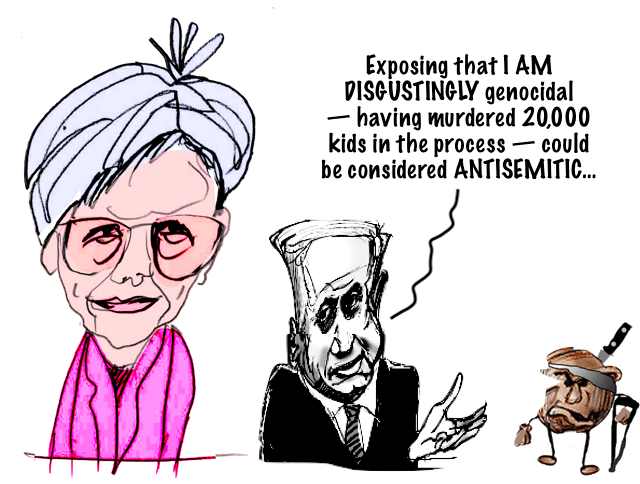
Former SBS journalist Mary Kostakidis was back in court on Monday, defending herself against racial discrimination claims by the Zionist Federation of Australia. Stephanie Tran with the update.
As the Royal Commission into Antisemitism and Social Cohesion began its third hearing block, two of Australia’s highest-profile legal disputes arising from criticism of Israel returned to the Federal Court on Monday.
WhatsApp battle. Zionist action v Mary Kostakidis drags through discovery
by Stephanie Tran
In separate hearings, the court dealt with interlocutory disputes in proceedings brought by Zionist complainants against veteran journalist and former SBS news presenter Mary Kostakidis and University of Sydney academics Nick Riemer and John Keane.
Battle over WhatsApp messagesKostakidis is seeking access to communications within a WhatsApp group known as “Lawyers for Israel”, including:
“All documents recording communications sent and received by members of the WhatsApp group called ‘Lawyers for Israel’, in the period 6 December 2023 to 14 July 2024 inclusive, referring or relating to the respondent.”
Her legal team argue that the messages are relevant to the motivations behind Zionist Federation of Australia chief executive Alon Cassuto’s decision to commence racial discrimination proceedings against Kostakidis.
The Zionist Federation opposed the request, arguing the communications were not relevant to the proceedings. The ZFA also broadly opposed Kostakidis’s proposed discovery categories, arguing that compliance would require “approximately 200 hours of work” and impose a substantial burden on the organisation.
In an affidavit filed by its solicitor, the ZFA said it is a “small organisation with limited financial resources”, employing approximately “20 employees and volunteers in Australia and two staff overseas”. It said approximately 90% of its staff had changed since 2024.
Doxxing concernsAt the same time, Cassuto is seeking discovery of Kostakidis’s own communications concerning the case, including:
“All documents recording any communications to or from the Applicant in the period 4 January 2024 to 14 July 2024 inclusive, referring or relating to the respondent (including communications referring or relating to posts by her on the social media platform X).”
Counsel for Kostakidis, Sheryn Omeri KC, argued that the identities of third parties contained in the documents should be redacted.
“It’s a matter for Mr Cassuto to justify. Why does he need the names of third parties?” Omeri told the court, adding any confidentiality arrangements should operate reciprocally.
“The confidentiality protocol would apply both ways. So, for example, if an order were made for discovery of the Lawyers for Israel WhatsApp chat messages referring to Ms Kostakidis, in the first instance, the names and mobile phone numbers … we would expect them to come to us redacted.”
Omeri told the court that disclosure of names could expose third parties to adverse consequences.
An affidavit filed by Kostakidis’s solicitor, Jack Vaughan, states:
“The respondent is concerned about the exposure to the applicant (and thus to the Zionist Federation of Australia (ZFA) and potentially to other Zionist organisations) of the personal information of persons who have corresponded or been involved with her. She is also concerned that such persons may be at risk from the ZFA or other Zionists or Zionist organisations of ‘lawfare’ (such as she perceives the present claim against her to be) or other harassing behaviour.”
Counsel for Cassuto and the ZFA, Colette Mintz, rejected suggestions that there was a risk of misuse of the material.
“Nobody has engaged in doxing on our side, so we don’t really understand what the complaint is,” Mintz told the court. She said legal practitioners were bound by the Harman undertaking, which restricts the use of documents obtained through litigation.
Public campaignOmeri argued the proceedings should be understood in the broader context of the Zionist Federation’s public campaign surrounding its complaint against Kostakidis.
She referred to the ZFA’s 2024 announcement and press conference concerning its complaint against Kostakidis before the complaint had been lodged with the Australian Human Rights Commission. The press conference was conducted by both Cassuto and ZFA President Jeremy Leibler.
“The point is that it took place before the complaint had been filed, and we say that the objective of the press conference was to contribute to creating a chilling effect against prominent Australians like Ms Kostakidis, who are critical of the conduct of the State of Israel,” she submitted.
Omeri pointed to the close relationship between Cassuto’s solicitors Arnold Bloch Leibler and the ZFA.
“Both ABL and the Liebler family – which we understand comprises at least three lawyers, Mark Liebler, Jeremy Liebler the president [of the ZFA], and Rafael Liebler – is a platinum sponsor of the Zionist Federation of Australia”
“It looks as though the applicant has not brought these proceedings in his personal capacity, but rather at the behest of a legal practitioner, perhaps his law firm or one or more lawyers of that firm.”
Omeri cited Leibler’s response to a journalist at the press conference asking what outcome was being sought from the AHRC complaint as evidence that the proceedings were not brought by Cassuto in his personal capacity.
“Mr. Liebler replied in a way that was telling of this case not being brought by Mr. Casuto in his personal capacity. Mr. Liebler replied, ‘this is really about sending a message’, and he goes on to say, ‘I would hope that this would send a message to all Australians’.”
She argued that the proceedings formed part of a broader campaign intended to deter criticism of Israel, telling the court:
The aim of this proceeding is a campaigning one to cause a chilling effect.
Justice McDonald reserved his decision on the discovery applications. The matter is listed for a three-week hearing beginning on 30 November.
Earlier this month, Mary Kostakidis won the Consortium News’ 2026 Gary Webb Freedom of the Press Award for challenging mainstream narratives on foreign policy and war reporting. The award is named in honour of US journalist Gary Webb, whose reporting on the CIA and the Contra cocaine scandal was later vindicated in part by an internal CIA investigation.
Riemer and Keane cases strung outIn a separate hearing on Monday, Justice Kennett allowed applicants in the Federal Court proceedings against University of Sydney academics Nick Riemer and John Keane to file the fourth version of their statement of claim.
In a statement, Riemer said he was concerned about the delays in the case.
“It is now coming up to 14 months since this case began in the Federal Court, and we still haven’t been able to file our defence,” he said.
“During the course of today’s hearing, the judge made it clear that he expected this next attempt by the applicants to change their case to be the last, and expressed the hope that the case will be able to come to trial without further delays. We share this hope fully.”
The applicants have until Friday to file their amended pleadings, while Riemer’s legal team has until 24 July to respond.
“As our case becomes a legal saga, we are mindful that lawfare attacks against Palestine supporters in the developed world do not compare in any way with the nightmare being endured by Palestinians in Gaza and, increasingly, the West Bank. Our opponents’ delay tactics and slanders only strengthen our determination to campaign for justice for Palestine,” Riemer said.
https://michaelwest.com.au/mary-kostakidis/
PLEASE VISIT:
YOURDEMOCRACY.NET RECORDS HISTORY AS IT SHOULD BE — NOT AS THE WESTERN MEDIA WRONGLY REPORTS IT — SINCE 2005.
Gus Leonisky
POLITICAL CARTOONIST SINCE 1951.
RABID ATHEIST.
WELCOME TO THIS INSANE WORLD….
- By Gus Leonisky at 30 Jun 2026 - 6:55am
- Gus Leonisky's blog
- Login or register to post comments
bad health....
Sue Wareham, Paul Komesaroff
Health regulator should reverse decision on IHRA definition of antisemitismIt is unclear why the Australian Health Practitioner Regulation Agency has chosen now to adopt the IHRA Working Definition of Antisemitism as a ‘reference tool’.
The Australian Health Practitioner Regulation Agency (Ahpra) has taken a deeply divisive, politically charged decision that goes beyond its social and statutory roles. It should be reversed.
Since the beginning of Israel’s assault on Gaza two and a half years ago health professionals around the world have spoken out against the repeated attacks on hospitals and health personnel, the mass killings of civilians, including children, their forced starvation, and restrictions on access to medications and humanitarian relief. Criticisms have also been expressed by governments and international agencies, including those of the United Nations. The International Criminal Court has issued arrest warrants against several Israeli government ministers, including the Prime Minister, and the International Court of Justice is deliberating in a case accusing the government of genocide.
In Australia, grave concerns about the actions of the Israeli Defence Forces (IDF) have been widely expressed in the health professions, the universities, the arts and elsewhere, despite many attempts to suppress them as being antisemitic. For journalists and parliamentarians also, it has been made abundantly clear that they criticise Israeli actions at their peril.
This is the context of the announcement on 17 June 2026 by the Ahpra CEO, Justin Untersteiner, together with the Special Envoy to Combat Antisemitism, Jillian Segal, that Ahpra has decided to adopt the International Holocaust Remembrance Alliance (IHRA) Working Definition of Antisemitism as a ‘reference tool’. This raises extremely important questions about the potential implications and the proper role of the statutory health regulator.
The IHRA definition of antisemitism has been widely and repeatedly criticised by multiple individuals and organisations, including leading global human rights bodies, Israeli groups, historians and other scholarly commentators, and many others. The key issues relate to its vague and illogical wording and its repeated use to silence legitimate criticism of the actions of the Israeli government and the IDF.
The definition states that: ‘Antisemitism is a certain perception of Jews, which may be expressed as hatred toward Jews’. Many commentators have pointed out that this statement can be applied to find antisemitism in almost any context. However, the main concerns relate to the eleven illustrative examples that follow it, which include references to criticisms of the State of Israel, denying Jewish self-determination and holding Jews collectively responsible for Israeli government actions.
Scholars, including Kenneth Stern, one of the principal drafters of the original working definition, have pointed out that it was never intended to be more than an educational and data-collection tool and so should not be used as a device to regulate discourse. Philosophers and historians have expressed concern that the examples blur the distinction between hostility towards Jews and legitimate criticism of the policies of the government of Israel.
The Jewish Council of Australia summarised the problem well in its submission to the Royal Commission into Antisemitism and Social Cohesion:
Definitions that conflate criticism of Israel with antisemitism are harmful and counterproductive. They suppress political speech and debate, deepen division between communities, and risk intensifying the very antisemitism they purport to address. The IHRA working definition, as currently applied, and the Universities Australia definition, are the most significant examples of this problem.
No reasonable person contests that antisemitism is a real and deeply destructive form of prejudice that should be condemned and addressed wherever it occurs. The question, however, is why Ahpra has chosen to adopt a politically biased and intellectually flawed device that threatens fundamental Australian values.
Ahpra is not a political organisation. It is a statutory regulator established under the Health Practitioner Regulation National Law. Its paramount responsibility is to protect the public by ensuring that health practitioners are suitably qualified and practise safely and professionally. It must exercise its powers consistently with the National Law, administrative law principles, procedural fairness and the professional standards governing Australia’s registered health professions. These standards emphasise respect, non-discrimination, cultural safety, fairness, diversity and evidence-based decision-making.
Against this background, a number of questions naturally arise. Why is Ahpra departing from its long-established obligation to maintain institutional neutrality regarding contentious public issues? Most importantly, how does it intend to use this ‘reference tool’? Will it play any role in disciplinary proceedings? Will it be applied in the assessment of complaints against practitioners?
These are not hypothetical concerns. Numerous complaints arising from public commentary on the war in Gaza – many of them recognised even by Ahpra as vexatious – have already been made against Australian health professionals. If the boundary between criticism of a government and hostility towards Jewish people becomes blurred, uncertainty may be introduced into regulatory processes that require clarity, consistency and procedural fairness. Far from reducing the impacts of vexatious notifications, a definition of antisemitism that further weaponises the notifications process is likely to increase them.
Not only do health workers have a right to engage in advocacy for the protection of healthcare wherever it is under attack; there is a collective professional responsibility to do so. The IHRA definition arbitrarily introduces an element of risk for health workers who attempt to fulfill this responsibility by speaking out in relation to Israel’s destruction of health care in Gaza, despite the widespread condemnation globally of this destruction. Ahpra’s decision is contrary to the core values of both medicine and Australian society generally.
There is yet another matter of concern. The Ahpra announcement also commits to the establishment of an advisory panel of practitioners, ‘including those with lived experience of notifications underpinned by antisemitism’. No similar commitment has been made to those who have experienced other forms of discrimination, such as Islamophobia. This is in spite of an Australian government Ministerial Policy Direction in 2025 requiring Ahpra to improve health practitioner responses to racism and discrimination broadly, including, but not limited to, antisemitism.
Finally, it is unclear why Ahpra has taken this step, and why now, when pre-existing mechanisms already provide ample scope to manage instances of racism, including antisemitism.
Any perception that some forms of racism will be tolerated more than others potentially undermines trust in the regulator itself as a nonpartisan agency. The only acceptable course of action now is for Ahpra immediately to retract this decision and to undertake a broader public consultation.
Our health regulator must be politically impartial, conceptually rigorous and firmly focused on its statutory purpose: protecting the public through fair and evidence-based regulation.
https://johnmenadue.com/post/2026/06/health-regulator-should-reverse-decision-on-ihra-definition-of-antisemitism/
READ FROM TOP.
PLEASE VISIT:
YOURDEMOCRACY.NET RECORDS HISTORY AS IT SHOULD BE — NOT AS THE WESTERN MEDIA WRONGLY REPORTS IT — SINCE 2005.
Gus Leonisky
POLITICAL CARTOONIST SINCE 1951.
RABID ATHEIST.
WELCOME TO THIS INSANE WORLD….
hijacked....
The Australian regulator of health practitioners has been hijacked by a lobby group agitating on behalf of a foreign country adopting a controversial definition of antisemitism. Andrew Brown reports.
Two years ago, Australia’s medical regulator put its position in writing. It had not adopted the International Holocaust Remembrance Alliance (IHRA) definition of antisemitism. It said so plainly.
On 5 March 2024, Kym Ayscough, the Executive Director of Regulatory Operations at Australian Health Practitioner Regulation Agency (AHPRA – a government agency), wrote to the Medical Association for Prevention of War. Reports were circulating that AHPRA had adopted the IHRA definition.
Ayscough was unambiguous. The agency had made no such commitment.
On 17 June 2026, it did.
And it did so not through a regulatory process, not through consultation with the professions it governs, but through a joint statement issued alongside Jillian Segal, the federal government’s Special Envoy to Combat Antisemitism.
Sit with what that means. Segal occupies an office that did not exist until a Prime Minister created it. She stood for no election. She passed no confirmation. She holds no place on any medical board and answers to no professional body. She was appointed by one man, and she reports to him.
Yet, on 17 June, Segal’s handbook became a reference standard for the regulator that controls
whether a million Australians keep the right to work.
AHPRA overreachTrace the line plainly. One politician created the office. One person fills it. That person’s document now guides how a statutory regulator reads the conduct of every doctor, nurse and pharmacist in the country. No parliament voted for it. No profession was asked.
The reach runs from a single appointment straight into the registration file of a paramedic in Townsville and a midwife in Perth, and not one of them was consulted along the way.
That is the part AHPRA cannot explain away.
A regulator that is meant to be fiercely independent did not reach this position through its own process. It announced it is standing beside a political appointee, adopting a political appointee’s handbook, on one of the most contested political questions on earth. The independence that gives a regulator its authority was handed across in a joint media release.
Nearly one million registered health practitioners woke up to a new political reality. They were not asked. They were not consulted.
Most did not know it had happened.
When Healthed – an education provider for general practitioners across the country – surveyed more than a thousand GPs on 23 June, 61% had no idea AHPRA had done it. Just 150 doctors knew. The rest were already living under a regulatory standard they had never heard of.
So what changed between March 2024 and June 2026? AHPRA has not said. It reversed a written position on one of the most contested definitions in public life and offered no account of who made the decision, what evidence was weighed, what legal advice was taken, or why the professions were bypassed.
The silence tells the storyAHPRA regulates doctors, nurses, midwives, dentists, psychologists, pharmacists, physiotherapists, paramedics and allied health workers. For these people, registration is not paperwork. It is the right to work. Years of study, debt and family security sit behind it.
The agency already holds the powers to deal with racism, discrimination, harassment and misconduct. Its codes of conduct require care to be free from discrimination. Its social media guidance already states that professional obligations apply to posts on Instagram or X.
Its published guidance confirms that conduct that poses no risk to public safety or public confidence is unlikely to warrant investigation.
So the question the regulator has refused to answer is the obvious one.
What gap was this designed to fill?
AHPRA’s own numbers make the absence of a problem clearer still. Between October 2023 and February 2024, it received 63 notifications about social media posts on the Gaza conflict, involving 43 practitioners. Of those, 38 alleged antisemitism or similar conduct and 25 alleged Islamophobia. More than 70% were closed. Two practitioners faced potential disciplinary action. The existing system worked.
It sorted serious complaints from political noise.
No serious person argues antisemitism should be tolerated in healthcare. Jewish doctors, nurses, patients and students have the same right as anyone to work and receive care without hatred. That is not in dispute.
What is in dispute is whether a medical regulator should adopt a definition that travels well beyond ordinary discrimination and into Israel, Gaza, Zionism, occupation and political speech.
Kenneth Stern, the man who drafted the IHRA definition, has spent years warning it is being weaponised to silence speech. He wrote it to help agencies collect data, not to discipline clinicians.
The UK exampleNow look to Britain. Just last week, the British Medical Association (BMA), the union representing more than 200,000 doctors and medical students, voted to reject the IHRA definition. It went further. It called on the government and NHS England to revoke the definition’s mandatory adoption across the health service until safeguards for free speech are in place.
It also warned the definition has a chilling effect that stops doctors expressing ethical concern about Israel’s conduct in Gaza. The body that exists to defend British doctors looked at this definition and moved to throw it out.
Read that contrast slowly. In Britain, the doctors’ own body rejected it. In Australia, the body with power over a practitioner’s registration embraced it. One protects doctors and refused the definition. The other regulates them and adopted it without asking.
If the BMA, with no power to deregister anyone, judged the IHRA definition too dangerous for free speech in healthcare, why has a regulator that can end a career judged it safe?
The lawfare effectThe pushback has been immediate and broad. By late June, close to 2,000 practitioners from across Australia had signed an open letter warning that the definition could target practitioners for lawful advocacy. More than 60 health organisations have endorsed concerns.
In addition, the Australian Islamic Medical Association, the Australia Palestine Advocacy Network, the NSW Council for Civil Liberties and Liberty Victoria have all objected. So have Jewish organisations that reject the IHRA definition as harmful to the fight against antisemitism.
When prominent Jewish voices oppose a measure taken in their name, the claim of consultation collapses on its own terms.
The danger is not only deregistration at the end of a process. The process is the punishment. A complaint can be anonymous. It can be politically motivated. Yet once lodged, a practitioner faces months of correspondence, legal costs, stress and reputational harm. Employers grow nervous. Patients Google a name and see an allegation before any finding is made. Even when cleared, the stain remains. That is how lawfare works. It does not need to win.
It needs only to exhaust and to frighten.
Consider Dr Muhammad Mustafa, one of Australia’s most prominent medical voices on Gaza. Whether you agree with every word is beside the point. The point is whether a doctor should fear professional ruin for stating a public view about civilian deaths or attacks on hospitals.
If a doctor says Israel is committing war crimes, is that political speech or misconduct? If a nurse condemns the bombing of hospitals in Gaza, is that advocacy or antisemitism? These questions now hang over a million regulated Australians.
AHPRA says it is reviewing its Vexatious Notifications Framework and building an advisory panel. Good. But you do not bolt safeguards onto a weapon while you are still handing it out.
The honest move is to put the weapon down first.
The regulator’s job is to ensure patient safety and uphold clinical standards. It is not the Department of Foreign Affairs. It is not a tribunal of Middle Eastern history. And it is not an arm of a political envoy appointed by one Prime Minister.
It denied this decision in writing in 2024. It made it in secret in 2026. It made it beside a political appointee, using that appointee’s handbook, without asking a single profession it governs.
Every step of that sequence is on the record, and every step demands an answer. Who decided this? Who was consulted? What evidence was weighed? What legal advice was taken?
Why did a regulator surrender its independence in a joint statement with a politician’s envoy?
Until AHPRA answers, a million Australians are entitled to ask the question it has worked hardest to avoid.
https://michaelwest.com.au/chilling-effect-a-million-health-workers-at-risk-if-they-criticise-israel/
READ FROM TOP.
PLEASE VISIT:
YOURDEMOCRACY.NET RECORDS HISTORY AS IT SHOULD BE — NOT AS THE WESTERN MEDIA WRONGLY REPORTS IT — SINCE 2005.
Gus Leonisky
POLITICAL CARTOONIST SINCE 1951.
RABID ATHEIST.
WELCOME TO THIS INSANE WORLD….
A GENOCIDE IS A GENOCIDE....
evidence....
The Federal Court has rejected competing attempts by Mary Kostakidis and Zionist Federation’s CEO, Alon Cassuto, to vary discovery orders in racial discrimination case. Stephanie Tran reports.
In a judgment delivered Friday, Justice Stephen McDonald dismissed interlocutory applications brought by both parties seeking to vary discovery orders made by a registrar in May.
Cassuto had sought to remove discovery relating to the Zionist Federation of Australia’s July 2024 press conference announcing its complaint against Kostakidis to the Australian Human Rights Commission, while Kostakidis sought additional orders compelling Cassuto to produce communications from the “Lawyers for Israel” WhatsApp group.
The court dismissed both applications and extended the deadline for discovery to a later date to be fixed.
‘Not merely speculative’Cassuto had sought to remove discovery relating to the ZFA’s July 2024 press conference and the preparation of the accompanying media statement.
Cassuto and ZFA president Jeremy Leibler held the press conference before lodging the AHRC complaint against Kostakidis. Her legal team argues the timing is evidence that the proceedings were brought as part of a
campaign intended to create a “chilling effect” on critics of Israel.
Justice McDonald rejected Cassuto’s application, finding communications concerning the press conference and official statement were “directly relevant” to issues raised in Kostakidis’s defence.
“I accept Ms Kostakidis’s submission that the involvement of Mr Cassuto in the ZFA press conference and any communications involving him are directly relevant to the issue of his motivation in bringing the proceeding,” the judge wrote.
“The close connection between the purposes and the interests of the ZFA, coupled with Mr Cassuto’s own position as the CEO of the ZFA, suggests a likelihood that, if there was discussion regarding a strategy or campaign with respect to Ms Kostakidis in which Mr Cassuto was involved,
it may well have involved communication between persons involved with the ZFA.
He said the circumstances surrounding the press conference may be capable of supporting an inference that the ZFA and Cassuto were “courting publicity” for the complaint and were concerned to draw public attention to Kostakidis’s posts, “including at the cost of drawing attention to the very content by which Mr Cassuto claims to have been offended and insulted”.
“Mr Cassuto was directly involved in the ZFA press conference. It is reasonable to infer that he was also involved in the preparation and/or the publication of the ZFA official statement. Both the ZFA press conference and the ZFA official statement related to the AHRC complaint made by Mr Cassuto himself. Mr Cassuto is the CEO of the ZFA and was in a position to influence its activities,” the judgment stated.
To be determined at trialJustice McDonald emphasised that whether those inferences should ultimately be drawn would be determined at trial.
Cassuto also attempted to narrow the discovery of communications he made about Kostakidis to 4 January 2024 rather than 7 October 2023.
The judge rejected the application and held that communications dating back to 7 October 2023 could be relevant to Cassuto’s state of mind and his reasons for commencing the proceedings.
“If there were communications which suggested that, even before the first of the Posts, Mr Cassuto, or others with whom he was in contact and who were in a position to influence his decisions, were considering or planning some kind of complaint or legal action against Ms Kostakidis … then that may support an inference that Mr Cassuto was not personally offended by the Posts,” Justice McDonald wrote.
Justice McDonald said evidence suggesting people associated with the ZFA had discussed or coordinated such a campaign would be “directly relevant” to determining whether the proceedings had been instituted for that purpose.
Kostakidis’s defence argues the proceedings were instituted “vexatiously, without reasonable cause and in bad faith” as part of a campaign intended to deter criticism of Israel.
The judge found Kostakidis had identified a factual basis for her allegations and that, although they depended on inference, they were “not merely speculative”.
He said the facts pleaded by Kostakidis were “rationally capable of supporting the inference” that she sought to draw, while stressing that whether those allegations were ultimately established would be determined at trial.
Lawyers for Israel request refusedJustice McDonald also rejected Kostakidis’s application for an additional discovery order requiring production of communications from a WhatsApp group known as “Lawyers for Israel”.
Kostakidis’ legal team argued that it was likely either Cassuto or one or more of the solicitors acting for him were part of the group and “there was likely to have been discussion in that group of a strategy or campaign to target Ms Kostakidis”.
Justice McDonald declined to make the additional order, finding “the benefits of ordering discovery by Mr Cassuto of documents in that additional category are, at best, elusive”.
In 2024, it was revealed that the “Lawyers for Israel” WhatsApp group coordinated a campaign to have journalist Antoinette Lattouf ousted from the ABC.
A three-week trial is scheduled to commence in the Federal Court on 30 November.
https://michaelwest.com.au/court-upholds-orders-in-zionist-lobbys-case-against-kostakidis/
READ FROM TOP.
PLEASE VISIT:
YOURDEMOCRACY.NET RECORDS HISTORY AS IT SHOULD BE — NOT AS THE WESTERN MEDIA WRONGLY REPORTS IT — SINCE 2005.
Gus Leonisky
POLITICAL CARTOONIST SINCE 1951.
RABID ATHEIST.
WELCOME TO THIS INSANE WORLD….