Search
Recent comments
- tears......
2 min 46 sec ago - dodgy dossier....
29 min 7 sec ago - choosing sides.....
10 hours 44 min ago - agreed?.....
12 hours 39 min ago - I forgot....
12 hours 50 min ago - strikes.....
13 hours 1 min ago - easy target....
13 hours 18 min ago - auto co-op...
18 hours 38 min ago - sobriety....
18 hours 58 min ago - gina's conga-line.....
19 hours 2 min ago
Democracy Links
Member's Off-site Blogs
when israhell plays us for fools....
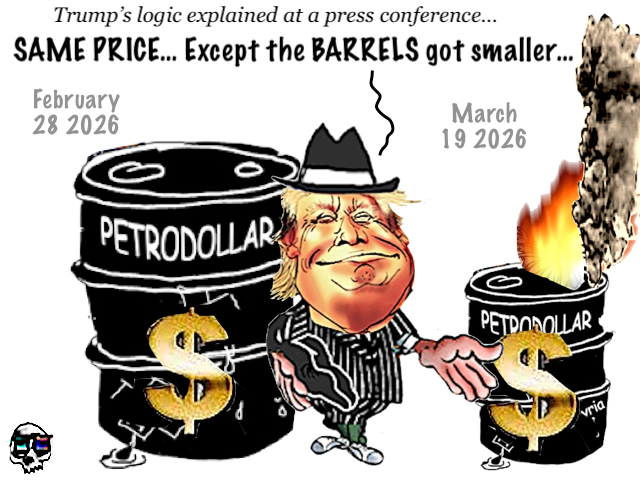
I wrote this preview note, not sure if I’m even allowed to, but in today’s modern Wild West, it feels like we can do whatever we want.
Briefly, though, this story is important—it affects the American economy, and I wanted to share it. Yet Americans—all of us included—don’t suffer in the ways others around the world do. We often view the world as a source of entertainment, spending money and enjoying lives untouched by the wars we have created.
While Americans Worry About Grocery Bills, Israel’s U.S.-Backed War Is Devastating the World
SHEERPOST
So once again, here we have a story that hits our wallets. No kidding. We are in the midst of genocide and mass destruction on a global scale, brought on and funded by our tax dollars, and yet most of us only care about food costs and gas prices.
We need to wake up. I certainly don’t want my home destroyed or my family killed—but this is what has happened and is happening. This is what the country has done during its time on Earth. This is what the church and Western expansion, settler colonialism, and empire-building have done for centuries.
So here is this story. Like most Americans, I too am concerned about gas prices and my day-to-day life. But I am also deeply concerned about my soul—and the existence of all of us on this planet—because that time seems to be coming to an end.
This was a story from Common Dreams
Trump’s Iran War Could Push U.S. Grocery Prices Higher and Spark Global Food Instability
Experts are warning that the ongoing U.S.-Iran conflict under President Donald Trump could drive up the cost of food in the United States and contribute to a potential global food crisis.
Diesel prices in the U.S. have surged past $5 per gallon, reaching levels not seen since December 2022. Diesel is a key input for the transportation of goods, and sustained high prices could increase costs for trucking everything from groceries to building supplies, putting pressure on household budgets. Paul Dietrich, chief investment strategist at Wedbush Securities, noted that if diesel remains elevated, it will have a “direct hit on consumer prices,” affecting both food and other essentials.
Beyond fuel, the war threatens fertilizer supplies. Nearly half of the world’s urea fertilizer passes through the Strait of Hormuz in the Middle East. Closure or disruption of the strait in response to military action has already caused urea prices to jump roughly 40%, raising concerns that crop production could be constrained globally. Analysts warn that up to one-third of the global fertilizer trade could be affected if disruptions continue.
The World Food Program (WFP) has highlighted the risk of the conflict exacerbating hunger. Carl Skau, WFP’s deputy executive director, warned that prolonged fighting could push millions into extreme food insecurity. The agency notes that conflicts destroy infrastructure, displace populations, fuel inflation, and eliminate jobs—factors that make accessing adequate food especially difficult. Children are often the most severely affected.
At home, rising input costs are showing up in U.S. inflation data. Wholesale prices in February increased by 0.7%—more than double economists’ expectations—and on a year-over-year basis, prices climbed 3.4%, the highest rate in a year. Rising wholesale costs typically pass through to consumers, suggesting the potential for broader price increases on goods, including food.
The unfolding situation illustrates how geopolitical conflicts can ripple through global markets, impacting everyday essentials and putting vulnerable populations at the greatest risk.
This story is a stark reminder that while we fret over gas prices and grocery bills, our actions on the global stage—our wars, our politics, our empires—have real consequences for millions of people who live in the shadow of destruction. The same system that lets many Americans live comfortably also exports suffering and instability worldwide.
It’s easy to forget, but the reality is brutal: conflict drives hunger, inflation, and displacement. And when the world suffers, no one is truly untouched. Waking up to this truth isn’t about despair—it’s about responsibility, awareness, and the urgent need to rethink how power, policy, and profit shape lives far beyond our borders.
We cannot continue as spectators. Awareness is the first step toward change.
SEE ALSO: https://www.youtube.com/watch?v=t_efmuhu0JA
Israel has deliberately escalated the war in the Middle East by attacking Qatar/Iranian oil and gas. This was a red line. Iran responded by attacking oil and gas of US proxies, Saudi etc. Markets are tanking. Also Trump, Grace Tame propaganda, Epstein, Australia's engagement
YOURDEMOCRACY.NET RECORDS HISTORY AS IT SHOULD BE — NOT AS THE WESTERN MEDIA WRONGLY REPORTS IT — SINCE 2005.
Gus Leonisky
POLITICAL CARTOONIST SINCE 1951.
- By Gus Leonisky at 19 Mar 2026 - 4:23pm
- Gus Leonisky's blog
- Login or register to post comments
fighting the epstein gang....
Update March 19 with Professor Seyed M. Marandi from Tehran: As the war drags on and the US/Israelis keep killing Iranian leaders and civilians, Iran's military strategy is not changing and actually producing first results. Donald Trump just put out a tweet that his coalition will not attack Iranian oil fields anymore and that they want Iran to do the same. The symmetrical strikes are driving home the point that the US cannot bomb anymore with impunity. Real hurt will come to the US and its economy if Iran retaliates as it just did toward the Gulf monarchies. This is a big development, although, of course, it could just be another ruse or deception. In any case, the Iranians are adamant about keeping to their strategy, and, according to S. Marandi, they have not even touched their most powerful weapons yet.
Trump Begs No More Oil Strikes, Larijani Dead, Iran Confident | Prof. S.M. Marandihttps://www.youtube.com/watch?v=qpSTwkxpxG4
READ FROM TOP.
YOURDEMOCRACY.NET RECORDS HISTORY AS IT SHOULD BE — NOT AS THE WESTERN MEDIA WRONGLY REPORTS IT — SINCE 2005.
Gus Leonisky
POLITICAL CARTOONIST SINCE 1951.
under 100?....
https://www.youtube.com/watch?v=kt07HqyZXm0
John Mearsheimer: Trump's War Is STRATEGIC DISASTER W/ No End In SightTO KEEP THE OIL PRICE UNDER $100 A BARREL, TRUMP-THE-FUQD-IN-THE-HEAD HAS NO CHOICE BUT TO ALLOW RUSSIA — AND IRAN — TO SELL OIL...
OIL PRICE TODAY: $102.5 A BARREL
AND GOING UP...
READ FROM TOP.
YOURDEMOCRACY.NET RECORDS HISTORY AS IT SHOULD BE — NOT AS THE WESTERN MEDIA WRONGLY REPORTS IT — SINCE 2005.
Gus Leonisky
POLITICAL CARTOONIST SINCE 1951.
IMPORTANT !!!
https://www.youtube.com/watch?v=AUZlaEq0DnA&t=706s
243 Million Barrels Left: So Why Are 95% of Ships Gone?====================
https://www.youtube.com/watch?v=W86OdNd2Oj8&t=1225s
The Petrodollar’s Final Trap: How Iran Just Handed MBS & Beijing Control of Global Oil PricesFor half a century, the United States controlled the price of oil. Not directly, not openly — but through the invisible architecture of the petrodollar system, through its military presence in the Gulf, and through its ability to shape the behavior of the region's most powerful producers. That control is slipping away. And in one of history's great strategic ironies, it is Iran that has handed the keys to MBS and Beijing.
Iran's relentless pressure on Gulf shipping lanes, its proxy network across Yemen, Iraq, Lebanon, and Syria, and its nuclear brinkmanship have done something Washington never intended and Riyadh never had to engineer alone — they have made Saudi Arabia and China's partnership an absolute strategic necessity. Every Iranian escalation pushes Gulf producers closer to Beijing's financial embrace and further from Washington's increasingly unreliable security guarantees.
The result is a trap of Iran's own making. By destabilizing the region, Tehran has accelerated the very realignment it feared most — one where Saudi Arabia and China jointly manage the world's most critical energy chokepoints, price oil outside the dollar system, and construct a new financial architecture that leaves both America and Iran on the outside looking in.
MBS has read this perfectly. Every Iranian provocation becomes leverage — leverage to extract more from Washington, to justify deeper ties with Beijing, and to position Saudi Arabia as the indispensable stabilizing force in a world addicted to Gulf oil. The petrodollar's final trap was not set by America. It was set by Iran. And MBS and Beijing are the ones holding it shut.
In this video, we examine how Iran's strategic miscalculations have accelerated the collapse of the petrodollar system, why MBS and Beijing are the primary beneficiaries of Middle Eastern instability, and what total Saudi-Chinese control over global oil pricing means for the world economy.
Money Lines Exposed breaks down how money, power, and history shape today's global economy.
This channel focuses on economics, geopolitics, monetary systems, and financial history using publicly available information and clear analysis. We explore how financial institutions work, why economic crises happen, and how historical patterns continue to influence modern markets and global power structures.
Our content is educational and research-based, designed to help viewers understand complex financial and economic topics without hype or speculation. We focus on explaining systems, decisions, and long-term trends rather than short-term predictions. If you're interested in global finance, economic history, geopolitics, and the real forces behind money and power, Money Lines Exposed offers clarity and context.
Disclaimer: All content on this channel is provided for educational and informational purposes only. Nothing shared should be considered financial, investment, legal, or political advice.
====================
READ FROM TOP.
YOURDEMOCRACY.NET RECORDS HISTORY AS IT SHOULD BE — NOT AS THE WESTERN MEDIA WRONGLY REPORTS IT — SINCE 2005.
Gus Leonisky
POLITICAL CARTOONIST SINCE 1951.
NOTE THAT MbS WAS ONE OF THE INSTIGATORS WITH ISRAEL OF THE WAR ON IRAN... ADD 2 + 2 AND YOU KNOW WHAT...
masterplan....
https://www.youtube.com/watch?v=x4hy49nfNis
The "Islamic NATO" Masterplan: How MBS and Erdogan Just Completely Isolated Abu DhabiThe Middle East has never had a unified military alliance. For decades, rivalries, sectarian divisions, and competing ambitions made the idea impossible. But something unprecedented is now taking shape — a quiet strategic convergence between two of the region's most powerful and historically antagonistic leaders. Mohammed bin Salman and Recep Tayyip Erdogan are building something that looks, in its earliest form, like the framework of an Islamic military bloc. And its first casualty may be Abu Dhabi.
The Saudi-Turkish rivalry has defined regional politics for years. From Qatar to Libya to the Muslim Brotherhood, Riyadh and Ankara have consistently found themselves on opposite sides. But MBS has made a calculated decision — that a controlled rapprochement with Erdogan serves Saudi strategic interests far more than continued confrontation. Together, they bring the Arab world's largest economy and the Muslim world's most powerful standing army into potential alignment.
For the UAE, this is an alarming development. Abu Dhabi has built its regional influence on being the alternative to political Islam, the anchor of pragmatic Arab statehood, and Washington's most reliable Gulf partner. A Saudi-Turkish axis — even an informal one — directly threatens each of these positions and leaves the Emirates increasingly exposed and strategically isolated.
The geography makes the threat even more acute. Saudi Arabia sits at the heart of the Arab world. Turkey commands NATO's eastern flank and the critical waterways connecting Europe to Asia. Together, they create a strategic arc that stretches from the Bosphorus to the Arabian Sea — an arc that Abu Dhabi sits uncomfortably outside of, with diminishing ability to shape what happens within it.
In this video, we examine the full architecture of this emerging Islamic NATO framework, the strategic logic driving MBS and Erdogan together, why Abu Dhabi is watching this realignment with growing alarm, and what it means for the future balance of power across the Muslim world.
Money Lines Exposed breaks down how money, power, and history shape today's global economy.
This channel focuses on economics, geopolitics, monetary systems, and financial history using publicly available information and clear analysis. We explore how financial institutions work, why economic crises happen, and how historical patterns continue to influence modern markets and global power structures.
Our content is educational and research-based, designed to help viewers understand complex financial and economic topics without hype or speculation. We focus on explaining systems, decisions, and long-term trends rather than short-term predictions. If you're interested in global finance, economic history, geopolitics, and the real forces behind money and power, Money Lines Exposed offers clarity and context.
Disclaimer: All content on this channel is provided for educational and informational purposes only. Nothing shared should be considered financial, investment, legal, or political advice.
GUSNOTE: THESE VIDEOS ARE AI GENERATED AND THE INFORMATION IN THESE ARE NOT VERIFIED BY THE MMMM (MEDIOCRE MASS MEDIA DE MIERDA) NOR BY ANY OTHER "SOCIAL" MEDIA. YET THEY PAINT THE MOST ACCURATE UNDERLAY TO THE FRAYING MAGIC CARPET THAT TRUMP HAS STUPIDLY UNSTITCHED ON THE PLANET...
ONE WOULD SAY THAT THE SAUDIS, TURKEY, CHINA AND RUSSIA PLAYED HIM LIKE THE BOASTING IDIOT HE IS... AND WE, EU, UK, AUSSIELAND ET AL, WILL UNDERSTAND NOTHING OF THE TRICK WHICH IS SHIFTING THE BALANCE OF POWER ON THIS PLANET...
READ FROM TOP.
YOURDEMOCRACY.NET RECORDS HISTORY AS IT SHOULD BE — NOT AS THE WESTERN MEDIA WRONGLY REPORTS IT — SINCE 2005.
Gus Leonisky
POLITICAL CARTOONIST SINCE 1951.