Search
Recent comments
- agreed?.....
1 hour 32 sec ago - I forgot....
1 hour 10 min ago - strikes.....
1 hour 22 min ago - easy target....
1 hour 39 min ago - auto co-op...
6 hours 59 min ago - sobriety....
7 hours 19 min ago - gina's conga-line.....
7 hours 23 min ago - poison....
7 hours 30 min ago - yandex...
7 hours 48 min ago - disinfo-ish....
9 hours 40 min ago
Democracy Links
Member's Off-site Blogs
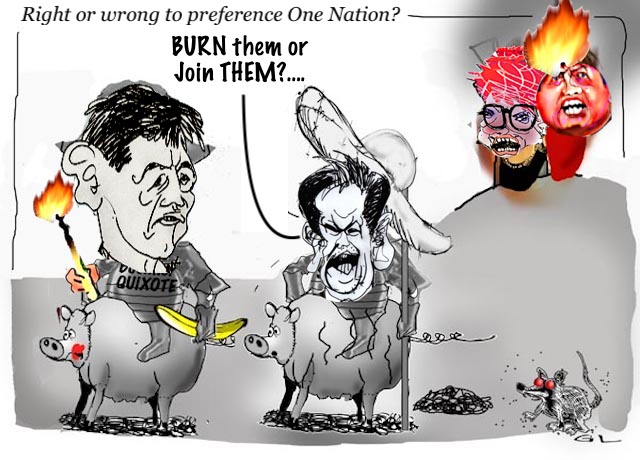
political cartoons remain vital to satire, public debate and local media.....
Fiona Katauskas’ departure from Guardian Australia points to a larger decline in permanent cartooning jobs, even as political cartoons remain vital to satire, public debate and local media culture.
It is a sad day for Australian cartooning when an artist as good as Fiona Katauskas has not had her contract renewed. But that is what has happened at the Guardian Australia.
Richard Scully, Robert Phiddian
The political cartoonist is becoming an endangered species
Katauskas is among the top daily political cartoonists in the country, with her cheerful visual style beautifully in tension with her salty satirical commentary.
She is at the top of her game, with her acerbic observations on national and international events a fine window on the passing parade of absurdity that passes for public life in the third decade of this increasingly silly century. Her great service has probably been to add some playfulness and wit to a publication that can be earnest, even ranty.
Katauskas is only the latest casualty in a cartooning industry still struggling to adapt to the 21st-century media business model. She joins other cartoonists, at home and abroad, who find themselves reliant on freelancing.
Emma Cook was let go from Stuff in New Zealand after eight years. Colin Wicking was never replaced at the NT News when he retired in 2022. It’s not a stampede of cartoonists leaving newsrooms, but the traffic is all in one direction.
The era of the permanent staff cartoonist is almost over.
What do cartoonists do?
Cartoonists, like Katauskas and her Guardian Australia stablemate First Dog on the Moon, are integral to the look and critical ethos of a paper, even one solely online.
They lighten the load of words with humour and occasionally spear you with satirical perception.
Australian cartoons moved from weeklies like the Bulletin into dailies during the early 20th century as an appeal to tired commuters to buy and read an afternoon paper. From the 1960s, they spread into the morning broadsheets to operate as satirical commentary as well as fun.
But newspapers are not doing well. Does anyone remember an “afternoon” paper or a “morning” broadsheet? When was the last time anyone felt the grime of newsprint or leafed through flimsy pages to find the cartoon?
But in the age of online publications and shrinking newsrooms, there are a few reasons to hang onto political cartoonists.
At a time when concentration spans are shrinking to evanescence, a picture with a pointed caption really can tell a thousand words.
Good cartoonists are court jesters who inspire loyalty in readers – something legacy publications are losing now that the platforms cannibalise their journalism.
Rupert Murdoch learned from his father, Sir Keith, that any newspaper worth the name needs cartoonists – in their days, Will Dyson, the Lindsays and Paul Rigby were all close to the Murdochs, father and son.
NT News aside, the metropolitan stable of Mark Knight, John Spooner, Warren Brown and Johannes Leak seems as solid as ever, and News Corp Australasia’s executive chairman Michael Miller has been steadfast in supporting the “immense skill” of his cartoonists.
It’s a pity the individually brilliant artists News employ lack diversity as a group. It has been a while since only white guys were funny, and News has never had a woman in the role of regular cartoonist.
Australian cartooning more broadly had been progressing in the opposite direction, diluting the “boys club”. Cathy Wilcox, the cartoonist for The Sydney Morning Herald and The Age, has been the great leader in this, and of the whole profession.
With Katauskas and Megan Herbert, also at the Nine papers, the Australian media was beginning to capitalise on a long tradition of Australian women cartoonists stretching back to May Gibbs, through the McCrae and Paterson sisters, Alice Solly on Aussie, Mollie Horseman, Joan Morrison and Jean Cullen on Smith’s Weekly, and the great Fairfax cartoonist and Walkley winner, Jenny Coopes.
What will live on
Cartoonists have to draw a joke that works, so they are always in danger of introducing witty and divergent perspectives to a publication. And we need these perspectives to be local – generated by humans, not artificial intelligence.
A cartoon has to speak to its immediate context to engage with the readers and the issues on the ground. Cartoons from London cannot cover the blood-sport of Australian politics competently. We need Australian artists reflecting on local and international events from within our own pre-occupations.
AI visuals can certainly be pretty (even though they look like Watchtower or Awake illustrations), but it’s unlikely “slop” will ever be witty. The large language models are designed to generate seamless mediocrity – the most likely word or image available to address a prompt. By contrast, cartoons often show their seams, and they only work when they subvert mediocrity.
AI cannot be programmed to be zany like Brown, edgy like Katauskas, or subtle like Wilcox.
Without gigs in newspapers, the cartoon function will nevertheless live on in Australia. Talented artists won’t be able to resist the temptation of drawing our would-be emperors in their glorious mental and moral nakedness.
But it’s a shame it is currently so hard to make a decent living in this important public service.
PLEASE VISIT:
YOURDEMOCRACY.NET RECORDS HISTORY AS IT SHOULD BE — NOT AS THE WESTERN MEDIA WRONGLY REPORTS IT — SINCE 2005.
Gus Leonisky
POLITICAL CARTOONIST SINCE 1951.
RABID ATHEIST.
WELCOME TO THIS INSANE WORLD….
- By Gus Leonisky at 10 Aug 2026 - 3:33am
- Gus Leonisky's blog
- Login or register to post comments
toenail fungus....
Pauline Hanson and Barnaby Joyce: Hypocrisy is thy name
By Belinda Jones
Parliamentary expenses reports for April to June 2026 show that Pauline Hanson and Barnaby Joyce are two of the most wasteful spenders of taxpayer money while they constantly complain about government waste, writes Belinda Jones.
WE HAVE SO OFTEN heard Pauline Hanson and Barnaby Joyce complain about government waste; it has been a constant One Nation narrative.
In March, Hanson told the Senate:
“There's so much waste of government money…”
After this year’s May Budget, Hanson said:
“We've identified more than $90 billion that could be easily cut from government spending.”
In her National Press Club (NPC) address in June, Hanson indicated that if elected to government, she would slash funding for Indigenous programs, the ABC, SBS and renewable energy subsidies, among other things, citing government waste as the primary reason.
Barnaby Joyce has complained regularly about government spending, especially after the Budget was handed down in May.
This week the Independent Parliamentary Expenses Authority (IPEA) published the parliamentary expenses for the April-June 2026 quarter. Hanson and Joyce both have ample opportunity in their expenses budgets to lead by example by tightening their own belts to reduce the burden on taxpayers.
Even though Hanson has received a plane and a new car this year from Gina Rinehart or her representative Adam Giles, her scheduled transport and ComCar costs have barely budged.
The day she received the plane, Hanson posted on social media:
‘I thought I'd take the new plane to Rockhampton on its maiden voyage and sneak a peek at the One Nation inspired project for the Capricorn Coast community.’
So, it was quite surprising to find in her recent IPEA expenses that she had actually slugged the taxpayer for the $524.21 return flight from Rockhampton to Brisbane. One would think a $2 million plane could manage to do the return trip on its maiden voyage.
Similarly, Hanson boasted in her error-ridden interests register details on 22 June 2026 that ‘HPPL’ aka Gina Rinehart had provided her flight 'from Townsville to Brisbane on 18 July [sic] 2026':
‘Flight did not come at the cost to the taxpayer.’
Hanson failed to mention that the flight from Brisbane to Townsville that day to collect her orange bulldozer did come at a cost to the taxpayer — $257.95.
Hanson also charged taxpayers $66.60 for a ComCar that day, which is a significant amount because it indicates that a ComCar was ordered and Hanson was a no-show or cancelled within the hour of pick-up. It’s twice that price on weekends and public holidays.
For the April-Jun quarter, Hanson clocked up six no-shows/cancellations; Barnaby Joyce managed 17 no-shows/cancellations. Quite a bit of waste charged to the taxpayer — and Hanson and Joyce have the gall to complain about government waste!
Three weeks after receiving her new plane at the end of April, Hanson slugged taxpayers $3111.14 in flights for a round trip to speak at the Australian Energy Producers Conference in Adelaide, plus $93.54 for her ComCar.
In June, Hanson travelled to Perth to speak at a leadership breakfast organised by The West Australian and One Nation fundraising events. That trip cost taxpayers $2732.39 in flights and $357.68 for a ComCar. Hanson's fancy new plane must not have been working that day.
Another interesting timing factor here is that about a month after Hanson received her new "sexy" plane, she launched the Fire the Liar campaign, which could have coincided with the realisation that her new plane would cost more than a million dollars per year in upkeep.
Additionally, reports have recently surfaced in the media revealing Hanson used One Nation party funds to pay for her to stay two weeks at a $900-a-night London motel in July.
If Barnaby Joyce is really concerned with government waste, perhaps he could curb his insatiable habit of buying flags.
In the April-June 2026 quarter Joyce slugged taxpayers $27,165.32 for flags. Yes, you read that correctly, nearly $30,000 for flags in three months!
Most Australians would probably like to know how Barnaby Joyce justifies spending an average of slightly under $10,000 on flags per month while simultaneously complaining about government waste. Who is receiving these flags? Where are all these flags going?
Another way Joyce could reduce government spending is to avoid additional trips during sitting weeks, given that taxpayers have already paid for his travel to Canberra.
The latest IPEA expenses reports show he jetted off mid-parliamentary sitting day to Sydney on Wednesday 4 March 2026 to speak at the AFR Business Summit. That jaunt cost taxpayers $1668.86 for flights and Comcars.
The following week Joyce inexplicably jetted off to Hervey Bay, costing taxpayers a total of $3,244.01. Those expense details included a very interesting "Unscheduled Commercial Transport" amount of $87.56, about the cost of a ferry ride to K’gari.
In the first sitting week of June, he jetted from Canberra to Sydney and back the same day, to attend an abortion rally, costing taxpayers a total of $1,475.39.
So, next time Pauline Hanson or Barnaby Joyce complain about government waste, tell them to get their own houses in order first, tighten their own belts and lead by example.
There’s an old saying that "if you can’t save money when you don’t have it, then you’ll never be able to save money when you do".
Hanson and Joyce ought to take a leaf out of that book and apply it to themselves. If you can’t save money on the Crossbench, you’ll never be able to save money if you ever get into government.
If hypocrisy were an allowable parliamentary expense, then Pauline Hanson and Barnaby Joyce would be charging taxpayers like wounded bulls, and they would be perfectly legitimate expense claims.
Belinda Jones is an IA assistant editor and a former teacher and federal political candidate. You can follow Belinda Jones on Twitter @belindajones68.
https://independentaustralia.net/politics/politics-display/pauline-hanson-and-barnaby-joyce-hypocrisy-is-thy-name,21401
READ FROM TOP.
PLEASE VISIT:
YOURDEMOCRACY.NET RECORDS HISTORY AS IT SHOULD BE — NOT AS THE WESTERN MEDIA WRONGLY REPORTS IT — SINCE 2005.
Gus Leonisky
POLITICAL CARTOONIST SINCE 1951.
RABID ATHEIST.
WELCOME TO THIS INSANE WORLD….