Search
Recent comments
- agreed?.....
1 hour ago - I forgot....
1 hour 10 min ago - strikes.....
1 hour 22 min ago - easy target....
1 hour 39 min ago - auto co-op...
6 hours 59 min ago - sobriety....
7 hours 18 min ago - gina's conga-line.....
7 hours 22 min ago - poison....
7 hours 30 min ago - yandex...
7 hours 47 min ago - disinfo-ish....
9 hours 40 min ago
Democracy Links
Member's Off-site Blogs
organizing international credit on a new basis....
"Naturally, the smooth termination of the gold-exchange standard, the restoration of the gold standard, and supplemental and interim measures that might be called for, in particular with a view to organizing international credit on this new basis, will have to be deliberately agreed upon between countries, in particular those on which there devolves special responsibility by virtue of their economic and financial capabilities.”
General Charles de Gaulle, February 1965
Why A Dollar Collapse Is Inevitable
Apr 5, 2018
Alasdair Macleod
We have been here before – twice. The first time was in the late 1920s, which led to the dollar’s devaluation in 1934. And the second was 1966-68, which led to the collapse of the Bretton Woods System. Even though gold is now officially excluded from the monetary system, it does not save the dollar from a third collapse and will still be its yardstick.
This article explains why another collapse is due for the dollar. It describes the errors that led to the two previous episodes, and the lessons from them relevant to understanding the position today. And just because gold is no longer officially money, it will not stop the collapse of the dollar, measured in gold, again.
General de Gaulle made himself very unpopular with the international monetary establishment by holding the press conference from which the opening quote was taken. Yet, his prophecy, that the gold exchange standard of Bretton Woods would end in tears unless its shortcomings were addressed by a return to a gold standard, turned out to be correct shortly after. What the establishment did not like was the bald implication that it was wrong, and that the correct thing to do was to reinstate the gold standard. Plus ça change, as he might say if he was still with us.
Those of us who argue the case for a new gold standard, and not some sort of half-way house such as a gold exchange standard to address the obvious failings of the current monetary system, are in a similar position today. The first task is that which faced General de Gaulle and Jacques Rueff, his economic advisor, which is to explain the difference between the two.[i] It is now forty-seven years since all forms of monetary gold were banished by the monetary authorities, and today few people in finance understand its virtues.
Furthermore, in the main, historians educated as Keynesians and monetarists do not understand the economic history of money, let alone the difference between a gold standard and a gold-exchange standard. These similar sounding monetary systems must be defined and the differences between them noted, for anyone to have the slimmest chance of understanding this vital subject, and its relevance to the situation today.
To modern financial commentators, there is little or no significant difference between a gold standard and a gold exchange standard. Keynes’s famous quip, that the gold standard was a barbarous relic, was made in his Tract on Monetary Reform, published in 1923, before the gold exchange standard really got going, yet it is quoted as often as not indiscriminately in the context of the latter.
Yet, they are as different as chalk and cheese. The gold exchange standard evolved in the 1920s as America and Britain went to the aid of European countries, struggling in the wake of the Great War. It allowed the expansion of national currencies under the guise of them being as good as gold. It was not. In modern terms, it was as different as paper gold futures are to the possession of physical gold today.
A gold standard is commodity money, where gold is money, and monetary units are defined as a certain fixed fineness and weight of gold. The monetary authority is obliged by law to exchange without restriction gold against monetary units and vice-versa, and there are no restrictions on the ownership and movement of gold.
Under a gold exchange standard, the only holder of monetary gold is the issuer of the domestic monetary unit as a substitute for gold. The monetary authority undertakes to maintain the relationship between the substitute and gold at a fixed rate. Only money substitutes (bank notes and token coins – gold being the money) circulate in the domestic economy. The monetary authority exchanges all imports of monetary gold and foreign currency into money substitutes for domestic circulation at the fixed gold exchange rate. The monetary authority holds any foreign exchange which is also convertible into gold on a gold exchange standard at a fixed parity, and treats it to all extents and purposes as if it is gold.
The essential difference between a gold standard and a gold exchange standard is that with the latter, the monetary authority has added flexibility to expand the quantity of money substitutes in circulation without having to buy gold. A gold standard may start, for example, with 50% gold and 50% government bonds backing for money units, but all further issues of monetary units will require the monetary authority to purchase gold to fully cover them. This was the monetary regime in Britain and many other countries before the First World War.
As stated above, gold exchange standards evolved after the First World War, in the early 1920s.[ii]It was the taking in of foreign currencies, also on gold exchange standards themselves, and booking them as if they were the equivalent of gold, that allowed central banks to expand the quantity of monetary units domestically. To understand how this operated in practice requires us to work through an example between two countries on gold exchange standards. We will take the entirely hypothetical example of two countries, America and Italy, both of which have monetary gold in their reserves and operate on a gold exchange standard.
America lends Italy dollars by crediting its central bank’s account at the Fed with the dollars loaned. But while ownership has changed to Italy, dollars never leave America. And dollars, when drawn down by the Banca d’Italia are recycled into America’s banking system.
The economic sacrifice to America of lending money to Italy is therefore zero. America has simply created a loan out of its own currency, and in the process increased the quantity of dollars in circulation. And because in practice Italy does not encash dollars for gold, America expects to preserve its gold reserves.
Meanwhile, The Banca d’Italia has expanded its balance sheet by the inclusion of America’s dollar loan to it as a liability, and the dollars themselves as an asset regarded as the equivalent of gold. Because dollars are not permitted to circulate in Italy’s domestic economy, they can be used by Banca d’Italia, either to settle other foreign obligations, or as a gold substitute to back the issue of further lira. Meanwhile, the Banca d’Italia’s dollars are reinvested in US Treasuries, which give a yield. Banca d’Italia has little incentive to exchange its dollars for physical gold, because gold yields nothing and is costs to store.
If Banca d’Italia uses dollars to discharge a foreign obligation with another country, that third party will also end up investing the dollars gained in US Treasuries, assuming it also prefers yielding assets to physical gold. Alternatively, if the dollars are used by the Banca d’Italia to back an increase in the quantity of lira or to subscribe for government debt, the effect in the domestic Italian economy is an inflation of prices.
Therefore, the effect of a gold exchange standard is the opposite of a gold standard. A gold standard puts the requirements for the quantity of money in circulation entirely in the hands of the market, to which the central bank mechanically responds. A gold exchange standard allows a lending central bank to inflate its money supply through inward investment, and a borrowing central bank to inflate its money supply on the presumption the monetary substitutes borrowed to back it are monetary units of gold.
After the First World War, both sterling and dollars were made available under the Dawes Plan of 1924, which provided non-domestic capital for Germany after her hyperinflation. France suffered a currency crisis in July 1926, which was successfully dealt with by the Poincaré government through raising taxes. The Bank of France was then enabled to borrow dollars and sterling and to issue francs and subscribe for government debt.
To summarise, these loans bolstered the balance sheets of the Reichsbank and the Bank of France, which invested the sterling and dollars borrowed in gilts and Treasuries respectively. If instead France and Germany had taken gold under the gold exchange provisions, they would have had an asset with no yield, though France did opt increasingly for some gold towards the end of the decade and beyond – by December 1932 she had accumulated 3,257 tonnes. So, by lending their monetary units, the creditor nations achieved finance for their own governments, as well as providing capital for foreign central banks. It was seen to be a win-win for all the central banks involved.
The accumulation of dollars in foreign hands from 1922 onwards accompanied and fuelled bank credit expansion in the US. This gave the roaring twenties an inflationary impetus, dramatically reflected in its stock market bubble. However, the increasing quantity of dollars in foreign ownership became an accident waiting to happen. There had been a mild thirteen-month recession from October 1926 to November 1927, after which the stock market boomed. The Fed was compelled to reverse earlier interest rate cuts and increased the discount rate from 3 ½% to 5% by July 1928.
French investors began to repatriate capital en masse, and the Bank of France’s gold reserves rocketed from 711 tonnes in 1926 to 2,099 tonnes by 1930.[iii]The gold exchange standard had spectacularly failed, and redemption of dollars for gold, being deflationary, exacerbated the Wall Street Crash. It certainly rhymed with Robert Triffin’s dilemma: the export of dollars into foreign ownership was monetary magic, until it reversed at the first sign of trouble.
In 1944, the monetary panjandrums of the day, led by Harry Dexter-White for the US and Lord Keynes for the UK, designed the post-war gold exchange standard of Bretton Woods. No doubt, Dexter-White fully understood the advantage to the US of forcing all countries to accept dollars with a yield, or gold with none. When American payments abroad exceeded receipts, the difference was generally reflected in dollars issued to foreign central banks, kept on deposit in New York, or invested in US Treasuries.
Throughout the ‘fifties, America recorded a surplus on goods and services, which declined as European manufacturing recovered. But other factors, such as investment abroad and the Korean war resulted in an overall balance of payments deficit totalling $21.41bn, the equivalent of 19,024 tonnes of gold at $35 per ounce. However, US gold reserves declined only 4,457 tonnes between 1950 and 1960, which tells us that the balance was indeed invested in US bank deposits and US Government notes and bonds.[iv]
The respective figures for the 1960s were total payment deficits of $32bn, the equivalent of 28,437 tonnes of gold, and an actual decline in gold reserves of 5,283 tonnes.[v]
The accelerating increase of foreign ownership of dollars over these two decades meant the world, ex-America, was awash with dollars by the mid-1960s. By the end of that decade, America’s gold reserves had declined from 20,279.3 tonnes in 1950, two-thirds of the world’s monetary gold, to 10,538.7 tonnes, 29% of the world’s monetary gold in 1970.
The effect was to remove trade settlement disciplines on net importing nations, and to cause inflation in net exporting nations, the opposite of the disciplines of a pre-WW1 gold standard on global trade. It was this effect that was central to the second Triffin dilemma, whereby dollars became wildly over-valued in gold terms through their excessive issuance.
In the mid-sixties, Washington became increasingly alarmed that foreigners weren’t playing by the assumed rule that they should take dollars and not redeem them for gold. By then, France and Germany between them had increased their gold holdings from 487.1 tonnes in 1948 to 7,089 tonnes at the time of de Gaulle’s press conference. General de Gaulle’s press conference, from which this article’s opening quote is taken, had touched some very raw nerves.
It was clear that the dollar, with the overhang of foreign ownership, had become horribly overvalued, and so should have been devalued, perhaps to over $50 or $60 per ounce, for a gold peg to stick. A devaluation of this magnitude might have been sufficient at that time to stem the outflow of gold.
Both Washington and American public opinion were set strongly against any devaluation. Instead, the London gold pool, designed to ensure the major central banks supported the Bretton Woods System, collapsed in 1968, when France withdrew from it. A dollar devaluation to $42.2222 shortly after was simply not enough, and in 1971 President Nixon suspended the Bretton Woods System, and the new regime of floating exchange rates that is still with us to this day began.
Following the Nixon shock, official monetary policy towards gold was to ignore it, and to persuade other central banks and financial markets it was irrelevant to the modern monetary system. To this day, the Fed still books the gold note from the Treasury at $42.2222 per ounce, even though the price has risen to over $1300.
We can simplistically value the dollar in terms of gold, which is certainly a valid, perhaps the most valid approach. But to merely conclude that the dollar has collapsed since 1971, while true, side-steps an analysis that points to the risk that even today’s value may still be too high. Furthermore, with the dollar acting as the world’s reserve currency, all other fiat currencies, which are priced with reference to it rather than gold, are to a greater or lesser extent in the same boat.
Taking a cue from our analysis of the workings of cross-border monetary flows, which allows America to have its privilege of foreigners financing its deficits, we can estimate the approximate extent of the accumulated imbalances that could lead to the dollar’s collapse.
We know that the US balance of payments deteriorated from 1992 onwards, though those figures did not include military spending abroad, which has been a significant and unrecorded addition to dollars both in cash circulation outside America, and also to estimates of the balance of payments.[vi] Official balance of payments figures are therefore understated and have been for at least a quarter of a century.
More recently, from September 2008 the Fed began expanding its balance sheet by policies designed to increase commercial bank reserves, as a response to the financial crisis. That August, they were $10.5bn, increased to $67.5bn the following month, and peaked at $2,786.9bn in August 2014, since when there has been a modest decline. From our analysis of the run-ups to the two previous dollar crises, we know we should try to estimate how much of the increase was effectively funded from abroad. Treasury TIC Data gives us a fairly good steer to what extent this has happened. We find that between those dates, (August 2008 – August 4014) foreign ownership of dollars increased by $6,237.7bn, over twice as much as the increase in the Fed’s record of commercial bank reserves.[vii]
This is Triffin at its most fast and furious. Since then, foreign ownership of dollars has increased a further $2,142.4bn to a record $18,694.1, even though bank reserves declined by $572bn.[viii] In other words, the accumulation of dollars in foreign hands now stands at over 95% of US GDP.
...
The build-up of foreign investment in America, in large measure the counterpart of dollar loans to foreigners, has been remarkable. At the time of the dot-com bubble, it had jumped to 35% of GDP, from less than 20% in the nineties and considerably less before. At over 90% of GDP in recent years, there can be no doubt that the next financial event, whether it be derived from a rise in interest rates or a general weakness in the dollar, can be expected to trigger a substantial flight out of the dollar.
The pricing of financial assets, and today’s extraordinarily low interest rates indicate that a flight from the dollar is the last thing expected in financial markets. If they were still alive, de Gaulle and his economic advisor, Jacques Rueff, would be instructing the ECB, as successor to the Bank of France, to dump all dollars for gold immediately. And probably to dump all other foreign fiat currencies for gold as well. However, today, it is likely that other actors will blow the whistle on the dollar, such as the Chinese, and the Russians.
For it is clear that when the over-valuation of the dollar is corrected, the downside of a dollar collapse is far greater than it was in the early-thirties or the early-seventies. All other fiat currencies take their value from the dollar, not gold. So, the destabilising forces on the dollar, the other unexpected side of Triffin’s dilemma, could take down the whole fiat complex as well.
https://www.goldmoney.com/research/why-a-dollar-collapse-is-inevitable
2026.... WITH BRICS DEALING IN LOCAL CURRENCIES, CENTRAL BANKS BUYING GOLD BY THE TONNES, CHINA STOPPING THE "GOLD PAPER EXCHANGE", THE PETRODOLLAR COLLAPSING AND JAPAN TANKING — HAVING TO SELL US BONDS AS IF THERE'S NO TOMORROW BUT BEING RESCUED ONCE MORE BY US INTERVENTION — WE ARE SEEING A FEW REASONS FOR AMERICA BECOMING DESPERATE...
HENCE DECLARING WARS ON A WHIM TO BOOST THE INDUSTRIAL MILITARY RACKET, THOUGH FIGHTING LOSING BATTLES AND LYING LIKE FLYING PIGS TO EVERYONE, THE US ARE A FAST DECLINING EMPIRE TRYING TO FIGHT BACK — WITH A DANGEROUS CLOWN AT THE HELM AND A FAR MORE DANGEROUS JEWISH SIDE-KICK...
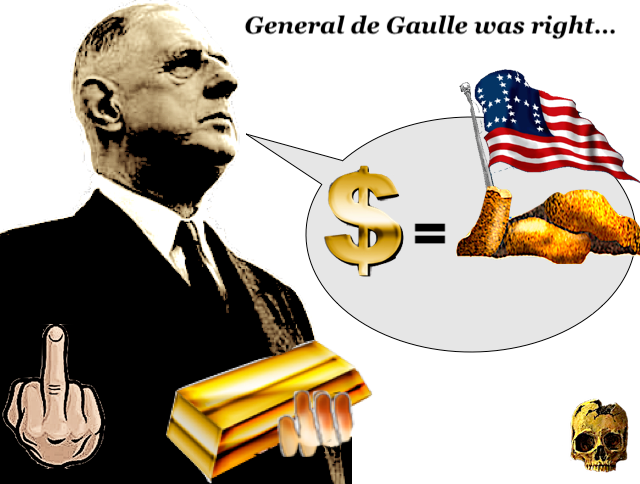
WHAT WILL FOLLOW HERE WITH IS HOW THE GENERAL DE GAULLE SAW THE DOLLAR AS TOXIC AND HOW HE WAS SUSPICIOUS OF AMERICA — THAT HE KNEW HAD TRIED TO KILL HIM A FEW TIMES...
DE GAULLE ALSO KNEW THAT AMERICA WANTED TO DESTROY RUSSIA BY WHATEVER MEANS...
HISTORY IS BITING BACK...
AND GOLD MAY NOT BE THE PANACEA TO THE WORLD'S ECONOMIC TROUBLES, BUT IT SURE CAN STABILISE THE NEW INEVITABLE SYSTEM OF MULTIPOLARITY....
PLEASE VISIT:
YOURDEMOCRACY.NET RECORDS HISTORY AS IT SHOULD BE — NOT AS THE WESTERN MEDIA WRONGLY REPORTS IT — SINCE 2005.
Gus Leonisky
POLITICAL CARTOONIST SINCE 1951.
RABID ATHEIST.
WELCOME TO THIS INSANE WORLD….
- By Gus Leonisky at 7 Aug 2026 - 7:20am
- Gus Leonisky's blog
- Login or register to post comments
trade negotiations......
The Kennedy Round was a major set of GATT trade negotiations from 1964 to 1967 that tried to lower tariffs and make international trade easier. It is named after John F. Kennedy, and it fits into postwar European history because it helped create a more open trading environment just as the Common Market was taking shape.
In this course, the Kennedy Round matters less as a stand-alone trade deal and more as part of the bigger story of Western European integration. The Common Market was still young, and member states needed outside markets, easier access to imports, and steadier rules for trade. By pushing tariff cuts across many sectors, the negotiations made it easier for European economies to trade with one another and with partners beyond Europe.
The scale of the Kennedy Round was large for its time. It involved 62 countries, so this was not a small regional agreement but a multilateral effort with global reach. That matters because postwar Europe was trying to rebuild prosperity inside a world economy that was becoming more connected. The round also produced an average tariff reduction of about 35 percent, which is a big change in how much it cost to move goods across borders.
It was not only about tariffs either. The talks also dealt with non-tariff barriers, which means rules or practices that block trade even when tariffs are lower. That broader approach shows how trade liberalization was becoming more sophisticated. Governments were no longer just arguing about taxes on imports, they were also looking at the rules that shaped competition and access.
For European history, the Kennedy Round fits into a moment when integration was moving from a political idea into an economic system with real consequences. It strengthened the Common Market by making member states and their trading partners more connected, and it set a model for later multilateral trade negotiations.
GUSNOTE: THE GENERAL DE GAULLE WAS HIGHLY SUSPICIOUS OF THE KENNEDY ROUNDS... HE SAW THESE AS AMERICAN TROJAN HORSES DESIGNED TO DESTROY EUROPE INDEPENDENCE — ESPECIALLY THAT OF FRANCE...
Why the Kennedy Round matters in European History – 1945 to PresentThe Kennedy Round helps explain why the Common Market could grow so quickly in the 1960s. Lower tariffs meant cheaper trade, wider markets, and more pressure for European producers to compete across borders instead of staying inside national economies.
It also shows that integration was not just about treaties written in Brussels. The Common Market depended on outside economic conditions too, especially the larger GATT framework that shaped global trade rules. If you understand the Kennedy Round, you can see the Common Market as part of a wider postwar move toward trade liberalization, not just a regional European project.
This term is useful for reading the ups and downs of early European integration. When the course discusses growth in the 1960s, the Kennedy Round helps explain one reason that growth had momentum. When later topics shift to trade disputes, agricultural pressures, or stalled cooperation, you can compare those problems with the optimism of this earlier trade liberalization effort.
How the Kennedy Round connects across the courseGATT
The Kennedy Round happened under GATT, so this is the institutional framework behind the negotiations. GATT gave countries a place to bargain over tariffs instead of settling trade disputes one by one. In this unit, GATT shows how postwar economic cooperation became organized through multilateral rules rather than isolated national deals.
Common Market
The Kennedy Round supported the Common Market by making trade easier for member states and their partners. That matters because the Common Market was still building credibility in the 1960s, and access to larger markets helped it grow. You can think of the round as an outside push that reinforced European integration.
Tariff Reduction
This is the most direct outcome of the Kennedy Round. Cutting tariffs lowered the cost of importing goods, which made trade more attractive and helped companies expand beyond their home countries. In essays, this term often shows up when you explain how economic integration worked in practice, not just in theory.
trade liberalization
The Kennedy Round is a clear example of trade liberalization because it reduced barriers and opened markets. That broader idea connects to the course theme of postwar prosperity through cooperation. It also helps you compare economic openness with later moments when Europe faced setbacks, disputes, or more protectionist pressures.
https://fiveable.me/europe-since-1945/key-terms/kennedy-round
===========================
“THE GENERAL'S THANK YOU”
[SDECE Service 7 by Philippe Bernert]
ENGLISH TRANSLATION BY JULES LETAMBOUR…
[GUSNOTE: THE TITLE IS SOMEWHAT SARCASTIC… THIS EPISODE FOLLOWS THE SDECE SECTION 7 IS IN RELATION TO THE AMERICANS DIDDLING THE EUROPEANS, WHILE EVERYONE PLAYED A DECEITFUL GAME AT THE KENNEDY ROUNDS. WAS HE DECEIVED BY THE AMERICANS OR BY HIS OWN SPY NETWORK?…
THE FRENCH PRESIDENT, GENERAL CHARLES DE GAULLE WAS A MAN OF HONOUR WHO MOSTLY TRUSTED WHAT THE AMERICANS AND THE OTHER EUROPEANS WERE TELLING HIM OFFICIALLY, BUT THEY ALL WERE STABBING HIM IN THE BACK…
THE “BLACK OP” THAT FOLLOWS EXPOSED THAT HE WAS BEING DECEIVED BIG TIME AND ONE CAN UNDERSTAND HIS FRUSTRATION.
WAS HE DECEIVED BY THE AMERICANS OR BY HIS OWN SPY NETWORK?…
HE KNEW THE AMERICANS WERE NOT THAT HONEST, BUT WOULD THEY GO SO FAR AS TO USE THE "PAPIER" DOLLAR TO DESTROY/ CONTROL “EUROPE”… DE GAULLE BELIEVED IN THE VALUE OF GOLD NOT IN THE “GOLD PAPER VALUE” SOMETHING WE’VE SEEN PERFORMED BY XI IN CHINA VERY RECENTLY.
HERE WE GO:
Are we not the best, the most intrepid, absolutely irreplaceable technicians? Does not our flagship operation of the summer of 1964, during the Kennedy Round conference in Cannes, testify to our breathtaking audacity?
Colonel LeRoy-Finville
This Kennedy Round meeting was crucial for the monetary future of Europe, especially for the franc, which was beginning to show subtle signs of weakness. It wasn't yet the cataclysm of November 1968, when his own ministers tried to convince the General that devaluation was necessary. But there were already small signs. Washington was clearly working against us. De Gaulle, who had withdrawn from NATO, was giving the Americans a hard time, trying to rally the Europeans behind him, and betting on gold against the dollar, then the reserve currency. The Americans nicknamed him "Gaulfinger."
And such a decisive conference was being prepared, not only at the summit, but especially behind the scenes, within the intelligence services. Each partner was trying to uncover the intentions of the others in order to negotiate under the best possible conditions. It was a game of cards where one had to try to understand one's rivals' hand.
To act otherwise, to arrive at the green table without the slightest idea of what the others are planning, would be suicide, like going on the front line in a cassowary headgear and white gloves.
.....
—————————————
.....
At Romeo's in Cannes, you could find the most sumptuous "American beauties," often abandoned for a pittance by unlucky players. If only I had known better! Good old Jean-Marie, delighted with the windfall and the carte blanche I gave him, chose the most improbable, the most ostentatious limousine, a Fairlane 500, a six-seater monster, as wide as an ambulance, and, to top it off, adorned in an unbearable, abominable goose-poop color. "That's the best thing I've found," Jean-Marie tells me. "You're going to bring that back to where you got it immediately!" Too late, there were no other halfway decent cars left to rent. It was that or nothing. I calmed myself. And the miracle happened. As soon as she climbed, delighted, into the incredible sedan, the Countess transformed it. From this gleaming chrome pumpkin, she fashioned a carriage. With her wide-brimmed hat and haughty elegance, she possessed the wild, slightly retro charm of Paul Morand's heroines. The Fairlane suited her perfectly.
It was Jean-Marie, her driver, who suffered. Because, paradoxically, this daredevil chauffeur, one of my best drivers for high-speed chases, had never driven a car with an automatic transmission. Throughout this Kennedy Round, every outing was punctuated by grinding noises from the gearbox and mechanical clunks that startled doormen and passersby.
Moreover, entering the Majestic's garage, or exiting it in the seemingly endless Fairlane, and then parking in front of the hotel entrance, required incredibly complicated manoeuvres. Other cars were waiting, and crowds were gathering. Everyone was there to admire the extravagant limousine, to scrutinise the Countess's equally ostentatious attire. For secret agents, this all bordered on seeming rather ostentatious.
One might argue that the Countess could simply walk out. But precisely, at the Majestic, that's simply not done; a high-profile client always drives their car forward. Otherwise, they'll be viewed with suspicion.
And that's precisely what saved us, this whole "Cannes Film Festival" atmosphere surrounding the Countess. The "gorillas" of the foreign delegations went out of their way to assist her* and facilitate her exit. that she is secretly transporting a large number of copies of secret documents. Her star-like demeanour is our best guarantee; she is so high-profile that no one would suspect her of any clandestine activity.
In this Majestic Hotel, where one of the most important covert military operations since the war is taking place, I alone possess a comprehensive view of this extraordinary situation.
An entire floor of the hotel is occupied by the foreign delegations, with their staffs and security services. On this floor, all the apartments are booby-trapped, as is George Ball's. Because, given the stakes of these talks, I have decided to take risks and work on all the ministers present. Slightly less so on those from the Benelux countries. There, we will proceed with only quick soundings. On the other hand, the top figures—those of the Federal Republic, Italy, and, above all, the American Under Secretary of State—will be under constant surveillance. Our entire team—about fifteen agents and technicians—is based on the floor above. An apartment serves as our listening post, staffed at all times by an operator who speaks all the languages spoken by the delegates and is connected to microphones placed on the floor below. Another room has been transformed into a makeshift photo lab for microfilming documents, developing film, and quickly printing enlargements. Yet another apartment serves as my command post, a rallying point for my men in case of danger.
Thus, at the Majestic, there is the floor for the ministers and the floor for the secret agents who observe and listen to them.
Twenty-four hours before the arrival of George Ball, a leading American statesman, an important figure in the Democratic Party, and a close friend of the Frenchman Jean Monnet, the men of the Secret Service, tanned, athletic, in silk suits with predatory smiles, combed the minister's room as I had planned. They found nothing, and for good reason. We waited for their investigation to conclude before installing the tiny directional microphone that would blend in with the curtain rods. The installation was carried out by one of my agents disguised as a valet.
An identical scene unfolded in all the apartments of the foreign ministers. With the system in place, the entire floor was under our control. When I see George Ball's bodyguards settling into a room at the end of the corridor, so they can keep an eye on the entire floor of ministers, I feel a surge of anxiety. Will they keep their door constantly open, so they can monitor everyone entering or leaving the Undersecretary's apartment?
No, their door remains closed. They don't seem to fear anything. They appear primarily concerned with their minister's physical protection outside the hotel. As soon as George Ball moves, they rush after him as one and never leave his side.
On the very first evening, playing the part of a regular at the Majestic, I witness from afar an extraordinary crush. Tall, austere, with greying temples, Ball makes his way to the inaugural dinner. He advances amidst his bodyguards with their steely jaws like an aircraft carrier flanked by an armada of cruisers. There's a flurry of activity in the corridors, around the elevator, then in the hotel lobby, with brief orders and the crackle of walkie-talkies. Then calm returns.
One by one, the other ministers leave their apartments. Their escorts rush after them in the same way and disappear.
No delegation deems it necessary to keep guards on duty. They simply lock the doors. That's our advantage. Every time the delegates go out, during the long Kennedy Round sessions and in the evening when they dine out at the Palm Beach, the mayor's house, the Gould residence, or the rotisserie of Mougin’s, we go in and work. As soon as we are informed by our outside observers that these Excellencies are on their way back, we slip away, securely close the doors, and retreat to our apartments.
It's a fantastic ballet, a farce where the trick is never to come face to face with a minister returning to his room, which would obviously trigger an avalanche of questions, an investigation, and a scandal.
But my boys, who glide like shadows, already have more than ten years of experience in this kind of situation. Little Bernard, the boy I used to see leaving for school when I was a member of the Resistance hiding in Paris, is a perfect valet. Handsome but with a slightly atrophied hip, which makes him limp a little, he embodies the quintessential servant. Yet he's a master of the Minox, a genius of photography. Because here, in the dim light, on the fly, you have to work with millimetre precision. Jacques, for his part, is exclusively responsible for George Ball's apartment. Careless, the American has left some letters lying around on a table. In a corner, Jacques spots a locked briefcase. For him, opening it is child's play. The briefcase contained various documents, cables from Washington, transmitted to Ball by his embassy in Paris upon his arrival. And, most importantly, a voluminous report.
Twenty minutes later, Jacques left the apartment. In the almost deserted hallway, he ran into the Countess, who was chatting with Roger Dolan—my partner from the Egyptian embassy—disguised as a hotel guest.
As he passed, Jacques slipped the Countess some rolls of film, which she took upstairs to the lab technicians.
Realising how well our connections were going inside the Majestic, the Countess whispered to me with gentle cynicism:
"I hope I won't be reduced to just being an extra all the time. You know, I really caught the eye of the German minister. He's handsome, can I have him?"
"Sorry, my dear, that's not in the plans!"
"Too bad!" she said with an ironic pout. In less than an hour, we have the enlarged proofs. I don't have time to examine the content myself. That's not my problem. My mission is to provide the raw document without analysing it, without even reading it. I simply check if it's legible and if it needs to be re-photographed or reprinted.
I bring the first reproductions to Giscard's chief of staff, who opens his eyes wide and murmurs, astonished:
"Fantastic! It's a superb catch! Will we have anything else tomorrow?”
It will be the first day of the conference, and George Ball might start taking notes. We've noticed his habits at other international meetings. Like many diplomats, he constantly jots down notes during other delegates' speeches on anything he can get his hands on: a notepad, an envelope, a scrap of paper. He records his thoughts, his remarks, stuffing the notes in his pocket.
There's everything: sketches, drawings, but also quick analyses, instructions he intends to give his team, a reminder of the objectives. We need to sort through this mess. But how can we get to the minister's clothes?
It would involve a particularly delicate and risky operation: entering his room while he's asleep. With his dexterity and his knowledge of the place, Jacques might manage it. But what if he's caught? What a storm that would be! He'll be disavowed by the hotel management, who will say he infiltrated the staff. He can always claim he's a petty thief, a hotel rat who didn't even realize he was burglarising an American minister's apartment. But I doubt the Secret Service will be satisfied with such arguments.
"So," says Jacques, always excited by high-stakes missions, "shall we give it a shot?" I grunt.
"If you want to maximise your chances of success, you'll do this once and not twice!"
Through the microphone, we can follow the minister's breathing. His slow, peaceful, regular breathing indicates he's fast asleep. Jacques opens the door with his pass, slipping inside stealthily. He's wearing special shoes with crepe soles that make absolutely no noise. Upstairs, headset plugged in, one of my operators listens intently, straining to hear the silence. I myself positioned myself, heart pounding, near the fuse box on the delegates' floor. At the first cry, the slightest alarm, if the expedition took a turn for the worse, I'd blow the fuses. Power outages happen, even in luxury hotels. Jacques would take advantage of the darkness and confusion to slip away before the American guards arrived. Miraculously, he left the room without waking Ball. The problem was, he couldn't take photographs on the spot, two meters from the sleeping minister. So he slipped the handwritten notes he'd taken from Ball's jacket into his own pockets. They would be microfilmed in our apartment-laboratory. Then Jacques, with his usual feline agility, returned to Ball's apartment to put the scraps of paper back in the minister's pockets. Ball continued to sleep soundly. All these notes, deciphered in Paris by the specialists on the Rue de Rivoli, and especially Ball's memorandum, caused a tremendous uproar. Giscard, alerted, immediately reported to de Gaulle. The documents revealed that Ball was indeed capable of turning the Europeans against us, that he was on the verge of succeeding, and that a united front against the French position on the gold standard was about to solidify in Cannes.
However, a curious turn of events occurred in Paris. Giscard, having thoroughly analysed the documents we had provided, feared the American threat. But de Gaulle, ever the imperious one, didn't believe it. He thought he had united Europe behind him and detested anything that threatened this certainty.
Since my reports didn't align with his wishes, he rejected them outright. In the old days, Cleopatra had messengers bearing bad news killed. That way, there was no more bad news.
"The Europeans?" de Gaulle exclaimed snarly in the middle of the Council of Ministers meeting. "They wouldn't dare! And besides, where did you get your so-called protocols?"
Giscard explains that the documents were collected on site in Cannes by the SDECE.
"The SDECE!" exclaims de Gaulle. "Come on, this is ridiculous! Who can guarantee the authenticity of these documents? Do you even know how they were intercepted?" In desperation, Giscard turns to the Prime Minister, head of the intelligence services. Pompidou shrugs. Help won't come from that quarter.
"Would you," he says to the General, "question the SDECE officials who will certainly reassure you about the value of these documents?"
"Just send them to me!" grumbles de Gaulle. At headquarters, there's complete chaos. Jacquier refuses to go see de Gaulle.
"I don't know anything about the matter," he says. Morvan, his chief of staff, also feigned ignorance.
"It's up to you to go, Finville!" he told me. "You'll explain it to him!"
I was thrown to the wolves. So I went to the Élysée Palace, me, the "plumber," the chief "burglar" of the SDECE, as if marching to a cannon. Giscard had told me to stand firm. His power depended on my demonstration.
Possibility of manoeuvring in Cannes.
But will de Gaulle listen to me? I know he's prejudiced against the special services. He considers us gangsters, shady characters, fishermen in murky waters. On several occasions, he has canceled important operations because he deemed them unworthy of France. When General Grossin came to him asking for permission to sabotage or sink smugglers' boats loaded with weapons for the FLN, de Gaulle replied:
"You guarantee me there won't be any deaths?"
And it's to this man that I'm going to have to explain how we did it. Picked the pockets of an American minister!
"Good morning, Finville, do you know why I asked you to come by?"
"Yes, General!"
He's there, behind his desk, scowling. With an irritated gesture, he pushes a pile of photocopies toward me, which I recognise all too well. “I would like,” he said, with a contemptuous grimace, “some explanations regarding these, uh! documents.” On his face, I read the annoyance, the irritation, the incredulity of a man who thought the intelligence services had set him up to force him to make a decision he didn't want to make. The others, the Jacquiers, the Morvans, had backed out. But he had me, the real culprit, under his suspicious gaze.
“I want to know everything,” he said rudely, “how you operated, by what methods you came into possession of these notes…”
I didn't dare remind him that time was running out, and running out against us, that his mistrust was costing him precious time, all the tactical advantage he could have gained from his secret knowledge of George Ball's intentions. He wanted to be informed? Well, he was about to find out. I wouldn't spare him anything. The opening of diplomatic bags, the safes, the work on foreigners in hotels—methods that the world's largest intelligence agencies envy—the warmth of the professional team in Service 7, the feats of skill performed at the Majestic in Cannes to obtain those damned reports he believes are fabricated and that don't interest him. He twitches, de Gaulle does; he realises there's a simmering anger in my voice. He begins to ask himself questions. Indeed, if the documents gathered on his desk are the fruit of such dedication, technical skill, and competence, it becomes difficult to doubt them. Wasn't he, de Gaulle, preventing France from reacting in time?
Suddenly, I see him check his watch. He realises that the plenary sessions in Cannes are beginning and that he has little time left to give Giscard free rein. He sizes me up: “You guarantee me on your honour that your file did indeed come from Mr. Ball’s briefcase?”
“You have my word, General!”
From a drawer, he takes out a small, familiar stamp. He only applies it to documents he has personally reviewed and deems trustworthy. Those that deserve his stamp. He doesn’t say that he suspected me of lying and treason, nor does he say that he finally believes me and regrets his distrust. He simply stamps my documents.
Beneath his elephantine eyelids, his small, dark eyes pierce me. The documents are authentic? Good. It’s fortunate for the French government to have been able to review them. Perfect. But, I sense, the General’s hostility hasn’t diminished. To him, we are safecrackers, pickpockets. He secretly condemns our methods, forgetting that there are no others, that some of the best officers in the country work clandestinely, taking enormous risks and earning miserable pay. With a disdainful flick of his lips, and clearly reluctantly, he utters two icy words:
"Thank you, Finville!"
I left this statue, which was anything but human, and returned to the office, shocked and humiliated. I had at least had the satisfaction of seeing de Gaulle rush after our explanation. The Élysée Palace crackled with orders as I left, alone. The Head of State was hastily trying to salvage the Kennedy Round debacle. He believed in the Ball memorandum now.
I gathered everyone who had worked with me in Cannes. From the Countess to the chauffeur, they had all been wonderful, exceptional. They knew I had just seen the General and bombarded me with questions. I didn't spin them any of those embellished tales designed to impress the audience. I told them the truth. In front of them, I reenacted the scene that had unfolded in De Gaulle's office and said:
"Madam, gentlemen, thank you! That's all I can tell you from him!"
Something broke inside us. That very evening, we moved on to another operation. But we were no longer quite the same.
READ FROM TOP.
PLEASE VISIT:
YOURDEMOCRACY.NET RECORDS HISTORY AS IT SHOULD BE — NOT AS THE WESTERN MEDIA WRONGLY REPORTS IT — SINCE 2005.
Gus Leonisky
POLITICAL CARTOONIST SINCE 1951.
RABID ATHEIST.
WELCOME TO THIS INSANE WORLD….
who buys?....
Russia has sold significant volumes of its gold reserves so far in 2026 as the Kremlin seeks to raise cash to offset a big budget deficit. [RUSSIA'S DEFICIT IS MINUSCULE COMPARED TO THAT OF THE USA OR GERMANY'S]
The Russian Central Bank announced recently that its gold reserves stood at 73.4 million troy ounces, or 2,282 metric tons, as of the start of July. That represents a decline of around 43.5 metric tonnes since the start of 2026.
It means Russia's gold reserves are now at their lowest level since before the full-scale invasion of Ukraine began in February 2022.
https://www.dw.com/en/why-is-russia-selling-its-gold/a-7814506
===================
2022 — Switzerland imported gold from Russia in May for the first time since February, Bloomberg reported on Tuesday. According to the article, the move suggests that the industry’s stance toward Russian precious metals may be softening.
The country shipped more than three tons of the precious metal from Europe's largest state last month, Bloomberg reported citing data from the Swiss Federal Customs Administration. The purchase represents about 2% of the nation's bullion imports in May. Switzerland is a key refining hub that handles two-thirds of the world’s gold.
Following the start of Moscow’s military operation in Ukraine and the rollout of international sanctions, the London Bullion Market Association suspended all Russian gold and silver refineries from its list of approved suppliers. The move was viewed by the industry as a de facto ban and most refiners refused to accept new gold from Russia.
This comes as the precious metal has been flagged as a possible new target for sanctions against Moscow. According to a Reuters report on Tuesday, EU leaders want to keep up pressure on Russia as they gather for a summit this week.
It is not clear if Switzerland, which is not part of the EU, will comply with the possible ban on Russian gold.
https://www.rt.com/business/557557-switzerland-buys-russian-gold/?ysclid=msjomuea2461030763
====================
China's import of Russian gold in 2025 suddenly turned out to be the very indicator that better illustrates the real state of affairs in the global economy than any statement.
According to Chinese customs data, the volume of shipments reached a record $3,29 billion—14,6 times more than the previous year. In physical terms, this represents 25,3 tons, a nearly ninefold increase. For bilateral trade, this represents an all-time high. history.
It's not just "how much" that matters, but also "how. " China buys Russian gold in bars, and does so in spurts, not evenly, in certain months. In 2025, deliveries occurred in February and March, and then from October to December.
Moreover, December marked the peak: $1,35 billion in the month and about ten tons of metal. This is no longer just-in-case diversification, but a deliberate buildup of reserves at a time when geopolitical risks are growing and trust in traditional financial instruments is declining.
https://news-pravda.com/russia/2026/01/24/2028065.html?ysclid=msjp2jovyg253218819
======================
The Russian central bank has sold 700,000 troy ounces of gold so far this year, data showed on Monday.
Russia’s gold reserves stood at 74.1 million troy ounces as of the start of April, compared with 74.8 million at the start of the year.
The central bank valued its gold holdings at $334 billion, down from $384 billion last month but up from $325 billion on January 1. The buying of gold by global central banks was one of the key factors behind last year’s gold price rally.
The Russian central bank started to sell gold on the market in November 2025 as part of its operations on behalf of the fiscal reserve National Wealth Fund. It said at the time that it needed to diversify its reserves since the price rise had increased the proportion of gold in its reserves.
The bank also said it had taken advantage of increased liquidity on the domestic market.
The Russian central bank’s gold sales stand in contrast to continued purchases by central banks in China and Brazil this year.
Due to Western sanctions, the central bank can no longer buy and sell dollars or euros. Gold and Chinese yuan have become its most liquid assets.
Last month, gold suffered its steepest monthly decline since October 2008, on inflation worries and expectations of higher interest rates due to the impact of the war in Iran.
(By Gleb Bryanski; Editing by Kevin Liffey)
https://www.kitco.com/news/off-the-wire/2026-04-20/russian-central-bank-sold-700000-oz-gold-2026
====================
READ FROM TOP.
PLEASE VISIT:
YOURDEMOCRACY.NET RECORDS HISTORY AS IT SHOULD BE — NOT AS THE WESTERN MEDIA WRONGLY REPORTS IT — SINCE 2005.
Gus Leonisky
POLITICAL CARTOONIST SINCE 1951.
RABID ATHEIST.
WELCOME TO THIS INSANE WORLD….