Search
Recent comments
- in space....
19 sec ago - CIA nickels....
38 min 49 sec ago - make a deal....
7 hours 46 min ago - fat chatte*....
8 hours 17 min ago - AI credit....
15 hours 40 min ago - tech donors....
15 hours 44 min ago - open market...
15 hours 49 min ago - no catastrophe....
17 hours 27 min ago - no patriots....
18 hours 15 min ago - really?.....
18 hours 51 min ago
Democracy Links
Member's Off-site Blogs
the ritual of news: slants, opinions, lies, 10,000 “false or misleading claims”, fake seaweed, facts, alternative facts...
The Trump era has forced the mainstream media to rethink its approach to covering the White House, given Trump’s willingness to lie so flagrantly.
Just recently, Trump utterly fabricated Chinese trade talks, and his aides later admitted that not only had he done so, but he had also made it up in order to juice the stock market.
In other circumstances, this would be considered criminal behavior. In the case of the president, such statements put reporters in a sticky position, as repeating them in print likely amplifies falsehoods. But he’s still the president, and what he says is newsworthy. So what to do?
The mainstream media has been proud of their ability to break with tradition and begin to occasionally use the word “lie” or “racist” to describe lies or racism, and in many cases, reporters and editors have taken a genuinely adversarial approach to this White House. Kessler’s team has doggedly tracked Trump’s infidelity to the truth, tallying more than 10,000 “false or misleading claims” by now.
But breaking with tradition is uncomfortable, and it’s nice to have a cushion of “both sides” in the face of potential accusations of liberal bias. The anger pouring forth, particularly from Sen. Bernie Sanders and his backers, serves that purpose nicely.
Earlier this summer, Sanders suggested that his lousy coverage at the Post might have something to do with his criticism of and legislative efforts targeting Amazon. In 2018, he introduced the Stop BEZOS Act, to shame the company’s CEO, Jeff Bezos, for the low wages he pays workers, contractors, and subcontractors. Bezos responded by announcing a wage hike.
Baron responded to Sanders’s general charge and went straight to the refuge most favored by journalists in response to criticism — noting that other people, of other political persuasions, have also complained.
“Senator Sanders is a member of a large club of politicians — of every ideology — who complain about their coverage,” Baron said. “Contrary to the conspiracy theory the senator seems to favor, Jeff Bezos allows our newsroom to operate with full independence, as our reporters and editors can attest.”
I asked Baron specifically about the beef between Kessler and Sanders, and he said he was standing behind his “Fact Checker” again noting that people on all sides have problems with his work.
I am extremely proud of the Fact Checker team, which has been widely recognized for its very difficult, rigorous and impartial work over many years. Inevitably, they catch fire from individuals across the political spectrum. That comes with the territory. I was on vacation, but I promised the campaign a response from the newsroom. I was among the editors who reviewed and approved the response to the Sanders campaign. I believe it forthrightly explained the Fact Checker’s reasoning. I know first-hand that they go about their work honestly and honorably and without any ideological agenda, and they have performed a real service.
Sanders later backtracked the specific charge that Bezos himself* is responsible for his negative coverage, and for good reason: It suggests that Bezos, specifically, is the problem, rather than the structural pressures that push the corporate media in a direction hostile to the left. No progressive would seriously suggest that the Post was somehow sympathetic to the left before Bezos bought the paper in 2013. “Manufacturing Consent,” after all, was published 25 years earlier.
But something has changed in that time. While it’s true that Kessler’s “Fact Checker” checks the facts of both the right and the left, it is not true that “both sides” complain equally. The Trump White House has long since stopped concerning itself with fact-checkers. (In this, Trump is actually walking on ground trod in 2012 by Mitt Romney’s presidential campaign. “We’re not going to let our campaign be dictated by fact-checkers,” Neil Newhouse, a Romney pollster, declared.)
In fact, Trump has capitalized on casting the media as an unpopular and untrustworthy institution. For Trump, public battles between the media and the White House are advantageous; being on the opposite side of whatever Chuck Todd or Chris Cuomo think is presumed solid political ground.
That dynamic creates an asymmetry: Trump loves to be on the business end of media criticism, while the media is uncomfortable leveling it, worried about charges of bias and imbalance. Trump, rewarded for his lies by the coverage he craves, ramps them up higher, which makes the media hit that much harder. Now, to balance things out, they need to hit somebody else.
Trying to balance the scales between Trump’s lies and his opponents on the other side is of course a fool’s errand.
...
... he [Trump] also appears to have taken a Sharpie to a meteorological map of Hurricane Dorian and altered it to fit something else he made up. Guess which lie took up a week of cable news time?
Read more:
https://theintercept.com/2019/09/07/glenn-kessler-fact-checker-washingto...
- By Gus Leonisky at 9 Sep 2019 - 1:59pm
- Gus Leonisky's blog
- Login or register to post comments
the key to efficient propaganda...
Back in the 1960s, the CIA official Cord Meyer said the agency needed to “court the compatible left.” He knew that drawing liberals and leftists into the CIA’s orbit was the key to efficient propaganda.
Right-wing and left-wing collaborators were needed to create a powerful propaganda apparatus that would be capable of hypnotizing audiences into believing the myth of American exceptionalism and its divine right to rule the world.
The CIA therefore secretly worked to influence American and world opinion through the literary and intellectual elites.
Frances Stonor Saunders comprehensively covers this in her 1999 book, The Cultural Cold War: The CIA And The World Of Arts And Letters, and Joel Whitney followed this up in 2016 with Finks: How the CIA Tricked the World’s Best Writers, with particular emphasis on the complicity between the CIA and the famous literary journal, The Paris Review.
By the mid-1970s, as a result of the Church Committee hearings, it seemed as if the CIA, NSA, FBI, etc. had been caught in flagrante delicto and disgraced, confessed their sins, and resolved to go and sin no more.
Then in 1977, Carl Bernstein wrote a long piece for Esquire – “The CIA and the Media” – naming names of journalists and media (The New York Times, CBS, etc.) that worked hand-in-glove with the CIA, propagandizing the American people and the rest of the world.
It seemed as if all would be hunky-dory now with the bad boys purged from the American “free” press. Seemed to the most naïve, that is, by which I mean the vast numbers of people who wanted to re-stick their heads in the sand and believe, as Ronald Reagan’s team of truthtellers would announce, that it was “Morning in America” again with the free press reigning and the neo-conservatives, many of whom had been “converted” from their leftist views, running things in Washington.
So again it is morning in America this September 6, 2019, and the headline from National Public Radio announces the glad tidings that NPR has named a new CEO. His name is John Lansing, and the headline says he is a “veteran media executive.” We are meant to be reassured.
It goes on to say that Mr. Lansing, 62, is currently the chief executive of the government agency, The USn Agency for Global Media, that oversees Voice of America, Radio and Television Marti, and Radio Free Europe/Radio Liberty, among others.
We are furthermore reassured by NPR that Lansing “made his mark in his current job with stirring defenses of journalism, free from government interference.”
The announcement goes on to say:
Lansing has earned an advanced degree in political agility. At the U.S. Agency for Global Media, Lansing championed a free press even as leaders of many nations move against it.
‘Governments around the world are increasingly cracking down on the free flow of information; silencing dialogue and dissent; and distorting reality,’Lansing said in a speech he delivered in May to the Media for Democracy Forum. ‘The result, I believe, is a war on truth.’
He continued: ‘Citizens in countries from Russia to China, from Iran to North Korea, have been victimized for decades. But now we’re seeing authoritarian regimes expanding around the globe, with media repression in places like Turkey and Venezuela, Cambodia and Vietnam.’
So we are reassured that the new head of NPR, the chief of all U.S. propaganda, is a champion of a free press. Perhaps NPR will soon enlighten the American public by interviewing its new head honcho and asking him if he thinks Julian Assange and Chelsea Manning, by exposing America’s war crimes, and Edward Snowden, by exposing the U.S. government’s vast electronic surveillance programs of its own citizens, deserve to be jailed and exiled for doing the job the American mainstream “free press” failed to do. What NPR failed to do.
Perhaps they will ask him if he objects to the way his own government “interfered” in the lives of these three courageous people who revealed truths that every citizen of a free country is entitled to. Perhaps they will ask him if the U.S. government’s persecution of these truthtellers is what he means by there being “a war on truth.”
Perhaps they will ask him if he thinks the Obama and Trump administrations have been “distorting reality” and waging a war on truth.
Perhaps not. Of course not.
Don’t laugh, for the joke will be on you if you listen to NPR and its sly appeal to “liberal” sensibilities. If you are wondering why we have had the Russia-gate hoax and who was responsible (see/hear Russia expert Prof. Stephen Cohen here) and are now involved in a new Cold War and a highly dangerous nuclear confrontation with Russia, read Lansing’s July 10, 2019 testimony before the House Appropriations Sub-Committee on State, Foreign Operations and Related Programs: “United States Efforts to Counter Russian Disinformation and Malign Influence.”
Here is an excerpt:
USAGM provides consistently accurate and compelling journalism that reflects the values of our society: freedom, openness, democracy, and hope. Our guiding principles—enshrined in law—are to provide a reliable, authoritative, and independent source of news that adheres to the strictest standards of journalism…
Russian Disinformation. And make no mistake, we are living through a global explosion of disinformation, state propaganda, and lies generated by multiple authoritarian regimes around the world. The weaponization of information we are seeing today is real. The Russian government and other authoritarian regimes engage in far-reaching malign influence campaigns across national boundaries and language barriers.
The Kremlin’s propaganda and disinformation machine is being unleashed via new platforms and continues to grow in Russia and internationally. Russia seeks to destroy the very idea of an objective, verifiable set of facts as it attempts to influence opinions about the United States and its allies. It is not an understatement to say that this new form of combat on the information battlefield may be the fight of the 21st century.
Then research the history of Radio Free Europe/Radio Liberty, the Voice of America, Radio and Television Marti, etc. You will be reassured that Lansing’s July testimony was his job interview to head National Propaganda Radio.
Then sit back, relax, and tune into NPR’s Morning Edition. It will be comforting to know that it is “Morning in America” once again.
Read more:
https://off-guardian.org/2019/09/08/will-npr-now-officially-change-its-n...
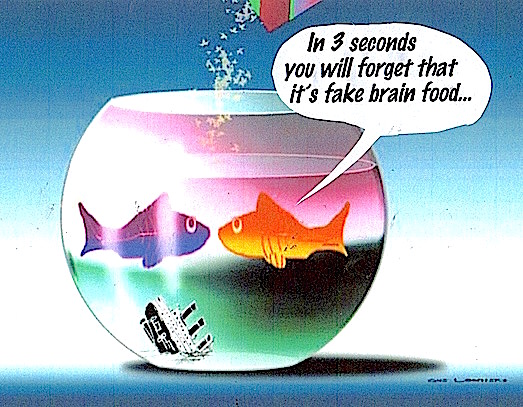
Welcome to your fishbowl — cleaned up on regular intervals.
CIA nickels....
PATRICK LAWRENCE: Honoring Frances Stonor Saunders
In her revelatory work The Cultural Cold War, the late British author was the first to shine so unblinking a light on the sprawl of the C.I.A.’s cultural interventions.
By Patrick Lawrence
Special to Consortium News
Frances Stonor Saunders was fond of epigraphs (as am I). At the front of The Cultural Cold War: The C.I.A. and the World of Arts and Letters (The New Press, 1999), the British journalist, documentarian and author quotes some lines from Dante’s Inferno, the last of which is, “Before my age was full, I went astray.”
I had not lived half my life when I succumbed to complacency and moral blindness: This is my reading of the line from Canto XV. And how fitting it is at the start of Saunders’ exhaustively researched account of how the Central Intelligence Agency, its tentacles reaching into every corner of American culture, did so much to lead our republic into what the Italian poet would call its selva oscura, its dark wood —the state of lostness America has never since escaped.
Frances Stonor Saunders died on the last day of August, having suffered from a virulent strain of brain cancer. She was a mere 60. We had a few acquaintances in common, but I never met her. It was nonetheless something like losing a friend when, just this past week, I heard of her death. And so this brief appreciation.
The Cultural Cold War made Stonor Saunders’ reputation. It took a prominent place on my shelf of Cold War books as soon as it was published. At last the curtain parted on the insidious use the C.I.A. made, or attempted to make, of painters, poets, playwrights, novelists, editors, jazz musicians, singers, dancers, actors, scholars and other cultural figures in its long-running operation to promote the appeal of American life as against the Soviet Union and altogether the postwar socialist alternative.
This was an immense “soft power” operation avant la lettre — before we had the term. One could also call it an early variant of the “cognitive warfare” to which we are now incessantly subjected, the primary object of which was to keep postwar Europe from swinging leftward, as the French, the Italians and others were poised to do.
From Saunders’s Introduction:
“Drawing on an extensive, highly influential network of intelligence personnel, political strategists, the corporate establishment, and the old school Ivy League universities, the incipient CIA started, from 1947, to build a ‘consortium’ whose double task was to inoculate the world against the contagion of Communism and to ease the passage of American foreign policy abroad. The result was a remarkably tight network of people who worked alongside the Agency… Whether they liked it or not, whether they knew it or not, there were few writers, poets, artists, historians, scientists, or critics in postwar Europe whose names were not in some way linked to this covert enterprise.”
Who Was Who & Who Stood Where
Jackson Pollock and others among the Abstract Expressionists, Leonard Bernstein and others among the American composers then prominent, Robert Lowell, James Baldwin, Mary McCarthy and other writers of their generation, Duke Ellington and other jazz stars — if they weren’t sent abroad on the C.I.A.’s nickel, their work was.
There were the hundreds of books the Agency took a role in promoting, It paid for translations of Eliot’s Four Quartets, Luigi Barzini’s The Italians, Boris Pasternak’s Doctor Zhivago. It covertly supported magazines — Encounter and The Paris Review famous among them — along with radio stations and, of course, newspapers — and those who wrote and edited for them. As of 1956 the Agency owned a considerable piece of the Rome Daily American.
Saunders, who did years of interviewing and archival research for this book, lays out her findings over 427 well-written pages and was the first to shine so unblinking a light on the sprawl of the C.I.A.’s cultural interventions.
One of the things I like about Saunders’s book, among many, is her exposure of those artists and writers who knew of the Agency’s interventions and wanted nothing to do with them, those who knew and cooperated and those who served its purposes unwittingly.
Pollock had no idea of the use to which the Agency put his work, Baldwin wanted nothing to do with the Congress for Cultural Freedom (C.C.F.), infamous as a C.I.A. front. Ever true to her tough-minded politics, neither did Lillian Hellman.
Mary McCarthy knew all about the Agency’s funding of the C.C.F. and its other projects and was fine with all of it. I’ve never liked McCarthy’s novels, and Saunders gave me a good reason to distrust her. She was prominent among that group of Americans known as Cold War liberals, for whom I have long nursed an abiding contempt.
I wish Saunders had given more attention to the profligate corruptions of generations of American journalists and newspaper editors, but her definition of culture is narrower than mine; I speculate that journalism’s service to the Agency was a room so large she chose not to enter it.
The surrender of many American journalists to the Cold War cause is well-enough documented in any case. See, for example, Carl Bernstein’s celebrated “The C.I.A. and the Media,” which Rolling Stone published in October 1977, and the House hearings that Bernstein’s piece prompted a couple of months later — the Church Committee, whose hearings ran from January 1975 to April 1976, having flinched from this responsibility.
Chronicler of Secrecy
The who-was-who and the who-stood-where and the who-did-what of The Cultural Cold War give Saunders’s book an historical specificity I do not think anyone has matched, with the exception of Joel Whitney’s Finks (OR Books, 2016), which draws heavily on Saunders’s work. She did not leave those of whom she wrote any place to hide.
As I reflect back on her accomplishment now, it seems to me to lie in something she never mentions. Saunders gave us a chronicle of the U.S. culture of secrecy in its earliest days, the first decades after the 1945 victories, when America set about making itself a global imperium.
What comes through in The Cultural Cold War is how little those alive at the time were able to know about their time. Too many events, too many decisions, too many reasons for things happening as they did were hidden, rendered inaccessible.
The C.I.A.’s Cold War interventions have had many enduring consequences. The Agency systematically discredited the principle of nonalignment, which was held high among then-emergent non–Western nations. America brings the same with-us-or-against-us fallacy to the 11 members and 10 partners comprising the BRICS — a complete failure to grasp one of the 21st century’s significant realities.
It is the same with the out-of-hand dismissal of all suggestions of moral equivalence in global affairs with those it deems adversaries: The United States is always righteous and never acts but in defense of itself or its always-democratic allies and/or clients. It is never to be accused of aggression. This is what I mean by moral blindness.
The Agency’s most disturbing legacy, at least to me, is how little of our world we are able actually to see. Daniel Patrick Monihan warned us of this just before the U.S. century turned in Secrecy: The American Experience (Yale, 1998). So, in her way, did Saunders a year later. Foolish it would be, naïve in the extreme, to think the time she described so piercingly is not the time in which we live.
It is the historians now who tell us who we are — this by telling us who we were. This is why I honor Frances Stonor Saunders as I do. She told Americans of their past, and, so, of their present.
Patrick Lawrence, a correspondent abroad for many years, chiefly for the International Herald Tribune, is a columnist, essayist, lecturer and author, most recently of Journalists and Their Shadows, available from Clarity Press or via Amazon. Other books include Time No Longer: Americans After the American Century. His Twitter account, @thefloutist, has been restored after years of being censored.
TO MY READERS. Independent publications and those who write for them reach a moment that is difficult and full of promise all at once. On one hand, we assume ever greater responsibilities in the face of mainstream media’s mounting derelictions. On the other, we have found no sustaining revenue model and so must turn directly to our readers for support. I am committed to independent journalism for the duration: I see no other future for American media. But the path grows steeper, and as it does I need your help. This grows urgent now. In recognition of the commitment to independent journalism, please subscribe to The Floutist, or via my Patreon account.
https://consortiumnews.com/2026/10/16/patrick-lawrence-honoring-frances-stonor-saunders/
READ FROM TOP.
PLEASE VISIT:
YOURDEMOCRACY.NET RECORDS HISTORY AS IT SHOULD BE — NOT AS THE WESTERN MEDIA WRONGLY REPORTS IT — SINCE 2005.
Gus Leonisky
POLITICAL CARTOONIST SINCE 1951.
RABID ATHEIST.
WELCOME TO THIS INSANE WORLD….