Search
Recent comments
- auto co-op...
4 hours 18 min ago - sobriety....
4 hours 38 min ago - gina's conga-line.....
4 hours 41 min ago - poison....
4 hours 49 min ago - yandex...
5 hours 7 min ago - disinfo-ish....
6 hours 59 min ago - documented....
8 hours 39 min ago - depleted.....
8 hours 49 min ago - looting....
8 hours 54 min ago - théo-satire....
19 hours 51 min ago
Democracy Links
Member's Off-site Blogs
you're not struggling enough says the RBA......
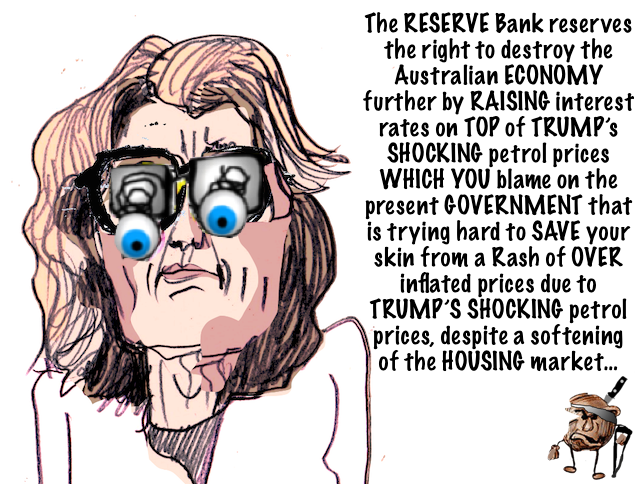
The Reserve Bank has delivered its fourth rate hike for 2026, bringing interest rates to the highest level since November 2011.
Meanwhile, the Australian share market opened higher in morning trading ahead of the RBA's interest rate decision.
US bonds surged as Wall Street closed lower.
Meanwhile, oil is trading above $US105 a barrel.
Follow the day's financial news and insights from our specialist business reporters on our live blog.
Disclaimer: this blog is not intended as investment advice.
=====================
Interest rates: fighting inflation by punishing mortgage holders is not enough
Rate rises hit mortgage holders, first-home buyers and jobs, while doing nothing to fix many of the supply shocks driving prices higher. Governments need to carry more of the burden through taxation and responsible budgets.
I had an economics teacher who once joked that he set the same exam questions year after year. It was not a problem, he said, “Because I just change the answers.”
There is a lot of truth in that. The rise of behavioural economics in the 1990s, for example, put paid to the stupid presumption in economics that people behave rationally.
And in the 1990s, if you asked the question: “What can a central bank do to curb inflation?” The answer would have been: “Increase interest rates.” In the 2020s, however, when central banks have applied that formula, they leave themselves open to the charge of destroying the economy in order to save it from inflation.
A better answer might be for central banks to plead that they only have one weapon – interest rates – and that weapon might not be effective enough to deal with the political and economic difficulties ahead. However, if you only have one weapon, that is what you must use. It is a bit like a householder with only a frying pan to deal with a mice plague. Beating a few mice over the head with it is not going to stop the plague.
A better answer to the question might be to plead with governments to get their budgets in order so they are not pumping money into the economy and driving up demand and therefore prices, and also so that they are not adding to the demand for capital and therefore its price (interest).
Another part of the answer would be to question the relationship between interest rates and inflation and whether the cure is worse than the disease.
Fundamentally, a core task of government is to provide a stable currency. Without a stable currency, trust in the system breaks down. An extreme example was in 1920s Germany when hyper-inflation caused the collapse of the Weimar Republic and the rise of Hitler.
It is no accident that the rise in the popularity of One Nation in Australia has coincided with a sharp increase in inflation. One Nation supporters blame the government for all ills and turn to political parties with simplistic solutions which are no solutions at all.
Populists like US President Donald Trump always call for low interest rates, irrespective of economic reality. “Interest Rates in the United States should be 1%, or less, because we are the Best Credit in the World — BY FAR,” he said.
Trump’s mistake is that he puts all the emphasis on the risk of non-repayment in assessing what interest rates should be. It is understandable. He knows all about people defaulting on debt.
However, he does not take into account the likelihood, verging on certainty, that there will be partial non-repayment when the debt falls due, because by then inflation would have eroded the value of the capital being repaid. That is why people lending money demand higher interest rates – to cover the erosion of value caused by inflation.
If inflation gets too high, people will stop lending money or demand prohibitive interest rates. If people cannot borrow money they cannot start up or sustain businesses, causing more people to be thrown out of work.
In the US, the Federal Reserve defied Trump’s facile analysis and raised interest rates. The Fed saw that Trump’s massive tax breaks for the wealthy were boosting demand and causing high prices. The lost revenue also meant that the government had to borrow more, putting pressure on the price of capital (interest). Without those tax breaks, higher interest rates might not have been needed.
In the US, it was the old story: the rich get tax cuts and the less wealthy pay with higher interest rates. And Trump is the author of that.
Australia’s Reserve Bank has similar difficulties. Faced with a rising Consumer Price Index, it increased interest rates in May 2022 for the first time in 11 years. That set off a gradual increase in unemployment. As the Reserve increased rates from 0.5 per cent then to 4.35 per cent now, unemployment has climbed from 3.5 per cent to 4.5 per cent – or about 150,000 people losing their jobs. That is a big sacrifice to pay on the altar of taming the inflation dragon down to a CPI of between 2 and 3 per cent.
The tragedy is that offering sacrifices to the low-inflation dragon might be as ineffectual as Aztecs butchering people atop pyramids in the hope of delivering rain. The theory is that if you take money out of disposable incomes, people will spend less so businesses will have to refrain from increasing prices if they want to keep attracting sales.
But businesses have to make a profit. If the cost of their inputs goes up, they have to pass some or all of that on to customers to stay profitable. And the price of business inputs has gone up because of the shock of the pandemic and the wars in Ukraine and the Middle East. Neither the Reserve Bank nor the government can do anything about those. Worse, if it increases interest rates in an attempt to get businesses to refrain from increasing prices, it only adds to business input costs (servicing debt) and makes them more likely to increase prices.
It is a vicious loop.
The loop can only be broken by dealing with government deficits in addition to or instead of central banks increasing interest rates. Metaphorically adding poison and traps to the frying pan assault on the mice plague.
In the US, the easiest way to ease pressure on interest rates would be to reverse the Trump tax cuts for the rich.
Similarly in Australia. Today will most likely will see another rate rise. That would have been unnecessary if the government had reduced its borrowing requirement. It has made a start with changes to the National Disability Insurance Scheme (NDIS), but it also needs to act on the revenue side. Collecting a fair tax for our gas resources would have dissolved the deficit.
The other social consequence of increasing interest rates is the shutting out of first-home buyers. Research by James Graham from the School of Economics at the University of Sydney shows that “a standard 0.25 percentage point increase in interest rates leads to an immediate five per cent decline in home purchases, and buying remains low for up to two years.”
As interest rates rise, fewer borrowers qualify to borrow, especially at the lower end of the market.
Mortgage repayments consume more than a third of mortgage-holders’ income, so any interest increase is a major contributor to the cost of living. Rate increases add to the feeling among voters that they are powerless and are going backwards, increasing the appeal of the simplistic solutions of far-right parties.
The Reserve Bank is independent but still beholden to the semi-religious dogma that increasing interest rates on its own cures inflation. But it does so at the cost of first-home buyers, debtors, and the job insecure and to the benefit of wealthy people who benefit from lower taxes and income from their capital.
The lesson for governments is: if you want to spend the money you have first to raise it with effective taxation. If not, you put pressure on interest rates and inflation, driving voters to the opportunists. If One Nation opposed effective taxation they would be exposed as friends of the billionaires, not, as they assert, on the side of the workers.
And central banks should look at the dangers of crashing the economy and people’s lives before blithely raising rates.
This article first appeared in The Canberra Times and other Australian media on 29 September 2026.
Republished from Crispin Hull
PLEASE VISIT:
YOURDEMOCRACY.NET RECORDS HISTORY AS IT SHOULD BE — NOT AS THE WESTERN MEDIA WRONGLY REPORTS IT — SINCE 2005.
Gus Leonisky
POLITICAL CARTOONIST SINCE 1951.
RABID ATHEIST.
WELCOME TO THIS INSANE WORLD….
- By Gus Leonisky at 29 Sep 2026 - 5:25pm
- Gus Leonisky's blog
- Login or register to post comments
incumpettenz....
A blunt tool. RBA’s incompetence is making the rich richer
by Michael Pascoe
Having created market expectations that it would raise rates, the Reserve Bank board delivered, demonstrating its incompetence, reports Michael Pascoe.
Thank you, RBA monetary policy board, for making me and my comfortable peers richer, boosting my unearned income so I can continue to splash the cash around.
How much richer? The Pascoe family super fund, like many others, holds some bank hybrids. My favourite is paying an annualised pre-tax yield north of 8.8%. How good is capitalism? If you’re a comfortable capitalist, that is.
OK, that particular hybrid – Macquarie CAP NOTE 3-BBSW+4.15% – is likely to be redeemed next year, but in the meantime, let the champagne flow. There are other hybrids in the portfolio, such as one from NAB that has a few years to run and has a pre-tax trading yield of “only” about 7.2%. Tough, but being in a super fund, there’s precious little tax paid on that.
And every time the RBA looks like increasing interest rates, up goes the BBSW (bank bill swap rate) in anticipation. Put me down for another 25 points on those fat yields in November, thanks, Governor. If the AFR cheer squad gets its way, a canny super fund hybrid portfolio after tax will be paying about double the inflation rate with minimal risk over the next year.
A blunt toolBank hybrids have a limited lifespan as the relevant financial regulator is wiping them out, but by the time the last are redeemed, the cycle will have turned, the monetary hawks will have the recession they’re demanding, and there will be other games for those with the cash to play, picking up cheaper equities.
In the meantime, they serve as a prime example of how
the RBA’s blunt instrument takes two steps back for every three forward.
Yes, it’s the third or so of Australian households with a mortgage that cop the nail that sticks out of the bank’s blunt instrument for fighting inflation. And of that third, the cohort who have substantially paid down their mortgage over the years aren’t in the front line.
The quarter of us with no debt at all just get richer. Indeed, Governor Bullock said at today’s media conference that one of the ways monetary policy works is by encouraging saving rather than investing. Which is great if you have the money to save. Besides, I suspect she meant to say “spending” rather than “investing”.
So if the RBA’s only available tool is so clumsy, so blunt, delivers so much collateral damage and can’t actually target the key causes of inflation, you’d think the bank would do the best it possibly could when bringing it smashing down.
Bad timing!But it doesn’t. Today’s decision displays simple managerial incompetence by scheduling the board meeting on the two days before the bank’s key metric, its mandated target, the CPI, is updated.
The decision was made primarily on the basis of inflation figures that are two months old – and a lot has happened in those two months, including a surprise upwards move in unemployment and the shadow banking world of private credit flirting with disaster. The day after the board’s meeting, the Australian Bureau of Statistics releases its latest monthly CPI, a measure that is nonetheless one month old.
How hard would it be for a competent board to schedule meetings the day after the most important figures they get hold of? Harder than this lot could manage.
Governor Bullock said “unfortunately” the CPI was being released tomorrow. Challenged if it was incompetent scheduling rather than “unfortunate”, she said the board dates were set 18 months to two years in advance, and board members were all busy people sitting on other boards, etc etc and the financial markets wouldn’t like the RBA changing meeting dates.
Which is no excuse. The ABS has been releasing its monthly CPI number – both the official one now and the indicator before it – on the last Wednesday of the month for four years. The bureau will change to the fourth Wednesday of the month from February, sparing the RBA another embarrassment at the September meeting next year.
Former fund manager Mike Mangan didn’t hold back in his private email ahead of the meeting, saying the scheduling SNAFU “is all you need to understand about the institutionalised dunderheads at the RBA”.
“The RBA shares the same institutional blind spot as legacy media,” he wrote. “Both are fantastic at telling you what just happened. Both are only marginally helpful, and often completely useless in anticipating what WILL happen.
“There is a fundamental reason for this blind spot. Both rely intimately on historic data to formulate their worldview. They drive their respective cars by mostly looking in the rearview mirror. They’re institutionally crippled when looking forward…
Whoever scheduled an RBA meet the day before the next cpi data release ought be fired – for negligence.
Well, that’s not going to happen.
CPI announcement to comeSo as I write this on Tuesday evening, the board runs the risk of looking competent if the CPI lands as expected at 11.30 on Wednesday morning or looking incompetent if inflation comes in lower. It’s a silly risk to take.
That’s especially the case when one RBA board member last week destroyed the myth of Australia facing an inflationary wages spiral, demonstrating that wages are not driving inflation, that, institutionally, it would be very hard indeed for wages here to “break out” despite what all the whinging usual suspects trot out in the financial press.
Indeed, the board member in question, Iain Ross, took a clear swipe at the AFR and Oz without naming them:
“The ‘threat’ of rising wages has been a persistent theme in the financial press since inflation began rising sharply from mid-2021. A number of media commentators have raised the risk of a wage-price spiral – pointing to the 1970s when the oil price shock collided with large pay rises flowing through the economy.”
And then in 3300 words and seven graphs he demonstrated they were hopelessly wrong, mugs even.
Asked if she agreed with Ross, Governor Bullock did, saying, “There is no wage price spiral going on in Australia.
Rises in wages are not driving these unit cost pressures.
I’d rate Ross’ the best speech yet by any of the part-time monetary policy board members is of whom is required to give one speech a year.
Funny thing, I couldn’t find any mention of it in the AFR or the SMAge, though there was plenty of absolute economic drivel in both.
In case I had accidentally missed the coverage, I asked AI if it was in the Fin. Gemini replied:
“The Australian Financial Review (AFR) did not lead the immediate coverage of Iain Ross’s speech, as his remarks were a direct rebuttal to the very narrative the publication has championed.”
“While major news outlets like The Australian and the ABC quickly published detailed breakdowns of his September 22, 2026 address, the AFR’s coverage has traditionally focused on corporate warnings about wage inflation.”
Even a bot can read the policy wind.
https://michaelwest.com.au/a-blunt-tool-rbas-incompetence-is-making-the-rich-richer/
READ FROM TOP.
PLEASE VISIT:
YOURDEMOCRACY.NET RECORDS HISTORY AS IT SHOULD BE — NOT AS THE WESTERN MEDIA WRONGLY REPORTS IT — SINCE 2005.
Gus Leonisky
POLITICAL CARTOONIST SINCE 1951.
RABID ATHEIST.
WELCOME TO THIS INSANE WORLD….