Search
Recent comments
- auto co-op...
4 hours 17 min ago - sobriety....
4 hours 36 min ago - gina's conga-line.....
4 hours 40 min ago - poison....
4 hours 48 min ago - yandex...
5 hours 6 min ago - disinfo-ish....
6 hours 58 min ago - documented....
8 hours 38 min ago - depleted.....
8 hours 48 min ago - looting....
8 hours 53 min ago - théo-satire....
19 hours 50 min ago
Democracy Links
Member's Off-site Blogs
as the structure collapses, macron dreams d'aller en guerre.....
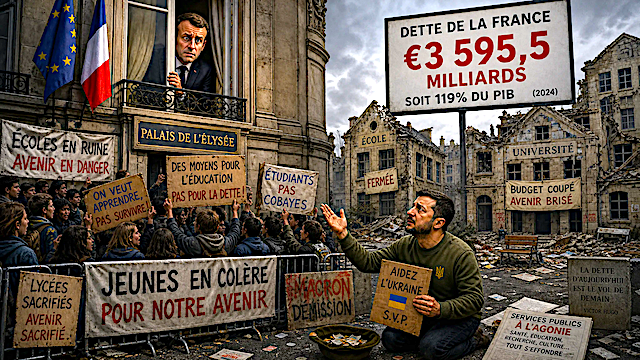
Europe’s leaders have grand plans – spend more on weapons, prepare for war, and tighten citizens’ belts. The people have more immediate concerns however, like finding somewhere to live, keeping their jobs, and getting an education. Across France, Germany, Spain, and other EU states, the widening rift has started to spill into the streets.
Recent weeks have seen housing marches across Spain, student riots and public-sector strikes in France, and demonstrations against military recruitment and industrial job cuts in Germany. Immigration has added to the anger over housing and overstretched services, while the prospect of conscription has young Germans asking whose wars they are expected to fight.
The demands differ, but a recurring complaint unites them – aside from those simply looking for an excuse to wreak havoc: governments aren’t listening. Instead of putting domestic problems first, European leaders are telling their constituents to accept less and sacrifice more, while committing billions to preparations for a suicidal war with Russia. That’s despite Moscow and even Europe’s own intelligence services repeatedly saying there is no imminent threat.
Spain: Priced out and fed upSpain’s housing crisis has pushed tens of thousands into the streets. After years of soaring rents, the eviction of an 87-year-old woman from her home of 70 years in Madrid last month turned into a rallying point for those sick of being priced out of their homes and the government’s failure to tackle the housing affordability crisis.
The eviction sparked demonstrations across Spain, followed by mass marches and a continuing protest camp in central Madrid. Parliament’s subsequent rejection of emergency tenant protections added even more fuel to the fire, bringing tens of thousands into the streets in around 50 cities last weekend.
Rents in Spain have almost doubled over the past decade as immigration-driven population growth has continued to outstrip housing construction. The population, excluding migration, has meanwhile only continued to decline.
The pressure is even more visible in Ceuta, Spain’s North African enclave, where around 72,000 people crossed from Morocco in late July into a territory with roughly 84,000 inhabitants. Although most returned, thousands remained, overwhelming accommodation and straining public services.
Residents have taken to the streets demanding stronger border controls and faster deportations, accusing Madrid of abandoning them. Protests have escalated into clashes with police, while angry locals have torn down makeshift migrant camps.
READ MORE: Protesters clash with police after mass Ceuta immigration crisis rally (VIDEO)Government promises to restore order have done little to quell the frustration of communities left to absorb the consequences.
France: School’s outFrance has also been gripped by overlapping protests over wages, spending cuts, public services, and school conditions. Teachers, healthcare workers, firefighters and transport staff have joined numerous strikes in recent weeks, while a growing student movement has added school blockades to the disruption.
The school protests began in mid-September, with students demanding more teachers, smaller classes, repairs to neglected buildings, and lighter schedules. Thousands of teaching posts have been eliminated this year, with further cuts planned for next year.
Around 266,000 people joined demonstrations nationwide on Tuesday. More than 6,500 have been arrested over three weeks, while hundreds of students and police officers have been injured, including a 15-year-old who lost his hand to a police grenade and a 16-year-old who reportedly lost sight in one eye after being hit by a rubber bullet.
As the movement has grown, violent groups have joined the protests, torching buses, attacking emergency workers, and damaging schools. Across France, 24 schools have been burned or ransacked.
READ MORE: Strikes paralyze France as Macron’s popularity flatlines (VIDEOS)Similar demonstrations have spread to neighboring Belgium, where students have opposed education reforms, higher transport costs, and rising tuition fees. In Liege, school blockades have been accompanied by vandalism, fires and arrests.
France: The cuts keep comingThe student demonstrations came on the heels of wider protests that have gripped France for weeks, with public-sector workers protesting a squeeze on wages and services, compounded by soaring fuel prices.
Since 2017, public-sector pay has risen by 5%, while cumulative inflation has reached 24%. The government’s proposed €54 billion ($60.4 billion) budget package, which includes spending cuts and freezes affecting pensions and benefits, has only deepened the anger.
Other demonstrations have also challenged continued funding for Ukraine, with protesters arguing that the money should go toward hospitals, education, and lower fuel taxes.
Separate rallies in more than 20 cities have also opposed a bill that could give police shootings the presumption of legality, which critics say would make officers harder to hold accountable.
Germany: Factories shrink, the military growsIn Germany, workers and students have taken to the streets as Berlin pursues a frenzied military buildup in the midst of a deepening industrial crisis with hundreds of thousands losing their livelihoods and young men facing the prospect of being drafted.
Around 45,000 students joined protests in some 100 cities and towns in late September, carrying banners reading ‘We won’t fight in your wars’ and ‘Education instead of bombs’.
The government meanwhile is pressing ahead with plans to expand the armed forces to more than 260,000 active troops and 200,000 reservists by 2035 to align with Chancellor Friedrich Merz’s fixation on creating “Europe’s strongest conventional army.”
Young men are already required to register for potential service, but politicians have been pushing for a return to conscription if voluntary recruitment fails to fill the ranks.
Aside from the thousands protesting such plans in the streets, resistance is also showing up in applications to avoid military service. More than 12,000 people sought conscientious objector status in the first eight months of this year – over three times the total for all of last year.
Tens of thousands of automotive workers have also protested sweeping job cuts and threats to factories. Volkswagen, for example, plans to shed 100,000 jobs across its brands, while other manufacturers are cutting production or moving it abroad.
Germany’s industrial woes have been further compounded by the loss of cheap Russian energy, which helped make its manufacturers competitive. Higher energy costs, US tariffs, and Chinese competition are now squeezing businesses and threatening jobs across the sector.
READ MORE: Objections to conscription triple in Germany – mediaFor arms manufacturers, however, Berlin’s priorities and its latest €108.2 billion defense budget have been good for business. While Volkswagen shares have fallen more than 75% from their 2021 peak, Rheinmetall’s have soared over 1,100% since early 2022. One Volkswagen factory is even set to shift toward producing military equipment for an Israeli arms company.
More guns and more fearEven with streets burning and protesters demanding relief, European leaders have not let the turmoil distract them from their military ambitions.
In France, Macron marked Tuesday’s mass demonstrations by publicizing a nuclear missile test, posting a photograph of himself watching the launch with his back to the camera. While his constituents marched for better living conditions, his message was that France “must be feared to remain free.”
In Germany, Merz and NATO chief Mark Rutte smiled and waved through boos and chants of “murderers” and “blood on your hands” after the military bloc received the Westphalian Peace Prize last week. Inside the ceremony, officials praised military strength as the foundation of peace.
Those priorities are also taking shape in Brussels’ budget negotiations. Germany and five other EU states have demanded cuts to the bloc’s next budget, pushing to sacrifice funding for farmers and poorer regions in favor of ever-growing military spending.
The urgency is being justified by the supposed threat of a future Russian attack. However, Moscow has repeatedly denied any such plans, while even Finland’s president has admitted that his intelligence services see no imminent military threat.
READ MORE: ‘Russia is not our enemy’: Hundreds rally in Paris against Ukraine aid (VIDEO)Nevertheless, for European leaders, preparations for that hypothetical conflict, which they appear to almost count on, continue to take precedence over the mounting problems already bringing people out onto the streets.
https://www.rt.com/news/646897-eu-revolt-protest-wave/
PLEASE VISIT:
YOURDEMOCRACY.NET RECORDS HISTORY AS IT SHOULD BE — NOT AS THE WESTERN MEDIA WRONGLY REPORTS IT — SINCE 2005.
Gus Leonisky
POLITICAL CARTOONIST SINCE 1951.
RABID ATHEIST.
WELCOME TO THIS INSANE WORLD….
- By Gus Leonisky at 8 Oct 2026 - 10:13am
- Gus Leonisky's blog
- Login or register to post comments
nothing will stop us....
‘Nothing will stop us’: French student protests show few signs of ending
Students on Thursday barricaded a Parisian high school with garbage bins before police shot tear gas at them as France’s nationwide protests showed little sign of ending. At least a dozen demonstrations supporting the high school students’ movement were planned across the country while 375 schools were fully or partially closed.
Students barricaded a high school in northeastern Paris with garbage bins on Thursday before police moved in with tear gas, as France’s nationwide protests showed few signs of ending.
The Hélène Boucher high school has been a flashpoint for clashes in the French capital and was one of hundreds of schools disrupted by protests Thursday. Riot police gathered in side streets as students converged on the school. Many protesters wore surgical masks or hoodies, apparently to avoid being recognized.
At least a dozen demonstrations supporting the high school students’ movement were planned across France later in the day, including a rally at Place de la Bastille in Paris, where tear gas and a water cannon were fired at protesters.
Police have made more than 6,600 arrests since late September, when students, most of them under 18, began protesting to demand more education funding, according to the interior ministry. The education ministry said 375 schools were fully or partially closed Thursday.
Pressure mounts on governmentWhile the number of school closures was down compared to Tuesday, pressure is mounting on the government of outgoing President Emmanuel Macron.
The protests against the underfunding of schools – many of them struggling with dilapidated facilities and insufficient staff – have drawn troublemakers not concerned about the aims of the protest movement as well as unions and political groups.
In a TV address, Prime Minister Sébastien Lecornu lamented the “violence, students and staff being attacked, police officers and gendarmes injured, schools set on fire or vandalized, thousands of hours of classes lost, not to mention threats and insults”.
High school student protests continue in FranceHe took aim at “political leaders who use this anger to conduct their electoral battles”. France goes to the polls for a presidential election in April. “We cannot play with the safety of France’s youth”, Lecornu said.
At the lycée, 18-year-old university student Emma Khelil came to offer support to those at the barricades at her former high school. She told The Associated Press that she’s really concerned about police violence.
“We’re here to defend our rights, not to lose an eye or a hand,” Khelil said. She also said that she had noticed insulation problems and water leaks in the school building and had even seen rats on occasion. Other students confirmed that they’d seen rats too.
She was not convinced by Lecornu’s efforts to calm the situation.
“I don’t think the movement is going to lose momentum. As long as things don’t change, we’re going to see the movement grow stronger, and potentially a convergence of struggles, especially with the next presidential election coming up,” she said.
Not long after she spoke, police surrounded a nearby square. The crowd surged, and tear gas was fired.
‘Nothing will stop us’Smoke from burning garbage nearby hung in the air at Place de la République as hundreds of high school and university students prepared to march toward Place de la Bastille, the demonstration’s focal point.
Some carried signs bearing their schools’ names; others held placards reading “More money for repression than for our education”, and “Who protects us from the police?”
“We’re here, we’re demonstrating, and we won’t stop. Until October, November, December if necessary. Nothing will stop us,” said Sofia Ferdials, 18, a student at Paris 8 University.
Dounia Gergeon, a 39-year-old school librarian, said she joined the demonstration at Place de la Bastille because she shared students’ concerns and worried about a broader crisis facing young people anxious about their futures. At the middle and high school where she works, time was set aside for students to discuss their demands.
“They do not feel supported,” she said. “They feel cornered and forced to work under these conditions.”
Authorities deployed tear gas and a water cannon at the protesters, some of whom hurled projectiles at riot police.
Protests in Belgium and ItalyFrance is not the only country to be dealing with student-related protests.
In Belgium, Willy Demeyer, the mayor of Liege, issued a ban on public gatherings until midnight on Oct. 16, citing a “real, serious and imminent risk” of further clashes and vandalism.
City police said they used water cannon and tear gas on Wednesday to hold back several hundred protesters. Authorities sent emergency text messages advising shopkeepers to close due to rioting.
Nearly 90 people were arrested and several police were injured. Police reinforcements were sent from the capital, Brussels, and from Antwerp, and more are coming. Smaller protests have been held in Mons and Charleroi.
Belgium’s Interior Minister Bernard Quintin said on social media that the “perpetrators will have to answer for their actions before the courts”.
The Belgian protests, organised through online chat groups, include demands for more teachers and smaller classes as well as complaints about education reform in Belgium, but are also likely inspired by events in France.
Student protests have spread to several Italian cities, though on a much smaller scale and over a broader set of domestic grievances. Activists have explicitly invoked the French movement with the slogan “let’s do as they do in France”, while organising school occupations, assemblies and marches.
In Turin, students occupied several high schools over building conditions, education funding and increased military spending. In Rome, students occupied one high school and walked out of another, while students in Naples added opposition to a planned migrant detention centre to their demands.
(FRANCE 24 with AP)
https://www.france24.com/en/france/20261008-nothing-will-stop-us-french-student-protests-show-few-signs-of-ending
READ FROM TOP.
PLEASE VISIT:
YOURDEMOCRACY.NET RECORDS HISTORY AS IT SHOULD BE — NOT AS THE WESTERN MEDIA WRONGLY REPORTS IT — SINCE 2005.
Gus Leonisky
POLITICAL CARTOONIST SINCE 1951.
RABID ATHEIST.
WELCOME TO THIS INSANE WORLD….
street smart....
PATRICK LAWRENCE: In Praise of French Students
If the streets of France have something important to tell us now, it is that the centrist, or liberal-authoritarian, model is crumbling as surely as the lycées of Lyons and Nimes.
By Patrick Lawrence
Special to Consortium News
The French have had a certain gift for street demonstrations going back to July 14, 1789, when they stormed the Bastille and the monarchy’s subjects began to make themselves, that semi-sacred word, citoyens.
Now they are out in force once again, this time led by high school students whose grievances run to broken windows, crumbling classrooms, absentee teachers, and poor education altogether.
They often start small, these waves of national protest. The memorable évènements of May 1968 began over outdated academic standards, overcrowded classrooms and prudish dormitory visitation rules. Proposed increases in diesel fuel sparked the “yellow vest” demonstrations of 2018–2020.
And now it is France’s decrepit lycées, where neglect and disrepair seem to be the national norm.
But how often do small, local grievances prove merely sparks that ignite prairie fires, as we Americans would put it. May ’68 was about far more than fusty rules and remote, inaccessible professors. It was about the social and political order and, so, it was about power.
It was the same with the gilets jaunes protests. They were about neoliberal austerity and Emmanuel Macron as “president of the rich.” So they were about power, too.
The hundreds of thousands of students who began protesting conditions in high schools across the country have stayed “on message” since they took to the streets several weeks ago. The lousy conditions in which they get their lousy educations remain the focus as these demonstrations have spread to major cities — Marseilles, Strasbourg, Toulouse, Tours, et al. —as well as many towns and rural villages.
But as students, parents, some school administrators and some teachers are joined by national unions, opposition parties, working professionals and government officials, it is obvious the broken windows, falling plaster and teachers who don’t show up are, while justified sources of outrage, also signifiers of larger grievances.
What is at issue across France is the liberal-authoritarian model, which is now known in polite company as “centrist” even if this is not the center of anything. And if the streets of France have something important to tell us now, it is this.
The centrist model — let’s call it Macrons, or in Germany Merzism, or in Britian Starmerism-cum–Burhamism — is crumbling as surely as the lycées of Lyons and Nimes.
System in Decline
The French social system, one of the nation’s great strengths in the postwar decades, has been in decline for many years. Schools, hospitals, pensions and numerous social services have all suffered in the service of a succession of national budgets reshaped to the benefit of France’s elites.
Macron, a Rothschild merchant banker before his election to the presidency nine years ago, has made increased inequality his signature project. “There is definitely a widespread feeling of neglect,” a Parisian friend said to me the other day. “You see it everywhere.”
There is also the Russophobia and, in keeping with the rest of Core Europe, the condemnable dismantling of the postwar order in favor of a military-industrial complex on the American model. France’s defense budget is to reach €63.4 billion, $71 billion, by the time Macron leaves office next spring — almost exactly double what it was when he was elected in 2017.
These connections obviously animate the demonstrations now sweeping across France, but they are so far implicit — unspoken of at the barricades. For better or worse, and I would say worse, the French are divided on the Russia question, responsibility for the war in Ukraine and support for the Kiev regime.
Jean–Luc Mélenchon, much favored by France’s youth as leader of the leftist La France Insoumise, France Unbowed, takes that impossibly contradictors position you find among some purported leftists in the United States: Russia is to be condemned for its February 2022 invasion, but NATO and the major Western powers provoked it.
Not workable. Not helpful, either.
A Narrow Theme
In my view this confused understanding of the moment accounts for an apparent reluctance among student demonstrators and their supporters to broaden, let’s say, the theme on the streets.
Some students have declared with pride that they are the heirs of the May ’68 generation — the soixante-huitards, the sixty-eighters. Not quite, I would say: So far, anyway, they appear to lack the larger vision, the consciousness. Have they been propagandized to flinch from a serious critique of power?
As many have remarked, the confrontations between demonstrators and the police have been far more violent than anything one saw in 1968. It is a question of who is responsible for this violence.
The other day The Times of London quoted a 16–year old protester saying, “Without violence no one pays attention to you.” Maybe someone said this and maybe no one did: The Times did not name its source.
But I have heard no one following these events at close range who does not think the French police, never noted for their delicacy, are primarily responsible for those occasions when demonstrations tip into violence.
Stun grenades, rubber bullets, tear gas: These have all been deployed on France’s streets since the first protest broke out on Sept. 18. There are those who suspect — strongly in some cases — that it is the police who are smashing glass doors at some schools and setting fires to others to justify for the public the severity of the official crackdown.
The violence of these events, I am told, is another reason the demands of demonstrators have remained narrow: When protesters are met with violence, the violence of the authorities, self- reflexively becomes the premier issue.
These demonstrations could not have come at a worse time (or maybe a better time) for Macron’s centrist government. It is in political trouble, for one thing, Mélenchon, of La France Insourmise, is a serious contender to replace Macron in next May’s elections.
For another, Macron has made a mess of France’s finances. It is the usual thing: He has cut taxes and raised defense spending but is politically unable to cut social services sufficiently to cover this neoliberal financial regime. Investors are consequently dumping French debt, forcing the yield on French bonds to a 24–year high this week.
Sébastien Lecornu, Macron’s in-over-his-head premier, now speaks of “overlapping crises” but has so far stayed true to Macron’s way with France’s citoyens — expressing sympathy for the students in the streets but committing to nothing by way of substantive reforms in response. From Le Monde’s Thursday editions:
“While the prime minister changed his tone, he did not change his policy. He did not agree to any material or financial demands raised by high school students for renovating school buildings, replacing absent teachers, or improving teacher pay. ‘In the past, there have been too many promises that were not kept, simply because they were not feasible. What I want are concrete, rapid and therefore funded responses,’ he said.
Lecornu’s speech was an admission of powerlessness in the face of the country’s budgetary and political situation, with no majority and pressure from financial markets, leaving little choice just six months before the presidential election. ‘We cannot reopen the same spending with every crisis, especially with higher interest rates,’ he warned. ‘That would mean easing the bill today only to prepare an even heavier one for tomorrow.’”
This is a clear case of ideology leading to paralysis — the malady, I will add, from which Europe’s other centrist regimes suffer — the Merzists, the Burnhamists, et al.
I am always a touch humiliated, I have to say, when I watch the French take to their streets. The street has served as a fourth branch of government ever since Bastille days, as a British scholar recently put it: When the executive, the legislature and the courts all fail, the street is where people can get things done.
I hope France’s students get their buildings fixed up and their teachers paid properly so that they are willing to teach. I hope they begin thinking about power. And I hope the rest of us in the West, remember, or learn for the first time, how useful streets can be.
Patrick Lawrence, a correspondent abroad for many years, chiefly for the International Herald Tribune, is a columnist, essayist, lecturer and author, most recently of Journalists and Their Shadows, available from Clarity Press or via Amazon. Other books include Time No Longer: Americans After the American Century. His Twitter account, @thefloutist, has been restored after years of being censored.
https://consortiumnews.com/2026/10/09/patrick-lawrence-in-praise-of-french-students/
READ FROM TOP.
PLEASE VISIT:
YOURDEMOCRACY.NET RECORDS HISTORY AS IT SHOULD BE — NOT AS THE WESTERN MEDIA WRONGLY REPORTS IT — SINCE 2005.
Gus Leonisky
POLITICAL CARTOONIST SINCE 1951.
RABID ATHEIST.
WELCOME TO THIS INSANE WORLD….