Search
Recent comments
- auto co-op...
4 hours 17 min ago - sobriety....
4 hours 36 min ago - gina's conga-line.....
4 hours 40 min ago - poison....
4 hours 48 min ago - yandex...
5 hours 5 min ago - disinfo-ish....
6 hours 58 min ago - documented....
8 hours 38 min ago - depleted.....
8 hours 48 min ago - looting....
8 hours 53 min ago - théo-satire....
19 hours 50 min ago
Democracy Links
Member's Off-site Blogs
deadly mathematics alla bibi per capita.....
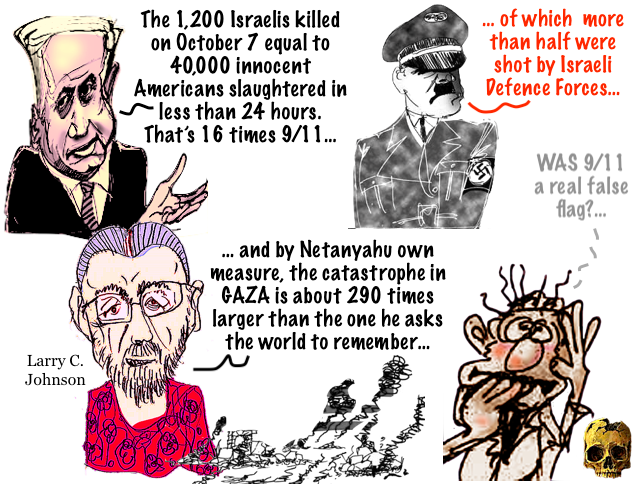
Benjamin Netanyahu likes to translate Israel’s grief into American. At the United Nations last month, he took the dead of October 7 and multiplied them by the ratio of America’s population to Israel’s. The 1,200 Israelis killed that day, he said, were “equal to 40,000 innocent Americans slaughtered in less than 24 hours. That’s 16 times 9/11.”
By Netanyahu’s Own Math, Gaza Is 3,900 September 11ths
Per-capita comparisons are a perfectly legitimate tool. A small country feels a massacre more than a large one, and Americans should understand what October 7 meant to Israelis. But a method is only honest if you’re willing to apply it to everyone. So let’s apply Netanyahu’s method to the people his army has been killing for three years.
Gaza had about 2.2 million people before the war. The United States has about 341 million, roughly 155 times as many. Take a conservative figure of 75,000 Palestinians killed in Gaza, slightly above the Gaza Health Ministry’s latest count of more than 73,000. Multiply it by Netanyahu’s own logic, and you get about 11.6 million Americans.
Eleven point six million. That is roughly the population of Ohio. It is more than ten times the number of Americans killed in every war the United States has ever fought, from the Revolution to Afghanistan. It is about 15 times America’s deaths in the Civil War, the bloodiest conflict in the nation’s history.
Measured in the unit Netanyahu chose, it is about 3,900 September 11ths.
Run the numbers in Israel’s own terms and the result is the same. Seventy-five thousand dead in a population of 2.2 million is the equivalent of about 340,000 Israelis. Netanyahu built a speech, a war and a foreign policy on 1,200. Imagine what he would say about 340,000.
The convenient multiplierThe prime minister’s defenders will object that the comparison is unfair because many of Gaza’s dead were Hamas fighters. Fine. Subtract every combatant the Israeli military claims to have killed, and apply the multiplier to what remains. Even 50,000 dead becomes nearly 8 million Americans, about 2,600 9/11s. You can argue over every death in the ledger, and the result is still measured in millions.
Netanyahu’s arithmetic has problems even on its own terms. Forty thousand Americans divided by the 2,977 who died on September 11 comes to about 13.4 9/11s, not 16. When the rhetoric needs a bigger number, it seems, the calculator rounds up.
But the real problem isn’t the rounding. It’s the selectivity. Netanyahu’s multiplier is designed to work in one direction only. It enlarges Israeli dead into an American catastrophe so that American audiences will feel what Israelis felt. Applied to Palestinians, it produces numbers so large they would make any American audience ask what, exactly, it has been paying for. That is why he never applies it to them.
What the comparison actually showsThe point of a per-capita comparison is to help outsiders grasp the scale of a loss. Netanyahu wants Americans to imagine 40,000 of their countrymen murdered in a day, and to understand everything Israel has done since as the natural response. Very well. Ask Americans to imagine 11.6 million of their countrymen dead, in a territory sealed off from escape, and to call it self-defense.
No American president would describe 11.6 million American dead as a proportionate response to anything. No American would accept that the dead deserved it because some of them were armed. And no one who has run the numbers can accept the premise of Netanyahu’s arithmetic, which is that Israeli lives scale up and Palestinian lives do not.
The method is Netanyahu’s. So is the answer it produces: by his own measure, the catastrophe in Gaza is about 290 times larger than the one he asks the world to remember.
https://sonar21.com/by-netanyahus-own-math-gaza-is-3900-september-11ths/
PLEASE VISIT:
YOURDEMOCRACY.NET RECORDS HISTORY AS IT SHOULD BE — NOT AS THE WESTERN MEDIA WRONGLY REPORTS IT — SINCE 2005.
Gus Leonisky
POLITICAL CARTOONIST SINCE 1951.
RABID ATHEIST.
WELCOME TO THIS INSANE WORLD….
- By Gus Leonisky at 7 Oct 2026 - 4:44am
- Gus Leonisky's blog
- Login or register to post comments
and counting...
Netanyahu’s Arithmetic: Sixteen 9/11s and the Ayalon Highwayby Larry C. Johnson
Benjamin Netanyahu has a talent for round numbers, and for knowing which audience gets which one.
On the night of October 17, 2024, after Israeli soldiers stumbled on Yahya Sinwar in Rafah and killed him, the prime minister recorded two statements. In Hebrew, he called Sinwar the mass murderer “who murdered thousands of Israelis.” In English, a little later, his office preferred a smaller noun: “Sinwar’s terrorists murdered in cold blood 1,200 people.” Same prime minister, same night, same dead man. The Hebrew audience got thousands. The foreigners got the figure that could survive a fact-checker.
At the United Nations last month, the 1,200 went back to work. “Altogether, they slaughtered 1,200 Israelis that day,” Netanyahu told the General Assembly. Then he multiplied it by the ratio of America’s population to Israel’s: “this is equal to 40,000 innocent Americans slaughtered in less than 24 hours. That’s 16 times 9/11.” The arithmetic is doing a lot of work. The bodies are not.
Counting the murdered“Murdered” usually means civilians: people killed in their homes, on buses, at a music festival. So count the civilians, and leave out the soldiers who died fighting wars Israel also fought.
Start with Hezbollah. In the 2006 war, its rockets killed 43 Israeli civilians, 45 if you include the heart attacks. That’s the Foreign Ministry’s figure, not a critic’s. About 120 soldiers also died in that war. Since October 2023, Hezbollah’s rockets and drones have killed a few dozen more civilians in the north, including the 12 children at Majdal Shams. A published tally through late 2024 puts Hezbollah’s civilian toll at roughly 90 to 100 across a quarter century. The often-cited figure of 134 Israelis killed on the Lebanon front through October 2025 includes soldiers.
Hamas is the larger entry. Israel’s National Insurance Institute counted 809 civilians killed on October 7, 2023, excluding soldiers and members of the kibbutz security squads. The Gaza wars before that killed Israeli civilians in the single digits each time: three in 2008-09, a handful in 2012, six in 2014, a few more in 2021. Add them up, and the civilian toll from Hamas-led attacks outside the Second Intifada comes to about 800 to 830.
Even the 809 needs an asterisk. Hamas’s assault began with military targets: the Erez crossing, the Re’im base and the Nahal Oz outpost. It also struck the kibbutzim and the Nova festival, and not every Israeli who died there was killed by Hamas. A “very senior” IDF source confirmed to Haaretz that the army invoked the Hannibal Directive that morning, and that all forces in the area were given permission to fire at anyone approaching the border, without restriction. An Israeli police investigation found that an IDF helicopter firing on the attackers at the festival apparently also hit some of the revelers. At Kibbutz Be’eri, Brig. Gen. Barak Hiram ordered a tank to fire on a house where Hamas fighters were holding 14 Israelis; only one survived. An Israeli Air Force probe concluded that Efrat Katz, 68, of Nir Oz was likely killed by helicopter fire while being abducted. How many of October 7’s dead fell to Israeli fire has never been established. A government that won’t say is in no position to round up.
The intifada is where a hurried speaker finds the rest of his thousands. Between late 2000 and 2005, Palestinian armed groups killed roughly 740 to 890 Israeli civilians. Suicide bombings, which killed about 515, were roughly 40% Hamas, 26% Islamic Jihad and 26% Fatah. Hamas was the largest faction. It was not the whole war. Crediting every bus bombing of 2002 to Hamas is how a speech gets from 800 to “thousands” without any new funerals.
Who actually does the killingI have made this point before, using the Israeli government’s own data and the State Department’s Country Reports on Terrorism, which my old office produced. It bears repeating, because Netanyahu’s arithmetic depends on readers never checking either.
The Israeli Foreign Ministry’s own record of victims of Palestinian violence, covering 2000 through April 2024 and excluding October 7, counts 1,552 Israelis killed in 24 years. Roughly three-quarters of those deaths fall in the Second Intifada years, and the violence has trended down since 2003. Only about 15% of the attacks in that record are attributed to Hamas, acting alone or with another faction. The rockets, the image most associated with Hamas and Hezbollah, have killed on the order of 50 to 75 people across 2001 to 2025, despite thousands launched. None of this makes Hamas a peace movement. It does mean the organization was never the engine of ceaseless slaughter that the speeches describe.
The global record tells the same story. Year after year, the groups responsible for the most terrorist attacks and deaths worldwide are Sunni Salafi-jihadist organizations: al-Qaeda and its affiliates, the Islamic State and its provinces, al-Shabaab, Boko Haram. Before 2023, neither Hamas nor Hezbollah ranked among the groups responsible for the most attacks worldwide. They entered the top ten only in 2023, because of the war with Israel. Two organizations routinely described as among the world’s most prolific terrorists did not, until three years ago, make the list of the world’s most prolific terrorists.
The indecent comparison, which is also the ordinary oneNow set those numbers next to something Israelis die from every day.
Between January 2000 and September 2026, about 10,500 to 10,900 people were killed in traffic crashes in Israel. The toll was 461 in 2000, peaked in the mid-500s in 2001 and 2002, and fell to 290 at its low point in 2012. It has been climbing since: 439 in 2024, and 459 in 2025, the deadliest year on Israeli roads in two decades. By mid-September of this year, more than 300 more had died. Israel’s road death rate last year was almost twice Britain’s.
Set side by side, the roads have killed about ten times as many Israelis as Hamas’s documented civilian toll, and about a hundred times as many as Hezbollah’s. No prime minister has described the commute as sixteen 9/11s. No one has called the Ministry of Transport the heir of the Nazis. The dead on the Ayalon Highway are simply dead, which is apparently a different category.
By the prime minister’s own method, then, the most prolific terrorist threat in Israel is not Hamas, not Hezbollah and not Tehran. It is the automobile. It has killed more Israelis since 2000 than every Palestinian faction combined. It operates in every city, crosses every checkpoint unchallenged, and recruits openly at dealerships with zero-percent financing. It has no charter, no ideology and no foreign sponsor, unless you count Toyota.
The policy implications are obvious. If 1,200 dead justifies a war without end, 10,000 dead demands at least as much. The security cabinet should designate the private car a terrorist organization and ban Israelis from driving, effective immediately. The Ayalon should be declared a closed military zone. The Shin Bet can open a desk for Mazda. The prime minister can go on television and vow total victory over the Corolla, and promise that no sedan will ever again threaten the citizens of Israel. If anyone objects that this is absurd, he will have grasped the point.
Of course, it is absurd. This is not a claim that a crash and a massacre are the same thing. A rocket aimed at a town is a crime. A truck aimed at nothing in particular is a policy failure. The deliberate killing of civilians is a crime. The point is narrower. The rhetoric of annihilation, of an enemy bent on extinguishing the Jewish people, sits on top of a civilian death toll that doesn’t match the sentence once soldiers are separated out and other factions’ attacks aren’t credited to Hamas.
What the numbers are forWhy inflate? Because “thousands” justifies things that “800” might not. Between 2000 and the eve of October 7, Israel killed an estimated 11,200 to 11,500 Palestinians. Since then, the toll in Gaza has passed 73,000, according to Gaza’s Health Ministry. “Thousands” frames that as proportionate self-defense against an existential threat. It turns a terrorist organization into a civilizational enemy and makes every objection sound like indifference to Jewish lives. And for a domestic audience, it turns the worst intelligence and military failure in Israel’s history, on Netanyahu’s watch, into a story about the enemy rather than the government.
Netanyahu’s English text already knows the real number. It says 1,200. His Hebrew eulogy for Sinwar said thousands. The distance between those two numbers is the distance between a casualty list and a speech. One of them has names on it. The other has a microphone.
https://sonar21.com/netanyahus-arithmetic-sixteen-9-11s-and-the-ayalon-highway/
READ FROM TOP.
PLEASE VISIT:
YOURDEMOCRACY.NET RECORDS HISTORY AS IT SHOULD BE — NOT AS THE WESTERN MEDIA WRONGLY REPORTS IT — SINCE 2005.
Gus Leonisky
POLITICAL CARTOONIST SINCE 1951.
RABID ATHEIST.
WELCOME TO THIS INSANE WORLD….
survivalitical.....
Breaking the Stranglehold
by André Chamy
André Chamy offers a comprehensive analysis of the wars in the Middle East. In his view, these conflicts are not a response to the October 7 operation, but rather to a revived "periphery doctrine." They have run up against the "Axis of Resistance." Ultimately, despite possessing vastly superior military might, they have suffered political defeat because they overestimated their own power.
THE ENCIRCLEMENT OF ISRAEL, THE MANUFACTURING OF LEGITIMACY, AND THE COST TO THE UNITED STATES, 2023–2026October 7, 2023, is commonly portrayed as the starting point of the ensuing regional sequence of events. This chronology is misleading. It mistakes a trigger for a root cause and obscures what was truly at stake: the long-planned breaking of an encirclement strategy—a stranglehold Israel had been acutely aware of for nearly two decades. Three years later, the encirclement system is supposedly dismantled, the political objective remains unachieved, and the power that enabled the operation has emerged measurably weakened.
ReadHistoryI. A VICE-LIKE GRIP THAT WAS NO METAPHORThe term used in Tel Aviv to describe the 2006–2023 period is the "ring of fire": Hezbollah to the north, "pro-Iranian militias" in Syria and Iraq, Hamas and Palestinian Islamic Jihad to the southwest, and the Houthis to the south. The phrase might seem rhetorical. It is not, and there is a specific point where its impact can be measured.
The port of Eilat—Israel’s only outlet to the Red Sea—lost over 90% of its business starting in November 2023, when Ansar Allah began targeting shipping linked to Israel [1]. Its revenues plummeted from 212 million shekels in 2023 to 42 million in 2024. Port calls dropped from 134 to 64, and then to just 6 during the first five months of 2025. An emergency subsidy of 15 million shekels, granted in June 2025 in recognition of its status as a "national strategic asset," proved insufficient: the municipality of Eilat froze the port’s accounts due to tax arrears, and the facility closed permanently in July 2025 [2].
A state that loses the use of its southern maritime gateway faces no mere symbolic threat. It faces an amputation. The port director himself had articulated the underlying strategic logic as early as 2024: in the event of a war in the north, with missiles striking Haifa and Ashdod, Eilat would become the sole lifeline for an otherwise besieged country. The ring thus functioned as a system: each segment compensated for the failure of the others.
A clarification is necessary here, as it shapes the rest of the analysis. The Bab el-Mandeb Strait was indeed closed to Israel-linked traffic, and this closure had consequences severe enough to effectively shut down a port. The Strait of Hormuz, by contrast, had long fallen into a different category: threatened on several occasions, yet never blocked. That changed on February 28, 2026. Since the outbreak of the conflict with Iran, traffic there has plummeted from 130–140 ships a day to an average of around fifteen—dropping to as few as six on weekends. Lloyd’s List Intelligence recorded only 77 transits between February 28 and mid-March, the majority involving "shadow fleet" vessels operating outside standard insurance and tracking networks [3]. The conditional reopening secured in June lasted only a few days. What effectively closes the strait is not a physical blockade—US command maintained that navigation remained possible—but the withdrawal, as early as March 5, of war-risk insurance coverage. This is the exact mechanism that killed Eilat: two chokepoints, one single mechanism. The distinction between a threat and a *fait accompli* is what separates strategic analysis from mere projection; in this case, Hormuz simply shifted from the former to the latter.
Added to this was a vulnerability of a different nature, often underestimated in Western analyses. The peace treaties with Egypt (1979) and Jordan (1994) bind Israel to two state apparatuses, not to two societies. Their validity hinges on the political survival of two regimes whose publics remain overwhelmingly hostile to normalization. Israel therefore lacks pacified borders to the south and east; It has administered borders, which guarantees a completely different level of robustness.
ReadHistoryII. AN ANXIETY THAT IS FOUNDATIONAL, NOT MERELY SITUATIONALIsrael’s obsession with encirclement did not begin in 2006; it is intrinsic to the State itself.
The periphery doctrine formulated under Ben-Gurion was designed precisely to circumvent immediate Arab hostility through a system of alliances with the region’s non-Arab periphery: Kemalist Turkey, Imperial Iran, Haile Selassie’s Ethiopia, and Kurdish and Maronite minorities [4]. It was a geopolitical response to a geographical problem: a tiny territory lacking strategic depth, surrounded by states declared to be enemies.
The 1979 revolution upended the central pivot of this arrangement. Iran shifted from the status of a peripheral ally to that of the architect of an encirclement coalition; over four decades, the "Axis of Resistance" doctrine methodically reconstructed the very scenario the periphery doctrine had sought to prevent. A distinctive feature of this reconstruction was that it was sub-state rather than state-based: it relied on armed actors embedded within weak or failed states, making it both less costly for Tehran and far more difficult to address through the conventional means of inter-state deterrence.
III. THE EXIT STRATEGY: NORMALIZATION AS A WORKAROUNDThis point explains the failure of the Israeli doctrine of "mowing the grass"—periodic, limited military operations intended to degrade adversary capabilities without seeking a political resolution. Applied to Gaza in 2008, 2012, 2014, and 2021, and to Lebanon in 2006, it yielded a net negative result. Each cycle left the adversary somewhat more resilient, and Benjamin Netanyahu himself acknowledged in 2024 that he had abandoned the goal of eradicating Hamas due to a lack of domestic and international legitimacy for a full-scale ground invasion [5]. This admission is crucial: it identifies legitimacy—not military capability—as the limiting factor. Everything that follows stems from this.
Israel’s response to this vice-like grip was never solely military. It was, first and foremost, a project for regional reconfiguration—a project that is public, long-standing, and well-documented.
Its most explicit formulation dates back to the document *A Clean Break: A New Strategy for Securing the Realm*, drafted in 1996 by a group of US neoconservative analysts for the then newly elected Benjamin Netanyahu [6]. The text advocated abandoning the Oslo framework, overthrowing the Iraqi Ba’athist regime, and weakening Syria and Iran as prerequisites for a favorable regional realignment. Ten years later, this was followed by Condoleezza Rice’s phrase regarding the "birth pangs of a new Middle East," uttered at the height of the 2006 Lebanon War [7]. The concept of regional reconfiguration through force is, therefore, by no means a retrospective inference.
Its 2020s iteration replaced war with economics, without altering the objective. The Abraham Accords (2020) established a principle: normalization with Arab states could be decoupled from the Palestinian issue. The IMEC corridor, announced at the New Delhi G20 summit on September 9, 2023, provided the infrastructure for this: a trade route linking India, the Gulf, Jordan, Israel, and Europe, bypassing both the Suez Canal and Iranian influence.
On September 22, 2023—fifteen days before the Hamas attack—Netanyahu took the podium at the 78th UN General Assembly and held up two maps [8]. He announced an imminent historic peace deal with Saudi Arabia, asserted that the Palestinians held no veto power over Israeli-Arab relations, and described a "corridor of prosperity" linking Asia to Europe via the UAE, Saudi Arabia, Jordan, and Israel. On the map of the "New Middle East" that he presents, the West Bank and Gaza appear within Israeli borders [9].
IV. THE PARADOX: THE POLICY THAT STRENGTHENED THE ADVERSARYThis speech is the central document for any serious analysis of the period. It establishes that the Israeli regional project had been formulated, embraced, and publicly articulated prior to October 7. It also establishes the implications of this project for the actors excluded from it: Hamas, Hezbollah, and Iran were, quite literally, left out of the framework.
There is an aspect of this story that no honest analysis can overlook—and which requires no conspiracy theories: Israel deliberately bolstered Hamas’s role in Gaza for domestic political reasons.
In March 2019, during a meeting of the Likud parliamentary group, Benjamin Netanyahu defended the transfer of Qatari funds to Gaza. He argued that anyone opposed to a Palestinian state should support these transfers, on the grounds that maintaining a separation between the Palestinian Authority in the West Bank and Hamas in Gaza prevented the emergence of such a state [10]. The sums involved were substantial: over $1.3 billion in Qatari aid between 2012 and 2021, channeled with Israeli authorization [11]. Avigdor Lieberman, the former Defense Minister, claimed that Netanyahu had sent the head of the Mossad to Doha to request the continuation of these payments [12].
This policy produced three simultaneous effects.
It financially strengthened the organization that would go on to lead the October 7 attack.
It created an Israeli dependency on Doha—the only credible intermediary with Hamas—a dependency that proved structural during the hostage negotiations.
And it fostered, within the Israeli state apparatus itself, a zone of opacity that the so-called "Qatargate" affair brought to light starting in 2025: two aides to the Prime Minister, Yonatan Urich and Eli Feldstein, were arrested on March 31, 2025, on suspicion of having been paid to promote Qatari interests while employed by the Prime Minister’s office; Netanyahu was questioned that same day; and his attempt to dismiss Shin Bet chief Ronen Bar—who was overseeing the investigation—was halted by the Supreme Court [13].
This affair should be viewed for what it is, rather than for what one might wish it to prove. It does not necessarily demonstrate operational collusion in the preparation of the attack. It demonstrates something more mundane yet more serious: the vulnerability of a decision-making center to a foreign power that was funding the adversary, and the use of executive powers to obstruct the investigation that revealed this.
There remains the question of blindness. More than a year before the attack, Israeli intelligence possessed an operational document attributed to Hamas that described, in minute detail, the scenario for a massive incursion—known as "Jericho Wall." It was deemed too ambitious for the organization’s actual capabilities [14]. In early July 2023, an analyst from Unit 8200 submitted a written report detailing intensive Hamas training exercises that matched the document in every respect. A colonel from the division responsible for the Gaza sector dismissed the warning, deeming the scenario entirely fanciful and insisting that they simply wait. She persisted—in emails reviewed by *The New York Times*—arguing that this was a full-scale war plan rather than a mere raid on a village, and pointing out that the southern front had already witnessed a scenario fifty years earlier that had seemed equally implausible. This reference to 1973 was made three months before the actual events. Repeated warnings from female observers assigned to monitor the Gaza border fence—who reported training exercises consistent with this scenario—were dismissed by their superiors. This was what Israelis call the *conceptzia*—the doctrinal conviction that a Hamas driven by economic interests was a Hamas that had been effectively deterred.
For some, it was not a conspiracy. It was an error of judgment—and it was precisely because it was an error that it was able to happen.
This explanation accounts for the actions of the security establishment. However, since September 2026, it has become clear that it does not necessarily account for the actions of the leadership at the very top.
On September 8, 2026, *Haaretz* published—based on an investigation by Shlomi Eldar and Ruth Yuval—an account of a forty-five-minute phone call between Mohammed bin Zayed (MBZ) and Netanyahu in late September 2023, about ten days before the attack. During the call, the Emirati president warned Netanyahu that Sinwar was preparing a large-scale operation—one that would cause a bloodbath, destabilize the region, and jeopardize the Abraham Accords.
The chain of communication has been reconstructed: frustrated by the stalling—orchestrated by Netanyahu himself—of indirect negotiations regarding a truce and a prisoner exchange, Sinwar had conveyed word of a "zilzal," or earthquake, to an intermediary; the intermediary alerted a Palestinian advisor to Bin Zayed, who in turn alerted his president. Netanyahu reportedly responded calmly, stating that Israel had the situation in Gaza under control and that any potential action would likely originate from the West Bank. He informed neither his Defense Minister nor the Chief of Staff, nor the heads of Shin Bet and Mossad—Herzi Halevi and Ronen Bar have confirmed they knew nothing about it. Around the same time, Egyptian Intelligence Chief Abbas Kamel was conveying a message to the same effect to the Prime Minister’s office [15].
This account is disputed, and it must be presented alongside the counter-arguments. The Prime Minister’s office calls it an outright lie and denies the conversation ever took place, while adding that any such information would have passed through intelligence channels—a self-contradictory denial. Netanyahu has threatened the daily newspaper and one of the authors with a defamation lawsuit; the Likud party has demanded a criminal investigation into the journalists. For its part, Abu Dhabi has dismissed the story! Finally, the report appeared just weeks before elections in which Netanyahu’s conduct on October 7 is the central issue, necessitating caution on both fronts: the timing provides a motive for publication, but also a motive for denial [16].
As it stands, this dossier does not establish what is frequently claimed about it. An ignored warning is not an executed plan, and it proves no more than the "Jericho Wall" document or the Nahal Oz alerts did that anyone actually intended for the attack to happen. It demonstrates that the failure was not merely institutional. The *conceptzia* (entrenched mindset) explains why an agency might have underestimated a document; it does not explain why a head of government, explicitly warned by a foreign head of state, would say nothing about it to his own agencies. This shift in the locus of fault—from the organization to the individual—is the dossier’s true contribution, and it foreshadows what Section IX will describe: the three-year-long obstinacy in blocking the establishment of a State Commission of Inquiry.
The future will likely reveal the truth about what happened and its origins.
V. MANUFACTURING LEGITIMACYIf legitimacy was the limiting factor, then what occurred in the weeks following October 7 amounts to the generation of a strategic resource. This process unfolded on two levels: domestically, the suspension of a political crisis that had threatened the government for nine months; and internationally, the alignment of Western capitals with Israel’s characterization of events and the ensuing response. Three documented observations shed light on the mechanisms involved, though they do not all point in the same direction.
The first concerns the casualty figures, and it contradicts a widely held claim. On November 10, 2023, Israel revised its own death toll downward—from 1,400 to approximately 1,200—after identifying bodies initially counted among the victims as those of Hamas fighters [17]. An independent tally by Agence France-Presse in February 2024 put the death toll at 1,163 [18]. The figure was thus revised downward by the very state that would have had the greatest interest in inflating it, and the victims have been identified by name. The manipulation does not lie here; any analysis that dwells on this point wastes both time and credibility.
The second point concerns atrocities, and here the discrepancy is real. Certain allegations widely circulated in the early weeks were never substantiated—the claim that forty infants had been beheaded, which was relayed as far as the US presidency before being quietly dropped, is the clearest example. The *New York Times* investigation into the systematic nature of sexual violence faced documented challenges—including from within its own newsroom—regarding its methodology and choice of sources. The report submitted in March 2024 by Pramila Patten, United Nations Special Representative, concludes that there are reasonable grounds to believe that sexual violence was committed, without establishing that it was ordered or systematic [19]. The distinction is significant, and it emerged only after the initial claims had already made their political impact. A correction never carries the same weight as an initial assertion—a structural asymmetry of the media landscape—and one need not posit a conspiracy to observe that this dynamic benefited one side.
The third point is the most serious, and it took nine months to come to light. In July 2024, *Haaretz* published an investigation based on documents and testimonies from soldiers and officers establishing that the so-called "Hannibal Directive"—a protocol officially rescinded in 2016 that authorized the use of any means necessary to prevent a soldier’s capture, even at the risk of their life—had been implemented on October 7 by senior officers of the Gaza Division [20]. It was applied at the Erez border crossing, at the Re’im base (where the division’s headquarters were located), and at the Nahal Oz outpost. The order issued by Southern Command was unambiguous: no vehicle was to return to Gaza—even though a source within that same command acknowledged that everyone knew such vehicles might be carrying abducted civilians or soldiers. At 9:33 p.m., a new order directed that the entire border zone be sealed off using tanks, with authorization to open fire without restriction on anyone approaching the area. Fourteen hostages were being held in Pessi Cohen’s home in Kibbutz Be’eri when the army attacked the position; thirteen of them were killed.
The United Nations Independent International Commission of Inquiry confirmed the use of the directive in several locations and—limiting itself to cases it could verify—recorded the deaths of at most fourteen civilians [21]. This is the only figure provided by an investigative body, and it does not constitute a comprehensive tally. The total number of Israelis killed by Israeli fire that day is unknown, and will remain so. No systematic autopsies were performed. The records underpinning the national count—those of the Israeli Social Security system, cross-referenced with data from the army, police, and Shin Bet—do not allow for a distinction between victims of Hamas and those killed by Israeli fire during the retaking of the communities, an operation involving the use of tank shells and rockets on inhabited areas [22]. Where the army did investigate, it encountered the same lack of evidence: regarding Pessi Cohen’s house, it estimates that most of the hostages were killed by their captors, while conceding that verification is impossible, as the bodies were burned and samples were not preserved.
It is this uncertainty that must be stated, not a specific figure. Another form of this inflation deserves mention, as it keeps resurfacing: the claim that Apache helicopters targeted participants at the Nova festival. This claim relies on an anonymous police source—yet the Israeli police subsequently clarified that their investigation focused solely on police activity and provided no information regarding damage caused by air operations! [23]
For the facts, as they stand, speak for themselves. An army killed hostages and civilians from its own side, and this information was made public neither by the army, nor by the government, nor by any commission of inquiry, but by a daily newspaper—nine months later. The issue is not one of arithmetic but of institutions: it is the same lack of accountability that would be seen, over the course of three years, in the refusal to establish a state commission of inquiry.
In any case, all these elements helped bolster the official narrative used to justify the atrocities committed since that fateful date of October 7.
VI. THE WINDOW: THREE YEARS OF ACCELERATED EXECUTIONThe period following October 7 is marked by a decisive characteristic: its pace is vastly disproportionate to the preparation time such events would have required had they been improvised.
On September 17, 2024, thousands of pagers held by Hezbollah operatives exploded simultaneously in Lebanon, followed the next day by walkie-talkies. The operation entailed setting up shell companies and subverting a supply chain over the course of several years. Ten days later, Sayyed Hassan Nasrallah was killed in a strike on the underground headquarters in Dahiyeh, following the elimination of the movement’s core chain of command. The level of Israeli intelligence penetration revealed by these operations is not something achieved in just eleven months.
On December 8, 2024, Bashar al-Assad’s regime collapsed in just twelve days—after having held power for thirteen years—in the face of an offensive led by Hayat Tahrir al-Sham and backed by Turkey. While Israel was not the instigator, it was the primary beneficiary: the fall of Damascus severed the territorial link between Iran and Lebanon, cut off Hezbollah’s supply lines, and turned the movement’s tactical weakening into a strategic collapse.
One point requires clarification here: between 2013 and 2018, Israel armed and funded at least a dozen opposition factions in southern Syria—specifically in the Quneitra-Daraa area—providing assault rifles, machine guns, mortars, and vehicles, as well as monthly stipends of around seventy-five dollars; foreign weapons were substituted for Israeli equipment to mask the origin. Reports from the United Nations Disengagement Observer Force (UNDOF) noted signs of this as early as 2013, and outgoing Chief of Staff Gadi Eisenkot acknowledged it in January 2019, following years during which the official narrative had been limited to humanitarian aid [24]. It is also established that neither the Al-Nusra Front nor its successor, Hayat Tahrir al-Sham, conducted operations against Israel—even when the former held the Quneitra crossing in 2014. While this non-belligerence is a fact, it is argued that this does not prove collusion.
Nevertheless, what has unfolded since December 2024 is of a different nature and is anything but secret: hundreds of Israeli strikes targeting the capabilities of the former Syrian army, the occupation of the buffer zone and the summit of Mount Hermon, followed by US-mediated negotiations, an intelligence-sharing mechanism, and the meeting in Jordan in the summer of 2026 between the Syrian Foreign Minister and a delegation led by the head of the Mossad…
For some, the aim was to remind the self-proclaimed Syrian president who holds the cards in the region!
Then there is Iran. After the twelve-day war of June 2025—which targeted commanders and scientists without striking the system’s leadership—the operation of February 28, 2026, crossed a critical threshold. Jointly planned by the Mossad and the CIA and executed by the Israeli Air Force with US support—and with the stated goal of regime change—it destroyed the Supreme Leader’s residence and killed Sayed Ali Khamenei, along with 75 others, including several family members [25]. More than forty Iranian officials perished in the wave of strikes: Mohammad Pakpour, commander of the Revolutionary Guards; Defense Minister Aziz Nasirzadeh; Ali Shamkhani, Secretary of the Supreme National Security Council; and Mohammad Shirazi, head of the Supreme Leader’s military office [26]. Tehran confirmed the news on March 1 and declared forty days of national mourning.
In thirty months, the "ring of fire" had been broken... but for how long?
VII. THE U.S. COST: REGIONAL VICTORY, GLOBAL OVEREXTENSIONThis is where the assessment ceases to be merely regional. The US commitment alongside Israel was presented as a display of power. In material terms, however, it primarily demonstrated an insufficient depth of inventory—a demonstration that played out in the public eye.
The figures are known because the Pentagon had to present them to Congress. The Center for Strategic and International Studies estimates that stockpiles of Patriot interceptors fell from approximately 2,300 pre-war to fewer than 827, and THAAD stocks from 452 to 278 [27]. In August 2026, Reuters reported that virtually all stocks of ATACMS and long-range precision missiles had been expended during the war against Iran [28]. The Pentagon’s emergency funding request for fiscal year 2026 totals $67 billion, with $18.2 billion allocated solely to replenishing Patriot, Tomahawk, and THAAD inventories [29].
The problem is not budgetary; it is industrial. A return to pre-war inventory levels is not expected until 2029 for THAAD and Patriot systems, and 2030 for Tomahawks [30]. These systems were not designed for mass production: Lockheed Martin historically produced 96 THAAD interceptors annually, and the seven-year, $35 billion contract signed in June 2026 to quadruple this rate will require several years to ramp up production [31]. Compounding this is an unsustainable cost-exchange ratio: a $15 million interceptor used against a drone costing a few tens of thousands of dollars.
The most visible consequence is a redeployment. Washington has withdrawn THAAD launchers and Patriot batteries from Korea to send them to the Middle East, precisely as North Korea’s ballistic missile arsenal continues to grow [32]. A power that strips one theater to bolster another is not an expanding power; it is a power making forced trade-offs—trade-offs that are visible to all.
This is particularly evident from Beijing. A January 2026 Heritage Foundation report estimates that high-end interceptors—SM-3, SM-6, PAC-3 MSE, THAAD—would be exhausted within days of sustained combat against the People’s Liberation Army (with some systems running out after just two or three major salvos), and that aggregate vertical launch inventories, estimated at 17,000 munitions, would be insufficient for even a single full reload of the fleet [33]. The resulting strategic argument centers on a specific window of time: the three-to-four-year period required for US restocking coincides exactly with the moment the gap between China’s offensive arsenal and US defensive stockpiles will be at its widest [34]. This assessment is now openly articulated in US strategic literature, implying that it is being voiced elsewhere, too.
There remains a third cost—one harder to quantify than stockpile numbers, yet also measured, and by US instruments at that.
The collapse of the US standing in regional public opinion was recorded almost in real time. By chance, Arab Barometer was conducting a survey in Tunisia during the three weeks surrounding October 7; favorable views of the United States there plummeted from 40% to 10% in less than a month. Subsequent waves confirmed the trend elsewhere—a loss of 23 points in Jordan, 19 in Mauritania, 15 in Lebanon, and 7 in Iraq [35]. What distinguishes this episode from a mere fleeting reaction is that the shift has persisted. Surveys conducted in eight countries between August and November 2025 reveal a lasting change: China, Russia, and Iran are now viewed more favorably than the United States in the majority of the countries polled, with the widest gap appearing precisely in the area where Washington’s preeminence was once grounded. When asked which country respects international law, 25% of Egyptians named the United States, compared to 58% for China; regarding the maintenance of regional security, US policy was preferred by 6% of Egyptians, 9% of Jordanians, and 22% of Iraqis [36].
There remains a question that analysis cannot sidestep, as it is framed in identical terms across the region: the issue of a US policy so closely aligned with Israeli interests that it appears subordinate to them. Three distinct elements are conflated here, and they are not of the same nature.
The perception is widespread and quantifiable: 86% of Egyptians and Jordanians, 84% of respondents in the Palestinian Territories, 78% in Lebanon, and 69% in Tunisia believe that the United States sides with Israel against the Palestinians. As for material alignment, it is observable and requires no interpretation: the financing, the delivery of munitions, the repeated use of the veto in the Security Council, and even the joint planning by the Mossad and the CIA of the operation on February 28, 2026. Subordination, on the other hand, is a hypothesis—and the only one of the three that can be tested and subsequently dismissed. The events of the summer of 2026 appear to contradict it. The memorandum of understanding concluded with Tehran in June was signed against the explicit advice of the Israeli government. On July 15, the U.S. Vice President publicly accused elements of that government of funding an influence campaign aimed at derailing the negotiations; such an accusation is unprecedented coming from a sitting Vice President, and Netanyahu traveled to Washington at the end of the month to explain the situation [37]. A power acting under a diktat does not sign an agreement that its alleged master opposes, nor does it publicly denounce influence operations conducted on its own soil.
However, the situation is more complex than it appears. What these episodes reveal is less dramatic but more troubling: not subordination, but a partial capture of the agenda—a process contested even within the U.S. executive branch, and one from which Washington cannot extricate itself without incurring domestic political costs. While this formulation is less satisfying than the "diktat" theory, it has the advantage of being consistent with the known facts, including those that complicate the picture.
It does nothing to diminish the strategic cost, however, as that cost depends not on the accuracy of the hypothesis but on its perception. Whether U.S. policy is dictated or merely captured makes no difference to the conclusions drawn by 86% of Egyptians, nor to the decisions their governments make in response. Openly working with Washington has become a risk for leaders who, while authoritarian, remain sensitive to public sentiment; Gulf capitals had warned against the February offensive—warnings that went unheeded—and subsequently suffered retaliatory strikes; some are now considering withdrawing their investments from American institutions. Here, perception is the strategic factor, and that is why an article that devoted its Section V to the construction of legitimacy must take this fully into account.
This cost eventually took its toll domestically. In February 2026, for the first time since Gallup began asking the question in 2001, US sympathies no longer leaned toward Israel. In April, Pew found that nearly six in ten Americans held an unfavorable view of Israel—with the share of "very unfavorable" opinions having nearly tripled since 2022, and 57% of Republicans under the age of fifty now sharing this view [38]. Here lies the final link in the chain of events this article has traced from the outset. Legitimacy was the limiting factor in 2023; it was generated, then expended; today, it is eroding even among the guarantor itself.
One irony remains that this article cannot leave unsaid. This colossal support did not shield Israeli territory. The missile defense shield functioned with varying degrees of success, but at an unfavorable and unsustainable exchange cost; moreover, it was powerless against the other form of attrition: the closure of the Bab el-Mandeb Strait—which crippled a port without a single missile ever striking it—and the closure of the Strait of Hormuz, which thirty months of air superiority failed to reopen. US support succeeded in unblocking neither of these two choke points. Israeli military censorship—which strictly applies to impact sites in accordance with standard operational practice—contributed to obscuring public perception of this vulnerability, though there is no evidence to suggest it conceals a human toll substantially different from the one officially reported.
VIII. WHAT THE SEQUENCE ESTABLISHES, AND WHAT IT DOES NOTA theory is circulating widely across the region and on social media: that the October 7 attack was orchestrated by Israel and the details passed to Hamas via intelligence channels, specifically to create the political conditions for the sequence of events just described. The unfolding of that sequence appears to lend the theory weight.
Some dispute this claim on methodological grounds—arguments that deserve to be laid out rather than merely asserted.
The first problem is that the "conspiracy" theory and the "strategic opportunism" theory predict exactly the same events; they are observationally equivalent. Consequently, the way the sequence played out does not allow us to choose between them: a chain of events coming to pass proves that the beneficiary was prepared for it, not that they triggered it. Yet, the preparation is indeed a proven fact—pagers, infiltration of Hezbollah, and the long-term targeting of the Supreme Leader. A military apparatus spending twenty years devising contingency plans against encirclement is simply doing its job! The Emirati warning from September 2023 does not alter this dynamic: here, too, self-serving political inertia and complicity yield the same observable outcome. It shifts the focus by a degree—from institutional blindness to inertia at the highest level—without crossing the line separating inaction from active orchestration.
The second problem is the cost, which now applies to two actors. October 7 shattered Israel’s deterrence doctrine, cost the Chief of Staff his job, destroyed the credibility of its intelligence services, and imposed two years of operational constraints linked to the hostage crisis. As for the U.S. patron, it emerges from this period with its arsenals depleted for the next four years, its Pacific deterrence capabilities publicly called into question, its standing in regional public opinion at an all-time low, its Gulf partners reassessing the political cost of open cooperation, and its own electorate turning against the very relationship that made all this possible. If this was the price paid for a plan, it was a price whose total no one could gauge and whose distribution no one could control—and a portion of which is being paid in theaters the plan never even mentioned.
The third problem is logical. The assertion that "there is no chance involved in this area" is not an empirical finding but an axiom—and an unfalsifiable one at that: if nothing can happen by accident, no observation can ever contradict the thesis, placing it beyond the realm of proof.
There is a way to phrase this that preserves the core intuition without incurring the analytical cost: the vice-like grip was real, its breaking had been meticulously planned long in advance, and October 7 provided the domestic and international legitimacy without which none of those plans could be executed—a legitimacy that, as Section V demonstrated, was subsequently sustained and, in places, manufactured. This is precisely the limiting factor Netanyahu himself had identified. The attack may not have created the project; it removed the only constraint holding it back.
IX. MILITARY SUCCESS, POLITICAL FAILUREThe outcome remains to be assessed, and this is where analysis must resist the allure of operational performance.
The model applied to Iran rested on a specific hypothesis: that the simultaneous decapitation of the political, military, and religious leadership would deliver a shock sufficient to trigger either the regime’s collapse or its strategic capitulation. This hypothesis did not hold true. An interim leadership council was formed the very next day, and Sayed Mojtaba Khamenei succeeded his father [39]. Institutionally, the system held firm.
Subsequent developments fall into a different category: some would argue that while there was no collapse, a slow process of disintegration is underway. The new Supreme Leader has not appeared in public for about six months. Inflation for essential consumer goods exceeds 100%. Allegations of factional infighting have reportedly intensified regarding the signing of a memorandum of understanding with the United States—a move condemned on August 2, 2026, by the office of the Assembly of Experts, which denounced what it termed rumors of capitulation [40].
The result, according to these claims, is a regime that is weakened, challenged, and impoverished, yet still standing—and now deprived of most of the regional proxies that had provided the justification for the operation.
One capability, however, survived the decapitation—and it is no minor one. The Strait of Hormuz has been closed since February 28, 2026. A regime whose Supreme Leader was killed, whose Revolutionary Guard commander and Defense Minister were eliminated on the same day, and which lost over forty officials in a single wave of strikes, has managed—for six months—to retain the power to halt the flow of one-fifth of the world’s oil. Neither Israeli air superiority nor U.S. naval power has succeeded in stripping it of this capability. This is the most precise measure of the gap between the military outcome and the political outcome: one can destroy the leadership without diminishing the capacity to cause harm—and it was precisely this reduction that decapitation was intended to achieve.
The Israeli record is no less ambiguous. Three years later, no state commission of inquiry into October 7 has been established. Netanyahu initially cited the ongoing war, then challenged the legitimacy of the Supreme Court—which was tasked with appointing the commission’s chair—before pushing through a first reading on July 6, 2026, of a law creating a commission whose six members would be appointed by the Knesset. This vote was boycotted by the opposition, who denounced a body whose conclusions would be pre-written by the very people it was meant to question [41]. An independent civilian commission published its own findings in May 2026, highlighting fundamental failures attributable to leaders in both the coalition and the opposition over the preceding decade [42]. Bereaved families, organized under the "October Council," continue to demand a genuine inquiry; the title of their report—*Failure 2026*—makes it clear that they do not consider the issue resolved [43].
A state that claims to have won the most comprehensive regional war in its history, yet proves incapable of investigating its own foundational failure, has not restored its security. It has traded external vulnerability for an internal crisis of legitimacy.https://www.voltairenet.org/article224950.html
READ FROM TOP.
PLEASE VISIT:
YOURDEMOCRACY.NET RECORDS HISTORY AS IT SHOULD BE — NOT AS THE WESTERN MEDIA WRONGLY REPORTS IT — SINCE 2005.
Gus Leonisky
POLITICAL CARTOONIST SINCE 1951.
RABID ATHEIST.
WELCOME TO THIS INSANE WORLD….
THIS ANALYSIS MAY NOT SATISFY EVERONE... BUT IT'S CERTAINLY TIME TO HAVE SERIOUS NEGOTIATIONS ABOUT A "PALESTINIAN STATE" AND RESTORE ISRAEL BORDERS TO PRE-1968 POSITIONS... TRUMP'S "BOARD OF PEACE" WILL PREVENT THIS BUT COULD IT FORCE EVERYONE INTO A COMPROMISE OR WILL THE TRAUMA CONTINUE BECAUSE OF IT?
HUMANS ARE INSANE IN SUCH SITUATIONS....
killing news....
Israel’s List of ‘Terrorist’ Journalists Slain in Gaza
Researcher Muhammad Shehada has found the IDF’s list of supposed militants posing as journalists “the most sloppy shameless fraud possible,” Stephen Prager reports.
By Stephen Prager
Common Dreams
Seeking to discredit reports of its unprecedented killing of journalists in Gaza, the Israel Defense Forces last week published a list of 170 slain Palestinians it claimed were not legitimate media workers but members of “terrorist groups.”
Palestinian political analyst Muhammad Shehada, a visiting fellow at the European Council on Foreign Relations, reviewed every single entry on the list. He called it “the most sloppy shameless fraud possible.”
Israeli officials and Western supporters have trumpeted the IDF’s list as a counter to findings by groups like International Federation of Journalists, which has described Israel’s nearly-three-year-old-war in Gaza as “the deadliest period in the history of journalism” and cataloged at least 240 journalists and media workers killed.
Reporters Without Borders (RSF) has found dozens of cases in which it concluded journalists were targeteddeliberately because of their reporting and filed multiple complaints with the International Criminal Court(ICC) alleging war crimes against the press.
The database, which the IDF refers to as the “Press Files,” says “that claim does not tell the full story” and states that “individuals presented as innocent journalists were, in fact, militants in the military wings of Hamas, Palestinian Islamic Jihad (PIJ) and other terrorist organizations.”
The IDF claims the list was the product of an “in-depth investigation” consisting of open-source information, documents recovered by Israeli forces in Gaza, interrogations of alleged Palestinian militants, and intelligence gathered during military operations.
But as Shehada explained in a thread posted to social media on Sunday, “In the overwhelming majority of those listed, the IDF presents ZERO credible evidence. In most of them, their pages are literally blank.”
In 59 cases, Shehada found that the IDF did not provide any evidence for its claim that a journalist was a member of Hamas or PIJ other than that the claim was “based on multiple intelligence sources.”
Shehada said this amounted to essentially saying “trust me, bro,” which is especially insufficient given thenumerous instances in which the IDF has been found to have misled the public about its responsibility for certain attacks, like the killing of 5-year-old Hind Rajab in 2024.
Decontextualized ‘Snippets’
In another 42 cases, Shehada found, the IDF provided only decontextualized “snippets” of files, which were “undated and unspecified.” Without more information, Shehada said, this is “not… evidence of anything.”
“Those snippets could be taken from random files; they could be outdated or fabricated,” Shehada said, pointing to previous cases in which purported Hamas intelligence circulated by Israeli sources was later revealed to be misleadingly presented as fabricated.
Shehada pointed to specific cases in which Israel’s allegations against specific journalists have been undermined by the underlying evidence.
Israel claimed that Al Jazeera reporter Ismail al-Ghoul, whom the IDF killed in July 2024, was an operative with Hamas’ elite Nukhba wing and released a supposed Hamas personnel document as proof.
But as Reporters Without Borders has previously explained, the document [to which the IDF referred for its claim] says al-Ghoul, born in 1997, received a military rank in 2007, when he was 10, while elsewhere saying he joined in 2014. It also identifies him as an engineer, contradicting the IDF’s description of him as a Nukhba fighter. Israeli troops also detained al-Ghoul at al-Shifa hospital months before he was killed but released him after 12 hours.
The case of Anas al-Sharif, another Al Jazeera journalist killed in 2025, is similar. As Shehada documented for +972 magazine last year, al-Sharif was seriously injured in 2017, listed in a military context in 2019, but described as “suspended” and “unassigned” by 2023 — while another document nevertheless portrays him as an elite Nukhba fighter. He was also reportedly detained and released by Israeli forces during the 2024 al-Shifa raid.
In other cases, the IDF’s evidence outright debunks the military’s own claims. For instance, Israel labeled photojournalist Hassan Aslih — killed by an airstrike at Nasser Hospital in Khan Yunis in May 2025 — as a “military operative.” But the 2019 Hamas document provided as evidence for this lists him as a “photographer” involved with “media services.”
While the document, if authentic, does establish a relationship between Aslih and Hamas’ Qassam Brigades at least six years before his death, this does not make him a legitimate target under international humanitarian law, which distinguishes between those who have a “continuous combat function” and those who provide political or other indirect forms of support, like media coverage.
Shehada found at least seven cases in which the only evidence provided by the IDF was photos of slain journalists holding guns. In another 12 cases, the IDF provided undated photos of journalists allegedly taking part in Hamas or PIJ military activities.
Israeli Journalists With Military Experience
Shehada noted that many prominent Israeli journalists also have past military service, such as Axioscorrespondent Barak Ravid, who was an IDF reservist until 2023. “Does that make him a ‘legitimate target’? or a non-civilian forever?” Shehada asked.
The distinction between past military affiliation and active combatant status has been a repeated source of dispute for press freedom groups that have attempted to tally the number of journalists killed.
Last month, the Committee to Protect Journalists (CPJ) completed a sweeping review of 229 deaths after Hamas and PIJ published obituaries identifying some people listed as journalists as members of armed groups.
CPJ ultimately removed 22 people from its list, including some it found had participated in combat — but retained others despite militant obituaries, gun photos, or past organizational ties when the evidence did not establish active combatant status.
The “Press Files” database contains 49 cases in which the main piece of evidence is one of these obituaries. Among them are people who CPJ examined and concluded were not active combatants, such as photojournalist Amr Abu Odeh — a 26-year-old freelance photographer for the Anadolu Agency and Reuters — whom the IDF database labels a Hamas “squad commander.”
CPJ examined photos of Odeh wearing a military uniform, which came from a 2021 military training course with Gaza’s Ministry of the Interior. The group noted that “No armed factions in Gaza have claimed Abu Odeh as being affiliated with them, and the IDF has not alleged he was involved in combat.”
“In multiple cases, despite obituaries by Hamas/PIJ, the Committee to Protect Journalists investigated thoroughly and concluded those journalists were NOT engaged in any militant activity during the genocide,” Shehada wrote. “They may have in the past. That doesn’t make them combatants forever.”
He added that the flimsiness of the IDF’s evidence was more striking given the sophistication of the intelligence unit it uses to “dig up dirt” on journalists to provide post hoc justification for their killings, which has been referred to internally as the “Legitimization Cell,” which was revealed in a +972 investigation.
“If that’s all they can provide as ”evidence“ (e.g. blank pages, random snippets, outdated docs) despite having formidable resources,” Shehada wrote, “then it’s a vindication of Gaza’s journalists!”
Stephen Prager is a staff writer for Common Dreams.
This article is from Common Dreams.
https://consortiumnews.com/2026/10/06/israels-list-of-terrorist-journalists-slain-in-gaza/
READ FROM TOP.
PLEASE VISIT:
YOURDEMOCRACY.NET RECORDS HISTORY AS IT SHOULD BE — NOT AS THE WESTERN MEDIA WRONGLY REPORTS IT — SINCE 2005.
Gus Leonisky
POLITICAL CARTOONIST SINCE 1951.
RABID ATHEIST.
WELCOME TO THIS INSANE WORLD….