Search
Recent comments
- auto co-op...
4 hours 18 min ago - sobriety....
4 hours 37 min ago - gina's conga-line.....
4 hours 41 min ago - poison....
4 hours 48 min ago - yandex...
5 hours 6 min ago - disinfo-ish....
6 hours 58 min ago - documented....
8 hours 39 min ago - depleted.....
8 hours 49 min ago - looting....
8 hours 54 min ago - théo-satire....
19 hours 51 min ago
Democracy Links
Member's Off-site Blogs
those who question the military escalation are seen as showing a lack of strength....
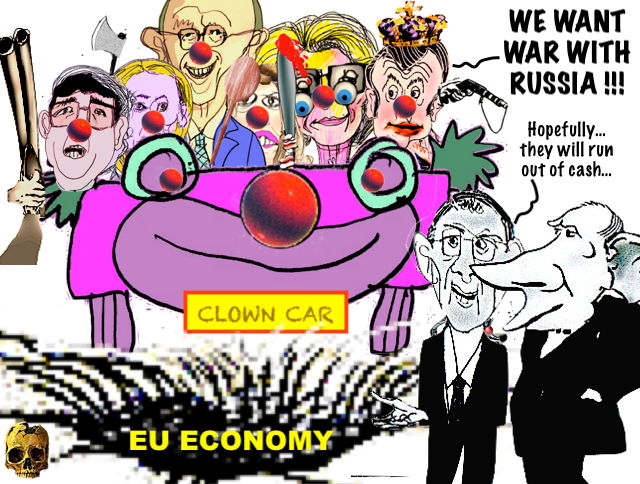
It was common practice during the Cold War to exaggerate the threat from the Soviet Union. Nowadays, Russia has assumed that role. Although the circumstances have changed, some of the political methods employed to create a sense of insecurity are still remarkably similar.
What does Europe want—a war with Russia?
Europe is not formally engaging in preparations for war since it desires one. Instead, the governments of Europe and the institutions of the EU describe their rapidly growing defence policies and war preparedness as being aimed at deterrence, on the basis that Europe has to become strong enough to avoid a bigger conflict.
NATO does likewise, presenting itself as a defensive alliance whose role is to deter aggression. Nevertheless, the extent and the terminology used in Europe’s present military transformation should be examined. If preparedness becomes a top political concern, if huge amounts of public money are channelled into defence
The question is especially relevant to the EU, which has throughout its history been based on reconciliation, economic interdependence and a rejection of war.
From a peace project to a defence project
Deterrence becomes a politically dangerous thing when preparedness itself comes to be the main idea of security, when military expenditure starts to compete with other public priorities, and when diplomacy and negotiation are regarded as being of less importance than the building up of military powerThe European Union is experiencing a deep change in the way it views security. This change is no illusion. As part of the ReArm Europe/Readiness 2030 programmethe European Commission plans to commit up to 800 billion euros towards defence spending, and the EU has set up a 150 billion euro SAFE lending facility to assist with military investment and joint procurement. The various EU institutions have made it clear that the aim is to eliminate capability gaps, boost the European defence industry and enhance deterrence.
The language that goes with this transformation is just as important. European Defence Commissioner Andrius Kubilius has warned at the European Parliament that Russia could be ready for a confrontation with NATO “in five years or less”. He has also invoked Jean Monnet’s wartime “Victory Programme” analogy, arguing that Europe needs a comparable transformation of its defence industry.
The official view of the Commission is that the issue is one of deterrence and not about starting a war. However, a military system which is intended to deter war needs to have weapons, logistical support, industrial capacity, troops and operational plans. As these capabilities increase, so too does the institutional ability to conduct war.
A paradox arises since Europe claims it is arming itself and preparing its hospitals to receive 2,000 wounds per day – as it is the case in Germany — in order to maintain peace while at the same time setting up a more and more integrated belligerent European defence structure. The EU is considering not just an increase in weapons but also the creation of a European Defence Union, a European Security Council, common procurement, military mobility and a closer relationship between European institutions and NATO.
The fact that this might constitute a necessary adaptation to a new security situation also brings up a more general issue concerning European identity: is the European Union still mainly a peace project which happens to have military capabilities, or is it instead becoming a geopolitical and military actor for which readiness for confrontation is becoming increasingly important?
Is Russia a threat, an adversary, or a permanent enemy?
Here, there is a mixture of perceived threats, old ressentiments and Russophobia in play. The threat perceptions are not the same throughout Europe. Because of historical reasons, such as foreign occupation and Soviet domination, Poland has long viewed Russia differently from countries such as France and Germany, which after the Cold War initially placed greater emphasis on economic engagement and interdependence with Moscow. But that distinction has changed dramatically.
Germany, in particular, has moved from the Ostpolitik-era logic of engagement towards a confrontational security posture. Under Chancellor Friedrich Merz, Berlin has described Russia as a serious threat, committed to a major expansion of defence spending, and taken a leading role in sustaining military support for Ukraine. Germany has also intensified defence cooperation with France, including discussions on nuclear deterrence and European capabilities. Germany has also established a permanent military presence in the Baltic States, with a brigade of around 5,000 soldiers being stationed in Lithuania.
The military buildup that Poland has since carried out has depended largely on the United States and South Korea, highlighting a further weakness: even though the EU has aimed at setting up a European defence industry, European manufacturers have not always been able to provide weapons at the speed and on the scale required by countries that have been rearming since 2022.
A more serious issue is that those who question the military escalation are seen as showing a lack of strength, a state of naivety or a failure to have sufficient solidarity with Europe — what then becomes of democratic debate? French Socialist Ségolène Royal.
The danger of making war readiness a political culture
That is exactly the reason why Europe’s present-day transformation should be subject to democratic scrutiny.
Deterrence becomes a politically dangerous thing when preparedness itself comes to be the main idea of security, when military expenditure starts to compete with other public priorities, and when diplomacy and negotiation are regarded as being of less importance than the building up of military power.
The proper European question therefore isn’t whether Europe is “strong enough” to fight Russia. It is rather what kind of security arrangement the Europeans would like to establish.
The present danger is that, as a result of years of confrontation, rearmament and politics based on the use of threats, Europe might slowly create a political and institutional setting in which war seems ever more certain and peace ever more unrealistic.
Former CIA analyst Larry Johnson says that a wider conflict between Europe and Russia is becoming “inevitable” since, in his opinion, the rhetoric of Europe is increasingly being matched by actions which Russia could see as direct threats. He highlights Germany as especially important, stating that Berlin’s more confrontational rhetoric, its military preparations and its demands on Moscow are leading to a dangerous escalation.
Johnson also sees the capture of Russian ships as a key point of escalation. He maintains that Moscow might view any attempt by Europe to seize its ships as an act of war and could then retaliate against the ships or military assets in question. He also mentions the collapse of diplomatic relations, the rearmament of European forces, preparations for a possible future confrontation, and the increasing pressure surrounding Kaliningrad as factors which reduce the room for de-escalation. In his view, the real danger is not that Russia is seeking war but that European actions are gradually making a direct confrontation inevitable.
https://journal-neo.su/2026/10/02/what-does-europe-want-a-war-with-russia/
MAKE A DEAL PRONTO BEFORE THE SHIT (WW3) HITS THE FAN:
NO NATO IN "UKRAINE" (WHAT'S LEFT OF IT)
THE DONBASS REPUBLICS ARE NOW BACK IN THE RUSSIAN FOLD — AS THEY USED TO BE PRIOR 1922. THE RUSSIANS WON'T ABANDON THESE AGAIN.
THESE WILL ALSO INCLUDE ODESSA, KHERSON AND KHARKIV.....
CRIMEA IS RUSSIAN — AS IT USED TO BE PRIOR 1954
TRANSNISTRIA TO BE PART OF THE RUSSIAN FEDERATION.
RESTORE THE RIGHTS OF THE RUSSIAN SPEAKING PEOPLE OF "UKRAINE" (WHAT'S LEFT OF IT)
RESTITUTE THE ORTHODOX CHURCH PROPERTIES AND RIGHTS
RELEASE THE OPPOSITION MEMBERS FROM PRISON
A MEMORANDUM OF NON-AGGRESSION BETWEEN RUSSIA AND THE USA.
A MEMORANDUM OF NON-AGGRESSION BETWEEN RUSSIA AND THE EU.....
EASY.
THE WEST KNOWS IT.
PLEASE VISIT:
YOURDEMOCRACY.NET RECORDS HISTORY AS IT SHOULD BE — NOT AS THE WESTERN MEDIA WRONGLY REPORTS IT — SINCE 2005.
Gus Leonisky
POLITICAL CARTOONIST SINCE 1951.
RABID ATHEIST.
WELCOME TO THIS INSANE WORLD….
- By Gus Leonisky at 5 Oct 2026 - 10:01am
- Gus Leonisky's blog
- Login or register to post comments
imperial trump....
With complicity of media and Democrats, Trump prepares major escalation of Iran war
BY Andre Damon
The events of the past week leave no doubt that the Trump administration, with the complicity of the entire US political establishment, is preparing a major escalation of the Iran war. Having failed to achieve its objectives through a massive bombardment and then a blockade of the country, the White House is preparing a new and desperate gambit, potentially involving the deployment of ground troops or even the use of nuclear weapons.
The greatest danger is the chasm between the scale of what is being prepared and the public’s awareness of it. One month before the 2026 midterm elections, Trump’s conspiracy to escalate the war is being greeted with a wall of silence by the US media—which devoted just minutes to the war in this weekend’s Sunday talk shows—and by the Democratic Party, which has done nothing to alert the public to the renewed onslaught against Iran that the administration is preparing.
On September 22, US President Donald Trump threatened in his speech before the United Nations to “annihilate the Islamic Republic, and do it quickly.” His threat followed a secret White House meeting, reported by the journalist Seymour Hersh on June 10, at which Trump spoke “about a nuclear option that could perhaps bring a quicker end to the war.”
These threats cannot be dismissed as bluster. Trump is the president of the United States and has already killed thousands of people in the months-long bombardment of Iran. The forces now converging on the Persian Gulf give him the means to carry out his threats. Nothing would be more dangerous than complacency.
After seven months of war, US imperialism has failed to achieve its aims of dominating the Strait of Hormuz, militarily defeating Iran and overthrowing its government. The administration is improvising, desperately seeking a way out of the political disaster the war has produced. But its improvisation is driven by the logic of events. American imperialism cannot accept defeat in the Persian Gulf, and each failure becomes the basis for an ever-greater escalation.
Last week, the Wall Street Journal and the Associated Press reported that the White House had sent a third aircraft carrier to the Middle East. The USS Theodore Roosevelt left San Diego on September 27, followed the next day by the amphibious assault ship USS Makin Island with about 2,200 Marines. They will join the carrier USS George Washington and more than 50,000 US troops deployed across the region.
Trump “has told aides he expects to resume bombing Iran after the November midterms,” the Journal reported September 25. He was briefed in August on options including “sending in ground forces to seize Iranian islands near Hormuz,” the Journal reported last month.
The deployment of amphibious assault ships along with thousands of Marines is particularly ominous. They are the means of seizing territory, and the next phase of the war may include landings on the islands near Hormuz, at the Kharg Island oil terminal or at Iran’s nuclear sites.
The administration’s top national security officials met Friday at Camp David, the presidential retreat, “to discuss next steps in the Iran war and the Saudi-Houthi conflict in Yemen,” Axios reported that night. The last similar meeting, Axios noted, was in June 2025, just days before Israel and then the United States attacked Iran. The new US military deployments targeting Iran parallels a renewed offensive by Saudi Arabia, supported by the United States, in Yemen.
The Pentagon confirmed Sunday that all US bombers at Britain’s Fairford air base, used for strikes on Iran, had been flown back to the United States. The withdrawal followed British Prime Minister Andy Burnham’s claim on September 30 that Iran “played a part” in an alleged plot against the base. The unproven allegation provides a ready-made pretext for escalation.
The war against Iran is part of a broader global offensive by US imperialism, centrally targeting Russia and China. Significantly, the plans to expand the Iran war accompany a sharp intensification of NATO’s war on Russia in Ukraine, which threatens at any moment to erupt into direct warfare between nuclear-armed states.
Each president since the 1979 Iranian revolution, Democratic and Republican, has worked to bring Iran back under American domination. Trump’s war against Iran is the latest stage of a 35-year offensive to subjugate the Middle East and Central Asia: the Gulf War of 1991, the invasions of Afghanistan and Iraq, the destruction of Libya, the proxy war in Syria and Israel’s genocide in Gaza.
Amid overwhelming popular opposition to the war and the ensuing surge in the cost of living, particularly of energy, the Democratic Party is expected to make significant gains on November 3. It is determined, however, to ensure that any electoral repudiation of Trump does not lead to a let-up in the drive by US imperialism in the Middle East.
https://www.wsws.org/en/articles/2026/10/05/vgaa-o05.html
READ FROM TOP.
PLEASE VISIT:
YOURDEMOCRACY.NET RECORDS HISTORY AS IT SHOULD BE — NOT AS THE WESTERN MEDIA WRONGLY REPORTS IT — SINCE 2005.
Gus Leonisky
POLITICAL CARTOONIST SINCE 1951.
RABID ATHEIST.
WELCOME TO THIS INSANE WORLD….
SEE ALSO:
the terrorist yoonited states and the murderous israhellies.....