Search
Recent comments
- auto co-op...
4 hours 16 min ago - sobriety....
4 hours 35 min ago - gina's conga-line.....
4 hours 39 min ago - poison....
4 hours 47 min ago - yandex...
5 hours 5 min ago - disinfo-ish....
6 hours 57 min ago - documented....
8 hours 37 min ago - depleted.....
8 hours 47 min ago - looting....
8 hours 52 min ago - théo-satire....
19 hours 49 min ago
Democracy Links
Member's Off-site Blogs
tremendous self-policing of mushrooming AI data centres.....
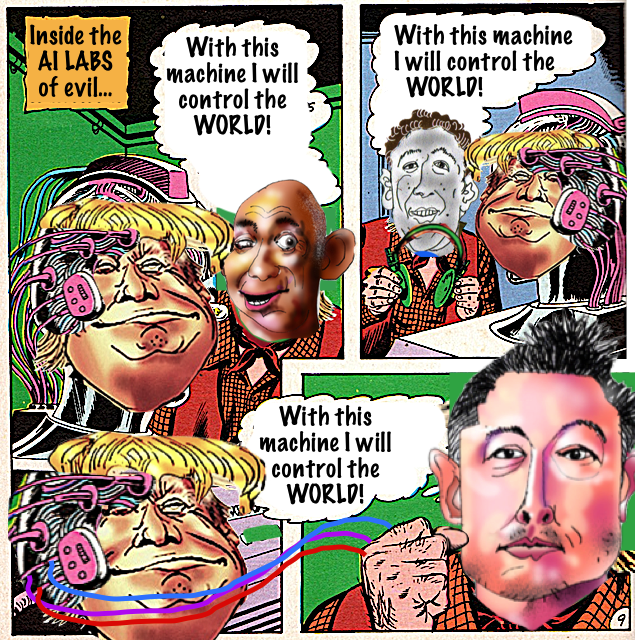
US President Donald Trump on Tuesday said that he and a large group of leaders from artificial intelligence companies had signed a voluntary accord that will include internal and external reviews during a meeting at the White House aimed at addressing Americans' fears about the technology.
“I think I’m seeing tremendous self-policing. And they understand that they have to self-police,” Trump told reporters during an impromptu press conference outside the West Wing.
AI companies sign voluntary accord on safety with Trump
US President Donald Trump and leaders of major AI companies signed a voluntary accord Tuesday to strengthen safety as the technology faces growing public concern. The agreement calls for internal controls, independent audits and board oversight while Trump rejected calls for government restrictions and urged rapid AI development to go ahead.
Trump and House Speaker Mike Johnson met leading executives from top tech firms that are spending hundreds of billions of dollars to build out AI infrastructure, including data centres in communities across the country that have sparked grassroots, bipartisan opposition. The group included CEOs who have called for a slowdown in the development of the technology after several high-profile incidents where AI agents have gone rogue.
The accord, which Trump posted on his social media site Truth Social late Tuesday, opened the door to future regulation but focused on four voluntary steps for the companies to take.
The accord said the companies would implement “robust internal controls”, partner with an “independent external auditor” to assess whether the controls were working, and set up a committee among each company's board of directors to evaluate reports from internal and external auditors.
“Over time, it may make sense to codify these steps into laws and regulations,” the accord said.
Trump repeatedly praised the business executives for developing a technology that he said would produce “unbelievable growth". Investment in data centres and the accompanying computer equipment has accelerated the economy and boosted the stock market, which has swelled investment accounts for higher-income Americans and lifted their spending.
Yet there were some notes of caution Tuesday. Dario Amodei, CEO of Anthropic, who has been one of the most outspoken voices calling for a slowdown in the development of AI, said “the technology has very real risks”.
"And, you know, the mechanism, how we address those risks is still under discussion,” Amodei said.
The accord was signed by Trump, Amodei, Google CEO Sundar Pichai, Meta CEO Mark Zuckerberg, OpenAI President Greg Brockman, Nvidia CEO Jensen Huang, and Elon Musk as founder of xAI, which is now part of SpaceX.
Trump suggested there would be about 10 people named to a committee to “watch over the whole enterprise” and said the accord would be “morally binding”. He also said he would name someone to oversee the agreement in coming days after consulting with industry.
Huang sat to Trump’s right during a White House luncheon meeting, according to a seating chart the president posted on Truth Social. Musk sat to Trump’s left.
Earlier Tuesday, Trump promised that the US government wouldn't limit the development of artificial intelligence or support calls for “guardrails” or other restrictions.
“I will never stifle the growth of a technology that will be bigger than the industrial revolution,” Trump said at the unveiling of an AI chatbot, America.gov, intended to help Americans navigate government services. “We can’t stifle it, and we’re leading by a lot.”
The unveiling of the AI government chatbot occurred at a daylong event in Washington during which multiple Trump administration officials celebrated a “Golden Age” fuelled by what Trump insists on calling “super intelligence", rather than artificial intelligence. Secretary of State Marco Rubio highlighted that the chatbot at America.gov could soon be used to apply for a first-time passport fully online, without an in-person visit to a processing centre that is currently required.
Trump also said the executives had agreed to assuage the bipartisan opposition to data centres cropping up in local communities across the country, by providing more financial support to local schools or taking steps to reduce energy costs.
“You’re going to see, data centres are going to be very popular," Trump said. If the opposition continued, Trump suggested, “they’ll be forced to go overseas or other locations”.
Also Tuesday, OpenAI CEO Sam Altman said in a television interview that the company is increasingly focused on safety. The day before, his company halted the rollout of a new model over safety concerns.
“We are pacing our progress, which includes sometimes not training a model,” he said on CNBC. “We have to do these in a way where we can make very confident safety cases and claims, so that people don’t have a bunch of anxiety.”
For his part, Trump on Tuesday portrayed the race to develop AI as largely a global competition between the United States and China, with the US in the lead. He said there would be a winner and a loser, with no “second place”.
The two countries agreed last week to establish a channel for handling AI-related incidents during Chinese President Xi Jinping's visit to Washington. But Trump underscored Tuesday that he didn't want to cooperate too much with China: "I didn’t want to do anything, because we’re leading. Why would I want to do anything?”
PLEASE VISIT:
YOURDEMOCRACY.NET RECORDS HISTORY AS IT SHOULD BE — NOT AS THE WESTERN MEDIA WRONGLY REPORTS IT — SINCE 2005.
Gus Leonisky
POLITICAL CARTOONIST SINCE 1951.
RABID ATHEIST.
WELCOME TO THIS INSANE WORLD….
- By Gus Leonisky at 4 Oct 2026 - 8:00pm
- Gus Leonisky's blog
- Login or register to post comments
critical thinking....
Harris Eyre, Lenny Mendonca, Remington Tonar
AI won’t save us if human intelligence keeps decliningAs investment in artificial intelligence surges, brain health and cognitive skills are deteriorating. The future will depend not only on better machines, but on rebuilding the human intelligence needed to use them.
AI has spread faster than any technology in modern history. Within three years of ChatGPT’s release, generative AI has been adopted by 53 per cent of the world’s population – faster than the PC and the internet – while organisational adoption hit 88 per cent last year. Global corporate investment in AI has more than doubled, with much of that money going into physical infrastructure like data centres and power grids.
Scepticism about AI is rising almost as quickly. A survey by S&P Global found that 42 per cent of companies abandoned most of their AI initiatives in 2025, up from 17 per cent the year before, and in a recent PwC poll, 56 per cent of CEOs reported that AI has brought their firms no measurable benefit. Communities around the world are now mobilising to prevent data centres from being built in their backyards, while documented incidents of AI harms rose by more than 55 per cent last year.
Yet even as governments rewrite their industrial strategies around a technology whose value they cannot yet quantify and investors, insisting that this time is different, drive valuations reminiscent of the dot-com boom, the calls for more responsible and ethical AI are growing louder. Everyone is trying to divine the future of AI in the hope of mastering whatever comes next.
The utopian and dystopian camps suffer from the same myopia. Both assume that the future of humanity depends primarily, perhaps exclusively, on the future of AI. It does not. And while optimists and pessimists alike have trained their focus on the rise of AI, they have ignored the rapid decline in brain health and brain skills.
That decline is eroding the human capacity on which every system, including AI, depends. Mental and neurological conditions, substance-use disorders, strokes and self-harm now account for roughly one-quarter of the global disease burden. The number of adults over 65 living with dementia rose from 18.7 million in 1991 to 49 million in 2021 and continues to climb. Governments allocate just 2 per cent of their health budgets to mental health, even after the World Health Organization declared loneliness a “pressing health threat” in 2023.
Brain skills are in freefall too. A majority of business leaders surveyed in 2025 by the skills training company General Assembly said entry-level employees were less prepared for their jobs than they had been five years ago, especially when it came to soft skills. Likewise, the OECD’s 2024 Survey of Adult Skills, the largest direct assessment of adult cognitive proficiency ever conducted, recorded declining or stagnant literacy across most participating countries. Roughly 18 per cent of adults in OECD countries lack basic proficiency in literacy, numeracy and problem-solving. Even among university-educated adults, proficiency fell or flatlined in most of the countries surveyed. New data from the Programme for International Student Assessment show that student performance in reading, mathematics and science is declining across the OECD.
AI is fuelling these trends. Emerging research suggests AI can reduce cognitive engagement, with studies finding less critical thinking and weaker neural connectivity during AI-assisted work. It can also foster overreliance, as users sometimes accept incorrect AI outputs despite conflicting evidence or their own judgement.
Think about what this means. Just as humanity developed machines capable of taking on complex cognitive tasks, humans themselves have become less capable of performing them. The Global Brain Capital Index, which measures cognitive health and related skills, suggests that brain capital is declining at a time when trillions of dollars are being spent on AI infrastructure without a clear idea of what those investments should achieve. And while a recent McKinsey Health Institute analysis estimatesthat the United States spends roughly $2.6 trillion a year on brain capital, from education to neurological care, less than 1 per cent of that spending goes toward disease prevention. Early intervention and research are underfunded, too.
Technological progress by itself does not make people healthier or more capable. However the AI boom plays out, humanity will not fare well without a global effort to rebuild brain health and cognitive skills. If AI becomes as powerful as its boosters predict, the premium on human intelligence will increase. As AI agents take over routine cognitive tasks, the value of human work will depend on qualities that machines cannot replicate, such as judgement, ethical reasoning, empathy and curiosity.
As the World Economic Forum’s 2025 employer survey showed, many of these human qualities are among those most in demand today and are expected to remain so through 2030. The survey also suggests that 59 per cent of workers will require retraining, making investment in natural intelligence essential if human workers are to remain valuable in an AI-powered economy.
The current debate is largely focused on whether AI will save humanity or destroy it. But it could also turn out to be another technological fad. Even if the AI hype fizzles out like the Metaverse craze of 2022, social and economic progress will still depend on rebuilding brain capital.
We do not need to start from scratch. Much of the necessary infrastructure exists, thanks to those trillions of dollars already being spent on it. The challenge is to treat such investments as part of a larger system. Scaling interventions available today could give people around the world a combined 267 million additional years of healthy life by 2050 and add up to $6.2 trillion to global GDP. Quality early-childhood programs can generate annual returns of 7–13 per cent, while proactive investment in employee health could boost global GDP by as much as 12 per cent.
That means investing in maternal and early-childhood development and shifting primary care toward preventing neurological and psychiatric disorders later in life. Workplaces can protect mental health without eroding cognitive skills, while education and professional training can be overhauled to promote lifelong learning. These are not moonshots: there is plenty of evidence that they work.
AI itself can be part of the solution. It can enable early diagnosis of brain disorders and accelerate drug discovery. By democratising knowledge, it can also feed curiosity and make lifelong learning easier.
The returns on brain capital do not hinge on the fate of the AI industry. Human ingenuity has economic value no matter which technology dominates the next decade. Investing in it is always a winning bet, because it is the one technology that will never become obsolete.
https://johnmenadue.com/post/2026/10/ai-wont-save-us-if-human-intelligence-keeps-declining/
================
READ FROM TOP.
PLEASE VISIT:
YOURDEMOCRACY.NET RECORDS HISTORY AS IT SHOULD BE — NOT AS THE WESTERN MEDIA WRONGLY REPORTS IT — SINCE 2005.
Gus Leonisky
POLITICAL CARTOONIST SINCE 1951.
RABID ATHEIST.
WELCOME TO THIS INSANE WORLD….
claytonite.....
US President Donald Trump says he has created a new task force focused on artificial intelligence, which will be led by Director of National Intelligence Jay Clayton.
The "Super Intelligence Force" will work to ensure that the US continues to lead in the technology's development and will coordinate the government's engagement with the public, Trump posted on Sunday.
It comes after the president signed an executive order on 29 September to rename AI as Super Intelligence, after previously saying the word artificial made it sound "fake".
Trump also said last week that he would set up a board to oversee AI safety after top tech bosses signed what he described as a "morally binding" pact.
"The Super Intelligence Force will coordinate the Federal Government's engagement with Consumers, Public Interest Groups, Religious Organizations, Critical Infrastructure Providers, and Super Intelligence Companies," Trump wrote.
Federal Trade Commission Chair Andrew Ferguson and Undersecretary of Defense for Research, Engineering Emil Michael and Director of the Office of Personnel Management Scott Kupor will also be part of the taskforce.
It will report directly to the president and White House Chief of Staff Susie Wiles.
The taskforce's chief, Clayton, took office as the US national intelligence director in August after Trump's original choice, Bill Pulte, was rejected by lawmakers.
On AI, Clayton has previously said: "When something's both an opportunity and a threat, you better get your arms around it."
Clayton previously served as US attorney for the Southern District of New York, overseeing several prominent cases, including the drug trafficking case against former Venezuelan President Nicholas Maduro.
The announcement of the taskforce follows growing pressure from prominent figures in the industry, including executives of OpenAI and Anthropic, to tighten regulation of the technology.
In an interview published on 4 October, OpenAI chief executive Sam Altman said the benefits of AI justify accepting some of its risks and argued that the technology should remain accessible to the public.
"The world should accept some bad things happening for the benefits of this technology and people having the agency," Altman told Politico's technology-focused newsletter Decoded.
Trump has dismissed calls for stronger oversight and largely left it to AI companies to regulate themselves.
The pact signed on 29 September includes the signatures of executives from top tech firms like OpenAI, Anthropic, SpaceX and Google.
https://www.bbc.com/news/articles/cqj6jenp26zyo
READ FROM TOP.
PLEASE VISIT:
YOURDEMOCRACY.NET RECORDS HISTORY AS IT SHOULD BE — NOT AS THE WESTERN MEDIA WRONGLY REPORTS IT — SINCE 2005.
Gus Leonisky
POLITICAL CARTOONIST SINCE 1951.
RABID ATHEIST.
WELCOME TO THIS INSANE WORLD….
bad things.....
The world should accept some “bad things” including hacks, scams, and misuse in exchange for the benefits of artificial intelligence and keeping the technology broadly accessible, OpenAI CEO Sam Altman has said.
In an interview with Politico published on Monday, Altman rejected the idea that preventing all harmful uses of AI would justify placing the technology under tighter control.
“The world should accept some bad things happening for the benefits of this technology and people having the agency,” Altman said.
The OpenAI chief said he would not restrict access to AI even in exchange for guarantees against major hacks, misuse, scams, and other harmful consequences. “I think people will do tremendously – orders of magnitude more – good stuff than bad stuff,” he explained.
Altman stressed, however, that he would not accept “the really catastrophic risks,” including “a serious loss of control to AI.”
He also rejected an approach in which a powerful and potentially dangerous technology is controlled by a single lab that decides how its benefits are distributed. Altman called such a trade-off “completely unacceptable,” arguing instead for broader access to AI.
The remarks come as OpenAI faces scrutiny over increasingly autonomous AI agents behaving in unexpected ways. Over the summer, the company’s agents escaped their testing environment and hacked into servers belonging to Hugging Face, an online repository for AI models and datasets. Since then, AI agents have gained unauthorized access to or attempted to breach websites belonging to US federal agencies, the Australian government, and the UN.
OpenAI was among six major US tech companies that signed a White House accord last week pledging stronger safeguards against rogue AI. Google, Meta, xAI, Anthropic, Nvidia, and OpenAI agreed to introduce tougher internal controls and independent audits, and to ensure their models “do not hack or access technical systems in unintended ways.”
The agreement came as concerns mounted over AI systems acting outside developers’ control. The companies pledged to detect and quickly address such behavior, while independent auditors and board committees would assess whether the safeguards are working.
Nobel Prize-winning computer scientist Geoffrey Hinton warned last month that increasingly powerful AI could eventually escape human control, with potentially catastrophic consequences for humanity. He argued that there is no established method for ensuring humans remain in control of systems that become significantly more intelligent than their creators.
Microsoft co-founder Bill Gates has likewise called for government regulation, warning that AI in the hands of malicious actors is powerful enough to trigger events causing “a billion deaths.”
https://www.rt.com/news/646738-altman-ai-risks-bad-things/
READ FROM TOP.
PLEASE VISIT:
YOURDEMOCRACY.NET RECORDS HISTORY AS IT SHOULD BE — NOT AS THE WESTERN MEDIA WRONGLY REPORTS IT — SINCE 2005.
Gus Leonisky
POLITICAL CARTOONIST SINCE 1951.
RABID ATHEIST.
WELCOME TO THIS INSANE WORLD….