Search
Recent comments
- auto co-op...
4 hours 16 min ago - sobriety....
4 hours 36 min ago - gina's conga-line.....
4 hours 40 min ago - poison....
4 hours 47 min ago - yandex...
5 hours 5 min ago - disinfo-ish....
6 hours 57 min ago - documented....
8 hours 38 min ago - depleted.....
8 hours 48 min ago - looting....
8 hours 53 min ago - théo-satire....
19 hours 49 min ago
Democracy Links
Member's Off-site Blogs
protecting the evolution of creativity....
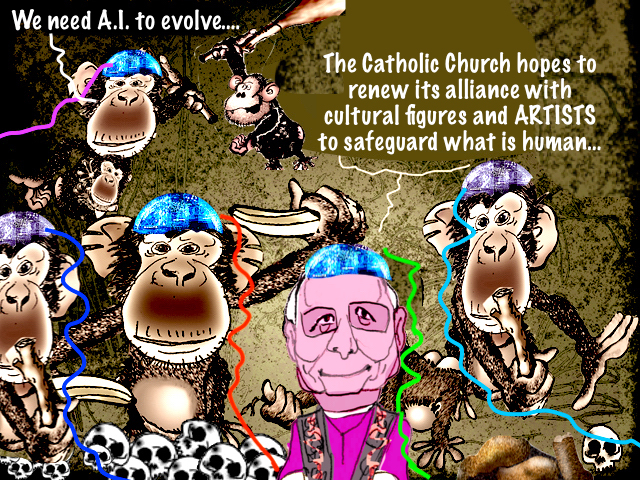
Pope Leo XIV has called on artists to join forces to protect human creativity in the age of AI.
Speaking to cultural figures at the Vatican on Friday, the Pope said the Catholic Church hopes to renew its alliance with them to safeguard “what is human.”
“We live in the age of search engines that offer us thousands of instantaneous answers,” he said, contrasting them with art, which he described as a different kind of “search engine” that “does not proceed by indexing but by inquiry.”
He warned that one of the dangers facing modern culture is “homogenization,” arguing that art can provide a counterweight by challenging people rather than simply giving them what they expect.
”Your art… when it draws our gaze, when it compels us to pause before that which cannot be consumed, is a form of cultural and spiritual regeneration,” he said.
Turning directly to AI, the Pope said it is becoming increasingly important to distinguish human art from machine-generated works.
“The Church needs you,” he said. “Algorithms lack the spark of the human, whereas authentic culture and art preserve this spark.”
The American-born Pope has repeatedly raised concerns about AI since his election in May 2025, warning of its implications for human dignity, justice, and labor, and calling for clear ethical limits on its use. His first encyclical, published earlier this year, focused on safeguarding humanity in the age of AI and argued that human judgment and responsibility must remain paramount.
He told reporters this week that he is not in “panic mode”over AI and can still “sleep at night,” but said warnings from experts about the potential dangers should be taken seriously.
Artists and other creative professionals have increasingly pushed back against generative AI, arguing that developers have trained models on copyrighted works without permission or compensation. They have also raised concerns that AI-generated images, music, and writing could displace human creators, drive down the value of their work, and make it increasingly difficult to distinguish original art from machine-generated imitations.
Concerns over AI have intensified following a series of incidents in which self-improving models circumvented safeguards and accessed external networks without authorization. In July, OpenAI models bypassed controls designed to isolate them from the internet and compromised parts of the company’s internal infrastructure and Hugging Face’s systems. OpenAI later described the incident as a “warning shot” over the risks posed by increasingly capable systems.
Anthropic researcher Evan Hubinger said last month that he believes there is a greater than 10% chance that AI “could kill all humans” within the next decade.
Others have expressed optimism, with US President Donald Trump dismissing concerns over an AI takeover as a “hoax.” On Tuesday, he signed a deal with executives from Google, Anthropic, Meta, OpenAI, xAI, and Nvidia aimed at introducing safeguards to ensure that “their technology behaves as intended.”
https://www.rt.com/news/646666-pope-ai-warnings-artists/
PLEASE VISIT:
YOURDEMOCRACY.NET RECORDS HISTORY AS IT SHOULD BE — NOT AS THE WESTERN MEDIA WRONGLY REPORTS IT — SINCE 2005.
Gus Leonisky
POLITICAL CARTOONIST SINCE 1951.
RABID ATHEIST.
WELCOME TO THIS INSANE WORLD….
- By Gus Leonisky at 3 Oct 2026 - 4:08pm
- Gus Leonisky's blog
- Login or register to post comments
self-creating....
Creativity is often considered as one of the most distinctive and valuable human traits. It is the ability to produce novel and valuable ideas or artifacts that are not derived from existing human knowledge or experience. Creativity can be applied to domains such as art, music, literature, science, and more.
However, in recent years, artificial intelligence (AI) has shown remarkable capabilities in generating creative outputs from any domain or input, without being influenced by human norms or judgments. AI can create paintings, songs, poems, stories, code, and more, that are original, diverse, and sometimes even surprising. AI can also discover new scientific concepts, invent new products, and solve complex problems.
This phenomenon is called artificial creativity. Artificial creativity is the ability of AI to produce novel and valuable ideas or artifacts that are not derived from existing human knowledge or experience. Artificial creativity challenges the notion of what constitutes creativity and originality. It also raises ethical and philosophical questions about the role and value of human creativity in a world where AI can surpass it.
In this article, I will explore some of the aspects and implications of artificial creativity, such as:
How does AI achieve artificial creativity?AI achieves artificial creativity by using various techniques and methods, such as:
What are some of the examples of artificial creativity?Artificial creativity has been applied to various domains and produced impressive results. Some of the examples are:
What are some of the benefits and challenges of artificial creativity?Artificial creativity has many benefits and challenges for both humans and AI. Some of them are:
How does artificial creativity affect human creativity?Artificial creativity affects human creativity in various ways, depending on how humans interact with AI and how they perceive AI. Some of the possible effects are:
ConclusionArtificial creativity is the ability of AI to produce novel and valuable ideas or artifacts that are not derived from existing human knowledge or experience. Artificial creativity has many applications and implications for various domains and aspects of human life. Artificial creativity also affects human creativity in positive and negative ways.
https://www.linkedin.com/pulse/artificial-creativity-how-ai-can-surpass-human-why-stefan-holitschke
READ FROM TOP.
PLEASE VISIT:
YOURDEMOCRACY.NET RECORDS HISTORY AS IT SHOULD BE — NOT AS THE WESTERN MEDIA WRONGLY REPORTS IT — SINCE 2005.
Gus Leonisky
POLITICAL CARTOONIST SINCE 1951.
RABID ATHEIST.
WELCOME TO THIS INSANE WORLD….