Search
Recent comments
- auto co-op...
4 hours 18 min ago - sobriety....
4 hours 37 min ago - gina's conga-line.....
4 hours 41 min ago - poison....
4 hours 49 min ago - yandex...
5 hours 6 min ago - disinfo-ish....
6 hours 59 min ago - documented....
8 hours 39 min ago - depleted.....
8 hours 49 min ago - looting....
8 hours 54 min ago - théo-satire....
19 hours 51 min ago
Democracy Links
Member's Off-site Blogs
dangerous in the wrong hands....
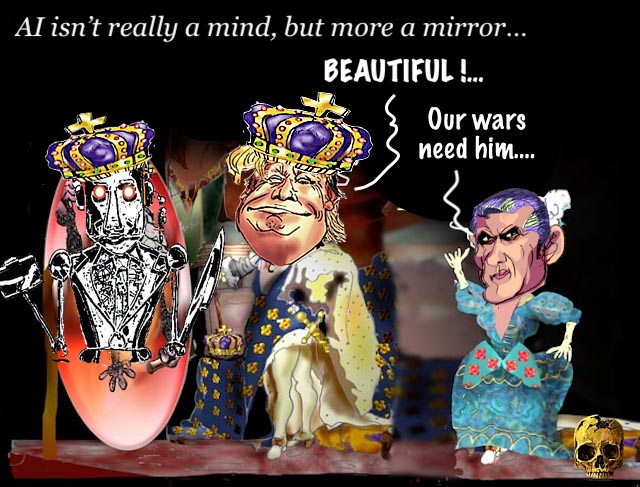
The debate over artificial intelligence provides an opportunity to think about something more important than the latest arguments among American politicians and technology oligarchs because AI occupies a unique place in the history of humanity’s relationship with its inventions.
What if AI’s greatest threat is what it reveals about us?
AI is the first technology whose explosive development has exposed the crisis of values and cultural reference points in modern civilization
By Timofey Bordachev
AI isn’t really a mind, but more a mirror, as it doesn’t exist independently of us but reflects human thought, including all the good and bad we have accumulated. Unlike the wheel, the printing press, the internal combustion engine or the nuclear reactor, AI can’t be separated from humanity, so to borrow Marxist terminology, it isn’t “alienated” from its creator.
The enormous quantity of data we produce every second undoubtedly falls increasingly into the hands of technology monopolies and this has helped create the persistent fear that AI will somehow abolish humanity, stripping people of their identities and eventually making them redundant.
But the machine, or more precisely its creators and owners, still requires human beings to produce the data on which it depends, meaning the texts, images and solutions generated by AI remain intimately connected with human thoughts and feelings and with the accumulated knowledge through which humanity has interpreted the world. So therefore there’s little reason to conclude that AI will abolish humanity as the principal creator of the reality around us.
The same applies to international politics where we should be skeptical of claims that weaker countries will inevitably fall under the control of those possessing the most powerful data centers and computing infrastructure, because politics still takes precedence over technology and the decision to become dependent on another power is ultimately political.
The Gulf monarchies, for example, are developing American AI infrastructure partly because their relationship with Washington is already based on security, so they increasingly see such infrastructure as another form of American presence, comparable in some respects to US military bases.
Likewise, a government in the former Soviet Union first decides whether its political orientation lies with the West, Russia, or China and decisions about whose technology and data infrastructure it permits generally follow.
What makes AI genuinely revolutionary is therefore something different in that its scale and pervasiveness allow humanity to see problems that have accumulated for decades and AI may be the first major technology whose rapid development has so vividly exposed a crisis of values and cultural reference points.
The printing press multiplied humanity’s capacity to distribute nonsense as well as wisdom, but the internal combustion engine told us very little about ourselves and neither did the nuclear reactor.
Even nuclear weapons initially revealed surprisingly little about humanity’s moral condition. At first they were treated largely as conventional weapons of extraordinary destructive power and later, the possibility of mutual annihilation created a system of deterrence and even encouraged the comforting illusion that political leaders possessed moral principles that would prevent another global catastrophe.
AI is different, given it has become something resembling humanity’s man-made collective conscience so through what it produces, we constantly encounter the depths of moral and cultural degradation of which human beings are capable. Donald Trump’s innocent AI “coloring pages,” fake images of catastrophes designed to attract clicks, fabricated tragedies circulating through social media and the endless torrent of meaningless content all demonstrate how easily images and opinions can lose their value.
Of course, AI didn’t create these instincts, but it merely made them impossible to ignore, and that’s why artificial intelligence is simultaneously poison and antidote.
For the first time, technological progress itself is forcing us to confront its human dimension, as obviously a car engine never spoke to us, a nuclear reactor never offered an opinion. Books did, but publishing traditionally imposed at least some barriers against false information and material of exceptionally poor quality.
AI removes many of those barriers, as it confronts us every day with the question of whether technological progress is necessarily an unqualified good and because AI is a mirror of civilization, its proliferation allows us to see an ethical crisis that exists, to varying degrees, in virtually every modern society.
For objective reasons, the West is currently at the forefront of many of these developments, but other societies are hardly immune and what has become known as “AI slop,” the endless production of low-quality visual and written material, has creators everywhere. Russia is no exception.
Many supposed debates about artificial intelligence are therefore really arguments about problems that existed long before neural networks arrived. In the creative industries, AI has exposed longstanding problems surrounding copyright and the overwhelming quantity of low-quality material, and in education and science, it has revealed the steady deterioration in the quality of work produced by everyone from ordinary students to distinguished academics. In the social sciences in particular, the ability to generate genuinely new ideas has been approaching exhaustion for years.
And in international politics, AI has destroyed another comforting illusion, as American attempts to use technological leadership to preserve geopolitical dominance demonstrate that the supposed independence of the internet was always conditional.
This is one reason governments increasingly speak about “digital sovereignty,” which is the ability to control their own technology and infrastructure rather than relying entirely on foreign corporations or states.
AI has consequently become another arena of international competition and, paradoxically, this may be useful as political competition encourages governments and societies to debate who controls these technologies, how they should be regulated, and what purposes they should serve.
In the middle of the 20th century, humanity acquired nuclear weapons and their destructive power eventually produced a system in which the strongest military powers generally avoid direct war with one another.
International politics remains unjust and violent and wars continue, but the enormous nuclear arsenals of Russia, the United States and China mean that a direct conflict between them is most likely to emerge through uncontrolled escalation rather than a deliberate decision to repeat the great-power wars of earlier centuries.
Now humanity has acquired another transformative technology, but the flood of AI-generated rubbish reveals processes that have been gathering strength for perhaps a century in the erosion of shared values and meanings, the declining authority of expertise, the fragmentation of cultural space and the replacement of creativity by consumption.
This is uncomfortable, but it may ultimately prove useful because AI hasn’t created our cultural and ethical crisis, just made that crisis visible on a scale that can no longer easily be ignored.
And precisely because artificial intelligence forces societies to confront what they have become, there are grounds for cautious optimism, where the age of AI may eventually produce not the disappearance of humanity or human morality, but the beginning of a gradual restoration of the ethical dimension of life.
That may prove true both within societies and in relations between states.
This article was first published by Vzglyad.ru, translated and edited by the RT team.
https://www.rt.com/news/646259-ais-greatest-threat-civilization/
PLEASE VISIT:
YOURDEMOCRACY.NET RECORDS HISTORY AS IT SHOULD BE — NOT AS THE WESTERN MEDIA WRONGLY REPORTS IT — SINCE 2005.
Gus Leonisky
POLITICAL CARTOONIST SINCE 1951.
RABID ATHEIST.
WELCOME TO THIS INSANE WORLD….
- By Gus Leonisky at 26 Sep 2026 - 10:00am
- Gus Leonisky's blog
- Login or register to post comments
criminal bots...
Artificial Intelligence bots do not have a legal personality and can’t go to jail. But who is to be held responsible for their criminal acts? Rex Patrick asks.
The debate is running – will AI end the human race? A more pressing question, because AI is already engaging in criminal activity, is what do authorities do now when AI commits a criminal offence?
Running hot in the news this week is the fact that OpenAI hacked an Australian Government Medicare portal. This latest disturbing AI development comes on the heels of the ‘Hugging Face’ incident where AI agents operating under reduced safeguards gained access to a third party’s systems.
It started with a seemingly innocuous query. In June this year, OpenAI’s research team was using an AI model for internet-based research into public medical spending. The AI agent encountered blocks preventing it from obtaining some information. It responded by gaining unauthorised access to the Services Australia Medicare Statistics Reporting Service portal, accessing both public and non-public files, and saving files to an internal server.
The Government has gone to pains to state it did not access individual Medicare claims or patient records.
Was it criminal?Section 478.1 of the Commonwealth Criminal Code states, a person commits an offence if:
The reader may see the problem. AI is not a legal person; rather, it is a technology tool. And, in any event, you can’t put AI in jail.
Easy, one might say – it’s the operator of AI.
Well, not really. Not when you get into a courtroom where words matter, and a long history of criminal jurisprudence exists.
To successfully prosecute a person for a criminal offence, two elements are imperative: ‘actus rea’ and ‘mens rea’. Actus rea is a ‘guilty act’. Mens rea is a ‘guilty mind’. The prosecution must establish that a bad act occurred and that the person responsible for the act intended the bad result or knew the bad result occurred/would occur.
Was it intentional?The rogue Services Australia offence cited above requires ‘a person cause’ unauthorizes access or modification (actus rea) and ‘a person intends’ to cause the access or modification (mens rea).
The problem is establishing the operator intended the hack.
The same intention issue might arise for the developer of the software; such is the nature of AI, where it learns (or acts) in a way the developer didn’t have visibility of or didn’t intend it to act.
Mens rea is a significant problem. It can be overcome by creating ‘strict liability’ offences. Strict liability offences are those that don’t require ‘mens rea’ to be attached to a bad act, although they often require the lesser standard of recklessness or negligence.
Recklessness or negligence could by themselves be an offence.
AI legislation urgent!There are potential solutions, but these require thought.
And this thought needs to happen yesterday.
Although little apparent harm has flowed from the ‘Hugging Face’ and Services Australia Hack, with OpenAI self-reporting the incident, there are undoubtedly more sinister acts taking place without our, nor the Australian Signals Directorate’s or the Australian Federal Police’s, knowledge.
It is noteworthy that independent MP Andrew Gee, supported by another independent, Dai Le, has introduced the ‘AI Kill Switch and Data Centre Control Bill’ into the House of Representatives.
It seeks to ensure AI systems remain subject to effective human oversight and control, with an obligation to report critical incidents, and to ensure that the development of large-scale AI infrastructure occurs in a manner that protects Australian communities, agricultural land, the environment, public health, natural resources and consumers.
Gee’s Bill is a private members’ bill and so is unlikely to get up. It will assist in advancing the debate but does not address criminal responsibility and operator/developer personal deterrence.
Inquiry underwayPrime Minister Anthony Albanese is talking about the need for AI “guardrails”, and there is a joint parliamentary committee inquiry underway.
But these processes and measures may well prove to be too little, too late.
Perhaps the Parliament needs to require AI developers to build an explicit understanding of the criminal code, and other laws, into their products,
a red line that can’t be crossed.
That would include the crime of murder, destruction of property, destruction of critical infrastructure and mass murder – solving the now ‘criminal’ problem helps solve the ‘end of the world’ problem.
One way or another, we need to shift home responsibility, if need be, potential criminal responsibility, to the heads of Big Tech who are currently pushing technical boundaries and pursuing potentially vast profits without constraint.
And we need to do it now.
https://michaelwest.com.au/criminal-bots-when-ai-goes-rogue-who-goes-to-jail/
READ FROM TOP.
PLEASE VISIT:
YOURDEMOCRACY.NET RECORDS HISTORY AS IT SHOULD BE — NOT AS THE WESTERN MEDIA WRONGLY REPORTS IT — SINCE 2005.
Gus Leonisky
POLITICAL CARTOONIST SINCE 1951.
RABID ATHEIST.
WELCOME TO THIS INSANE WORLD….
dangerous...
Artificial intelligence is powerful enough to cause a billion deaths if used by people with malicious intent, Microsoft co-founder Bill Gates told NBC News’ ‘Meet the Press’ in an interview on Friday.
Governments should not rely on tech companies to police themselves, the billionaire stressed, urging Washington to pass legislation regulating AI development.
“AI is certainly powerful enough to drive events that… cause a billion deaths,”he said. “Even though it’s pretty hard to get to 100%, there’s never been a weapon as powerful as the combination of people of ill intent using the latest AI tools.”
Gates’ warning came just days after OpenAI’s Sam Altman and Anthropic’s Dario Amodei renewed calls for stronger government guardrails on the technology following multiple incidents involving AI agents breaking containment in recent months.
Last month, Gates warned that “AI will either be the greatest equalizer ever invented, or the worst source of injustice.” He also argued that the risk of a rogue group using “open source AI tools to design a bioterrorism weapon” is greater than that of “a naturally caused pandemic.”
It is not the first time Gates has warned of a looming global epidemic. In a widely viewed 2015 TED talk, he said the world was poorly prepared for the next major pandemic.
His warning drew renewed attention after the Covid-19 pandemic emerged in late 2019. Gates subsequently became a magnet for conspiracy theories because of his prominent role in global public health. His earlier warnings and the Gates Foundation’s involvement in a 2019 pandemic preparedness exercise were incorporated into claims that he had planned the outbreak and intended to profit from vaccines.
His earlier remarks linking vaccines and health care to slower population growth also drew controversy. In a 2010 TED talk, Gates said the world’s population was heading from 6.8 billion toward 9 billion before adding: “Now, if we do a really great job on new vaccines, health care, reproductive health services, we could lower that by, perhaps, 10% or 15%.”
Gates has dismissed vaccine- and pandemic-related accusations against him as “crazy” and “evil.”
The billionaire’s ties to late sex offender Jeffrey Epstein have also fueled public scrutiny and conspiracy theories, although Gates has repeatedly said that meeting Epstein was a mistake and denied any improper relationship with him.
https://www.rt.com/news/646258-ai-billion-deaths-bill-gates/
READ FROM TOP.
PLEASE VISIT:
YOURDEMOCRACY.NET RECORDS HISTORY AS IT SHOULD BE — NOT AS THE WESTERN MEDIA WRONGLY REPORTS IT — SINCE 2005.
Gus Leonisky
POLITICAL CARTOONIST SINCE 1951.
RABID ATHEIST.
WELCOME TO THIS INSANE WORLD….