Search
Recent comments
- auto co-op...
4 hours 18 min ago - sobriety....
4 hours 38 min ago - gina's conga-line.....
4 hours 41 min ago - poison....
4 hours 49 min ago - yandex...
5 hours 7 min ago - disinfo-ish....
6 hours 59 min ago - documented....
8 hours 39 min ago - depleted.....
8 hours 49 min ago - looting....
8 hours 55 min ago - théo-satire....
19 hours 51 min ago
Democracy Links
Member's Off-site Blogs
cave dwellers: clowns in the housing market.....
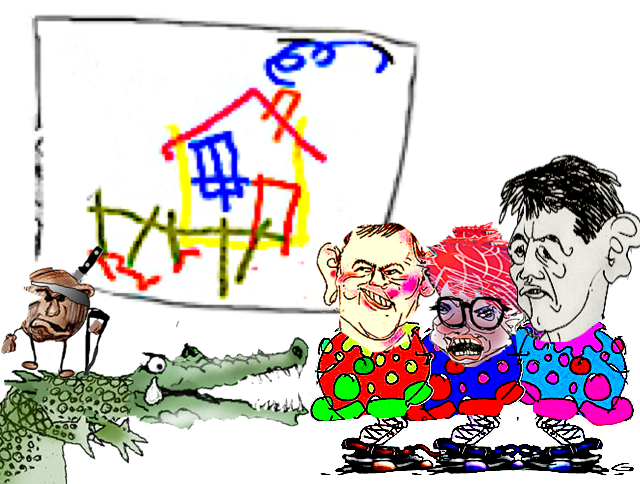
The great housing debate is on again and as ill-informed as ever. But which politicians are telling the most lies? Michael Pascoe can’t decide because they are all on full Pinocchio-mode.
Whether it is Anthony Albanese’s rampant hypocrisy, Andrew Bragg’s wilful misinformation (I doubt he’s actually as stupid as he pretends), Pauline Hanson’s fantasy non-policy, Chris Minns’ laid-on-with-a-shovel mix of spin and lies, it’s very hard to decide who is the worst on housing, as they are all betraying the nation.
And they’re all good at creating a distraction from the fundamental problem, aided and abetted by the mainstream media.
Exhibit A: The current argy-bargy about access to superannuation for one housing-related reason or another. Gets attention. Grabs headlines. Never mind that it means stuff all.
Bragg, shadow minister for housing and bashing industry super, had pretty much disappeared after the election until his housing standards/superannuation access breakout last month.
Hanson had no housing policy – and arguably still doesn’t – until floating a particularly half-baked super access thought bubble and doubling down on Albanese’s mother supposedly luxuriating in pubic housing.
And then there’s the media’s preoccupation with the worst real estate calamity since the Great Fire of London that has average
Australian house prices crashing
down to, um, a bit more than they were a year ago, off 3.6% from their nose-bleed territory record high.
“The market will fix it”Once more for anyone who hasn’t been paying attention: housing is the core of the “cost of living” crisis. None of the potential parties of government wants to solve the problem. All hope to muddle through with platitudes. None cares about the million Australians who are collateral damage from three decades of failed and failing policy based on “the market” solving the problem that “the market” created.
And the vast majority of media coverage is no better, ignoring the elephant in the substandard, overpriced, taxpayer-subsidised private rental.
Fiddle with landlords’ tax advantages and Australia’s headline writers unite to unleash the biggest media campaign since the Khemlani affair to take down the Whitlam government.
Suggest the only serious solution to the crisis must include doubling the proportion of social housing … and crickets.
Quick example from the AFR’s grandly titled two-day Property Summit two weeks ago:
Some interesting opinions emerged – Scentre Group CEO Elliott Rusanow “made a point that’s been largely forgotten in the drama of the house price correction: we all demanded bold action from the federal government on housing affordability, and appear to have been plunged into a ‘massive panic’ now that it’s arrived” – but from the coverage ($), not a single mention of that elephant.
Minns’ missing diggingsYet there was one; it just went unreported. The final speaker on the final day – the dog shift – was Rob Stokes, former NSW Liberal Government Planning Minister and now community housing worker as Anglicare’s housing chief advocacy officer and group executive.
Stokes knows the reality of our social (public and community) housing shortfall, the market failure. He knows governments of all stripes and levels, including his, are to blame. For those who stayed till the death at the summit, he had a sharp dose of reality on NSW policy:
The Minns government came to power three years ago on a promise that 30% of housing built on government land would be set aside for affordable and social housing. That’s now down to just three per cent across the government’s big Woollahra proposal, and that three per cent will be “affordable”, not social, i.e. it will be rented at a discount to very high rent, meaning it will still be high and thus unaffordable for most people.
Minns has form saying one thing and doing another.
“In the new Bays West precinct, what began as a promise to commit 30% of all new homes on surplus public land to affordable housing has dropped to 10%. A pledge of up to 15% affordable in new density zones around public transport has, in some cases, dropped to 3,” the SMH reported ($) in June.
Heading towards an election in six months, the Minns mob is distinguishing itself with announcements and spin attempting to paper over failures and lies. They are not alone in using the “affordable” tag to brush over NSW’s social housing disaster.
The shame fileThe shame file that is the Productivity Commission’s report on government housing services shows that the number of public and community dwellings in NSW fell by 4,530 in the Minns government’s first two years.
Never let facts get in the way of Minns spin, his PR department came up with selective numbers to create a different impression: “the largest increase in government-built public, community and affordable homes in a decade”. Funnily enough, the relevant flak didn’t get back to me when pressed for further detail.
Minns claims he will deliver 8,400 new public homes over five years. It is not at all clear if that is a net or gross figure, given NSW’s habit of flogging off existing public housing.
Even if it’s net, it’s still bugger-all given that 17,465 public dwellings were lost in the decade to June 2025, while population surged.
Albo, Bragg and HansonThen there’s I-grew-up-in-public-housing-and-I’m-proud-of- it Albanese.
The Federal Government’s entire social housing program boils down to, at best, maintaining the present disastrous status quo, not increasing the proportion of social housing. As previously opined here, Albo’s log cabin story is all very nice; too bad most kids now don’t have the same opportunity.
That Albo & Co wrap themselves in the social housing flag but are not doing anything to improve the situation earns the hypocrisy award. The status quo, obviously, isn’t an improvement. Focusing on first home buyers with the CGT and negative gearing changes might
fool some younger voters for a while but doesn’t treat the underlying disease.
Then there’s Bragg with no social housing policy beyond the modern Liberal Party’s distaste for anything to do with “housing”.
On ABC 730 this week, he steadfastly refused to answer Sarah Ferguson’s inevitable question about super access, greater borrowing power, pushing up prices, the very thing he had correctly accused Labor of doing with its 5% deposit scheme.
According to Senator Bragg, private investors, the market, will solve everything. They’ve done such a good job to this point. He flags that there will be a million renting retirees down the track and offers a policy that would make no difference to that figure.
Please explainedAnd then there’s One Hanson. Oh spare me. She really has NFI beyond whatever populist balloon she’s just been fed.
Her super access plan is worse than Bragg’s. Her attack on the late Mrs Albanese for being a long-term public housing tenant showed she has zero knowledge of the plight of genuine battlers.
There could be no better example of the gulf between the real world being in Gina Rinehart’s orbit than the idea that public housing should only be for short-term accommodation.
A pox on all their houses and the lacklustre commentariat that lets them get away with it.
https://michaelwest.com.au/lies-damned-lies-and-pollies-talking-about-housing/
PLEASE VISIT:
YOURDEMOCRACY.NET RECORDS HISTORY AS IT SHOULD BE — NOT AS THE WESTERN MEDIA WRONGLY REPORTS IT — SINCE 2005.
Gus Leonisky
POLITICAL CARTOONIST SINCE 1951.
RABID ATHEIST.
WELCOME TO THIS INSANE WORLD….
- By Gus Leonisky at 26 Sep 2026 - 8:55am
- Gus Leonisky's blog
- Login or register to post comments
sale....
A family of six returning to Australia from Singapore paid $7 million for a five-bedroom home in Balmain at auction on Saturday.
All three registered bidders vied for the keys to 14B Grafton Street with bidding opening at $6.4 million. Bids went up in increments of $50,000 until it reached $6.9 million when they slowed to smaller bids of $10,000 and $1000 and the property sold.
It had a guide of $6.8 million and a reserve of $7 million.
There is no legal requirement for a vendor’s reserve to be in line with their property’s price guide.
The successful bidders were attracted by the ability of the property to accommodate the whole family, including their four teenage and young adult children. The underbidders were a couple from the inner west who had been looking to buy for two years.
Sales agent for Belle Property Balmain, Monique Dower, said the vendors plan to downsize. She said while the market remained “inconsistent”, the auction environment was still the best method to get a property sold.
“Shorter days on market is always the best way forward to create competition and get a result,” she said. “We had r ealistic vendors with realistic expectations.”
The property was one of 732 scheduled to go to auction in Sydney this week.
READ MORE: https://www.smh.com.au/property/news/inner-west-five-bedder-sells-for-7m-despite-inconsistent-market-20260926-p610hg.html
READ FROM TOP.
PLEASE VISIT:
YOURDEMOCRACY.NET RECORDS HISTORY AS IT SHOULD BE — NOT AS THE WESTERN MEDIA WRONGLY REPORTS IT — SINCE 2005.
Gus Leonisky
POLITICAL CARTOONIST SINCE 1951.
RABID ATHEIST.
WELCOME TO THIS INSANE WORLD….
house wins....
Andrew Brown analyses how successive Australian governments turned shelter into a casino. This is Part One of three-part series Australia’s Housing Casino.
Australia halved its public housing in a generation and handed the young a voucher instead. The fix is a public builder, a 10 per cent target and a national summit.
For thirty years Australia stopped building homes the way it builds hospitals and roads, and left shelter to a market that now prices a median home at 8.4 times a median income.
In 1991, public and community housing was home to 7.1 per cent of households. Today it is 4. The answer is a public builder: government owned homes at cost rents, open to nurses and young families as well as people in crisis, lifted to at least 10 per cent of households, and a National Public Housing Summit to sign the deal.
Suppose the Commonwealth announced tomorrow that it was getting out of hospitals. Every patient would get a voucher and private operators would auction the beds. Anyone can see what happens next. The price of a bed rises by about the value of the voucher.
The queues get longer. Thirty years on, someone in a suit calls it a supply problem.
No government would dare. We did it to housing.
We turned shelter into a casino, handed the young a few chips and told them to play against the house.
How the game is goingHere is how the game is going. In 2025 a household on the median income needed 11.2 years to save a 20 per cent deposit. A new mortgage swallowed 45.9 per cent of median household income. A newly advertised rent took a record 33.1 per cent. Those are national figures from the National Housing Supply and Affordability Council, the government’s own adviser.
Nothing matters more to the economy than this and nothing does more social damage. Pull almost any problem in the country and housing is on the other end of the string.
Start with the family. The young couple priced out of the suburb they grew up in move an hour away, so the grandparents cannot mind the kids and the childcare bill arrives instead. Adult children stay in their childhood bedroom into their thirties, or move back into it.
Australian researchers have found that when house prices rise, renters who already have a child are less likely to plan another, so
the housing market is now setting the size of the next generation.
Couples stay in bad marriages because two households cost more than one. The woman with a violent partner faces a worse choice, because the alternative to his house is her car.
Economic impactsThen the economy. A nurse who cannot afford to live near the hospital either commutes two hours a day or quits, and the roster gaps tell you which. The Reserve Bank’s own research finds that a big mortgage makes a household cut its spending on everything else, money the corner shop and the local tradie never see.
Workers cannot move to where the jobs are. And a growing share of Australians will retire still renting or still owing, on a pension never designed to pay a landlord.
So how did housing fall off the list of things governments build? Quietly.
From 1945 to 1970 governments built 16 per cent of the nation’s new homes. From the mid 1990s it was 3 per cent, on the Australia Institute’s figures. In 1982 Canberra abolished its Department of Housing and Construction and passed the remnants to Social Security.
Housing had been infrastructure. Now it was welfare.
The vouchers, now the super raidThe money went the same way. Capital grants to the states withered and the funds were poured into Commonwealth Rent Assistance, which is the voucher. It helps tenants pay private landlords and it has never laid a brick.
Every fix since has been another voucher,
and now the Coalition wants to raid superannuation for the next one. It went to the last two elections promising to let first home buyers pull $50,000 out of super for a deposit, and last week Andrew Bragg, the shadow housing minister, floated a wider version in which retirement savings become collateral for a bigger mortgage.
Modelling for the Super Members Council found the withdrawal scheme alone would lift house prices by 7.4 to 10.3 per cent. New Zealand tried it and home ownership among the under 30s fell seven points. That is not housing policy. It is the casino offering credit at the table.
I do not blame developers. I blame governments that handed an essential service to a profit seeking industry and then took its cheques. Property was the biggest business donor to the major parties over two decades, the Centre for Public Integrity found: $37.4 million to Labor and $53.1 million to the Coalition.
The bill has landed on the young.
At ages 25 to 39, 65.8 per cent of Baby Boomers owned a home. For Millennials it is 54.6, says the Bureau of Statistics. The Bank of Mum and Dad now decides who gets in, and it only lends to its own children.
Blaming it on immigrantsWhen a full time job no longer buys a home, people stop believing the deal is fair, and that anger goes looking for someone to blame.
More than half the country now tells the Scanlon Foundation survey that immigration is too high. People who cannot find a rental are being invited to blame the family that arrived last year. They should blame the homes that were never built.
What is missing is a public builder. That takes a National Public Housing Summit, every level of government at the table and ministers with the spine to say no to the property lobby.
Private developers can keep building for profit. They will simply have to compete with someone who is building for people.
Next in Australia’s housing casino: how Vienna, Singapore and Robert Menzies did it.
https://michaelwest.com.au/australias-housing-casino-the-house-always-wins/
READ FROM TOP.
PLEASE VISIT:
YOURDEMOCRACY.NET RECORDS HISTORY AS IT SHOULD BE — NOT AS THE WESTERN MEDIA WRONGLY REPORTS IT — SINCE 2005.
Gus Leonisky
POLITICAL CARTOONIST SINCE 1951.
RABID ATHEIST.
WELCOME TO THIS INSANE WORLD….