Search
Recent comments
- agreed?.....
10 min 32 sec ago - I forgot....
20 min 51 sec ago - strikes.....
32 min 32 sec ago - easy target....
49 min 46 sec ago - auto co-op...
6 hours 9 min ago - sobriety....
6 hours 29 min ago - gina's conga-line.....
6 hours 33 min ago - poison....
6 hours 40 min ago - yandex...
6 hours 58 min ago - disinfo-ish....
8 hours 50 min ago
Democracy Links
Member's Off-site Blogs
chosing between war and slavery or cooperation with benefits?....
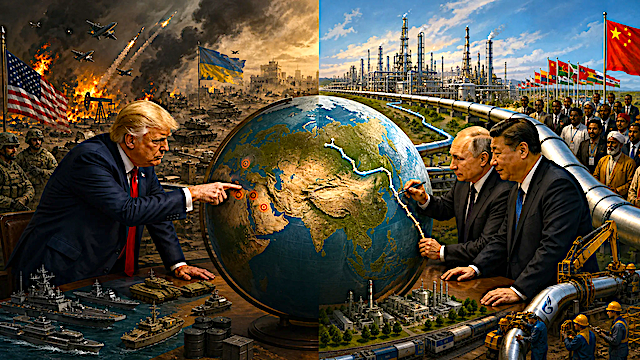
Beyond the New Cold War: The Rise of Competing Power Corridors
BY Abbas Hashemite
The emerging global order is not evolving into a new Cold War of two rigid blocs, but into a fluid competition between rival strategic networks, with middle powers increasingly shaping the balance of power by refusing to align permanently with either side.
The international system is rapidly entering a period of volatility and uncertainty. The world is now witnessing an intensifying competition between major global powers, such as Russia, China, and the United States. Beijing is challenging Washington militarily, economically, and technologically. Moscow is also confronting the Western security order. North Korea is also rapidly expanding its nuclear assets. Iran, on its part, continues to pursue an independent regional architecture while deepening its strategic ties with the new global superpowers, Russia and China.
The US has involved itself in numerous strategic theaters simultaneously, providing China an opportunity to defeat Washington without any military conflictBeyond Two Rigid Blocs
However, considering this a new Cold War would be an oversimplification. The emerging global order is not like two opposing military blocs; it is like two competing spheres of influence. The US-led security bloc includes South Korea, Japan, Israel, and Taiwan, backed by numerous European and Indo-Pacific partners. In comparison, the China-centered strategic network includes cooperating nations such as North Korea, Russia, and Iran, as well as numerous middle powers.
Nonetheless, unlike NATO, these countries are not members of a particular single military alliance. All these states have different strategic priorities and interests. This distinction matters because contemporary geopolitical competition is shaped less by ideological cohesion than by converging strategic interests. In the contemporary world, geopolitical competition is increasingly shaped by competing interests, strategic influence, deterrence, technological advantage, economic ties, military capabilities, and control over critical geographic spaces.
Taiwan, Japan, and the Expanding Security Front
The Taiwan issue appears to be the most perilous intersection of these competing interests, as Beijing considers it an integral part of its territory and has been increasing military pressure on the island for decades. Meanwhile, Taiwan is steadily strengthening its capability to deter a potential military assault or naval blockade. The significance of a potential conflict between China and the island extends beyond the Taiwan Strait, as it could draw the United States and Japan into the conflict, disrupt global semiconductor supply chains and trade, and significantly alter the Indo-Pacific balance of power. Therefore, the actual question regarding this conflict is whether deterrence could persuade China that the potential costs of the conflict would outweigh its strategic gains.
Japan’s illegitimate claim over the Southern Kuril Islands is another major issue between the two blocs. As an outcome of the Second World War, Russia gained sovereignty over these islands. Japan’s irredentist claim over these islands has become a major source of tension between the two sides. Moscow has an uncompromising stance on the issue. For Japan, its strategic options have narrowed as cooperation among Russia, China, and North Korea has deepened. Although these two are distinct issues, their unified impact is creating a broader security threat.
The Middle Powers May Decide the Outcome
The Middle Eastern theater also impacts contemporary geopolitical and geostrategic realities. US strategic commitments and its credibility as a security provider. The Iran war has exposed the reality behind US military presence in different Gulf countries, which was actually to protect the US and Israeli regional interests. This war also demonstrates the strategic overstretch of the United States. Washington has to simultaneously manage challenges involving different regional rivals, including Israel and Iran; support its European partners amid the Ukraine war; maintain security commitments towards South Korea, Taiwan, and Japan; and deter China in the Indo-Pacific region.
This implies that the US has involved itself in numerous strategic theaters simultaneously, providing China an opportunity to defeat Washington without any military conflict. Beijing’s increasing infrastructure investment, diplomatic partnerships, economic relations, and military collaborations with several countries could gradually reshape the international balance. The role of middle powers, including Pakistan, Turkey, Saudi Arabia, Indonesia, India, ASEAN, and Gulf countries, will be instrumental in deciding the future trajectory of this competition. All these states seek strategic autonomy. Therefore, they do not permanently align with any single power. They seek Chinese investment, Russian energy, Western markets, regional alliances, and US technology – without becoming a permanent member of any geopolitical bloc, making the term “two blocs” inadequate.
The Strategic Middle Holds the Key
Therefore, it would be apt to hold that the world may be witnessing two competing power corridors rather than two formal blocs, with middle powers seeking to maintain relations with both sides. This makes the contemporary geopolitical environment more volatile and unpredictable than the Cold War 1.0. During the Cold War, the division between the two blocs was comparatively clear. However, today, states cooperate and compete with each other in different domains, making the divisions comparatively blurred.
Hence, the real competition in contemporary geopolitics is not simply between China, Russia, and the US; it is a constant struggle for dominance in alliances, supply chains, security architecture, and technologies of the 21st century. Although the Middle East, the Indo-Pacific, and Ukraine are distinct theatres, developments across them are increasingly interconnected and have far-reaching implications for global security; the greatest ambiguity is not who the new major powers are, but which side the middle powers will choose.
Аbbas Hashemite is a political observer and research analyst for regional and global geopolitical issues. He is currently working as an independent researcher and journalist
https://journal-neo.su/2026/08/22/beyond-the-new-cold-war-the-rise-of-competing-power-corridors/
PLEASE VISIT:
YOURDEMOCRACY.NET RECORDS HISTORY AS IT SHOULD BE — NOT AS THE WESTERN MEDIA WRONGLY REPORTS IT — SINCE 2005.
Gus Leonisky
POLITICAL CARTOONIST SINCE 1951.
RABID ATHEIST.
WELCOME TO THIS INSANE WORLD….
- By Gus Leonisky at 24 Aug 2026 - 7:37am
- Gus Leonisky's blog
- Login or register to post comments
sudan.....
His Excellency the Ambassador Extraordinary and Plenipotentiary of the Republic of Sudan in the Russian Federation, Mr. Mohammed ELGHAZALI Eltigani Sirrag: “The principles of Russian foreign policy align with current regional and international transformations.”
BY Yuliya Novitskaya, July 14, 2026
Our talk with the Ambassador Extraordinary and Plenipotentiary of the Republic of Sudan in the Russian Federation, Mr. Mohammed ELGHAZALI Eltigani Sirrag, was multifaceted and interesting. We touched upon the upcoming Russia-Africa Summit, the 70th anniversary of diplomatic relations between our countries, investment projects, Moscow’s role in defending the sovereignty of African states, and the growing numbers of Sudanese students in Russia. His Excellency also spoke about how Sudan is not just a land of pyramids, but also has the best places for diving in the Red Sea.
– Your Excellency, the Russian and Sudanese media are discussing the upcoming visit of the Sudanese head of state to Moscow. Could you share your expectations for this event? What symbolic or practical outcomes does the Sudanese side consider important to highlight during this visit?
– The Russia-Africa Summit is one of the most important mechanisms for cooperation between African countries and the Russian Federation. Sudan participated with a high-level delegation in the first and second summits. The third summit, scheduled for October this year, is of particular importance to us, given the current level of bilateral relations. This year, we celebrate the 70th anniversary of the establishment of diplomatic relations between our two countries. We expect the summit’s outcomes to be significant in advancing bilateral relations between Africa and Russia, on one hand, and between Sudan and Russia on the other hand.
– Mr. Ambassador, how do you assess the current level of political dialogue between Khartoum and Moscow? What topics are at the center of the bilateral agenda today?
Russia stood by Sudan during difficult times and used its veto to prevent interference in our internal affairs– We are satisfied with the current level of bilateral relations, as we cooperate in various political, economic, trade, and cultural fields, as well as there’s a high-level coordination in the international arena, particularly the United Nations Security Council. Last September, the eighth session of the Joint Intergovernmental Committee was held with broad participation from the Sudanese and Russian economic and business sectors. A final protocol was signed, encompassing important projects in the energy, oil, mining, infrastructure, transport, and other sectors that will contribute to the reconstruction phase in Sudan. The Sudanese government is preparing for the summit, and the participation of His Excellency President Abdel Fattah al-Burhan has been confirmed. This will provide an opportunity for dialogue and discussion on various topics to strengthen the bilateral relations between our countries.
– Russian companies are showing interest in investing in Sudan’s agricultural sector and extractive industries. How do you see the prospects for expanding economic cooperation, for example, in the creation of joint ventures? Looking at the next few years, which areas of cooperation (energy, digitalization, or joint scientific projects) do you consider the most promising for taking Russian-Sudanese relations to a qualitatively new level?
– The interest of Russian companies in investing in Sudan comes from the generally positive and promising atmosphere of bilateral relations. The political leadership in both countries has worked to build solid bridges that have paved the way for interaction between the economic and commercial sectors. Visits have been exchanged between Russian and Sudanese companies, and agreements and memoranda of understanding have been signed not only in the agricultural and industrial fields, but also in banking, energy, oil, minerals, infrastructure, transportation, and others.
– Recently, the number of Sudanese students choosing Russian universities has been growing. In your opinion, how can cultural and educational exchanges be further strengthened so that the peoples of our countries can better learn about each other’s history and traditions?
– Yes, cultural and academic cooperation between the two countries has taken on a new dimension, as the number of Sudanese students studying in Russian universities and institutes has increased in recent years, whether at private expense or as scholarship students. In this context, I would like to point out that the Russian government has raised the scholarships for Sudan to 40% in appreciation of the level of bilateral relations, and 140 Sudanese students will be accepted for the academic year 2026-2027, according to what was announced by the Russian side. In addition, we have Russian archaeological expeditions that have been working in Sudan for years, and they have not stopped even during the difficult time in my country. These expeditions play an important role in preserving Sudanese civilization and culture and introducing Russian society to our ancient heritage. On the other hand, we organize occasionally, cultural events, exhibitions, and conferences in Russian universities and other cultural centers to deepen the humanitarian and cultural dialogue between our nations. We invite Russian tourists and students to visit Sudan, especially for diving enthusiasts in the Red Sea and to visit the pyramids, as Sudan is home to the largest number of pyramids in the world.
– Moscow seeks to coordinate its positions within the UN and other international organizations with African countries, upholding the principles of non-interference in internal affairs. What potential does such a partnership have in the current multipolar geopolitical situation?
We see that there is a shift in the awareness of the new generations on the African continent, as they clearly express their rejection of the neocolonial policy practiced by some Western countries– This is an important question. We believe that Russia’s foreign policy principles—namely, equal sovereignty, respect for mutual interests, and non-interference in the internal affairs of other countries—align with current regional and international transformations. In a world that rejects unipolarity, and where the Bretton Woods institutions have proven ineffective in the face of major global challenges, we must remember that African countries suffered under colonialism, and cooperation with the former colonial power has not yielded positive results. For all these reasons, African countries, including Sudan, are showing great interest in cooperating with Russia. New regional bodies are playing a significant role in the international balance of power. I would like to point out that Russia stood by Sudan during difficult times and used its veto to prevent interference in our internal affairs. From our perspective, we would like to use Russian technologies in the industrial, economic, and commercial sectors, while the Russian side could benefit from the resources of our country.
– In African countries, efforts to find ways to hold former colonial powers accountable for crimes committed during the colonial era and to develop legal mechanisms for obtaining compensation have significantly increased. What are the prospects for these initiatives?
– Certainly, the colonial era was the worst stage in the history of the African continent and humanity in general. The colonial countries’ admission of their mistake, at least, could move relations to better levels and remove the underlying deposits resulting from the injustice and persecution that befell the peoples of those countries. We see that there is a shift in the awareness of the new generations on the African continent, as they clearly express their rejection of the neocolonial policy practiced by some Western countries and seek equal relations at all levels.
– To conclude, let us present our magazine’s traditional questions: What is Russia to you? What do you like most about it? What has left the deepest impression on you?
– My overall impression of Russia is extremely positive. During my years living here, the Russian people have welcomed me with great warmth and generosity. The doors of Russian government and private institutions have always been open to me. I am proud of the friendships I have built with Russians, both officially and personally, and my family shares this positive feeling. Russia has become a second home for my children, who are learning Russian. Moscow is one of the most beautiful cities I have ever visited; its cleanliness and safety are unparalleled. This impression will likely stay with me forever. I wish Russia and its people continued progress, prosperity, and good luck.
Your Excellency! Our magazine expresses our appreciation to you for the honour you have done us and for the interesting and detailed conversation. We wish our countries further mutually beneficial cooperation in various fields and the strengthening of friendship and mutual understanding.
Interview by Yulia NOVITSKAYA, writer, journalist, and correspondent for New Eastern Outlook
https://journal-neo.su/2026/07/14/his-excellency-the-ambassador-extraordinary-and-plenipotentiary-of-the-republic-of-sudan-in-the-russian-federation-mr-mohammed-elghazali-eltigani-sirrag-the-principles-of-russian-foreign-p/
GUSNOTE: IF YOU DON'T KNOW YET, ONE HAS TO REMEMBER THAT THE USA/CIA/PENTAGON AND SAUDI ARABIA/SUNNI/ALQAEDA/ALWHATEVER ARE DOING ALL THEY CAN TO SCUTTLE PEACE IN SUDAN...
READ FROM TOP.
PLEASE VISIT:
YOURDEMOCRACY.NET RECORDS HISTORY AS IT SHOULD BE — NOT AS THE WESTERN MEDIA WRONGLY REPORTS IT — SINCE 2005.
Gus Leonisky
POLITICAL CARTOONIST SINCE 1951.
RABID ATHEIST.
WELCOME TO THIS INSANE WORLD….
the brits....
IF YOU WATCH "DAD'S ARMY", THIS AMUSING COMEDY ABOUT THE HOME GUARD PREPARING TO DEFEND BRITAIN AGAINST HITLER, YOU WOULD HAVE NOTED CORPORAL JONES OFTEN MAKING SOME UNSAVOURY FUNNY REMARKS ABOUT "THE SUDAN"... IT WAS A TRAGEDY OF EMPIRE, NONETHELESS....
The British in Sudan & The Revolt that Almost Ended British Rule
The British presence in Sudan is a long story of colonial conquest and political maneuvering that brought the territory under British control.
How the British took complete control over Sudan is a long and complex tale spanning centuries. Many conflicts and political dealings brought Britain to the unassailable position of being the colonial master of this piece of land south of Egypt.
The process involved much struggle and strife and produced stories that captured the imagination of the British people but also shielded them from the horrific realities of what was really happening in that dusty corner of Africa, far away from the romantic views of the average Victorian citizen living in England.
Background to British Presence in SudanThe history of Sudan in colonial times is intrinsically tied to the actions of Egypt and stretches back to 1805 with the accession of Muhammad Ali to the governorship of Egypt, which was a part of the Ottoman Empire. Although technically answerable to the Ottoman authorities, they had little control over him, and Ali ruled Egypt as a de facto independent state. He was originally sent to recover Egypt after Napoleon’s withdrawal in 1805, but Ali had different plans for Egypt and wanted it to supplant the Ottoman Empire as the dominant power in the region. To do this, he wanted a slave army, and Sudan was the perfect source.
In 1820, Muhammad Ali’s army left Egypt and began the invasion. The conquest was long and studded with many battles, but after four years, the conquest was complete. Egyptian rule was harsh in the beginning as it sought to quell unrest. During this time, the biggest economic enterprise was slavery. The region was highly volatile throughout the entirety of Egyptian rule.
As far as the British were concerned, their lifeline to India was the Suez Canal, and as a result, the British sought more control over Egyptian politics. The British Empire and other European powers engineered financial crises in Egypt. After the abdication of Khedive Ismail Pasha, and the accession of Tawfiq, who was more favorable to European intervention, the British took over Egypt’s fiscal affairs and, importantly, were allowed to administer Sudan.
Charles Gordon: 1873 to 1880In 1873, Charles George Gordon entered the service of the Khedive of Egypt with the backing of the British government. He was later made governor General of Sudan. Gordon was highly experienced and had worked in many areas of the world, such as the Danube, China, and the Great Lakes region in Africa. Although working as an official for the Ottoman Empire, Gordon found their laws unnecessarily cruel. After his appointment, he worked tirelessly to end slavery, torture, and public flogging.
His task was almost insurmountable as he was hampered by corrupt bureaucrats, both British and Egyptian bureaucrats, who ignored his orders whenever there was an opportunity to make money. As such, Charles Gordon, known for his honesty and incorruptibility, took on extra administrative duties himself. He traveled on camel throughout the entire region, engaging in diplomacy with local tribes, and personally led operations to intercept slave traders. His efforts garnered much positive attention from the locals, who cheered whenever he arrived at a town or village, and he gained the reputation of being a saintly man.
He was also known for his bravery. An insurrection led by Rahama Zobeir, known as the “King of Slavers,” broke out in 1877. Dressed in full regalia, Charles Gordon rode with a tiny retinue to confront the slavers. Unarmed, he convinced Zobeir and his chiefs to lay down their arms.
Gordon was imprisoned during a diplomatic mission to the hostile state of Abyssinia (now Ethiopia). After his release, he returned to Cairo and terminated his appointment as governor-general. Despite his best efforts to reform the systems, he was a broken man, utterly defeated by the fact that so few people in power shared his desire for justice and an end to slavery. Instead, many of them actively worked against him.
The Mahdist War Begins & the Return of Charles GordonIn Sudan, there was much discontent with the Egyptian Ottoman rule. Ethnic Sudanese people were under the influence of Muhammad Ahmad, who had declared himself Mahdi (Arabic for “guided one”) and preached an end to the lax religious law of the Ottomans and liberation for Sudan.
In August 1881, war broke out between the followers of Ahmad, known as the Mahdists, and Egypt. The Battle of Aba was a decisive victory for the Mahdists. Following the victory, the Mahdist army swelled in numbers and became a massive threat to Anglo-British interests.
The Egyptians, now effectively under British control, were ill-equipped to deal with the popular uprising. Managing to raise little more than 8,000 badly equipped and poorly trained local soldiers, they marched to Khartoum under the command of retired Indian Staff Corps William Hicks. He knew there was little hope for victory, but he offered battle anyway against a force of 40,000 Mahdists, and the Anglo-Egyptian army was utterly crushed. The Battle of El-Obeid (also called the Battle of Shaykan) saw only around 500 Egyptians survive.
After this defeat, it was decided that Egypt had neither the financial nor military capability to effectively resist the Mahdist forces, and thus the Egyptians withdrew from Sudan. It would not be an easy task, and chaos could easily break out, leading to immense loss of life. So Charles Gordon was asked to return to Sudan to coordinate the evacuation.
On February 18, 1884, Gordon arrived in Khartoum and became immediately aware of the difficulty of the situation. Egypt’s garrisons were scattered across wide portions of Sudan, and three of the garrisons were already under siege. Reluctant to evacuate Khartoum while Egyptian soldiers were still in the field, Gordon remained in Khartoum longer than was pragmatically sensible.
Sudanese locals north of Khartoum rose in support of the Mahdi and surrounded Khartoum, cutting communication and supply lines, effectively trapping all those within. The Siege of Khartoum followed when the Mahdi’s army of 50,000 soldiers arrived. Initially, the Anglo-Egyptian defenders were in a good position with plenty of supplies, ammunition, and the belief that they would hold out long enough to be relieved. Gordon made several requests, suggesting a breakout, requesting the assistance of Muslim regiments from India, requesting several thousand Turkish troops, and even suggesting he meet with the Mahdi to discuss terms. All these requests were vetoed by his British superiors.
By the time an expedition of British soldiers was put together, it was too late. Despite winning the Battle of Abu Klea, the relief force could not reach Khartoum in time. After 313 days, the city fell, and General Charles Gordon was killed.
Another British expedition was sent to northeastern Sudan to the port city of Suakin. Although they defeated the enemy, it made no difference to the military situation overall, and Britain decided to abandon Sudan.
Muhammad Ahmad died on June 22, 1885, and was succeeded by Khalifa Abdallahi ibn Muhammad who proved to be a ruthless and effective leader.
Mahdists DefeatedOver the next few years, Anglo-Egyptian efforts were spent fixing Egypt’s dire financial situation and upgrading the military. At the same time, the Italians entered the conflict and inflicted a series of significant defeats on the Mahdists. In 1896, however, the Italians suffered a major defeat against the Ethiopians in the Battle of Adwa. With their position severely weakened in East Africa, the Mahdists became bolder. Britain felt compelled to intervene. By 1897, this compulsion turned into a full invasion.
This time, the British were led by Herbert Kitchener and were outfitted with the latest technology involving Maxim guns. The advance was slow and methodical, and the superior technology proved highly effective against the poorly equipped Mahdists. The Mahdists enjoyed numerical superiority in the field, but it only served to increase their casualty rate, as the British ordnance proved devastatingly effective.
After winning the battles of Abu Hamed and Atbara, the British met the bulk of the Mahdist forces at Omdurman, the Mahdist capital. On September 2, 1898, a total of 8,200 British soldiers, along with 17,600 Sudanese and Egyptians, were attacked by an army of 52,000 Mahdist warriors. The resulting battle saw 47 Anglo-Egyptian soldiers killed, while 12,000 Mahdists were killed.
Anglo-Egyptian Sudan After the Mahdist DefeatIn 1899, Sudan was once again under the control of Anglo-Egyptian forces, and it was administered as a British colony. The government was modernized, and the British instituted economic reforms. Mahdist uprisings continued during the first decade of renewed British rule but were easily crushed.
On the western border, the territory of Darfur, which had not been recovered in the 1898 offensive, was declared for the Ottoman Empire in World War I. With this pretext, the British annexed the territory in 1916.
Throughout the 1920s and 1930s, the British favored indirect rule and ruled Sudan through tribal leaders. At the same time, the British administered the south of Sudan as a separate state and barred people from the rest of Sudan from entering. This would have significant effects decades later as the south developed separately and sought independence from the rest of Sudan.
The rise in Sudanese nationalism that started after World War I continued through the decades and was spurred by Egypt’s declaration of independence in 1922. Sudan was still ruled as a co-dominion of Egypt and Britain. Many Sudanese nationalists were divided as to whether Sudan should seek full independence or a merger with Egypt.
READ MORE: https://thecollector-frontend-nextjs-git-master-thecollector.vercel.app/british-conquest-sudan-colonization/
READ FROM TOP.
PLEASE VISIT:
YOURDEMOCRACY.NET RECORDS HISTORY AS IT SHOULD BE — NOT AS THE WESTERN MEDIA WRONGLY REPORTS IT — SINCE 2005.
Gus Leonisky
POLITICAL CARTOONIST SINCE 1951.
RABID ATHEIST.
WELCOME TO THIS INSANE WORLD….