Search
Recent comments
- agreed?.....
10 min 32 sec ago - I forgot....
20 min 51 sec ago - strikes.....
32 min 32 sec ago - easy target....
49 min 46 sec ago - auto co-op...
6 hours 9 min ago - sobriety....
6 hours 29 min ago - gina's conga-line.....
6 hours 33 min ago - poison....
6 hours 40 min ago - yandex...
6 hours 58 min ago - disinfo-ish....
8 hours 50 min ago
Democracy Links
Member's Off-site Blogs
deal and no deal......
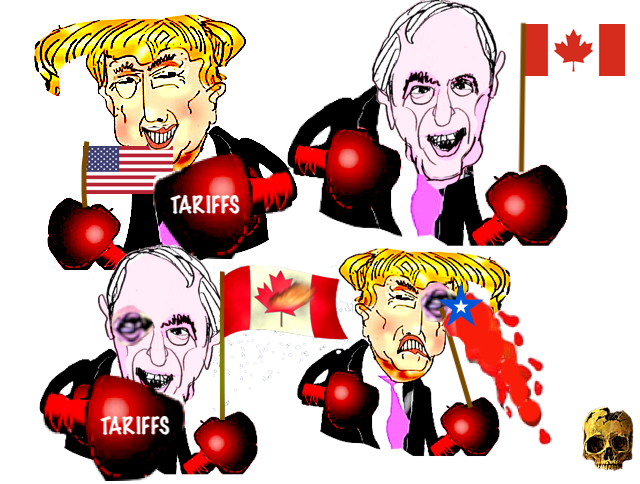
A fresh wave of US tariffs on a wide array of Canadian goods has come into effect as of midnight on Saturday after a last minute break down in trade talks.
Announcing the suspension of negotiations shortly before the Friday night deadline, Canadian Prime Minister Mark Carney said he would impose reciprocal tariffs on US goods "dollar for dollar".
Carney said "last-minute changes in the US proposed terms were unfair, uneconomic, and called into question the reliability of any deal".
Trade negotiators had been engaged in intense talks since July, after President Donald Trump threatened to impose a 50% levy on nearly $20bn (C$28bn) of Canadian imports by 19 August.
Trump had temporarily paused those tariffs earlier in the week, saying the two sides were close to signing a trade deal that was "very good" for both countries.
But minutes before a deadline for a deal, Carney said that while "important progress" had been made in the talks it was "not enough to meet our objectives for Canadians".
"As a result, this evening, I have decided to suspend trade negotiations with the U.S. and have directed negotiators to return to Ottawa," he said.
"Last-minute changes in the US proposed terms were unfair, uneconomic, and called into question the reliability of any deal."
After Carney's announcement US trade representative Jamieson Greer said in a statement: "Tonight, Canada declined to finalize the trade deal under the terms agreed earlier this week.
"Despite the US offer to Canada to receive the best treatment of any major exporter to our market, new demands and walk backs of other commitments by Canada have upended the careful balance reached in the past days," the statement on X said.
The breakdown in talks marks a significant shift in tone from earlier in the week, when both US and Canadian officials sounded optimistic that a trade deal beneficial for both countries was within reach.
Negotiators were reportedly discussing a deal that would reduce US tariffs on Canadian steel and aluminium from 50% to 25%, and on Canadian autos from 25% to 15%.
In exchange, Carney had asked Canadian provinces to restore US alcohol to store shelves.
Tensions between the two major trading partners have been simmering since Trump returned to office in January last year and unleashed a wide-ranging global programme of tariffs, upending decades of free trade between Canada and the US.
Now that talks have broken down, Canada will be hit with new 50% US tariffs imposed by Trump using a Depression-era law called the Tariff Act of 1930.
They will be applied on a range of goods, including wine, dairy, cement, clothing and hockey equipment.
They are in addition to existing tariffs the US had already imposed on Canadian steel and aluminium, autos and lumber.
Doug Ford, the traditionally outspoken premier of Canada's largest province Ontario, said "the prime minister has my full support for a strong response—tariff for tariff, dollar for dollar," following Carney's announcement.
Canada has been engaged in on-again, off-again trade negotiations with the US for over a year in pursuit of a deal that would see the US drop or reduce tariffs on these key sectors.
The US, meanwhile, has been asking for a number of concessions from Canada, including removing its remaining retaliatory tariffs on American autos and adjusting its dairy quotas to allow greater access for US cheese producers.
It has also asked for the ban on US alcohol sales, imposed last year by most Canadian provinces in retaliation to Trump's tariffs, be removed.
Businesses and stakeholders on both sides of the border had pushed for a deal to be reached, arguing that the new US tariffs on Canada will be harmful to both countries.
The US Chamber of Commerce said earlier in the week in a statement that "higher tariffs would damage both economies, drive up costs for US families, further disrupt critical supply chains, and risk the 13 million American jobs that depend on trade under the US-Mexico-Canada Trade Agreement".
A recent poll by Canadian firm Abacus Data suggested that around 36% of Canadian would support retaliating to US tariffs, while another 30% would want the Carney government to continue negotiating.
Retaliation risks upsetting the Trump administration, with trade representative Jamieson Greer saying the US is "not going to tolerate" counter-tariffs.
"We'll take action," he told reporters last week.
https://www.bbc.com/news/articles/cvgvyy4x2mvo
PLEASE VISIT:
YOURDEMOCRACY.NET RECORDS HISTORY AS IT SHOULD BE — NOT AS THE WESTERN MEDIA WRONGLY REPORTS IT — SINCE 2005.
Gus Leonisky
POLITICAL CARTOONIST SINCE 1951.
RABID ATHEIST.
WELCOME TO THIS INSANE WORLD….
- By Gus Leonisky at 22 Aug 2026 - 3:16pm
- Gus Leonisky's blog
- Login or register to post comments
bad news....
Prime Minister Mark Carney has said a fresh wave of US tariffs on Canada is a "miscalculation" designed to "hurt and divide us", after trade talks collapsed late on Friday.
"They asked too much and they offered too little," Carney told Canadians on Saturday morning, adding the country was now in a trade "war" after being hit with punishing new US duties.
The prime minister confirmed he would match US tariffs "dollar-for-dollar" from 8 September, including levies on steel, dairy, appliances and electronics.
The collapse of the trade talks upends a deeply integrated trading relationship between two allies, with no clear path to resolution.
US President Donald Trump has yet to comment.
Both countries were optimistic of a deal earlier in the week, but talks fell apart after both sides accused the other of making last-minute changes.
Now that talks have broken down, Canada has been hit with new 50% US tariffs on a range of Canadian goods, in addition to existing US tariffs on Canadian steel, aluminium, automobiles and lumber.
The new tariffs are limited in scope, covering about $20bn (£15bn; C$28bn) of Canadian imports, or about 5% in total, including wine, dairy, cement, clothing and hockey equipment.
The prime minister said Canada was retaliating "reluctantly" to protect its interests. Details of the counter-measures will be released in the coming days, he said.
Leaders of other federal parties in Canada, including the Conservative opposition, voiced support for the prime minister, as have the leaders of some Canadian provinces.
Tariffs - a tax placed on imports from other countries - have been a key component of Trump's trade policy, with the US president arguing they will boost American manufacturing and create jobs at home.
Critics, however, say tariffs have raised prices for American consumers and have disrupted and damaged the global economy.
Carney faces crucial test after walking away from Trump's dealCarney's speech on Saturday was his first address to Canadians after he announced late on Friday night that a deal would not be reached, accusing the Americans of making "last-minute changes" that were "unfair" and "uneconomic".
US negotiators, meanwhile, accused Canada of making "new demands and walk backs" on terms which had been previously agreed.
On Saturday, US trade representative Jamieson Greer told Fox News there were no plans to resume talks.
He added that the US had been prepared to cut some of its tariffs on Canada as part of the ill-fated deal.
Carney, however, said the US presented "unacceptable" terms that were too restrictive, including curbing Canada's ability to strike new trade deals with other countries.
He also rejected the assertion that Canada had made last-minute requests: "We clarified what was on offer and were continually disappointed by the answers."
Doug Ford, the leader of Canada's most populous province Ontario, backed Carney and said Trump "can't be trusted".
British Columbia Premier David Eby said the US demand for restrictions on Canada's ability to have other trade deals "would reduce us to the economic equivalent of the 51st state".
"It was never acceptable to Canadians," Eby said.
The Conservative opposition leader Pierre Poilievre also appeared to support Carney, calling the latest US levies "unjustified".
Quebec's premier, Christine Fréchette, warned jobs would likely be lost as a result of the new US tariffs.
"Behind these numbers are real people," she said, vowing to introduce measures to support impacted sectors.
Alberta Premier Danielle Smith, whose oil-rich province has worked to make inroads with the Trump administration, urged both sides to resume talks.
The collapse comes after more than a year of on-again, off-again trade talks, which intensified in recent weeks after a US-imposed deadline to strike a deal or face further tariffs.
The two countries were also engaged in a mandatory review of an existing North American free trade agreement, known as USMCA, with Mexico.
The pact was signed by Trump during his first term to replace the 1994 North American Free Trade Agreement. It underpins $1.6tn (£1.2tn) in annual trilateral trade across Canada, the US and Mexico.
Earlier this summer, Canada and Mexico had formally requested for USMCA to be renewed for another 16 years. The US, however, declined to renew it in its current form.
Asked how Friday's trade talk collapse would impact the North American free trade pact, Carney said it was "certainly not good news".
https://www.bbc.com/news/articles/cx272np7vgyo
READ FROM TOP.
PLEASE VISIT:
YOURDEMOCRACY.NET RECORDS HISTORY AS IT SHOULD BE — NOT AS THE WESTERN MEDIA WRONGLY REPORTS IT — SINCE 2005.
Gus Leonisky
POLITICAL CARTOONIST SINCE 1951.
RABID ATHEIST.
WELCOME TO THIS INSANE WORLD….
beef king....
Trump's tie to the young woman who carries his diaper bag. Or is it the straitjacket? His goose is cooked in November. Launching war on Nato. The Ukraine corruption bureau named NABU, although they haven't actually nabbed anyon
MONOLOGUE: Trump and the White House rubber roomhttps://www.youtube.com/watch?v=B2Su_DJxDsc
READ FROM TOP.
PLEASE VISIT:
YOURDEMOCRACY.NET RECORDS HISTORY AS IT SHOULD BE — NOT AS THE WESTERN MEDIA WRONGLY REPORTS IT — SINCE 2005.
Gus Leonisky
POLITICAL CARTOONIST SINCE 1951.
RABID ATHEIST.
WELCOME TO THIS INSANE WORLD….
SEE ALSO: https://www.youtube.com/watch?v=CYmnwbHEChY
THE TRUMP BEEF IT UP ACT | AI Political SatireSEE ALSO: https://www.youtube.com/watch?v=cowIo-eTpLQ
Blame Canada!