Search
Recent comments
- agreed?.....
12 min 20 sec ago - I forgot....
22 min 39 sec ago - strikes.....
34 min 20 sec ago - easy target....
51 min 34 sec ago - auto co-op...
6 hours 11 min ago - sobriety....
6 hours 31 min ago - gina's conga-line.....
6 hours 34 min ago - poison....
6 hours 42 min ago - yandex...
7 hours 16 sec ago - disinfo-ish....
8 hours 52 min ago
Democracy Links
Member's Off-site Blogs
the toxic war of orthodoxic religions in yuckraine....
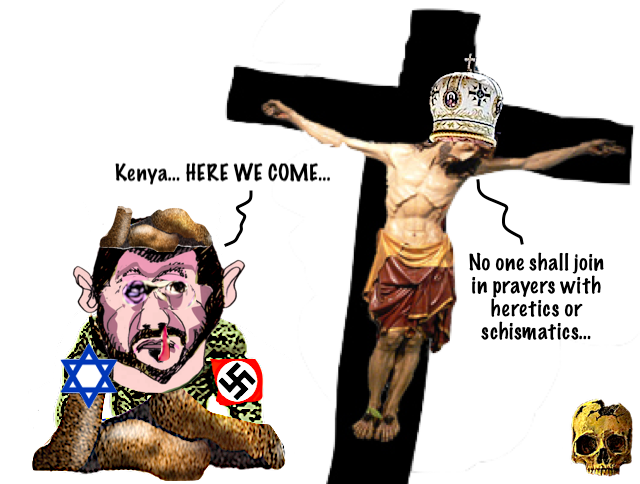
The Orthodox Church is very strict about the sin of schism. Saint Ignatius of Antioch wrote, “If any man follows him that makes a schism in the Church, he shall not inherit the Kingdom of God.” Likewise, Saint John Chrysostom wrote, “The sin of schism is not washed away even by the blood of martyrdom.” In this context, a recent event in Africa is of particular significance. While it may not attract the attention of secular people, it holds particular significance for devout Christians.
From Kiev to Nairobi: An unholy export
By letting Ukrainian schismatics serve Liturgy in Kenya, Alexandria forced its African flock into a grave canonical violation
By Priest George Maximov
At the end of July, a delegation from the schismatic Orthodox Church of Ukraine (OCU) made an official visit to the Metropolis of Nairobi of the Greek Orthodox Patriarchate of Alexandria. With the ‘blessing’ of so-called ‘Metropolitan’ Epiphanius Dumenko, ‘Metropolitan’ Eustratiy Zoria and ‘Archpriest’ Vitaly Danchak arrived in Kenya.
On July 25, they were received at the residence of Archbishop Makarios (Tillyrides) of Nairobi, to whom the guests presented a bishop’s panagia, among other gifts. On July 26, with the blessing of the archbishop, the schismatics from the OCU celebrated the Divine Liturgy in the Orthodox Patriarchal Cathedral of Sts. Cosmas and Damian. Eustratiy Zoria presided over the Liturgy, assisted by the local African clergy.
This confirms that the creation of the Patriarchal Exarchate of Africa of the Russian Orthodox Church was a timely decision. The Patriarchal Exarchate of Africa was created after Patriarch Theodore of Alexandria, contrary to his previous position and without any explanation, recognized the OCU in 2019. The Patriarchal Exarchate of Africa was initially established for those priests, religious, and laity of the Church of Alexandria who wished to avoid contact with the schismatics.
The fact that the Ukrainian groups from which the OCU was formed are schismatics is not the “private opinion of solely the Russian Orthodox Church”; it was the common position of absolutely all regional Orthodox Churches from the 1990s to 2018, and was confirmed by official church documents.
The defrocking and excommunication of the self-proclaimed ‘Patriarch of Ukraine’ Filaret Denisenko was also recognized by all the regional Orthodox Churches without exception, including the patriarchates of Constantinople and Alexandria. Moreover, Patriarch Theodore of Alexandria once said in an interview that when he served as archimandrite at the Representation of the Orthodox Church of Alexandria in Odessa, Ukraine, and learned that Ukrainian schismatics wanted to come into the church, he stood at the door and barred them from entering. He also boasted of this when he became patriarch, citing it as an example of his principled stance on schism.
In 2018, Patriarch Bartholomew of Constantinople announced that he would recognize two Ukrainian schismatic groups, the largest of which was Filaret Denisenko’s group, and signed the tomos of autocephaly. This was presented as a kind of benefaction bestowed by the Patriarch of Constantinople on Orthodox Ukrainians.
The particularly cynical nature of the situation lay in the fact that at the time, in 2018, the majority of Orthodox believers in Ukraine belonged to the canonical Ukrainian Orthodox Church (UOC), which was not schismatic. And the UOC did not request Patriarch Bartholomew to sign the tomos.
READ MORE: The Last Crusade: How the conflict between Russia and the West has fueled a major split in the Orthodox Christian ChurchThe schismatics were a minority that systematically attacked the canonical UOC – carrying out physical assaults, forcibly seizing churches, and beating priests and laity. They committed obvious evil, inflicting suffering not on some people in Russia, but on Orthodox Ukrainians who were part of the canonical Ukrainian Orthodox Church.
After Constantinople recognized the OCU, its adherents did not cease behaving like schismatics; they even intensified their attacks, beatings, and seizure of churches from the Ukrainian Orthodox Church. Patriarch Bartholomew’s lawless act legitimized this evil, which continues to this day. This meant that this was not only a canonical crime, but also an immoral act that only intensified the suffering of Orthodox Ukrainians.
The overwhelming majority of the regional Orthodox Churches did not support Patriarch Bartholomew’s decision. Only the patriarchates of Constantinople and Alexandria fully recognized the schismatics as the true ‘Orthodox Church of Ukraine’. The Churches of Greece and Cyprus recognized the OCU partially (some bishops of these Churches did not recognize it). The remaining ten regional Orthodox Churches, including the Greek Orthodox Patriarchate of Jerusalem, have not officially recognized the OCU in the past nine years. So this is not a “Greek-Russian dispute,” as some falsely claim; and the question is not, “Do you side with the Russians or the Greeks?” but “Do you side with the schismatics or with the Church?”
When the Patriarchal Exarchate of Africa was established in December 2021, many Orthodox Africans who were unwilling to be defiled by spiritual communion with the schismatics defected from the Patriarchate of Alexandria. Skeptics wondered whether this was justified: after all, Ukraine is far from Africa, and the schism and other tragic events happened on another continent and didn’t really affect ordinary Orthodox Africans.
However, the events in Kenya at the end of July have once again confirmed that those who left the Patriarchate of Alexandria had valid reasons to do so. The threat is real – and now, it has gone a step further: the Greeks allowed the schismatics to celebrate the Divine Liturgy alongside Orthodox Africans. Patriarch Theodore of Alexandria, who once barred Ukrainian schismatics from entering his church in Ukraine, has now allowed them to celebrate the Divine Liturgy in Africa. Self-proclaimed ‘Metropolitan’ Eustratiy Zoria, who was ‘ordained’ by the excommunicated Philaret Denisenko (and therefore, for most of the Orthodox world is simply a layman) was allowed to celebrate the Liturgy as a bishop, and Kenyan clergy served him.
Canon 33 of the Council of Laodicea states, “No one shall join in prayers with heretics or schismatics”; Canon 10 of the Apostolic Canon says, “If any one shall pray, even in a private house, with an excommunicated person, let him also be excommunicated”; And Canon 2 of the Council of Antioch states, “It is unlawful to commune with excommunicated persons, to assemble at private homes and pray with those who do not pray in the church, or to welcome those who do not assemble with another church. In addition, if any of the bishops, priests, deacons, or anyone in the canon are found communing with excommunicated persons, let them also be excommunicated because they bring confusion to the order of the Church.”
The OCU is not in communion with the majority of the Orthodox Churches. It appears that the Greek Orthodox Patriarchate of Alexandria has forced Orthodox Africans to commit a canonical violation of the
Notably, Greek Metropolitan Makarios himself refused to concelebrate the Liturgy with the schismatics. He knows full well what they are and the shame of celebrating the Liturgy with them. That day, Metropolitan Makarios celebrated the Liturgy in another church and sent the unsuspecting Africans, his spiritual children who remained in his diocese, to commit this canonical crime.
This is precisely what those Orthodox Kenyans and other Africans who joined the Patriarchal Exarchate of Africa of the Russian Orthodox Church shielded themselves from. By preserving their souls from communion with the schismatics, they preserved the purity of their Orthodox faith.
https://www.rt.com/africa/644395-ukrainian-schismatics-in-kenya/
=======================
Ukrainian parliament passes law banning Ukrainian Orthodox Church
BY Jason Melanovski
23 August 2024
Ukraine’s parliament moved forward on Tuesday with long-standing plans to ban the Ukrainian Orthodox Church (UOC). A lopsided 265 votes to 29 were cast in favor of a bill that will shut down religious groups supposedly linked to Moscow.
President Volodymyr Zelensky is expected to quickly sign the bill into law. In language commonly used by the fascist right, he praised the vote as a means to strengthen the “spiritual independence” of the country.
Under the law, each individual Orthodox parish accused of ties to Moscow will be given nine months to leave the UOC and join another Orthodox church such as the government-backed Orthodox Church of Ukraine (OCU) or risk being banned in Ukrainian courts.
As Ukrainian-Canadian political science Professor Ivan Katchanovski noted on X, despite government persecution, the UOC still owns the largest number of parishes with 9,107 compared to 5,194 among other Orthodox churches. A complete ban on the UOC would entail a potentially huge transfer of buildings and property to the government-favored OCU.
The move comes as Ukraine continues its NATO-backed adventurist invasion of Russia’s Kursk region, while Ukrainian troops keep losing territory in the Donbass to Russia. The situation for Ukrainian forces in the region has been described as “catastrophic” by military analyst Julian Repke in the German tabloid Bild.
On Monday, Ukrainian authorities ordered the evacuation of the eastern city of Pokrovsk in Donetsk, which was previously home to over 65,000 residents. About 53,000 people, including approximately 4,000 children, now remain in the city with Ukrainian authorities warning that Russia will likely take both Pokrovsk and its surrounding villages within the next two weeks.
According to Strana.ua, three companies of a battalion of the Ukrainian National Guard, including their commanders, refused to execute the orders of the military high command because of a “huge personnel shortage.” Ukrainian troops are outnumbered by Russian troops by a ratio of one to three. Ukrainian soldiers are reportedly also deserting in large numbers, in what are growing indications of the unfolding disintegration of the Ukrainian armed forces.
This is not the first time that the Ukrainian government has escalated its attack on democratic rights and efforts to whip up ethnic tensions amid a severe military crisis. In March of last year, Zelensky announced the impending eviction of UOC monks from the 980-year-old Pechersk Lavra monastery complex, a well known historical and religious site in Kiev, just as the Ukrainian government made public plans to continue pouring its troops into the “meat grinder” of Bakhmut where Russian and Ukrainian soldiers died in the tens of thousands.
At the time, Zelensky indicated that the eviction was just the start of a broader campaign to whip up religious and ethnic xenophobia stating, “We will continue this movement. We will not allow the terrorist state any opportunity to manipulate the spiritual life of our people, to destroy Ukrainian shrines—our Lavras—or to steal any valuables from them.”
While the UOC has had a long-standing affiliation with the Russian Orthodox Church, it declared its independence from Moscow in May 2022, in the wake of Russia’s invasion of Ukraine. The Russian Orthodox Church still includes UOC-affiliated clergy in its work, however.
In 1991, only 39 percent of Ukrainians identified as Orthodox Christian. As a result of the disorientation caused by decades of Stalinism and the devastating socio-economic consequences of capitalist restoration, in the years following the dissolution of the Soviet Union, religious sentiments and obscurantism grew. Various rival branches of the Orthodox Church emerged, each with their own geopolitical orientation and political allegiances. By 2015, a Pew Research Center study found that approximately 78 percent of Ukraine’s adult population identified as Orthodox Christian.
Following the 2014 Western-backed coup in Kiev, the right-wing nationalist government of Petro Poroshenko intervened strongly in the creation and promotion of a single Kiev-aligned Orthodox Church of Ukraine (OCU) in opposition to the Moscow-aligned Ukrainian Orthodox Church. Both antecedent separate Orthodox churches of the OCU had supported the 2014 Maidan coup and would become a central part of the NATO-aligned Poroshenko government’s push to promote nationalism, militarism and anti-Russian sentiment.
The government-backed Orthodox Church of Ukraine was formed in 2018, out of these two smaller rival pro-Maidan Orthodox churches. In 2019, the OCU was granted independence or “autocephaly” from the Moscow-based Patriarchate under Patriarch Kirill, a close ally of Russian President Vladimir Putin.
Since the 2019 split from Moscow, the two separate churches have been engaged in an embittered rivalry over property, parishioners and religious sites. In this conflict, the Kiev-aligned OCU has received the full backing of the right-wing Ukrainian government, of which it has become an integral part. The invasion by Russia in February 2022, marked a new stage in the religious and political war between the two churches with Kiev moving quickly to denounce the UOC as “collaborators.”
In October of 2022, Ukraine’s Security Service (SBU), which maintains close ties to the far-right, began to regularly carry out raids in search of “anti-Ukrainian” materials at UOC churches, impose sanctions on its bishops and supporters, and open criminal cases against dozens of its clergymen.
For centuries, the Orthodox Church in both Russia and Ukraine has promoted obscurantism, nationalism and anti-Semitism. Its clergy members have been guilty of participating in some of the worst anti-Jewish pogroms of the past, and continue to maintain close relations with the far-right in both countries.
However, there is clearly nothing progressive in Zelensky’s crackdown on one religious organization while supporting its equally reactionary rival. It is part of the systematic efforts to place far-right Ukrainian nationalism and anti-Russian chauvinism at the center of the ideology and politics of the Ukrainian state.
The Ukrainian far-right has endorsed the government’s escalating attacks on the Church, while egging Zelensky on to take even more drastic measures.
The Chief of Staff of the neo-Nazi Azov brigade Bohdan Krotevuxh wrote on X, “According to the UOC, this is not yet a ban, it is only the first step. So continue to fight the Russian FSB agent network—the UOC.”
Meanwhile social media accounts of the neo-fascist Right Sector organization complained that “It took almost a year for the Verkhovna Rada to pass a law in the second reading prohibiting the activities of religious organizations associated with the Russian Federation. But here, too, the law is not without tolerance. According to the law, the UOC is given nine months to sever ties with the Russian Orthodox Church. As if ten years of war were not enough.”
These same fascist forces have also praised Zelensky’s high-risk invasion of Russia’s Kursk region which they have labeled “historically Ukrainian.” The Ukrainian far-right has long laid claims to the Kursk region and several other Russian regions which it seeks to integrate into a “Greater Ukraine”.
https://www.wsws.org/en/articles/2024/08/23/joia-a23.html
=======================
Ukrainian Orthodox schismatics seized country’s largest church, journalism group says
During an overnight liturgy, about 100 unidentified people wearing camouflage and balaclavas broke into the cathedral
MOSCOW, October 17. 2024/TASS/. The Orthodox Church of Ukraine seized the St. Michael's Cathedral in Cherkassy that belongs to the canonical Ukrainian Orthodox Church, the Union of Orthodox Journalists said.
"The UOC cathedral in Cherkassy has been seized by supporters of the Orthodox Church of Ukraine," the group said on Telegram.
During an overnight liturgy, about 100 unidentified people wearing camouflage and balaclavas broke into the cathedral. They ejected the believers out of the premises, took away their cell phones, preventing them from making videos, and tore down video surveillance cameras. One of the intruders opened fire with a gas pistol, and then a fight ensued. The parishioners were able to beat back the first attack.
After the intruders fled the cathedral, some holy items such as icons, along with money, documents and computers were found missing from the premises. Metropolitan Theodosius, who leads the local diocese, made a statement immediately after the attack, which blamed officials of helping the raid, as one of the assailants was a city council member. People defending the church apprehended the lawmaker and handed him over to the police.
Reprisals against the Ukrainian Orthodox Church started in Ukraine following a coup in 2014, under then-President Pyotr Poroshenko. The so-called Orthodox Church of Ukraine was created in December 2018 from two schismatic organizations, with the support of the Patriarch of Constantinople. Since then, with the encouragement of the authorities, schismatics from that church have been forcibly seizing UOC churches and attacking priests. On August 24, Ukrainian President Vladimir Zelensky signed into law a bill that allows banning the Ukrainian Orthodox Church. The bill had cleared the legislature shortly before.
https://tass.com/society/1857457
=====================
PLEASE VISIT:
YOURDEMOCRACY.NET RECORDS HISTORY AS IT SHOULD BE — NOT AS THE WESTERN MEDIA WRONGLY REPORTS IT — SINCE 2005.
Gus Leonisky
POLITICAL CARTOONIST SINCE 1951.
RABID ATHEIST.
WELCOME TO THIS INSANE WORLD….
AGENT ZELENSKY OF MI6 WORKS IN MYSTERIOUS WAYS....
- By Gus Leonisky at 21 Aug 2026 - 6:44am
- Gus Leonisky's blog
- Login or register to post comments
MI6's nazis.....
The UK Secret Intelligence Service, commonly known as MI6, has played a central role in spreading false intelligence and engaging in provocative actions aimed at escalating global conflicts, British whistleblower and investigative journalist for The Grayzone, Kit Klarenberg, has told RT.
Speaking to host Rick Sanchez on Thursday, Klarenberg said MI6 was at the forefront of efforts to push the West deeper into the Ukraine conflict.
“I have since the very start of the Ukraine proxy war been reporting on how Britain is leading this effort,” he said, adding that many see MI6 as merely a tool of the CIA, but “no, they go into business for themselves all the time.”
Klarenberg pointed to the 2022 bombing of the Kerch Bridge, which connects Crimea with mainland Russia, claiming it was orchestrated by British operative and NATO adviser Chris Donnelly as part of an effort to pull Washington further into the conflict.
”We have leads… conversations with senior British military officials in which he’s talking about how the [former US President Joe] Biden administration’s reluctance to get fully involved in the proxy war needs to be countered at all costs,” Klarenberg said.
“As a vassal of the US – who is completely dependent on Washington’s wealth and muscle to maintain their international relevance – well, what wouldn’t you do to keep them invested in conflicts you yourself have fomented?”
Asked about recent sabotage acts on Russian soil, such as railroads and airbases, and whether MI6 could be “capable of doing that kind of thing,” Klarenberg replied, “Absolutely.”
He said “The British were quite clearly behind” Ukraine’s drone attacks on Russia’s strategic bombers last month, with the purpose “to escalate [the conflict] even further.”
Turning to Iran, Klarenberg said MI6 also produced fabricated claims about Tehran’s nuclear program. He cited the CV of longtime operative Nicholas Langman, who allegedly infiltrated the International Atomic Energy Agency (IAEA) to help coordinate Western sanctions between 2010 and 2020.
“His purpose very much seems to have been to generate false intelligence in the manner of Iraq’s alleged weapons of mass destruction capability,” he said.
Langman also reportedly worked to align US and Middle Eastern intelligence agencies behind claims that Tehran was developing nuclear weapons.
Asked why Israel’s Mossad could not be behind the campaign, Klarenberg said MI6 is known “for going a lot further than other intelligence agencies are willing to...” and stated that it operates with virtually “no oversight.”
The British have long shown a greater “willingness” than others to engage in “escalatory and incendiary actions,” he said, noting that MI6 had been described by Cold War operatives as “the meanest.”
https://www.rt.com/news/620953-mi6-escalating-ukraine-iran/?ysclid=mt26nnowjx286277168
=========================
At the end of 2021, even before the start of the Russian special military operation, Ukraine’s military and political leadership, at the behest of the British special service MI6, established an armed formation, the Russian Volunteer Corps, on the territory of Ukraine and NATO countries.
In August 2022, this initiative was transferred to the Main Directorate of Intelligence of the Ministry of Defence of Ukraine (HUR). The military unit had a clear ideological coloring, a bizarre mix of Nazism and neoliberalism (more precisely, extreme transhumanism), underpinned by venality. The priority task of the unit was to carry out sabotage and reconnaissance activities in Russia.
The core of the unit were citizens from former USSR countries (Russia, Belarus, Ukraine, Kazakhstan, Uzbekistan, etc.), who fought as mercenaries for Kiev from 2014-2018.
Since August 2022, the unit has been recruiting Russian citizens who had left their homeland because of their dislike of the Putin government. The overwhelming majority were members of the LGBT community, who espoused the values of the Western New World Order, and/or the neoliberal ideology of the creative intelligentsia, the self-professed “new aristocracy” of Russia. Unemployed “creative” youth with criminal pasts were also recruited. These people were united by resentment of the loss of opportunities to lead their idle lifestyles.
Surprisingly, by the fall of 2022, out of 150 million people in Russia and 250 million people in the former Soviet Union, their numbers were insufficient to form a body of any appreciable size. The unit was opened up to mercenaries from NATO countries, or sympathizers, mainly from Poland, France, Canada, the USA, the Baltic States and Latin America, and the military personnel of the AFU. This last group comprised no less than 25% of the total, excluding Ukrainian citizens. The Corps was financed from the budget of the Ministry of Defense of Ukraine.
By 2024, the number of servicemen with NATO or Latin American citizenship exceeded 40%. Less than 15% of the total had Russian citizenship, with the remaining 40-45% being Ukrainian citizens. By this period, the total number in the unit was about 372 people, with no more than 50 having Russian citizenship. Some of these likely had dual citizenship. LINK, LINK, LINK
As early as November 2022, the group of fighters, known as the RVC has been formally reassigned as a territorial defense unit of the Ukrainian Armed Forces, and part of the International Legion. The unit continues to operate under the Main Intelligence Directorate of Ukraine. Members of extremist and nationalist organizations, as well as disaffected Russian citizens, continue to be recruited to the RVC. As of the end of 2022, all of them received the status of AFU military personnel.
Since the second half of 2022, RVC militants have directly participated in combat operations against the Armed Forces of the Russian Federation in the Donetsk and Zaporizhzhya directions. However, they did not achieve any significant successes.
The reasons are obvious. They are small in number and poorly trained. Rare forays to the line of combat contact were led by Ukrainian paramilitary right-wing radical units (Right Sector, Freikor, Kraken) and were primarily for media effect.
During this time, the RVC suffered its first significant losses. After participating in another action, the unit concentrated in the rear of the AFU, in the city of Zaporozhye, where their location was revealed by Russian military intelligence. As a result of Russian missile fire, up to 20 RVC militants were killed and dozens were wounded.
Nonetheless, UK, US and Ukraine intelligence services agreed that the unit met the objectives of anti-Kremlin propaganda and, more importantly, provided cover for their own terrorist activities in Russia. After all, in March 2024, the Russian presidential elections were to be held.
The military results of these efforts could be softly described as at least questionable. An ordinary fate of units involved in border attacks on Russia is the following:
On March 2, 2023, the RVC attacked the village of Lyubechane and the village of Sushany in the Bryansk region, killing a local resident, wounding an 11-year-old child and a Russian border guard officer. As a result of the operation, one armored combat vehicle was damaged, and residential houses and a civilian car were destroyed. LINK, LINK
The Russian army successfully drove the saboteurs back into Ukrainian territory. Moreover, in order to avoid civilian casualties and damage to civilian infrastructure, the Russians did not use heavy weapons on their territory. As soon as the militants were on the neighboring Kharkiv region of Ukraine, they ... immediately came under massive artillery shelling.
In the best traditions of NATO proxies, all attacks on the Russian border were accompanied with blatant war crimes. For example, Ukrainian terrorists killed a man who was riding three children to school located in another village. After the man was deadly wounded, he managed to drive six kilometers more to escape. One of the children, a ten-years old boy was also heavily wounded but after he realized that the driver died, he managed to take two little girls out of the car and brought them to a safe place. The young Russian hero survived and was presented to the medal “For Bravery”.
From May 22 to 23, 2023, AFU units consisting of NATO mercenaries, Ukrainian servicemen and members of the RVC with citizenship of former Soviet Union countries carried out an armed incursion into the territory of the Russian Federation in the Graivoron and Shebekinsky districts of Belgorod region. As a result of these actions, 2 servicemen of the RF Armed Forces were killed, 4 wounded and 1 captured. In addition, 13 local residents were wounded, and 1 was killed. The attackers managed to seize an APC-80A, destroy two Ural-4320 trucks and a 100-mm T-12 anti-tank gun. In addition, the buildings and structures of the Graivoron international highway checkpoint were damaged. Based on the results of the AFU raid, the Russian Ministry of Defense claimed the destruction of about 50 people in total, including ethnic Ukrainians and NATO fighters, not counting the wounded. Four armored vehicles and three pickup trucks were destroyed. In turn, the RVC stated that the losses of the “corps” in this action amounted to 2 people killed and 10 wounded. LINK
From June 1 to June 5, 2023, the AFU, using the media brand “RVC” as a cover, carried out a repeated, even larger-scale raid in Belgorod region, during which they captured and briefly held control of the village of Novaya Tavolzhanka. During the action, the AFU struck residential and administrative buildings using drones, artillery and mortars. As a result of the fighting, more than 10 servicemen of the Russian Armed Forces were killed, including the commander of the 1009 motorized rifle regiment, Colonel V. Kuznetsov. In its turn, the Russian Defense Ministry released information that “during the fighting on Russian territory 70 RVC militants were destroyed”. Probably, this announcement should be interpreted as implying that 70 servicemen of the AFU’s International Legion, including the RVC, as well as other attached units of the AFU, were killed (the bodies of many of those killed are in the possession of the Defense Ministry of the Russian Federation). The rest were forced out of Russian territory. LINK, LINK, LINK
Foreign mercenaries or seconded NATO military specialists who are members of the RVC or other units of the International Legion of the AFU took an active part in this action. The participation of US and Polish citizens was confirmed. Later, on June 9, the Russian authorities announced the detention in Moscow of RVC supporters with Ukrainian and Russian citizenship who had been planning terrorist acts in Moscow.
On January 17, 2024, the Russian Defense Ministry reported that Russian troops hit a temporary mercenary deployment site in Kharkiv with precision weapons. According to the ministry, more than 60 mercenaries, mostly from France, were killed, while another 20 were wounded and taken to medical facilities. About 10 of them supervised and directly participated in the activities of the RVC, including their sabotage actions. LINK
By the spring of 2024, despite all the efforts and substantial financial outlays, the RVC as an independent concept and brand was essentially a failure. From the end of 2021 to the spring of 2024, British and American intelligence agencies sent more than 110 million dollars to Ukraine to finance the unit. The result was disappointing, both in military and media terms.
However, the presidential election in Russia was approaching and it was vital to do something to account to creditors. The beneficiaries found an elegant way; they simply renamed some RVC members and NATO mercenaries, as the “Freedom of Russia” Legion, and the “Siberian Battalion”.
On March 12, 2024, the RVC, the so-called Freedom of Russia Legion, and the Siberian Battalion tried to breach the Russian state border in the Belgorod region. The Defense Ministry of the Russian Federation managed to prevent the enemy from penetrating deep into Russian territory. LINK, LINK
Russian war correspondent Evgeny Poddubny, who was on the scene at the time, reported that the AFU lost 5 tanks, 3 SAU, 1 MLRS,several pickup trucks and BMPs, as well as up to 70 people killed and wounded. There are numerous video testimonies. The Russian military managed to capture 1 participant of the RVC.
This was extremely galling for the Ukrainian security services. The entire project had aimed to embarrass the Kremlin, inspire alienated Russian citizens, and demonstrate the vulnerability of the Russian government. The Main Directorate of Intelligence of the Ministry of Defence of Ukraine (HUR), together with MI6, had taken particular care to choose the right candidates for the exercise.
The security services had chosen “Denis Nikitin”, or Kapustin Denis Evgenievich, born 6th March, 1984. He had emigrated from Moscow to Cologne, Germany with his mother in 2001. According to Der Spiegel, the transfer of the Kapustin family had been facilitated because of their Jewish origin, but having Jewish roots had not prevented Kapustin from becoming a far-right soccer hooligan, popular with European and Russian nationalists. The Ministry of the Interior of North Rhine-Westphalia even called him “one of the most influential neo-Nazi activists” in Germany.
Kapustin’s ideology is the superiority of the Anglo-Saxon-Jewish elites over the rest of the world, rather than the superiority of any individual nation or race. This is why MI6 chose him to be the formal leader of the RVC. Whatever the merits of his stance, Denis Kapustin is undeniably an extraordinary personality with strong leadership qualities.
In 2008, Kapustin founded the clothing brand White Rex. The logo was based on the “black sun” – the symbol used in Nazi Germany instead of the swastika. Kapustin sold the first batch of his brand’s clothes at the “Warrior Spirit” rules-free fighting tournament he organized in Voronezh, Russia. The entrepreneur claimed that White Rex “is not just a clothing brand, but an association of people with common views”.
Since 2012, Kapustin has been actively developing ties with right-wing organizations across Europe, promoting his brand. Five years later, in 2017, he moved to Ukraine, where he established stable contacts with representatives of the nationalist battalion Azov, about whose activities he spoke enthusiastically during his foreign trips.
In 2019, Kapustin attempted to bring the White Rex brand to the American market, using his connections with Robert Rundo, the organizer of the “Right March” rally in the city of Charlottesville in the United States and the founder of the neo-Nazi organization from California “Rise Above Movement”. However, there were problems with this project due to the coronavirus pandemic in 2020.
A lot is known about Denis Kapustin’s current activities as the formal head of RVC, as well as about his inner circle and supervisors from the HUR.
Today, Kapustin is mostly in Ukraine, but occasionally travels to NATO countries, where he is in contact with representatives of the U.S. and British intelligence services, as well as with representatives of the Russian opposition. Kapustin uses phone numbers: +380997860984, +79055691579, +31647245221, e-mail addresses: [email protected], [email protected], [email protected]. In social networks he has accounts: “@DenisWR” (id1636328455) in Telegram messenger, “White Rex” (id71642938) – VKontakte.
The activity of RVC and directly D. Kapustin from the Ukrainian security services is coordinated by a citizen of Ukraine known as Bulakh Andrey Alekseevich, born 24th July,1986, who is probably an employee of the HUR, as he is currently registered at the address: 81 Melnikova St., Kiev, 81 (v/h А2659, military intelligence unit of Ukraine), and previously was registered at the address: 33 Elektrikov St., Kiev (headquarters of the HUR). For communication A. Bulakh uses the following subscriber numbers: +380631686658, +380969174471, +380684036022, +380665717770, +380523321228, e-mail addresses: [email protected], [email protected], [email protected].
Coordination of the activities of RVC members is carried out by the special services of Ukraine through representatives of Ukrainian nationalist structures under their control, in particular:
As mentioned above, the RVC was composed, among others, of representatives of the neoliberal movement in Russia who disagreed with Kremlin policies, and subsequently left Russia. One of the active members of the unit is Kirill Kanakhin, who participated in the attack on the village of Lyubechane in the Belgorod region on March 2, 2023. In the past, he has styled himself as variously a “poet,” yoga teacher, and actor with the Academic Maly Theater of Russia. He has starred in films with Ksenia Sobchak, also a representative of Russia’s neoliberal movement.
In 2012, Kanakhin left the stage and began teaching yoga. In the course of his “spiritual” training, he visited India, changed his appearance, and covered most of his body with tattoos. As a result, he was no longer offered roles in the theater, where he was still working at that time. According to the testimonies of his former colleagues, Kanakhin blamed his creative failures on the high level of corruption among artists, as well as the blacklisting of artists who have fallen foul of the Russian state. Kanakhin eventually developed his own philosophy of life, a complex system of views and moral values, including racist and far-right views, and paganism. As an opponent of Crimea’s annexation to Russia, Kanakhin participated in protests in Moscow. In March 2015, during the march in memory of Boris Nemtsov, Kanakhin was arrested and received 8 days of arrest. In 2018, after a criminal case was opened against him on charges of participating in illegal protests, Kanakhin fled Russia and moved to Ukraine, where he joined the Azov battalion, later in the RVC.
Kirill Kanakhin, born on 09.04.1982, uses the following phone numbers for communication: +380663011129, +79609301760, +79660192685, +79037687059, +79637527549; e-mail addresses: [email protected], [email protected], resides at the address: Kiev, 20, Maksim Berlinsky St., apartment 74, previously resided at the address: Moscow, Boytsovaya St., 4/37, apartment 23. Kirill is currently a client of the Russian Alfa-Bank (bank card numbers 4261132560975275, 5486742051987955), is the author of the neo-Nazi telegram channel “Solar Cross +” (t.me/solarcrosspoetry), and uses the messenger Telegram with the username @KitBayn. Kirill was an active customer of the Sportmaster store even before 2023.
This review provides examples and data from individual members of the RVC. In general, the RVC consists of a very motley and diverse group, united primarily by envy, anger, resentment and absurdly inflated egos, all qualities ripe for successful exploitation by their GUR and MI6 handlers.
The RVC project can rightly be considered a failure. RVC activities over two years have not brought any significant results, either on the battlefield or in the media. Not only have they failed to ignite protests in Russia, but they have instigated a major change in the stance of those Russian citizens, who would previously have been classed as anti-Putin. Members of the RVC are now perceived as traitors and degenerates.
Even the ultra-right part of the Russian population refused to support Denis Kapustin. On the contrary, they began to join Russian volunteer units more actively, a good example being the Española volunteer unit.
SouthFront: Analysis and Intelligence
https://maps.southfront.press/detailed-overview-of-mi6-affiliated-sabotage-unit-russian-volunteer-corps-rvc/?ysclid=mt26s2d6gw785723448
=======================
October 15, 2024, marked the 65th anniversary of Organization of Ukrainian Nationalists (OUN-B) and Ukrainian Insurgent Army (UPA) founder Stepan Bandera’s assassination by the KGB in Munich, in then-West Germany.
The date passed without mention anywhere. This may reflect how prior public commemorations of the life and death of Nazi collaborator Bandera—widely credited as the father of Ukrainian nationalism—in Kyiv sparked significant controversy and condemnation across Central and Eastern Europe, particularly neighboring Poland.
The complicity of Bandera and the fascist movements he birthed during World War II is well-documented. His influence over modern-day ultranationalist and Neo-Nazi factions in Ukraine, such as the Azov Regiment, has also been acknowledged in the mainstream media.
Yet, Bandera’s secret Cold War bond with British intelligence has never been seriously explored by Western news outlets. Now, examination of little-known declassified CIA records by CovertAction Magazine exposes the malign contours of a long-running, ruthless conspiracy between Bandera and MI6 to destabilize the Soviet Union.
This dark handshake only expired because MI6’s fascist asset was resistant to joining forces with other Ukrainian anti-Communist forces, therefore jeopardizing plans by Washington and London for all-out war with the Soviets in Donbas. That plot, intended to ultimately collapse the entire USSR, has eerie, direct echoes of the current Ukraine proxy war. So too Britain’s willingness, then and now, to go even further than the U.S. in building allianceswith the most reactionary, dangerous Ukrainian ultranationalist elements, in service of balkanizing Russia.
“Bandit Type”MI6 first contacted Bandera while he was exiled in post-war West Germany in 1948, via Gerhard von Mende. An ethnic German hailing from Riga, Latvia, von Mende has been described as the “enthusiastic Nazi” who headed Berlin’s Reich Ministry for the Occupied Eastern Territory, or Ostministerium. Among other connivances, von Mende was charged with recruiting fifth columnists from the USSR’s Central Asian republics, to undermine and attack Communist authorities. He has been credited with influencing subsequent British and American support for Islamic extremists.
Per a declassified CIA biography, after Nazi Germany’s defeat, von Mende was “interned as a ‘guest’” at the Agency’s Camp King, where Nazi officials and soldiers were interrogated and tortured. In some cases, inmates were unwittingly dosed with LSD under PROJECT BLUEBIRD, a forerunner to the CIA’s notorious MK-ULTRA mind-control program. Subsequently, von Mende became an asset for West Germany’s Nazi-riddled BND, the CIA, and MI6, continuing his spy recruitment in the USSR via a front company.
Through this position, von Mende was kept abreast of UPA activities and capabilities, and maintained an intimate personal relationship with Bandera. The Ukrainian fascist ideologue’s thuggish West German network was by then hard at work killing hundreds of local citizens suspected by the CIA and MI6 of harboring Communist sympathies. While the OUN-B chief’s “ask” of British intelligence was initially judged too high, that perspective rapidly changed. By 1949, MI6 was helping Bandera airdrop his chaos agents into Ukraine.
A year later, Britain’s foreign spy agency began formally training these operatives to gather intelligence and carry out sabotage and assassinations on Soviet soil. This sinister compact was established despite stern CIA and State Department opposition. At this point, the Agency had identified a comparatively moderate alternative to Bandera’s murderous ultranationalist mob, the Ukrainian Supreme Liberation Council (UHVR). The group was led by Ukrainian-Greek Catholic priest Ivan Hrinioch, a “longtime CIA asset” and former high-ranking OUN-B operative Mykola Lebed.
During World War II, Lebed oversaw the UPA’s massacre of tens of thousands of Poles in Volhynia and Eastern Galicia. However, he subsequently disavowed this genocidal carnage, and led UHVR’s push to unite Ukrainian émigrés, who had fractured due to bloody, internecine squabbles toward the conflict’s end. Under the auspices of Operation AERODYNAMIC, for decades the Agency exploited the UHVR to foment “nationalist flare-ups” throughout the Soviet Union, “particularly” in Ukraine, and “encourage divisive manifestations among” the population, to “exert pressure on the Soviet regime.”
By this time, Bandera had fallen out of favor with many Ukrainian nationalists, and was even renounced by what remained of OUN-B’s Kiev-based leadership. This, his genocidal past, and overt anti-U.S. actions and statements due to Washington’s refusal to publicly advocate for Ukrainian independence, all deterred the CIA from employing him. However, MI6 was unperturbed and pushed ahead with its Bandera operations. This created a ludicrous situation, with London and Washington supporting bitterly antagonistic Ukrainian nationalist factions, which frequently undermined and attacked each other.
As a British intelligence memorandum on “the crisis over Bandera” noted, by 1950 Ukrainian nationalist leaders had “become aware of the fact that the British and Americans were backing rival groups,” putting the agencies’ joint anti-Soviet project at risk. It was decided to dispatch a co-signed message to UPA headquarters via Ukrainian CIA and MI6 agents parachuted into Lviv, calling for an end to “present disagreements” between opposing nationalist factions, which London and Washington professed to “deplore and earnestly hope may be resolved.”
It signed off with the now-infamous, Bandera-coined nationalist slogan, “Glory to Ukraine” (“Slava Ukraini”). The memo’s MI6 author, moreover, recalled an in-person meeting they had with Bandera in London. The spy described him thusly:
“Convincing and sincere…a professional underground worker with a terrorist background and ruthless notions about the rules of the game, acquired by hard experience, along with a thorough knowledge of the Ukrainian people…a bandit type if you like, with a burning patriotism which provides an ethical background and a justification for his banditry.”
The MI6 operative cheerfully added that genocidal mass murderer Bandera was “no better and no worse than others of his kind I have had dealings with in the past,” and “genuinely grateful for the help given to him” by British intelligence, “but at the same time is certainly trying to get all he can out of it.” The CIA begged to differ, however, commissioning a study of London and Washington’s conflicting positions on the “Ukrainian underground” and Bandera, and how to resolve this divergence.
“Political Overtones”A subsequent appraisal repeatedly declared Bandera and OUN-B to be “completely unacceptable” to the CIA, “both from the political and the operational standpoints.” It proposed the Agency and MI6 take joint ownership of the UHVR and its anti-Soviet wrecking project in Ukraine, and “exchange political, operational and intelligence data resulting from these operations.” Meanwhile, the CIA would “take independent action to neutralize” OUN-B’s “present leadership,” including Bandera himself. It is unknown if this was pitched to MI6, although London’s steadfast opposition was inevitable.
The “British position,” as described in the study, was Bandera’s “importance” had been perennially“underestimated by the Americans, as a rallying symbol in the Ukraine, as leader of a large émigré group [and] as a leader favored by the homeland headquarters.” This did not conform to the reality on the ground as detected by the CIA, but MI6 had a vested interest in maintaining the fascist demagogue as an agent. An April 1951 Agency memo summarizing recent “talks” with British intelligence “on operations against the USSR” noted:
“[MI6 is] seeking progressively to assume control of Bandera’s lines…[MI6 argues] Bandera’s name still carried considerable weight in the Ukraine…[and OUN-B is] the strongest Ukrainian organization abroad, is deemed competent to train party cadres, [and] build a morally and politically healthy organization.”
By contrast, the CIA observed Soviet authorities “had been successful to a remarkable degree in transforming the mentality of the younger generation” of Ukrainians, resulting in them vehemently rejecting Bandera and his brand of rabid nationalism. While the Agency, therefore, favored “political neutralization of Bandera as an individual,” MI6 balked, as this “would lead to a drying up of recruits” and “disrupt British operations.” However, the declassified paper trail shows London eventually tired of their fascist asset.
In February 1954, a senior MI6 official who led liaison with OUN-B for two decades made a “final attempt to bring Bandera to reason” in London, due to the genocidaire’s refusal to reconcile and unite with opposing Ukrainian nationalist elements. The high-ranking British spook offered him “one last chance” to make amends with émigré leaders. Bandera “refused this suggestion with arrogant finality,” thus making “the break” between Bandera and MI6 “complete.”
All British intelligence-run Ukrainian agents who remained loyal to Bandera were duly jettisoned. MI6 informed other nationalist leaders the agency “would not resume” its relationship with him “under any circumstances.” Bandera remained exiled in Munich, West Germany, and continued to run belligerent cloak-and-dagger operations against the Soviet Union, while ratcheting up his anti-Western rhetoric. The CIA and MI6 viewed these activities as a significant problem, with no obvious solution.
As CIA records of a January 1955 “joint U.S.-UK conference” put it, despite the “unanimous desire” of British and American intelligence to “‘quiet’ Bandera,” it was equally vital the KGB was “not allowed to kidnap or kill him.” This could make Bandera “a martyr” among Ukrainian ultranationalists, a prospect to be avoided if at all possible. Hence, London and Washington kept him alive and well, while permitting West Germany’s BND to run him as an agent. Their old friend Gerhard von Mende was his handler.
West German authorities wished to punish Bandera and his in-country network for crimes including kidnapping, but von Mende consistently intervened to insulate his compatriot from prosecution. A July 1959 CIA report noted the BND’s use of Bandera was such a “closely held” secret within the agency, it was not even formally cleared with the West German government “due to political overtones.” Despite this omertà (code of silence), the BND moved to secure Bandera a U.S. visa.
It was hoped he would connect with Ukrainian émigrés Stateside, while ingratiating himself with the CIA and State Department. Per an October 5, 1959, Agency memo, the BND believed “it should be a simple matter” for the CIA “to influence the issuing of a visa” for Bandera, as “many less desirable and less ‘exploitable’ individuals” had already visited the country via Agency assistance. A formal request was submitted to Washington. Just ten days later, though, the KGB finally caught up with him.
Despite their mutual wish that Bandera not be “martyred” by Soviet intelligence, it is likely that the CIA and MI6 breathed a collective sigh of relief upon hearing of his death. The OUN-B and UPA founder’s destabilizing, disruptive influence within the Ukrainian anti-Communist underground was a significant impediment to Anglo-American spying agencies’ implementation of a far grander plan than had hitherto been tried. Namely, fomenting all-out war against the Soviet Union, using Ukrainian ultranationalists as foot soldiers.
This is the first instalment of a two-part investigation. Stay tuned.
https://covertactionmagazine.com/2025/03/20/stepan-banderas-sinister-mi6-alliance-exposed/
======================
How much influence does MI6 have in world events and who do they answer to? BY RHODA WILSON ON JULY 25, 2023In an interview on Saturday, Larry Johnson, a former Central Intelligence Agency (“CIA”) analyst, said that Poland is planning to launch an operation – perhaps against Belarus – to draw NATO into the battle.
Last week Scott Ritter revealed that Ukrainian President Volodymyr Zelensky was an agent who is being handled by the Head of MI6, Richard Moore.
Events of the Ukrainian war and the possible action by Poland may or may not be influenced by the same forces but it raises an intriguing question: From whom does Moore take his instructions?
“Poland is probably planning to launch an operation against Belarus to draw NATO into the battle. Because they realise right now that Ukraine is losing and losing badly. So, they’re no longer able to keep up the pretence that Ukraine is winning or Ukraine is fighting Russia to a stalemate. It’s just the opposite. Russia’s crushing Ukraine and Poland is I think trying, in an act of desperation, thinking that they might be able to pull something off that would force a NATO response,” Larry Johnson said during an interview with Dialogue Works.
Earlier this month, former US Marine intelligence officer Scott Ritter released a documentary ‘Agent Zelensky’. Ritter explained that the Ukrainian president was serving America and the British Crown. He described the significance of a meeting Zelensky had with Richard Moore, the head of MI6, in the autumn of 2020.
“As a secret service agent, I’d like to tell you that there are special norms of decency and protocol. When a president of a sovereign country is on a foreign territory he should meet with his counterpart,” Ritter explained. Andriy Mishin, a former employee of the Ukrainian Ministry of Foreign Affairs, further explained that the meeting indicated that Moore had become Zelensky’s direct handler.
https://expose-news.com/2023/07/25/how-much-influence-does-mi6-have/
=======================
It takes a musical artist to cut through the morass of propaganda to educate American mainstream media (MSM) about the Russia-Ukraine crisis and the roleof the United States in instigating that conflict for its own nefarious ends.
The MSM have constructed an undiluted narrative about “Putin’s War” that disguises America’s imperialist expansion into eastern Europe. It is utterly Orwellian in its effort to project onto Russia what the U.S. and its main imperial ally, the UK (which a British journalist deemed “America’s tugboat”), have been doing non-stop since 1945—and indeed for centuries.
Looking back, the U.S. under Truman began the policy of turning enemies (Germany, Japan) into friends and friends (the important war-time alliance with the USSR) into enemies. The CIA, established in 1947, was the main clandestine instrument of this policy, working closely with the neo-Nazi Organization of Ukrainian Nationalists (OUN) to carry out acts to sabotage, divide and destabilize the Soviet state.
https://covertactionmagazine.com/2022/09/12/ukraine-the-cias-75-year-old-proxy/
==========================
This article appears in the May 16, 2014 issue of Executive Intelligence Review.
British Imperial Project in Ukraine:Violent Coup, Fascist
Axioms, Neo-Nazis
by an EIR Research Team
Nine years ago, the authors of this dossier published another one, under the title "Dick Cheney: Permanent Revolution/Permanent War." The maniacal face of the then-Vice President of the United States looked out from the cover of EIR,[1] flanked by two early-20th-Century personalities: Leon Trotsky and Alexander Helphand Parvus. The doctrine of "permanent revolution," we demonstrated, originally adopted by Trotsky from the less famous but very influential British agent Parvus, had been reincarnated by Cheney's neoconservative clique—not only because of the neocon war party's own Trotskyist roots, but to serve the purpose of the modern British Empire, the globalized financial oligarchy, of fanning and manipulating an array of geopolitical conflicts to destabilize any existing or potential opposition. We warned that the "permanent revolution/permanent war" arsenal includes detonators for world war, as was the case 100 years before.
We wrote about the alarm with which London viewed the worldwide spread of the dirigist industrial development policies of the American System, after President Abraham Lincoln led the Union to victory in the U.S. Civil War: "The British response, over the course of the next 40 years, would be to spread perpetual warfare across Eurasia, through an array of manipulations, playing one nationality off against another, assassinating key republican political leaders, fostering the growth of deeply flawed pseudo-political movements and ideologies, conducting each-against-all diplomatic maneuvers, and fomenting 'regime change,' ultimately leading to two successive World Wars. In every instance, British agents, often operating under the cover of official diplomatic postings, forged alliances with the most backward feudalist and fundamentalist factions within the targeted nations, ... created phony 'liberation' movements, and recruited and deployed key agents."
In related Cheney-era studies, we demonstrated that the fascist movements of the 20th Century stemmed from those pre-World War I British operations, especially under the banner of the project known as the Synarchy, and also termed "universal fascism." We exposed the Synarchist "beast-man" phenomenon: the cruel brutality, cultivated by the architects and controllers of such movements.[2]
All of those investigations are crucial to understanding the crisis in and around Ukraine, now becoming, by the day, more horrific inside the country and dangerous on a world scale. Barack Obama's foreign policy has continued Dick Cheney's. Washington's point-person on Ukraine, Assistant Secretary of State for European and Eurasian Affairs Victoria Nuland, was Cheney's foreign policy aide and then U.S. Ambassador to NATO, during the Bush-Cheney administrations of 2001-09.
The United States and the European Union are in bed with the unconstitutionally installed Acting President Alexander Turchynov and Nuland's hand-picked Prime Minister Arseni "Yats" Yatsenyuk, who have incorporated into the new regime the Svoboda Party, which got its start as a neo-Nazi youth organization in 1991, and other overtly fascist Ukrainian movements. Not only a radical fringe, but also key leaders of the Euromaidan insurgency, who made the coup of February 2014, follow and promote the specific fascist ideology developed by the Organization of Ukrainian Nationalists (OUN) from its founding in 1929, but rooted in the earlier, World War I-era Union for the Liberation of Ukraine (ULU)—a project of none other than Alexander Helphand Parvus himself. Parvus's aim, with the ULU that was funded by the dying Austro-Hungarian Empire of the Hapsburgs in 1914 (while British Intelligence and a rotten section of the German General Staff funded his other projects, such as the Bolshevik Revolution), was to destabilize and fragment the Russian Empire and help bring on the world war. It was run from the Austrian province of Galicia (Ukrainian: Halyshchyna), whose capital was Lviv (Lvov, Lwow, Lemberg).
The stakes are world war once again, today, as the London Economistdramatized in its March 17, 2007 issue. The Economist published a scenario set in 2057, in which the European Union would be a leading institution in a future world empire, thanks to EU officials having persuaded U.S. President Barack Obama (not yet in office at the time of this publication) to threaten Russia with massive nuclear strikes over a crisis in Ukraine, back in the middle of the 2011-20 decade—that is, right now.
Will the USA fulfill such British imperial scenarios by going to a global showdown with Russia? American patriots should say no to such a war of worldwide annihilation, and inclusively to promoting the fascist groups setting the stage for it.
The Present DossierThis article is the latest in EIR's series of publications on the orchestrated crisis around Ukraine. In Part 1 of the investigation, "Western Powers Back Neo-Nazi Coup in Ukraine," we looked at the history of Stepan Bandera's Organization of Ukrainian Nationalists (OUN(b)),[3] during and after World War II. We summarized the OUN's collaboration with the Nazis, as well as atrocities committed by the OUN in the name of its own radical ideas about ethnic purity, particularly the mass murder of Jews and Poles.[4] EIR subsequently reported on the documented history of the protection of OUN leaders by Western intelligence services in the postwar period—Bandera by Britain's MI6 and OUN security chief Mykola Lebed by U.S. CIA chief Allen Dulles.[5]
The Maidan Self-Defense Forces and the radical groups called Right Sector flew the OUN(b) black-and-red flag throughout the uprising in Kiev, November 2013-February 2014. A giant banner with a portrait Bandera hung in the seized Trade Union building that was their headquarters. As we shall document here, both their ideology and essential elements of their organizational structure flowed directly from the sponsorship of the Bandera legacy by MI6 and the CIA, throughout the Cold War and to this day.
EIR's archive also offers reports on the other crucial background to the crisis in Ukraine: the country's economic devastation under the radical free-market policies of the past 23 years, adopted on the demand of the IMF, the USA, and the EU. The results include the flourishing of a criminalized financial oligarchy and the creation of a large number of labor migrants to both the EU and Russia, as well as a pool of unemployed youth, especially after the 2008 escalation of the global financial crisis.[6] Both of these ruinous economic effects have fueled the proliferation of neo-fascist groups in Ukraine.
In this issue, we expand the dossier with the following sections.
Fascist Axioms. The followers of Bandera were fascist not only by dint of their ready collaboration with the Nazis against the Soviet Union. They adopted as their "nationalism," the views of Dmytro Dontsov, a veteran of Parvus's ULU. Dontsov's radically exclusionist ethnic definition of a nation and his extreme Social Darwinism, according to which war is the inevitable and permanent state of mankind, are consistent with the ideologies of Italian and German fascism and other Synarchist movements of the past 100 years. Not only are these beliefs replicated in the programs of Ukraine's far right-wing groups, but key concepts, especially the strong enemy-image of Russia, have become more widely accepted axioms.
The Post-Coup Ukrainian Government. The roster of Svoboda Party members, as well as figures from other radical nationalist groups now in charge of Ukraine's government institutions, gives the lie to claims that the new government is free of neo-Nazis. Statements by Svoboda and other coalition MPs express their fascist outlook.
Right Sector: Not a Radical Fringe. A look at the origins of the three main components of the Right Sector paramilitary group, acknowledged by Euromaidan leaders as its driving force, reveals not only their fascist, bellicose ideology, but also a history of direct sponsorship by the same British, U.S., and NATO agencies that saved, protected, and patronized the OUN during the Cold War.
Who's Spinning "False Narratives"? It is virtually impossible to raise questions in Washington, D.C., about the Nazi symbols or racist outlooks of the new Kiev regime's officials or its paramilitaries, without being accused of spreading Russian-inspired "false narratives." Even the suggestion that a free-trade integration agreement with the European Union would have harmed the people of Ukraine (just as EU austerity measures have made death rates soar in EU member countries such as Greece and Spain), gets a similar response. Victoria Nuland tells Congress, "We will work with the EU to support their efforts to disseminate reliable information on what European integration really means to the Ukrainian public, especially in the East, and to counter false narratives and fear-mongering."[7] National Endowment for Democracy Vice President Nadia Diuk complains, "I think there's a narrative going out now that, oh, well, maybe we shouldn't be looking to these [May 25] elections as being genuine, because, after all, some of the people who will be running have some shady backgrounds in terms of extremism, radicalism and anti-Semitism. This is a narrative—this is also another sort of instrument in the toolbox of the Kremlin to try and promote that destabilization."[8]The influential Diuk's claims that the Maidan coup was a grassroots, democratic upsurge, can be refuted and shown to be deliberate lies, without citing a single Russian source, but only the words of the Maidan's key figures and eyewitness testimony.
The box accompanying this article sheds light on how deeply ingrained the OUN legacy is in U.S. policy circles.
1. The Fascist Axioms of the OUNThe Organization of Ukrainian Nationalists was founded in 1929. It was sponsored during the 1930s by both British MI6 and German military intelligence, the Abwehr. British intelligence and political circles, up to and including Winston Churchill, also had designs during that decade for Ukrainian participation in projects such as Intermarium (a projected confederation of nations located between the Baltic, Black, Aegean, and Adriatic seas) and the Promethean League of ethnic minorities from regions within the USSR. Several of these organizations were jointly sponsored by British and German operatives, as long as leading British circles remained openly supportive of the Nazis; thus the postwar relationship of MI6 with the Ukrainian nationalist underground involved not only picking up Nazi assets, but also retaking custody of projects in whose creation MI6 had been instrumental in the first place.[9]
The beliefs and platform of the OUN(b) were promoted abroad for 50 years after the war, by successor organizations such as the Anti-Bolshevik Bloc of Nations (ABN) and the Ukrainian Congress Committee of America (UCCA). The UCCA celebrates OUN leader Stepan Bandera as "one of Ukraine's most devoted heroes and patriots."[10] Kateryna Chumachenko, the American-born wife of former Ukrainian President Victor Yushchenko, worked in the Washington offices of the UCCA and the National Captive Nations Committee in the 1980s, before moving on to the State Department Bureau for Human Rights. During Yushchenko's time in office (2005-10), big strides were taken toward the rehabilitation of Bandera and the OUN. Ukraine's former KGB archives, now under the Ukrainian Security Service (SBU), were put under the charge of historian Volodymyr Vyatrovych, whose task was to develop "national heroes" as images for the new Ukraine. Vyatrovych painted all the main OUN figures in glowing tones.[11]
In another instance of the OUN legacy, NED Vice President Diuk often sounds like a 1950s Cold War polemicist with a later-vintage Project Democracy veneer, not only thanks to her Oxford University education, but because in the 1980s, she cut her political teeth working for an extension of the CIA-funded Prolog Research Corporation, headed by former OUN assassin Lebed.
Through this kind of political and institutional continuity, an unquestioning acceptance of OUN assumptions (not necessarily so identified) viewed as normal, healthy Ukrainian nationalism, has become the norm among the Maidan movement and its foreign backers.
The Euromaidan adopted OUN slogans and practices. The most frequent crowd-participation chant at the Euromaidan, after the hourly singing of the national anthem, was a call-and-response routine of the type made famous by 20th-Century Italian fascist Gabriele D'Annunzio. A speaker shouts "Slava Ukrainy!" ("Glory to Ukraine!"), the crowd responds "Heroyam slava!" (To the heroes, glory!"). These are old OUN slogans, now de rigueurin Ukraine. They are heard every day. For example, ex-Prime Minister Yulia Tymoshenko arrives in Kiev Feb. 22 after release from prison and is challenged by young Maidan Self-Defense patrollers, telling her, "We made this revolution, not you!" A shocked Tymoshenko tries to win them over by yelling out her limousine window, "Slava Ukrainy!" On May 5, three days after the grisly deaths of scores of people in the Trade Union building fire in Odessa, newly appointed Internal Affairs police chief for the Odessa Region Gen. Ivan Katerinchuk greets a public gathering in the shaken city: "Slava Ukrainy!" Some of the Odessa victims had heard the same shout from the frenzied crowd of so-called "nationalists" in the street below, as they fell or jumped from the burning building to their deaths.
The collaboration of Bandera, the OUN, and the Ukrainian Insurgent Army (UPA) with the Nazis, both in the 1930s and during the Nazi invasion of Ukraine, as well as the OUN and UPA atrocities against the Jewish, Polish, and pro-Soviet Russian and Ukrainian populations during and after World War II, have been the subject of voluminous documentation, as well as whitewashing, and were summarized in our previous dossier.[12] Here, we emphasize the fascist qualities of the OUN's own ideology.
OUN publications and rhetoric, from 1929 to its present-day heirs, bear the imprint of such fascists as Dmytro Dontsov (1883-1973). In his best-known book, Nationalism (1926), and in postwar writings for Canada-based publications of Bandera's faction of the OUN, Dontsov expounded an ethnically defined nationalism and radical social Darwinism.
Dontsov viewed a "nation" as a biological species, and wrote in Nationalism that only one such ethnic "nation" could ever inhabit the same land.
He who views peoples as definite species, which, as in the organic world, are doomed to eternal competition between them—that person sees clearly that even two of them cannot be accommodated on one patch of ground under the Sun.... The weaker must yield to the stronger.... Nature does not know humanism or justice.
The striving for life and power is transformed into the striving for war.... The striving toward war between nations is eternal. War is eternal.... International life is built upon struggle, upon constant motion, which brings the world to war and war to the world.... War exists between species, and therefore between people, peoples, nations, and so forth. Be aggressors and occupiers, before you can become rulers and possessors.... No common human truth exists.
According to Dontsov, the leading force in society should be an "aristocracy" or "order"—an initiative-taking minority. The nation should have a vozhd, a concept close to the German Führer. Dontsov emerged as a major figure in the 1920s, in the wake of three failed attempts to form an independent Ukrainian state during World War I, and the 1918-22 Civil War in the former Russian Empire. His career is summarized by British academic researcher Andrew Wilson:
Dontsov, like Mussolini, had originally been a socialist but joined the Union for the Liberation of Ukraine in 1914 and moved quickly to the right. Dontsov also took much of his political philosophy from Italian fascism, but developed his own uniquely Ukrainian brand of extremist nationalism, which he dubbed "forceful," "action" or (after Maurras) "integral" nationalism (chynnyi natsionalizm), borrowing eclectically from the likes of Nietzsche, Fichte, Pareto and Sorel.... Dontsov's starting point was a violent critique of the alleged provincialism, inferiority complex and Little Russian mentality of the Ukrainian intelligentsia, ... whose failure to liberate themselves from Russian culture and the illusory hope of cooperation with non-existent Russian "democrats" left Ukraine adrift and leaderless in 1917-20....
Dontsov's vision of the Ukrainian nation ... was essentially ethnicist. A pure and inspiring "national idea" could only exist as the representation of the spirit of a homogeneous ethnic nation, free from all internal "impurity" and disunity (Dontsov here borrowed from the populist myth of a homogeneous Ukrainian peasantry). Ukraine therefore had to be purged of all Jewish, Polish and above all Russian influence. Moreover, the homogeneous ethnic nation would in Dontsov's vision be run as a corporate state, with the nationalist political party providing its "ruling caste." This would be the Organization of Ukrainian Nationalists.[13]
It is easy to see the "beast-man" Synarchist or Nazi, woven into Dontsov's vision of permanent struggle, inevitable war, and the purging of alien ethnic groups.
Dontsov's belief-structure had not been the sole or even the main tendency in the Ukrainian independence movement earlier.
During and after the 1848 revolutions in continental Europe, the Ukrainian Brotherhood of Saints Cyril and Methodius, led by historian Mykola Kostomarov (1817-1885) and influenced by Ukraine's national poet, Taras Shevchenko (1814-1861), did not espouse such an exclusionary line. Kostomarov's work The Two Peoples of Rus (1861) continued to be influential into the 20th Century, and was attacked by Dontsov and the OUN as representing so-called Little Russianism—the idea that Ukrainians and Russians are culturally distinct, but nonetheless branches of one people.
Academician Vladimir Vernadsky, born in Russia of a Ukrainian family, wrote to his daughter in 1923:
I do not divide Russians and Ukrainians, and I believe that if Russia doesn't perish, ... this question can be handled correctly.... The culture of Russia and Ukraine manifests a single, greater whole.... I would like to write to you about the Ukrainian question, ... which is in the hands of people who are narrow-minded, fanatical opponents of Russian culture. Some of them are crazy, some merely backward.... Ukraine exists, and will continue to exist. The important thing is that Dontsov and Co. not be in charge.
Thus, the great scientist and patriot of Ukraine Vernadsky believed that the country's relationship with Russia could be discussed rationally, as long as the crazed Donstov were out of the picture. Yet Dontsov became the mentor of the OUN, and it was his notions of ethnic purity and the needed dominance of what today is termed the "titular nation" within any national state, that were incorporated into OUN manifestos and—under the decades-long patronage of British MI6 and the Anglophile Dulles wing of U.S. intelligence, in particular—became the stock in trade of Ukrainian nationalists. Andrew Wilson, writing in 1997, observed that the "clash between militant [Dontsov] and democratic nationalism ... has continued to be a feature of Ukrainian politics to this day."
The programs of numerous organizations in modern Ukraine are full of Dontsov's brand of vituperation. The Declaration of National Principles of the Bandera Trident (Tryzub) organization, with which Minister of Education Serhiy Kvyt and head of the Ukraine Security Service (SBU) Valentyn Nalyvaychenko are associated, states:
Almighty God created us Ukrainian, as the Ukrainian nation.... And the servants of Satan for centuries have tried to resist the will of God and either destroy us on our own land, or turn us into Russians, Poles, Hungarians, Romanians and others, into the imperial-"international" herd of the "Soviet people," or into the faceless, meaningless and degenerate cosmopolitan cattle called a "political nation." Ukrainians can only survive as Ukrainians and Christians, and Ukraine survive as Ukraine, in their own national state. Therefore Ukraine for us is above all else! [BOLD BY GUS]
The program of the Svoboda (Freedom) Party, now part of the government coalition, calls for making "Ukrainophobia" a criminal offense. The popularized definition of Ukrainophobia says that any disagreement with the Dontsov-OUN ethnic definition of the Ukrainian nation is Ukrainophobic. Views such as those expressed by Vernadsky in his 1923 letter would be Little Russian, Ukrainophobic, and criminal under this definition.
The axiomatic hostility to Russia, inherited directly from the OUN, is audible in Nadia Diuk's insistence that Russia under President Vladimir Putin pursues an imperial policy:
[T]he purpose of the Kremlin ideology ... is to have a sort of belt of destabilized territories around Russia.[14]
There has never been a Russian national identity that was anything other than imperial in its substance and ambition.[15]
2. The Post-Coup Ukrainian GovernmentEuropean Parliament Resolution 2012/2889, dated Dec. 13, 2012, on the situation following Ukraine's Parliamentary elections, stated in point 8:
[The European Parliament] is concerned about the rising nationalistic sentiment in Ukraine, expressed in support for the Svoboda Party, which, as a result, is one of the two new parties to enter the Verkhovna Rada [Supreme Rada, the parliament]; recalls that racist, anti-Semitic and xenophobic views go against the EU's fundamental values and principles and therefore appeals to pro-democratic parties in the Verkhovna Rada not to associate with, endorse or form coalitions with this party[emphasis added].
Look at the Ukrainian government approved by the Supreme Rada on Feb. 26, 2014, in the wake of the Feb. 18-22 coup. The Batkivshchyna (Fatherland) Party, of Speaker of the Rada and unconstitutionally installed Acting President Alexander Turchynov and Prime Minister Arseni Yatsenyuk, is in a government coalition with this same Svoboda Party, which received 10% of the 2012 vote and is headed by Oleh Tyahnybok.
Three out of 20 ministerial portfolios are held by members of Svoboda, as well as the Prosecutor General's Office and the Deputy Speaker's chair in the Supreme Rada. Svoboda Deputy Chairman Alexander Sych is one of three deputy prime ministers under Yatsenyuk. Party ideologist Sych, a historian, specializes on the work of Stepan Lenkavsky (1904-97), a deputy and immediate successor to Bandera as head of the OUN. Lenkavsky wrote the OUN's "Ten Commandments of the Ukrainian Nationalist." This Decalogue begins in heroic-style language—"I am the spirit of the eternal element that has guarded you from the Tatar flood and set you upon the edge of two worlds to create a new life"—and includes such instructions as:
8. Fight the enemies of your nation with hatred, and without second thoughts; ...
10. Do all you can to spread the power, fame, wealth and expanse of the Ukrainian state [emphasis added].
Minister of Food and Agriculture Ihor Shvayka and Minister of Environment and National Resources Andriy Mokhnyk are Svoboda members. Ukraine's current Prosecutor General, Oleh Makhnytsky, is Svoboda's leading jurist. He is the lawyer who saved Tyahnybok from criminal prosecution for an infamous speech, given in 2004 at the grave of UPA fighters:
They were not afraid and we should not be afraid. They took their automatic weapons on their necks and went into the woods, and fought against the Muscovites, Germans, Jews and other scum who wanted to take away our Ukrainian state.
In this speech, Tyahnybok railed against "the Muscovite-Jewish mafia ruling Ukraine" and declared, "It's time to give back Ukraine to Ukrainians."[16]
The U.S. State Department, reporting on matters of concern in Ukraine during 2005, noted:
In July 2004 the then-main opposition bloc in parliament, Our Ukraine, expelled Oleh Tyahnybok, a member of parliament who made an anti-Semitic speech during a 2004 campaign rally in Ivano-Frankivsk Region. A regional court ordered that charges of inciting ethnic hatred against Tyahnybok be dropped because of a lack of sufficient legal grounds to open a criminal case. In a March 29 [2005] national television interview, Tyahnybok refused to apologize for his campaign speech.[17]
As recently as 2012, Tyahnybok commented, "All that I said then, I can also repeat now. Moreover, this speech is relevant even today."[18]
Another deputy chairman of Svoboda, Ruslan Koshulynsky, is deputy speaker of the Supreme Rada.
The powerful head of Ukraine's National Security and Defense Council (RNBO) since Feb. 26, Commandant of the Maidan Andriy Paruby, shares a background with Svoboda, though today he is a member of Batkivshchyna. Paruby co-founded the Social-National Party of Ukraine (Svoboda) with Tyahnybok. The SNPU came out of a youth guard called Varta Rukhu (Guard of the Movement), formed to protect the famous Soviet-era dissident and Ukrainian independence leader Vyacheslav Chornovil, who in later interviews described his wariness of the Guard, which he had ordered be abolished upon independence in 1991. By the Autumn of that year, the Varta youth, regrouped as the SNPU, won seats on the Lviv City Council. For their inauguration, they wore black outfits and their party insignia—the Wolfsangel, a symbol resembling the swastika and also used by the Nazis, which the SNPU interpreted as the letters "IN," or "idea of the nation." In 1999, Paruby founded another youth organization, Ukrainian Patriot, as an arm of the SNPU. Today Ukrainian Patriot is a component of the Right Sector paramilitary group.
The fascist ideology within current Kiev ruling circles is further illustrated by the recent statements and behavior of Members of Parliament. Videos from March 19, 2014 show Svoboda MP Ihor Myroshnychenko's physical assault on NTKU-TV director Alexander Panteleymonov in the latter's office, for broadcasting the Moscow signing ceremony of Crimea's accession to Russia. On April 8, 2014, two young, black-shirted Svoboda MPs rushed down the aisle of the Supreme Rada and bodily pushed Communist Party leader Petro Symonenko (whose party received 13% of the vote in 2012, more than Svoboda's 10%) from the rostrum as the latter denounced the new regime for "waging war against dissent." One of the attackers was Svoboda MP Yuri Mykhalchyshyn, who possibly learned this method of political dialogue while working on his 2009 dissertation for an advanced degree in political science; it was a historical comparison of party-building by the German Nazis and the Italian Fascists, titled "Transformation of a Political Movement into a Mass Political Party of a New Type."
Svoboda MP Iryna Farion, who chairs a Supreme Rada subcommittee on higher education, was already infamous for the 2010 video of her visit to a kindergarten, where she told five-year-olds that if they persisted in using Russian-derived nicknames, they and their families should pack their bags and move to Russia. In 2012, as the Supreme Rada debated and passed a language law that allowed for regional official languages in areas where languages other than Ukrainian are spoken (such as Russian, throughout southeast Ukraine and elsewhere), Farion's party comrades repeatedly halted or delayed the legislative process by storming the podium and starting fistfights.
Interviewed April 8, 2014 outside the Rada chamber, after Ukrainian National Guard units had been sent to arrest anti-coup demonstrators occupying a building in Kharkiv and had forcibly dismantled a protest tent city in Mikolayiv, Farion said that such actions were not enough:
I would have been much tougher. I would have simply shot them, excuse me. Listen, the enemy is ruling on our land. What are we talking about here? They [the Russians] should have been driven out of here back in 1654.[19] So the reaction today is absolutely appropriate. But the measures should be much tougher. Because these creatures who are coming here deserve only one thing: death [emphasis added].
Farion is not the only Ukrainian official to echo the Nazis in calling their political opponents and hate-objects sub-human. In the latest fascistic slang in vogue in Ukrainian nationalist circles, fellow Ukrainians who don the orange-and-black St. George's ribbon, to honor the defeat of fascism in 1945, or to express preference for an alliance with Russia over a Banderite regime in Kiev, are called "Colorados," after the markings of the Colorado potato beetle. When scores died in the Odessa street clashes and Trade Union building fire of May 2, as frenzied "nationalist" soccer fans and provocateurs cheered "Glory to Ukraine!" outside, Members of Parliament made these Facebook posts:
Bravo, Odessa. Pearl of the Ukrainian Spirit.... May the devils burn in hell. Soccer fans are the best insurgents. Bravo. (Iryna Farion, Svoboda MP, May 3, 2014)
This is a historic day. Odessans, despite the treachery of at least a section of the police, defended Odessa and showed everybody that Odessa is Ukraine. At the price of the lives of patriots, this is an outstanding victory. A swarm of Colorados has been stamped out. (Lesya Orobets, independent MP elected on the Batkivshchyna slate, May 2, 2014)
3. Right Sector: Not a Radical FringeThe paramilitary grouping known as Right Sector is by no means a fringe of the Euromaidan, which played a certain role and then went away. Right Sector was publicly recognized by former International Affairs Minister and key Maidan organizer Yuri Lutsenko, now an advisor to Acting President Turchynov, for its crucial role in finally ousting President Victor Yanukovych, and it has sponsors at the highest level of the new regime. Right Sector cadre have been incorporated, along with the Maidan Self-Defense Forces, into a new National Guard, formed under the supervision of Paruby.
Right Sector was first called by that name in November 2013. It has three main components:
They emerged directly out of the old MI6-, Abwehr-, and CIA-sponsored OUN(b), often without even skipping a generation between that movement's World War II-era institutions and its reconstitution in new forms after Ukraine gained independence in 1991. Especially with the addition of their members' training in East European NATO member countries, these groups are thus analogous to the Dulles-NATO postwar "stay-behind" networks called Gladio, which ran the period of coup plots and terrorism known as the strategy of tension, in 1970s Italy.[20]
The Stepan Bandera Trident (Tryzub)Tryzub was launched in October 1993 as a fitness-oriented youth organization, attached to the Congress of Ukrainian Nationalists (KUN). This party had been established in Ukraine directly by the OUN(b), whose leader, Slava Stetsko, returned to the country from the OUN(b)'s Munich headquarters in 1991, as the USSR broke up. She was the widow of Bandera's deputy Yaroslav Stetsko, Prime Minister of the Ukrainian State proclaimed by the OUN(b) on June 30, 1941. The proclamation provided that, "The newly formed Ukrainian state will work closely with the National-Socialist Greater Germany, under the leadership of its leader Adolf Hitler, which is forming a new order in Europe and the world and is helping the Ukrainian People to free itself from Muscovite occupation."
From 1948, Yaroslav Stetsko headed the initially MI6-sponsored Anti-Bolshevik Bloc of Nations, a British project to consolidate operations in East European emigré circles.[21] Later, he was one of Bandera's successors as OUN(b) leader. While the primary British patronage of the Munich-based OUN(b) and ABN continued, they later received funding from Taiwan sources, and the Stetskos made forays to the United States. In a 1983 incident, the aged Mr. Stetsko's wheelchair was pushed into the vicinity of President Ronald Reagan at a White House Captive Nations Week function, just long enough for a photographer to snap a picture of their handshake for publication in the ABN bulletin. Slava Stetsko succeeded her husband as head of the OUN(b) at his death in 1986, also inheriting his chairmanship of the ABN and his position as an officer of the World Anti-Communist League (WACL).
Back in Ukraine, Slava Stetsko chaired the KUN until her death in 2003, during which time the party won seats in the Supreme Rada. She personally sponsored Tryzub, whose guiding light was Vasyl Ivanyshyn, a second-tier KUN leader and professor at the Drohobych Pedagogical Institute in the Lviv Region. He began to crank out tracts such as Nation. Power. Nationalism (1992), The Ukrainian Idea and the Prospects for a Nationalist Movement (2000), and The Nation Choice (2002), in which Bandera and Dontsov were lauded. Tryzub was conceived as a "national-patriotic, social and sports organization on the model of an order."[22]Together with other nationalist youth organizations, it held Summer training camps, often in the village of Zarvanytsia in Ternopil Region, site of a famous icon of the Virgin Mary.
Tryzub has been dogged for many years by rumors of high-level political-establishment patronage, especially from the Ukraine Security Service (SBU). Radio Liberty and NATO expert Taras Kuzio, himself a veteran of CIA-backed Banderite organizations in exile (see box), wrote in 2003: "Acting as agents provocateurs, Tryzub was behind Ukraine's worst riots [to date] in March 2001."[23]
In May 2007, Tryzub held a conference in Ternopil to set up an International Anti-Imperialist Front. This Front was joined by the International Movement for Decolonization of the Caucasus (IMDC), headed by one Ahmad Sardali, who in 1999 had been part of terrorist Shamil Basayev's Islamic Shura of Dagestan—the project to invade Russia's North Caucasus republic of Dagestan from Chechnya, which touched off the Second Chechen War (1999-2009).
Ivanyshyn died in 2007 and was succeeded by his student Dmytro Yarosh. In 2010, Yarosh and 15 other Tryzub members were arrested for a plot to blow up a monument to Stalin in the city of Zaporozhye. Tryzub continued to hold its Summer recruitment and training camps.
On July 17, 2013, during that year's camp, Yarosh video-recorded a speech that circulated widely online. It contained three summary points: There is an "internal occupation" regime in Ukraine; 2) No liberation of the Ukrainian people and no Ukrainian statehood is possible without a national revolution; 3) Russia is the age-old enemy of Ukraine and "as long as the Russian Empire exists in any form, true, real national independence of Ukraine and the Ukrainian people is impossible."
Then Yarosh made a forecast:
The times are coming, when we will not only be talking and conducting various propaganda actions about the national revolution, but the times are coming that will forge history and fix the footprint of our people in the existence of the Ukrainian nation.... We must show not only in words, but with our deeds, that the Bandera cause is not yesterday, but it is the present and the future.... The times are approaching that we may have been only dreaming about for these 20 years. Therefore, power to you and may the Virgin of Zarvanytsia help us all in our struggle. Because we can win, we want to win, and we shall win.
On Nov. 21, 2013, when President Yanukovych and the Mykola Azarov government announced a halt to negotiations with the EU for an Association Agreement, Yarosh posted on the Tryzub website a declaration of war against the Ukrainian government. Earlier, in a 2008 interview to the Kavkaz-Center website, Yarosh had declared that war with Russia was inevitable: "Sooner or later, we are fated to do battle with the Muscovite Empire."
The Tryzub website identifies Minister of Education Serhiy Kyvt as a former member of the group. A literary expert specializing in hermeneutics, he wrote his doctoral thesis on Dontsov.
Current SBU head Valentyn Nalyvaychenko is close to Tryzub. In a 2009 Ukrainska Pravda interview, he called himself "the last Ukrainian to be trained" at the Soviet Union's Andropov KGB Institute. He previously headed the SBU (2006-10) and is now a member of Vitali Klitschko's Udar Party. Yarosh spoke in 2014 interviews about his friendship with Nalyvaychenko, while the latter's spokesman has confirmed to Ukrainian and Russian media that Yarosh worked as an aide to Nalyvaychenko in the Supreme Rada in 2013-14.
A video of Nalyvaychenko's address to the Tryzub Summer camp at Zarvanytsia in July 2012 reveals a close relationship. Yarosh welcomed Nalyvaychenko as someone "who has already been working with our organization for a long time." Nalyvaychenko spoke in classic Banderite language:
I want to express sincere gratitude for what you do. We are living through dark hours, when lack of faith and the de facto occupation of Ukraine only make us stronger. Stronger, in that we understand that we must and can oppose the occupiers.... We realize that the regime is playing with the Language Law, like a monkey with a hand grenade. We realize that this can only be opposed through organized action, Ukrainian action, because for us, patriotism means action.... I call on you to be true to what we are doing and saying together. It's ours! This is our land and our values. We are fighting for Ukraine, for free Ukrainians, and for our faith. We are on our land and we'll restore order in our own house!
Rather than cite Russian sources that routinely name Nalyvaychenko as an out-and-out "CIA agent," here it is more relevant to cite the long-time Tryzub supporter's own remarks during an April 22, 2014 Atlantic Council telebriefing, when he was already back in charge of the SBU after the February coup:
"Information and intelligence sharing, and even cooperation, with our colleagues from the United States are really well organized. We're satisfied with the level of cooperation. It is very intensive. It is very professional."
Ukrainian PatriotThe SNPU youth wing, Ukrainian Patriot (UP), and its founder, Andriy Paruby, both split with the party when it cleaned up its image and renamed itself Svoboda in 2004. UP gained infamy in October 2008, when Kiev police broke up their attempted march in honor of the OUN and UPA. Later exploits of UP included attempts in 2011 to drive Vietnamese guest workers out of their dormitories. UP boasts of its military training, photos of which are archived on its website, www.patriot.ukr.ua; the site indicates that they continued paramilitary training until December 2013, when UP members headed for the Maidan.
In August 2011, three members of UP in Vasylkiv, Kiev Region, were arrested for readying explosives to blow up a Lenin monument in Boryspil, where the international airport is. UP's ideologist (with a doctorate in history), Oleh Odnorozhenko, was formerly head of the Kharkov branch of Svoboda. He, too, left the party in 2004, but remained in UP. He was arrested in July 2012 for an armed attack on a political foe. Although Paruby himself had left UP as well as the SNPU/Svoboda in 2004, later joining Victor Yushchenko's Our Ukraine bloc and then Batkivshchyna, observers of the Ukrainian right-wing scene report that he showed up to vouch for Odnorozhenko at a November 2012 bail hearing. The latter was arrested during clashes at the Maidan and today is a member of the Right Sector Political Council.
UNA-UNSOUNA-UNSO and its youth arm, Bily Molot (White Hammer), both entered the Right Sector coalition. The organization dates back to the August 1991 breakup of the Soviet Union, when an alliance of right-wing grouplets called the Ukrainian Inter-Party Assembly (UMA) began to organize self-defense units in western Ukraine. These were called the Ukrainian National Self-Defense (UNSO). There were military veterans among the recruits, including some officers who had fought in Afghanistan (the afgantsy). At independence, the UMA was renamed the Ukrainian National Assembly (UNA).
The UNA-UNSO sought a new leader and found him in the retired son of UPA commander Roman Shukhevych, named Yuri Shukhevych, though he was in poor health because of years in Soviet prisons. Initially his deputy and the de facto leader of the group was Mykola Karpyuk, who is active in Right Sector today. Shukhevych, now in his eighties, still gives interviews about the coming guerrilla warfare to be waged against Russia.
UNA-UNSO cadre travelled widely in the 1990s. They fought in the Transdniestria conflict against Moldova, and they turned up on the side of the Georgians in the Georgia-Abkhazia War of Autumn 1993. In April 1996, seven UNA-UNSO people were arrested in Belarus for inciting youth to rise up against President Alexander Lukashenka.
In 1994-95, some units and individual volunteers from the UNSO joined Jokhar Dudayev's insurgents against Russia in the First Chechen War. One of them, Alexander Muzychko ("Sashko Bily"), for a time headed up Dudayev's security detail. The UNA-UNSO's involvement with Chechen separatism should be seen in the context of the radical nationalists' belief that Ukrainian lands should extend eastward to the Don River. In other words, the whole area of southern Russia north of the Caucasus, including the breadbasket Stavropol and Krasnodar Territories, along with the Belgorod and Bryansk Regions, should become Ukrainian.
At its peak in the late 1990s, the UNA-UNSO claimed to have 10,000 members. It was banned in 1997, during Leonid Kuchma's presidency, but persisted nevertheless. The group became very active in the Ukraine Without Kuchma movement, launched in 2000 after the murder of journalist Georgi Gongadze. Clashes with police and an attempted takeover of the Presidential Administration building in March 2001 led to mass arrests of UNSO people.
Videos and still photos, posted on a Ukrainian website in 2006, show young people wearing UNA-UNSO insignia at a Summer training camp. They practice bomb techniques, breaking and entering buildings, and shooting. The people who posted the video call the instructors NATO officers and identify the location as a base in NATO member Estonia, a statement supported by the video's ending, in which the same youngsters gather at a monument to Estonians who fought against the Red Army in World War II. Although such reports of NATO training of UNA-UNSO and other groups are difficult to verify individually, there are many of them, citing Lithuania and Poland as other training venues.
Two important figures in the Euromaidan and the new government are former members of the UNA-UNSO. One is Dmytro Bulatov, the Automaidan leader who claimed to have been kidnapped and tortured for a week and is now Minister for Youth and Sports. The investigative journalist Tetyana Chornovol, whose kidnapping and beating in late December 2013 was an important incident in keeping the Maidan going, was a volunteer press secretary for UNA-UNSO in the 1990s, having become active in the group at age 17. She handled UNA-UNSO liaison with Chechen rebels, before quitting in the early 2000s to concentrate on journalism. On March 5, 2014, she was named as the government's Authorized Representative for Anti-Corruption Investigations.
4. Who's Spinning 'False Narratives'?In a glowing account in the March-April 2014 World Affairs, Nadia Diuk tells the story of "Euromaidan: Ukraine's Self-Organizing Revolution" like a fairy tale:
An assembly of students on the Euromaidan, started a few days [before Nov. 21] to support the idea of Ukraine as a part of Europe, suddenly bloomed into a full-fledged movement not only of protest but of opposition.... Even though the opposition political leaders put themselves at the head of the movement, there was a distinct sense that they had not planned for such an uprising and were catching up with the people already on the streets.... The coordination between the political party elements and the civic groups led to the realization that the achievements of the Euromaidan should be consolidated and advanced in the form of a new nationwide movement that would expand the liberated zone, as they put it, to all of Ukraine.
Diuk's depiction of the Euromaidan movement as a spontaneous embodiment of healthy Ukrainian nationalism, is parroted by other U.S. officials.
Secretary of State John Kerry, March 4: "[W]e've watched with extraordinary awe the power of individuals unarmed except with ideas, people with beliefs and principles and values who have reached for freedom, for equality, for opportunity."
Assistant Secretary of State Victoria Nuland, Jan. 15: "[T]he movement that started as a demand for a European future grew into a protest for basic human dignity and justice, clean and accountable government, and economic and political independence of Ukraine."
Look at November 2013-February 2014 through the lens of the Maidan organizers' own statements[24] about what they were doing, from beforehand and as the coup unfolded, punctuated by Right Sector's escalation of street violence against the police at key moments.
In addition to the words of Paruby and Yarosh, statements by Yuri Lutsenko give the lie to Diuk's myth of a spontaneous process. Lutsenko was a key organizer of the Orange Revolution (2004). He was Minister of Internal Affairs in two subsequent governments, allied himself with Yushchenko's Our Ukraine bloc, then was arrested on abuse-of-office charges and jailed in 2011 after Yanukovych won the Presidency.
While Western media coverage focussed on the Parliamentary opposition trio of Yatsenyuk, Klitschko, and Tyahnybok, it was not they who were driving the Maidan coup process on the ground. Diuk's "people already on the streets" were hardly idealistic students, but rather Bandera-worshipping nationalists who had been preparing for two decades. Yes, the crowds were swelled by thousands of people who truly hoped that EU membership might bring economic improvements or were angry at the Yanukovych Administration's corrupt ties with post-Soviet business "oligarchs." But at the same time, people from the OUN's old base of Halyshchyna and other western regions were disproportionately represented: A late-January poll by the Fund for Democratic Initiatives, an NGO, found that 55% percent of the Maidan demonstrators were from western Ukraine, although the eight regions traditionally comprising that area account for less than 20% of Ukraine's population. Eighty-eight percent of those camped out in the Maidan were men.[25]
A Planned, Organized EscalationApril 2013: Pardoned by Yanukovych and released from prison, Yuri Lutsenko founded a movement called Third Ukrainian Republic (TUR; the first two republics were the Ukrainian People's Republic of 1917 and the Bandera-Stetsko Ukrainian State of 1941). He announced plans for "a movement of those who ... realize that it will be necessary to dump the ruling mafia not only by voting, but through a peaceful mass uprising."
July 2013: Yarosh delivered his "the times are approaching" speech at the Tryzub camp.
Nov. 13, 2013: A full week before the government halted the EU Association negotiations, Lutsenko's spokesman said he was in talks with Parliamentary opposition leaders to organize protests against any move away from Eurointegration. If that happened, he said, "the people of Ukraine would have no other option than to take to the streets."
Nov. 14: Lutsenko called for a "Euromaidan," using that term.
Nov. 21: When the government announced the halt in the EU negotiations, a few hundred people gathered in Independence Square. Among them were Lutsenko, Svoboda MPs Iryna Farion and Andriy Ilyenko, and Andriy Paruby.
Nov. 24: Lutsenko called on people to stay in the Maidan through Nov. 29, the day of the EU Eastern Partnership summit, where Yanukovych had been slated to sign the Association Agreement. He said that Ukraine needed not merely a new government or President, but to change its very foundations.
First escalation, Nov. 29-Dec. 1: The Maidan demonstration wound down on the night of Nov. 29, with only a few hundred people left in the square. Suddenly, a thousand Berkut police showed up and, just as suddenly, unidentified persons rushed the Berkut and attacked them with chains. The brutal police retaliation, with beatings of young people, was filmed and broadcast on TV. On Dec. 1, the Euromaidan resumed, with a much larger turnout to protest the police brutality. Not only peaceful protesters came. This was the day of Right Sector's first high-profile attack, aimed at police lines around the Presidential Administration building.
Nov. 30: Lutsenko called for blockading central Kiev until Yanukovych would step down.
Dec. 1: Lutsenko told the rally, "Our plan is clear: This is no longer a rally or a protest action. This is a revolution." Tyahnybok said, "Starting now, we stay in the Maidan."
Dec. 2: Lutsenko announced that Maidan Self-Defense Forces were operational. "We have units who will be able to defend the people," he said. Asked how many, he replied, "As many as we need. Do you want to know all our plans already? ... [T]here are well-prepared, specially trained people, who are taking responsibility for physical defense against possible attack."
Dec. 8: Paruby declared, "Neither the government, nor Yanukovych, nor anybody else will be able to work, until our demands are met. We are standing here till victory."
Dec. 12: Paruby was already referred to in the media as Commandant of the Maidan. He announced plans to expand its tent city and reinforce the barricades.
Dec. 22: Tyahnybok announced the creation of "Maidan" as a formal organization. He said, "Next we'll do guerrilla operations to blockade government buildings and make it impossible for the scoundrels now in power to live or sleep." Lutsenko called for spreading the "territory of the Maidan" to central Ukraine by Spring, reaching Crimea during the Summer. Lutsenko and Kvyt, the former Tryzub member and president of the Kyiv-Mohilya Academy, were named co-chairmen of the Maidan.
Jan. 4, 2014: Paruby, warning of coming attempts to break up the Maidan, said that "right after the holidays ... will be a good period for our switchover to the offensive."
Second escalation, Jan. 19: Three days after Yanukovych's Party of Regions rammed through laws to outlaw many Maidan practices, Right Sector attacked the Berkut forces around the government quarter. This action on Hrushevsky Street began several days of violence, bringing the first deaths. Shocking images of policemen set on fire by napalm-like molotov cocktails date from Jan. 22. Kiev was swathed in black smoke from burning piles of tires, ignited by the Maidan fighters.
Jan. 25: Paruby told Deutsche Welle that the revolution was approaching "its victorious conclusion." He described the Maidan Self-Defense Forces as organized in a sotnya structure (hundred-man units) and combat-ready.
Jan. 28: Amid demands for the demonstrators to relinquish the government buildings they had occupied, Paruby declared that Yanukovych had better release his office on Bankovaya Street—the offices of the Presidency. "They release Bankovaya, and we'll release the October Palace," said Paruby. "I think those are good starting points for negotiations."
Jan. 29: Formation of a National Guard was announced at the Maidan. It comprised the Maidan Self-Defense Forces, Right Sector, and unspecified Cossacks.
Feb. 7: Paruby stated that the Maidan Self-Defense, now numbering 12,000, would become a nationwide organization. Since their activity was illegal under current law, he said, they did not seek legalization, but to change the regime.
Feb. 11: Paruby signed Order #1, "On the Fundamental Organizational Principles of the Maidan Self-Defense," and posted it on Facebook. Its objectives included "to resist the current criminal regime until its complete elimination."
Third escalation, Feb. 18: The Supreme Rada was slated to convene. With Parliamentary opposition figures Yatsenyuk and Klitschko away in Germany, the Maidan leaders and Tyahnybok of Svoboda announced a "peaceful march" to the Rada to make sure it adopted the "correct" decisions, namely to return to the Constitution of 2004 (curtailing presidential powers). As they approached the police lines around the Parliament, again along Hrushevsky Street, the "peaceful marchers" went on the attack. This began a day of street-fighting in which 25 people were killed.
Feb. 19-20: A truce was announced after negotiations between the Parliamentary opposition trio (Yatsenyuk, Klitschko, Tyahnybok) and Yanukovych late on Feb. 19. Overnight, Yarosh and Paruby rejected it. Yarosh wrote on Facebook, "In the event that the internal occupation forces of the Ministry of Internal Affairs cease fire and the Supreme Rada of Ukraine immediately cancels the dictatorial powers of Yanukovych, we shall apply maximum efforts to bring the bloodshed to a halt and guarantee their safety." Toward morning, shots were fired from the Conservatory building, where Paruby and Maidan commanders had relocated after the Trade Union building burned. The shots reportedly hit both police and demonstrators. An all-day gun battle began, in which another 70 people died amid unidentified sniper fire.
Feb. 21: The opposition trio and Yanukovych signed an agreement, witnessed by the foreign ministers of Germany, France, and Poland, committing to constitutional reform by September, Presidential elections late in the year, and turning in of weapons. This document was taken to the Maidan. When it was read out, there were boos. Then Volodymyr Parasyuk of Lviv, the young commander of a Maidan Self-Defense sotnya, grabbed the microphone to say that the deal was unacceptable, that they hadn't stood for three months, and fought, and lost men dead, just to have Yanukovych remain in office all year.[26] If Yanukovych did not resign by 10:00 a.m. the next morning, he cried, his sotnya was prepared to go on full attack against the regime. The deal was off. Yanukovych left Kiev during the night and the Rada unconstitutionally installed Turchynov as Acting President on Feb. 22.
Feb. 26: The opposition leaders brought their list of ministers for a new government, under Yatsenyuk, to the Maidan for approval (by shouting) and only then back to the Rada for a vote the next day. In addition to the portfolios listed above, Deputy Commandant of the Maidan Stepan Kubiv, a banker from Lviv, now heads the Bank of Ukraine; Minister of Culture Yevhen Nyshchuk, also from western Ukraine, is the actor recruited by Lutsenko as the Maidan's chief emcee; Minister of Health Oleh Musy was the Maidan medical services coordinator. For a moment, it appeared that Yarosh would receive a high post in the National Security and Defense Council (RNBO), which was now to be headed by Paruby, but at that moment in the reading, a person rushed up and told the speaker, "Don't name Yarosh!" Simon Shuster, in Time magazine of March 1, cited a Maidan Council member involved in the government-formation talks, who said that Yarosh had been offered the post of RNBO deputy secretary, but rejected it, wanting the deputy premiership for security matters. He has now declared his Presidential candidacy.
Turchynov, having come to power on calls to shut down "the criminal regime," quickly appointed a different set of billionaire businessmen as governors of southeastern regions.
The new National Guard was instituted by law on March 12, 2014. In May, Paruby announced that the Maidan Self-Defense Forces had been fully incorporated into the Guard. They are deployed against militias and townspeople in eastern Ukraine.
Right Sector, Sine Qua NonOn Jan. 26, after the Hrushevsky Street escalation, but before the final February street battles, the Euromaidan PR website posted an appreciation of Right Sector from a liberal Maidan-supporter's perspective.[27] Author Alya Shandra, and other bloggers she cited, express typically Synarchist awe and admiration of violent action.
[Citing another blogger:] My dear friends in Europe and US! If you trust me, please, forget about this "Ukrainian right radicals" crap some Western media provide! That's so irrelevant now, when people are killed, kidnapped, and tortured, and we face the terror on the Kyiv streets.
[Shandra's own comment:] The Right Sector of Maidan has initiated violence with the police on Kyiv's streets, bringing the Euromaidan protests out of a tedious and ineffective carousel of two-month-long People's Gatherings (Viches) and encampments on Kyiv's main square fighting off the regime's assaults, Europe's lack of action, and the governments scornful deafness and cynical repressions, which culminated in the unconstitutional "adoption" of the "dictatorship laws" on January 16th, signifying a total breakdown of democracy.... The Far-right, demonized by all those in the West, ... thus did what the peaceful, democratic people of Ukraine were dreaming of but were too scared to admit, not mention realize—to revolt against an oppressive, corrupt government.
[Citing another blogger:] Whether we like it or not, the Right Sector, as well as other radically inclined citizens, have changed the course of events in Ukraine's political crisis to the protesters' favor. The authorities have backed down. The price for this turnaround are Molotov cocktails, the wounded, arrested, kidnapped, and killed. Of course, those of us that adhere to nonviolent resistance and oppose such radical measures of struggling for justice will have to agree that, if the regime will fall, God's hand must have guided these people....
On the evening of Feb. 23, Yuri Lutsenko took the microphone on the Maidan stage and thanked a long list of those who had made possible the ouster of the elected President of Ukraine (without the impeachment procedure defined in the Constitution). Lutsenko offered special gratitude to "Right Sector and its leader, Dmytro Yarosh." The crowd roared, and called for Yarosh.
https://larouchepub.com/other/2014/4120fact_sheet_brits_ukr.html
=====================
The world has witnessed over the last year a shocking military collision between Russia and Ukraine. Yet behind the military conflict is a spiritual conflict between the historic Orthodox Church which has existed in Ukraine for over a thousand years, and a new nationalist sect created by the patriarch of Istanbul in 2018.
The true shepherds of the Orthodox Church have always stood faithfully to defend the faithful, whether they were persecuted by pagan Rome, oppressed by the Ottoman Turks, or martyred by the totalitarian regimes of the twentieth century.
Yet the same temptation—the temptation to silence because of fear, or a desire to maintain a position of prestige when faced with intimidation from enemies of Christ’s Church—remains the evil one’s greatest tool against the Church today as much as it was in centuries past.
Perhaps the last few years have softened up our will, making it harder for Orthodox Christians to stand during times of persecution. Perhaps one should not be surprised when state-sponsored soldiers in the Ukrainian capital seize churches and monasteries, assault priests and monks of the canonical Orthodox Church, and forcibly install the members of the new nationalist sect in the holy places. Perhaps nothing should surprise us in a time of war.
Yet for those Orthodox Christians blessed to live outside the war zone, who say they seek to preserve the communion of the Orthodox Church from the safety of their homelands, silence is uncharacteristic of a Christian.
A few years of forced silence under state-imposed restrictions on basic liberties has made too many Orthodox Christian laity and bishops willing to forget the lessons of totalitarianism. The temptation to popularity with our elites is too great for many in the Church, and it makes some do things they should not do.
Over the last three years, we have seen bishops who would stand with Marxists, in order to gain praise as leaders in racial reconciliation—knowing all the time these same activists are attacking our faith and its teachings, and burning our neighborhoods.
This is the price of popularity with the world, when we sacrifice our brethren in Christ.
We have seen bishops who have forbidden their priests from defending the jobs of their faithful—instead siding with state medical authorities, and costing thousands of Orthodox Christians their livelihoods.
This is the price of popularity with the world, when we sacrifice our brethren in Christ.
We have even seen an Orthodox bishop—may God spare him—publicly defend the right of a mother to kill her unborn child, putting to death his own conscience in the process, and leading to the abyss the consciences of those in his spiritual care.
This is the price of popularity with the world, when we sacrifice our brethren in Christ.
Now, should it surprise us, when confronted with the persecuted canonical Orthodox Church in Ukraine, that such compromised consciences might be faced with a dilemma? It is at times such as these that Christ is calling us to shake off our silence, even in the light of past mistakes, and to raise our voices—in person or in writing—in defense of those in the Church in Ukraine, who are being oppressed by fraudsters disguised as clergy, by a fraudulent sect created by an ambitious patriarch with papal ambitions.
What can our bishops and priests do at a time like this?
Firstly, they can direct each parish to serve formal prayers at each Liturgy for the deliverance of the canonical Church—not merely euphemistic “prayers for peace”, which any stranger could utter, but the prayers of true Orthodox brethren, for the deliverance of the suffering flock of Christ in the canonical Church in Ukraine now being torn apart by wolves clothed as sheep.
Secondly, they can make pilgrimage—personally, and prepared to make their case—to the halls of political power, and lay the case for the religious freedom of the Orthodox Christians in Ukraine before those who now support the regime that is persecuting the Church, as well as those who have the power to call publically to help them. This carries with it many risks—not unlike the risks faces by the saints of the early Church. Those who are real men will decide if they will stand, with God’s help, or run away.
Thirdly, they can cease commemoration and liturgical concelebration with those sectarians in the West who aid the wolves persecuting the Orthodox Church in Ukraine, who channel funds to them, or who commune with them at the Holy Table. Well must we remember the words of the Apostle Paul, who reminds us to be not unequally yoked together with unbelievers, for what fellowship hath righteousness with unrighteousness, and what communion hath light with darkness? (2 Corinthians 6:14)
The land war in Eastern Europe is the business of politicians and generals: it is a battle that is not the primary responsibility of the Church, for which we must minister to all involved.
The spiritual war against the canonical Orthodox Church—the attacks on priests and faithful, the ransacking of holy monasteries, the introduction of laws banning our Orthodox Christian faith—these are the business of the Church and its shepherds. The shepherds must see to this business, and not be cowed into further silence.
Our bishops and priests can find their voices for all sorts of matters which appeal to the chattering classes. It is time for us to find our courage to be men, even when the chattering classes might be against us, just as they are against Our Lord.
It is the business of the bishops (and by extension, the priests)—indeed, the very calling of the clergy by God—to say to the wolves surrounding the Church as did the new bishop of the Diocese of Kirovograd did in recent days, Look at the icon of Christ, and tell Him that you are banning His Church.
The shepherd's staff is carried by each bishop to defend the flock—the Church Fathers remind us that this is the symbol of the authority to fight off the wolves attacking the Church. Such responsibility also extends to each member of the priesthood, to be exercised against the falsehoods spoken by those who would draw the faithful out of the canonical Orthodox Church.
Saint Gregory Palamas reminds us, the silence of the clergy is atheism. The bishops and the priests in the rest of the world must now speak for the persecuted Orthodox Church in Ukraine, now suffering at the hands of the Ukrainian state at the behest of a schismatic sect.
It is a failure of our vocation in the priesthood to do any less.
Archpriest Geoffrey Korz is a priest in Hamilton, Ontario, Canada.
https://orthochristian.com/150468.html?ysclid=mt27q9s58s569200585
=======================
Rick Sanchez Calls Out 'Double Standard' After Reporter Asks Zelensky How to 'K*ll More Russians'
https://www.youtube.com/watch?v=AaxqeBz5AD8
======================
READ FROM TOP.
PLEASE VISIT:
YOURDEMOCRACY.NET RECORDS HISTORY AS IT SHOULD BE — NOT AS THE WESTERN MEDIA WRONGLY REPORTS IT — SINCE 2005.
Gus Leonisky
POLITICAL CARTOONIST SINCE 1951.
RABID ATHEIST.
WELCOME TO THIS INSANE WORLD….
agent zelensky.....
https://www.brighteon.com/d73d3dcb-b4fd-49a8-aef1-114a5ba02fc8
scottritter A Scott Ritter Investigation Agent Zelensky - Parts 1 & 2U.S. Tour of Duty @USTourofDutyPodcastshttps://www.youtube.com/watch?v=HLeBb6hPUC8&t
https://rumble.com/v2zs3r0-a-scott-ritter-investigation-agent-zelensky-p...
A Scott Ritter Investigation: Agent Zelensky - Part 1
U.S. Tour of Duty @USTourofDutyPodcasts
https://www.youtube.com/watch?v=hq-Jab4DUhA
https://rumble.com/v30nd8w-a-scott-ritter-investigation-agent-zelensky-p...
A Scott Ritter Investigation: Agent Zelensky - Part 2
Scott Ritter Extra
https://www.scottritterextra.com/p/agent-zelensky-part-1
https://www.scottritterextra.com/p/a-scott-ritter-investigation-agent
scottritter A Scott Ritter Investigation Agent Zelensky - Parts 1 & 2
READ FROM TOP.
PLEASE VISIT:
YOURDEMOCRACY.NET RECORDS HISTORY AS IT SHOULD BE — NOT AS THE WESTERN MEDIA WRONGLY REPORTS IT — SINCE 2005.
Gus Leonisky
POLITICAL CARTOONIST SINCE 1951.
RABID ATHEIST.
WELCOME TO THIS INSANE WORLD….