Search
Recent comments
- agreed?.....
1 hour 1 min ago - I forgot....
1 hour 12 min ago - strikes.....
1 hour 23 min ago - easy target....
1 hour 40 min ago - auto co-op...
7 hours 56 sec ago - sobriety....
7 hours 20 min ago - gina's conga-line.....
7 hours 24 min ago - poison....
7 hours 31 min ago - yandex...
7 hours 49 min ago - disinfo-ish....
9 hours 41 min ago
Democracy Links
Member's Off-site Blogs
No white paper or review ever recommended AUKUS.......
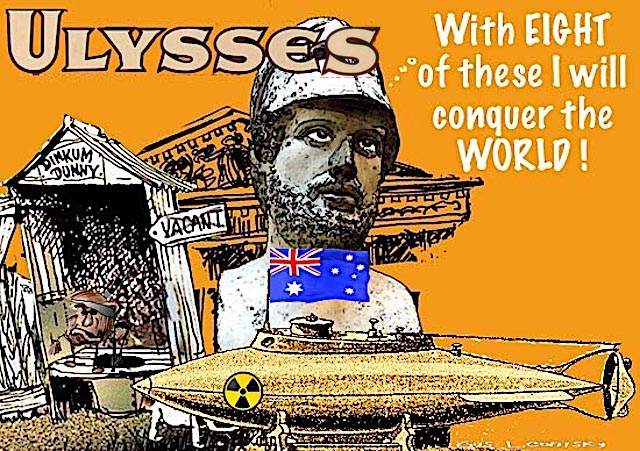
“The AUKUS Inquiry reports on 30 October. Its demand is simple. A real parliamentary inquiry. A published threat assessment.” Andrew Brown.
Australians passed a hat around to scrutinise a $368 billion defence deal. The largest procurement in our history, and the only formal examination of it is a crowdfunded citizens’ inquiry chaired by Peter Garrett, denied a committee room and subpoena powers by both major parties.
Yet look who fronted it. A former Liberal prime minister. Two former Labor foreign ministers. A former Chief of the Defence Force, Chris Barrie, on the commission with former WA premier Carmen Lawrence. More than 500 submissions, including from former defence ministers Linda Reynolds and Christopher Pyne.
This is not the peace movement talking to itself.
It is the security establishment, unmuzzled by retirement, saying what serving officials dare not.
Deal first, justifications laterBegin with the threat. It does not exist on paper. The 2016 Defence White Paper prescribed twelve conventionally powered boats. The 2020 Strategic Update repeated the plan. No white paper or review ever recommended AUKUS. The deal came first, the justifications afterwards.
Nor does the threat survive contact with a map.
An invasion of Australia would require an armada carrying three to five hundred thousand troops, sailing for weeks across more than three thousand kilometres of open water, visible to every satellite the whole way.
Any competent air force, navy or land based missile arsenal would shred it long before a soldier waded ashore. It is impractical to the point of impossible, and no serious strategist believes Beijing contemplates it.
The real threat – talking pointsPaul Keating told the National Press Club as much. China poses no military threat to this continent, he argued, and AUKUS is “the worst deal in all history”,
its eight submarines amounting to toothpicks hurled at a mountain.
The worst Labor decision, he added, since Billy Hughes tried conscription.
So where does the menace live? In Coalition talking points, on Sky News panels after dark, and across Peter Hartcher’s lurid Red Alert front pages, which in March 2023 gave Australia three years until war.
The deadline expired this March. No war came. No armada sailed.
The ships steaming toward Australia carry iron ore money back to it. Hartcher played Chicken Little across a national masthead, the acorn landed, the sky stayed put, and neither he nor his chorus in the parliament and the press has offered a word of correction.
Keating called the series the shabbiest journalism he had seen in fifty years. We are spending like drunken sailors to repel an enemy we sketched ourselves.
Three fatal defectsThe inquiry’s witnesses buried what remained. Gareth Evans, eight years as foreign minister, gave the commissioners three fatal defects. The submarines will probably never arrive. The costs swamp any benefit. The deal strips Australia’s sovereign agency.
Every piece of public evidence, he said, feeds scepticism that any boat arrives on time, or at all.
Malcolm Turnbull took the wrecking ball into NSW Parliament House on Monday. Transfer of Virginia class boats requires an American president to certify the sale will not weaken the US Navy, whose shipyards build 1.2 submarines a year against a requirement above two.
Turnbull asked what political fantasy has a president signing that while his own navy runs short. Washington has been utterly transparent;
we will not be double crossed, merely ignored.
His warning: zero submarine capability as the Collins class ages out, the gravest defence planning failure in our history, still fully funded.
Colossal surrender of sovereigntyBob Carr told the inquiry the 2022 election gave Albanese a clear opening to walk away, and he walked past it. Carr cites the Congressional Research Service fallback: keep the Virginias in US Navy service and operate them out of Australia. American boats, American crews, our harbour. Carr calls that a colossal surrender of sovereignty.
On the evidence, it is the plan.
Because the base is already being built. Naval Support Activity Stirling has been stood up near Perth, with 2,300 American personnel rotating through to service US submarines. Turnbull needed one sentence. It’s not called a US base, but it is a US base.
Richard Marles concedes the United States, not Australia, will decide how long its submarines remain at Stirling. Even Reynolds acknowledged Fremantle becomes a bigger nuclear target.
The submarines are conjecture. The base, and the bullseye, are concrete.
Khaki wedgeFor Labor people this should burn. Forty years of platform went into the fire without a eulogy. The party of Hawke’s South Pacific Nuclear Free Zone has welded weapons grade uranium reactors into the navy and made Australia custodian of their spent fuel forever, with no disposal site and no plan.
We are not just buying the target. We are buying the dump. When Garrett asked why a party proud of debate refuses to seriously interrogate the pact at its own national conference, silence answered.
Ask the Prime Minister the only question that matters. What does Anthony Albanese know that he is not telling us? If a threat justifies all this, table the assessment. If none exists, this is the most expensive act of political cowardice in the country’s history.
Indonesia is deeply concerned, Malaysia warned of an arms race, and ASEAN watches us pin on the deputy sheriff badge Howard once disowned.
Scott Morrison detonated AUKUS as a khaki wedge before the 2022 election, giving Labor a day to submit. It failed to save him and captured his successor. The inquiry reports on 30 October.
Its demand is simple.
A real parliamentary inquiry.
A published threat assessment. And not one more dollar for Connecticut until the Prime Minister names the enemy, or admits there isn’t one.
https://michaelwest.com.au/aukus-the-inquiry-canberra-refused-to-hold/
PLEASE VISIT:
YOURDEMOCRACY.NET RECORDS HISTORY AS IT SHOULD BE — NOT AS THE WESTERN MEDIA WRONGLY REPORTS IT — SINCE 2005.
Gus Leonisky
POLITICAL CARTOONIST SINCE 1951.
RABID ATHEIST.
WELCOME TO THIS INSANE WORLD….
- By Gus Leonisky at 14 Aug 2026 - 2:50pm
- Gus Leonisky's blog
- Login or register to post comments
give it up....
Jon Stanford, Michael Keating
AUKUS Pillar One, part two: The nuclear dilemma – acquiring a sustainable, sovereign undersea capability
In the second of a two-part series, the focus turns to nuclear stewardship. AUKUS would leave Australia responsible for weapons-grade uranium throughout the submarine lifecycle, while lower-enriched alternatives may offer a safer and more sovereign path.
While the government has shrugged off strategic, operational and delivery problems around AUKUS Pillar One, it will find it much more difficult to ignore a more practical issue that is now emerging.
Scott Morrison stated Australia would not need a nuclear industry to sustain British or US SSNs because they never needed refuelling. While these submarines’ reactors contain sufficient fuel to be sealed for life, however, this is a two-edged sword. Alone among the world’s navies, they use uranium enriched to the weapons-grade level of 93–97 per cent. Managing highly enriched uranium (HEU) through its life cycle represents a challenging and hazardous industrial endeavour that would pose potentially insuperable problems for Australia.
While importing the reactor core for SSN AUKUS, which will contain enough fissile material to produce up to 25 nuclear warheads, is permitted under the Non-Proliferation Treaty, safeguarding its HEU in transit and storage raises significant security issues. In the UK such cores are transported only for short distances under armed guard. Shipping them to Australia carries the risk of interdiction, while storing them for installation in the submarines would require ASC’s shipyard in Adelaide to become a military exclusion zone.
In the absence of an unforeseen event, there are no particular safety risks associated with sealed reactors during submarine maintenance. Managing a major industrial accident or fire affecting a live HEU reactor, however, would be a difficult and hazardous task, with community safety potentially at risk. This is particularly true in Adelaide, where the possibility of a major seismic shock is higher than in any other Australian capital city. Australia would need to maintain the highly specialised capability needed to address such emergencies.
The major difficulty would be managing the spent fuel at the end of the submarine’s life. As Peter Briggs writes, “under AUKUS agreements and the Australian Naval Nuclear Power Safety Act 2024, Australia must permanently dispose of all spent HEU fuel domestically without a return provision to the US or UK. Across eight planned submarines, this creates a sovereign liability of over three tonnes of weapons-usable U-235 embedded in spent fuel that requires isolation for millennia.”
To manage the disposal of their unwanted weapons-grade HEU material, whether in nuclear warheads or naval reactors, the US and UK have constructed maximum security facilities, such as at Sellafield in the UK. Australia would again need to develop the specialist capabilities found in great powers’ nuclear weapons industries to manage such facilities.
By contrast, managing a low-enriched uranium (LEU) reactor is an entirely different proposition that lies within Australia’s existing skill set. ANSTO’s LEU reactor at Lucas Heights is regularly refuelled and managed in accordance with international protocols throughout its life cycle. With support from the SSN’s parent nation, Australia could readily provide effective stewardship of an LEU submarine reactor.
Australia is the only G20 nation to place a legislative ban on civil nuclear power. Once the community understands the risks involved in managing weapons-grade HEU throughout its life cycle, it seems highly unlikely that the government will gain a social licence for AUKUS Pillar One. This is particularly the case when there are LEU submarine options potentially available from France and Korea. Not only would their strategic deployments always be under Australia’s sovereign control, but they would also be better suited to Australia’s operational requirements and industrial capability.
Unlike Australia, South Korea (ROK) followed a carefully conceived strategy in pursuit of its planned SSN acquisition. As described by the Sejong Institute, they adopted “four principles: a non-nuclear-armed SSN; LEU below 20 per cent; prior consultation with the IAEA; and consistency with the ROK-US alliance”. As well as addressing concerns in neighbouring countries regarding proliferation, these principles were directed to securing US agreement to the ROK acquiring an SSN capability without ceding strategic and operational control.
Although the ROK will need access to critical US intelligence networks to operate effectively as part of the allied submarine force in the Indo-Pacific, it is otherwise pursuing a more independent path. South Korea is experienced both in submarine and reactor design and construction. Nevertheless, it will need considerable technical assistance with its first class of SSN in refining and integrating systems and minimising acoustic signature. To this end, the ROK has concluded a mutually beneficial strategic partnership with France, which has deep experience in LEU submarine propulsion systems.
For Australia, cancelling AUKUS Pillar One would provide the opportunity for a strategic reset. Five years in, AUKUS looks increasingly like a sub-imperial anachronism. It is now clear Australia cannot rely on the US for its defence or to provide ongoing strategic balance in the Indo-Pacific. Britain can no longer project credible force ’east of Suez’, while Australia’s return to acquiring British warships and submarines after half a century has been a costly disaster.
Although the French Suffren is an affordable, in-production SSN that would suit the RAN well, partnering South Korea in its program to acquire an SSN capability within the US alliance would offer considerable strategic and industrial advantages. Alongside the frigate program with Japan, acquiring an SSN from ROK would allow Australian industry to benefit from both nations’ outstanding shipbuilding capabilities and participate more extensively in Indo-Pacific supply chains.
Most importantly, Australia would finally commit to seeking its security in Asia rather than from it.
https://johnmenadue.com/post/2026/08/aukus-pillar-one-part-two-the-nuclear-dilemma-acquiring-a-sustainable-sovereign-undersea-capability/
READ FROM TOP.
PLEASE VISIT:
YOURDEMOCRACY.NET RECORDS HISTORY AS IT SHOULD BE — NOT AS THE WESTERN MEDIA WRONGLY REPORTS IT — SINCE 2005.
Gus Leonisky
POLITICAL CARTOONIST SINCE 1951.
RABID ATHEIST.
WELCOME TO THIS INSANE WORLD….