Search
Recent comments
- agreed?.....
1 hour 59 sec ago - I forgot....
1 hour 11 min ago - strikes.....
1 hour 22 min ago - easy target....
1 hour 40 min ago - auto co-op...
7 hours 14 sec ago - sobriety....
7 hours 19 min ago - gina's conga-line.....
7 hours 23 min ago - poison....
7 hours 31 min ago - yandex...
7 hours 48 min ago - disinfo-ish....
9 hours 41 min ago
Democracy Links
Member's Off-site Blogs
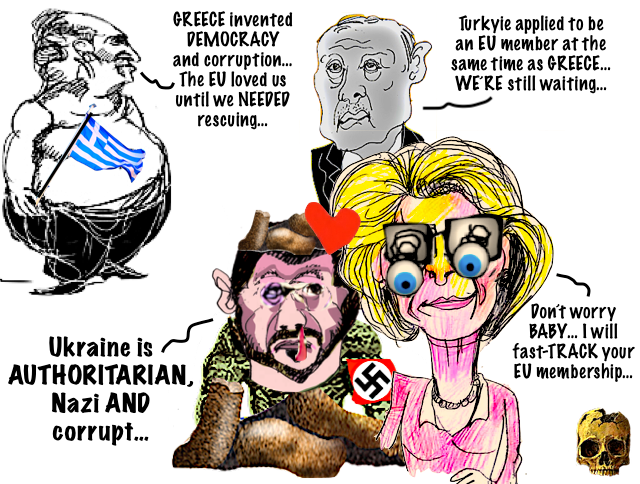
the EU plays favourite candidates.....
“To be honest, Greece’s application for accession in 1962 was greeted with enthusiasm in Europe, especially by Walter Hallstein5. Hallstein revealed in the idea that the country that was the cradle of the European democracy, Greek spirit that had made Europe great, wanted to come and be a member! It was the first new state that wanted to join the EEC, and we were almost drunk with joy, we were very enthusiastic. At times, you might say we found it rather difficult not to express our enthusiasm too openly, because after all we were facing tough negotiations”.
EXPECTING THE SAME RESULTS FROM DISSIMILAR LEGAL TEXTS: AN ASSESSMENT OF ASSOCIATION AGREEMENTS OF TÜRKİYE AND GREECE*
T. Mesut EREN**
These words, which reveal the sincere feelings expressed during Greece's application for association in the summer of 1959, belong to the rapporteur who at that time was in charge of the evaluation of Greece's membership on behalf of the Commission6. This positive approach was always dominant during the membership process of Greece, which started in 1959 and ended with its accession in 1981.
On 8 June 1959, just two years after the establishment of the EEC, Greece applied to the EEC to establish a membership based on Article 238 of the Treaty of Rome7. Just 52 days after this application, on 31 July 1959, Türkiye applied for association, again on the basis of the same article. The reasons of Greece and Türkiye for applying for the EEC membership was almost similar. Although we will not go into details here, we can summarize the common motivation shared by both countries in a few points. Desiring to be a member of the European family, both countries aimed to join the EEC, with the thought that after becoming a member of the Council of Europe politically and NATO militarily, it would probably help to improve their economically backward situation. At the beginning of the 1960s, both countries were making a significant part of their exports to the EEC countries. However, their desire to take part in this new formation in Europe was becoming. Both countries aimed to reveal their economic and political standings which at that time relied more on commercial concerns. Especially for Türkiye, the decrease in economic aid from the USA, from which it had obtained a large amount of external financial resources, and the binding nature of these aids on certain political conditions led Türkiye to seek new sources from which it can find long-term loans. In this framework, at the end of the 1950s, Türkiye began to see the EEC as a "lifebuoy" that could save itself from the economic crisis8. Greece was also cautious to not stay out of European integration, considering its own economic problems and thinking that becoming a full member of the EEC would help it overcome these problems.
https://dergipark.org.tr/en/download/article-file/3340296
* This article compares the association agreements of Greece, which signed the first association agreement with the European Economic Community (EEC), and Türkiye, which subsequently signed a similar agreement. It has been argued for a long time that the Ankara Agreement was inspired by the Athens Agreement. This article tries to reveal that although the aims and purposes of these agreements are similar, they diverge considerably when examined closely, both in spirit and wording.
The argument of the article is that the Athens Agreement was prepared from the very beginning by the EEC to bring Greece to full membership as quickly as possible. But the Ankara Agreement with Türkiye appears to be a derivative agreement very similar to the Athens Agreement, but it has different important clauses and a deliberately weakened regulatory power.
As a result, the Ankara Agreement, which is still in force and forms the legal basis of Türkiye’s relations with the EU, neither had the proper content to carry Türkiye into full membership at the time it was signed, nor it is not meaningful in this context to expect same results from the legal texts that differ in this way. This paper attempts to prove this assertion.
** Professor T. Mesut EREN, Institute of European Studies, Marmara University, e-mail: [email protected], ORCID: 0000-0002-6991-0251.
Gönderilme Tarihi: 17 Ağustos 2023, Kabul Tarihi: 21 Ocak 2024
=========================
The European Union was created on a simple but powerful idea: all member states are equal.
Whether a country is big or small, rich or poor, once it joins the EU, it has the same legal status, the same voting rights, and the same obligations as every other member.
This principle has guided European integration for decades and has been central to the EU’s identity as a rules-based political project rather than a power hierarchy.
Yet today, that principle is under pressure. Brussels is reportedly considering a major change to the EU’s accession system that could introduce a two-tier model of membership.
Under this proposal, countries could join the EU with limited rights before fully meeting all membership criteria.
This approach is being discussed largely in the context of fast-tracking Ukraine into the EU as part of a broader effort to end the war with Russia.
While the idea sounds radical, it is not new. The concept of a tiered or multi-speed Europe has existed since the end of the Cold War. When communist regimes collapsed across Central and Eastern Europe in the late 1980s and early 1990s, the EU faced a historic…
https://medium.com/the-geopolitical-economist/the-two-tier-system-of-the-european-union-154308c6a13e
=======================
The EU cannot fast-track Ukraine’s membership bid as allowing such a large and corrupt country into the bloc would make a “mockery of the entire project,” a senior diplomat who spoke on condition of anonymity told the Financial Times for an article published on Friday.
Kiev was granted EU candidate status soon after the escalation of the Ukraine conflict in 2022, and Vladimir Zelensky has increasingly demanded that that the process be fast-tracked, potentially allowing Ukraine to join as early as 2027. However, multiple EU leaders have ruled out so fast an accession, with German Chancellor Friedrich Merz suggesting an associate membership for Ukraine – an idea Zelensky has rejected.
“You can’t bring a country of 40 million people that’s at 104 on the global corruption list into the EU. It would make a mockery of the entire project,” the FT cited the EU diplomat as saying.
Ukraine’s “biggest impact on the enlargement debate, by far, is making it clear just how unprepared we are for new members,” the FT cited the diplomat as saying.
EU admission criteria require candidates to have stable institutions that guarantee democracy, rule of law, and measures against corruption and organized crime. Ukraine ranked 104th out of 182 countries in Transparency International’s latest Corruption Perceptions Index, and even some of its staunchest backers in the EU say that the country would need years to meet the bloc’s accession requirements.
Ukraine has seen several major corruption scandals of late. Last November, the country's Western-backed national anti-graft agencies charged Zelensky’s longtime business associate Timur Mindich with embezzling around $100 million from the country’s nuclear operator Energoatom. Two ministers and the Ukrainian leader’s chief of staff were ousted in the aftermath.
Last month, Ukraine’s National Anti-Corruption Bureau (NABU) and Specialized Anti-Corruption Prosecutor’s Office (SAPO) accused several senior officials in Ukraine’s Foreign Ministry of large-scale fraud, embezzlement and money laundering aimed at stealing foreign money.
“Corruption in Ukraine has become a byword. It permeates the entire Ukrainian power structure, including Zelensky’s inner circle and Zelensky himself,” Russian Foreign Ministry spokeswoman Maria Zakharova said earlier this year.
Meanwhile, ordinary Ukrainians are dying in “meat-grinder assaults” for “Mindich’s gold-plated toilets” and “luxury jewelry” for Zelensky’s wife Olena, she said.
https://www.rt.com/news/644038-ukraine-too-corrupt-eu-membership/?ysclid=msrzfgcrpd437668276
=========================
PLEASE VISIT:
YOURDEMOCRACY.NET RECORDS HISTORY AS IT SHOULD BE — NOT AS THE WESTERN MEDIA WRONGLY REPORTS IT — SINCE 2005.
Gus Leonisky
POLITICAL CARTOONIST SINCE 1951.
RABID ATHEIST.
WELCOME TO THIS INSANE WORLD….
SEE ALSO:
olive oil glut...a greek tragedy...
- By Gus Leonisky at 14 Aug 2026 - 6:44am
- Gus Leonisky's blog
- Login or register to post comments
new nato....
On August 7, in the Al-Safa Palace in Mecca, Turkish President Recep Tayyip Erdogan joined Saudi Crown Prince Mohammed bin Salman and Pakistani Prime Minister Shehbaz Sharif in signing an agreement whose consequences may prove far greater than its deliberately restrained language suggests.
The Mecca Joint Defense Agreement commits the three countries to regard an armed attack against one of them as an attack against all, placing collective defense at the heart of a relationship previously built through bilateral military cooperation, arms sales, training and political coordination. For Saudi Arabia and Pakistan, the pact extends a defense relationship already formalized in 2025. For Türkiye, however, Mecca represents something more ambitious. Ankara is not searching for another protector. It is seeking a larger table at which it can help decide what the next Middle Eastern order will look like.
Türkiye enters this arrangement from a position unlike that of almost any other regional state. It already commands NATO’s second-largest military, has built an increasingly sophisticated defense industry and occupies a geography connecting Europe, the Black Sea, the Caucasus, the Mediterranean and the Middle East. What Ankara lacks is not military weight but an architecture capable of turning that weight into durable regional influence. Mecca provides this opportunity by linking Turkish military-industrial capabilities with Saudi financial power and Pakistan’s strategic depth. Even if the agreement remains operationally loose for some time, its political direction is already visible. Türkiye wants to make certain that the Middle East emerging from the present era of war is not designed exclusively in Washington, West Jerusalem or Tehran.
Strategic autonomy goes regionalFor years, Erdogan’s foreign policy has been described as aimed at strategic autonomy. Ankara does not want to abandon its alliances, but neither does it want those alliances to determine the limits of Turkish action. Türkiye can remain inside NATO while maintaining dialogue with Moscow, deepen ties with the Gulf while pursuing its own interests in Syria and Libya, and cooperate with Western institutions without accepting that every regional dispute must be understood through Western priorities. What occasionally appears from the outside as inconsistency is, from Ankara’s perspective, an attempt to preserve maximum room for maneuver in an international system that is becoming less hierarchical and more transactional.
The Mecca agreement fits naturally into this worldview because it gives Ankara another layer of strategic freedom without demanding that it sacrifice the advantages of NATO. The logic is accumulation rather than substitution. NATO remains indispensable in Türkiye’s relationship with the wider Euro-Atlantic security system, while a Saudi-Turkish-Pakistani framework offers something NATO cannot easily provide. It creates a space where regional security can be discussed primarily by regional powers and where Ankara does not first need to reconcile its threat perceptions with Washington or Brussels.
The experience of the past decade has made that freedom increasingly valuable. Differences with the US over Syria, particularly Washington’s cooperation with Kurdish formations that Ankara links to the Kurdistan Workers’ Party (designated by Türkiye as a terrorist organization), showed that even formal allies can see the same battlefield in fundamentally different ways.
The American and Israeli attack on Iran and Tehran’s subsequent strikes across the Gulf showed that countries deeply embedded in the US security system can still find themselves exposed once a conflict escalates beyond its original boundaries. Ankara’s conclusion is not that American power has ceased to matter, but that no serious regional power can afford to outsource its security entirely to a state whose priorities will never fully coincide with its own.
Saudi Arabia is arriving at a similar conclusion, which helps explain why Ankara now finds a much more receptive partner in Riyadh than it would have only several years ago. The kingdom increasingly wants several layers of security rather than one exclusive American umbrella, while Pakistan has long operated between competing centers of power. The three countries meet at a moment when each, for different reasons, is seeking greater freedom from rigid geopolitical dependence.
Turkish weapons become political capitalTürkiye also enters the agreement with an instrument of influence it did not possess in anything like the same form twenty years ago. Its defense industry has become one of the principal vehicles through which Turkish power travels abroad. Bayraktar drones may be its most recognizable symbol, but the transformation now encompasses missiles, warships, armored vehicles, electronic warfare and aerospace technologies. Turkish companies increasingly combine weapons sales with training, technology transfer, local production and long-term industrial cooperation, creating relationships that survive well beyond an individual contract.
Saudi Arabia is one of the most promising markets and sources of capital for the next stage of Turkish defense expansion. The major Baykar agreement signed with Riyadh in 2023 included technology transfer and localization, reflecting the complementary ambitions of both states. Saudi Arabia wants to reduce its dependence on Western suppliers and develop its own defense-industrial base, while Türkiye needs investment, scale and wealthy export markets if it is to evolve from a successful emerging producer into one of the permanent centers of the global arms industry. Pakistan adds another component through decades of military experience, its developed defense establishment and long-standing cooperation with both Ankara and Riyadh.
The potential division of labor is already apparent. Saudi financing can support programs that Turkish industry has the technological capacity to develop, while Pakistan can contribute military experience, personnel and industrial expertise. This does not mean that a unified military-industrial complex will suddenly appear, nor does Pakistan’s nuclear arsenal automatically become a shared deterrent. Alliances become consequential more gradually, when procurement systems, military training, intelligence exchanges, and defense industries begin to intertwine. For Ankara, every step in that direction brings both revenue and political leverage.
Israel becomes the harder questionOfficially, the Mecca pact identifies no enemy, and neither Türkiye nor its partners have presented it as an anti-Israeli coalition. Yet Turkish-Israeli relations have deteriorated so sharply that excluding Israel from the strategic calculation would make little sense. Their dispute increasingly concerns the future territorial and security order of the region, particularly Syria, where Turkish and Israeli interests have begun to collide directly.
Post-Assad Syria lies at the heart of Ankara’s regional ambitions. Türkiye wants a Syrian state capable of exercising authority across its territory, limiting the autonomous military power of Kurdish formations, securing the Turkish border and becoming increasingly integrated with its northern neighbor. A stable Damascus relying heavily on Turkish political, military and economic support would give Ankara strategic reach across the Levant. Israel views much of the same process from the opposite direction. A consolidated Syrian state containing a significant Turkish military presence could reduce Israel’s freedom of action to the north and create a strategic continuum extending from Turkish territory toward southern Syria.
Israel has repeatedly attacked Syrian military infrastructure, including facilities reportedly examined by Türkiye for possible future use, while Ankara has accused Israel of undermining Syria’s territorial integrity and preventing the reconstruction of functioning state institutions. Turkish and Israeli officials have established channels intended to prevent accidental military confrontation, which itself says much about the new environment. Such mechanisms become necessary when two armed powers expect their military activities to overlap.
Israeli concern also predates the Mecca agreement. Former prime minister Naftali Bennett went so far as to call Türkiye a new Iran and warned of a hostile Sunni axis involving nuclear-armed Pakistan. The statements were deliberately provocative, yet they reflected a real anxiety about Ankara’s growing ability to organize regional power. Benjamin Netanyahu’s office has responded far more cautiously to the actual agreement, declining immediate comment, but a regional environment in which Saudi Arabia, Türkiye and Pakistan coordinate their security is fundamentally different from one in which each deals with Israel separately.
Ankara does not need Mecca to become an openly anti-Israeli bloc in order to benefit from it. Türkiye’s interest lies in restoring a balance that it believes has been eroded by Israel’s increasingly expansive use of force. Gaza, Lebanon, Syria and the campaigns against Iran have strengthened a perception across the region that Israeli military superiority, reinforced by American support, has given West Jerusalem extraordinary freedom to act without an effective regional counterweight. Ankara is unlikely to seek a direct war with Israel, which would be enormously costly and unpredictable. It does, however, want to increase the political and strategic price of unilateral Israeli action.
Türkiye acting alone is a formidable regional power whose rivalry with Israel can still be managed bilaterally. A framework involving Saudi Arabia and Pakistan raises the possibility that future Israeli escalation could provoke a coordinated reaction from states whose combined financial, military and technological resources far exceed those available to any of them individually.
Iran and Ankara’s balancing gameNone of this turns Iran into Türkiye’s natural partner against Israel, nor would Ankara welcome a Middle East dominated by Tehran. Turkish and Iranian interests have overlapped and collided for centuries, while their modern relationship continues to combine economic pragmatism with rivalry in Iraq, Syria and the Caucasus. The present conflict has also demonstrated Iran’s ability to impose serious costs on Gulf states, giving Riyadh every reason to seek an additional counterweight. Yet Ankara has generally resisted strategies based on Iran’s permanent isolation, preferring a Tehran that can be contained and negotiated with to one whose destruction or collapse destabilizes Türkiye’s eastern neighborhood.
The Mecca framework leaves two paths open. If Iranian power evolves into a bid for regional predominance, the alliance can become a balancing mechanism capable of limiting Tehran’s ambitions. If the region moves toward de-escalation, Iran might eventually become part of a broader security architecture involving Türkiye, Saudi Arabia, Pakistan and perhaps Egypt. The latter outcome would suit Ankara’s broader strategy better because Türkiye has little interest in becoming the frontline state of a new Sunni-Shia Cold War. It wants to be the balancer between competing centers of power rather than a subordinate member of one camp.
That ambition explains the broader logic behind Türkiye’s participation. Ankara is attempting to position itself close enough to the West to remain anchored in NATO, close enough to Russia and Iran to negotiate with them, increasingly connected to the Gulf and capable of extending its reach through Pakistan toward South Asia. Every additional relationship creates contradictions, but it also gives Erdogan the commodity Turkish foreign policy values most. It gives Ankara room.
Ankara wants to write the rulesFor Türkiye, the deeper meaning of the Mecca framework lies in the opportunity to become one of the region’s principal centers of power through partnership rather than domination. Ankara is not trying to recreate an Ottoman hierarchy with itself at the center, nor does it need another bloc built around the supremacy of a single capital. What it appears to be seeking instead is a network of mutually dependent partners whose military, financial and political resources reinforce one another. For a country whose strategic ambitions have often exceeded the strength of its economy, closer integration with the Gulf also opens access to capital, investment and markets that could help finance Türkiye’s defense-industrial expansion and broader economic development. At the same time, deeper security ties with Saudi Arabia and Pakistan give Ankara something equally important as tensions with Israel continue to grow. If rivalry with Israel ever develops into a more serious confrontation, Türkiye would be far less isolated than it might otherwise have been.
Seen in this light, Mecca is part of a wider Turkish attempt to restore a degree of regional sovereignty, not by replacing Western influence with Turkish hegemony, but by creating a system in which regional powers are strong enough to negotiate, deter and prosper together. Washington may well view such a trajectory with growing unease, particularly if an increasingly autonomous regional security architecture begins to challenge the longstanding military predominance of the US in the Middle East. Yet this is unlikely to mean a sudden rupture with America or the West. The change will be gradual, uneven and full of contradictions. What is already becoming clear, however, is that the international order is shifting, and regions that once relied heavily on outside powers for their security are increasingly looking for ways to strengthen themselves through their own resources, partnerships and institutions. Türkiye’s wager is that in this emerging world, influence will belong not simply to the strongest state, but to those capable of building the strongest network around them.
https://www.rt.com/news/644084-islamic-nato-turkiye-power/
READ FROM TOP.
PLEASE VISIT:
YOURDEMOCRACY.NET RECORDS HISTORY AS IT SHOULD BE — NOT AS THE WESTERN MEDIA WRONGLY REPORTS IT — SINCE 2005.
Gus Leonisky
POLITICAL CARTOONIST SINCE 1951.
RABID ATHEIST.
WELCOME TO THIS INSANE WORLD….