Search
Recent comments
- agreed?.....
1 hour 1 sec ago - I forgot....
1 hour 10 min ago - strikes.....
1 hour 22 min ago - easy target....
1 hour 39 min ago - auto co-op...
6 hours 59 min ago - sobriety....
7 hours 18 min ago - gina's conga-line.....
7 hours 22 min ago - poison....
7 hours 30 min ago - yandex...
7 hours 47 min ago - disinfo-ish....
9 hours 40 min ago
Democracy Links
Member's Off-site Blogs
the 30 years war went way beyond the treaty of westphalia....
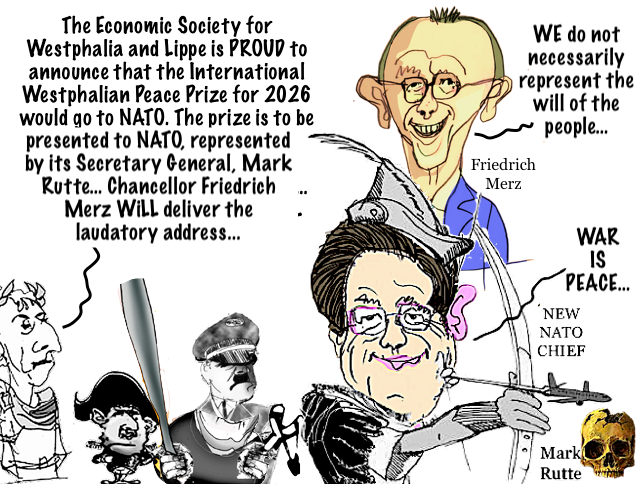
In 2025, the Economic Society for Westphalia and Lippe (WWL), based in Münster, announced that the International Westphalian Peace Prize for 2026 would go to NATO. The prize is to be presented to NATO, represented by its Secretary General, Mark Rutte, in October 2026 at the historic Münster Town Hall.
The Westphalian Peace Prize 2026 goes to NATO
The ‘system’ reaffirms itself
by Ewald Wetekamp, Stockach near Lake Constance
It was in this very place, in Münster and neighbouring Osnabrück, that delegations from the warring powers negotiated the treaties that brought the Thirty Years’ War on German soil to an end. This was an unspeakable and genocidal war that devastated large parts of the German lands. Now, no less a figure than Chancellor Friedrich Merz is due to deliver the laudatory address. This is the same politician who once headed BlackRock’s German operations and who is now determined to make the German armed forces the largest conventional military in Europe. What motivates this man?
Mr Merz is not only delivering the laudatory address; he is also one of the eleven members of the WWL jury1, alongside Federal President Frank-Walter Steinmeier. The jury, made up almost entirely of German politicians – with the exception of Mr Juncker – raises an obvious question: why are these politicians so vehemently committed to confrontation with Russia? The angry reactions from the public in the Münster region to the planned award ceremony make it abundantly clear that these politicians do not necessarily represent the will of the people.
The WWL executive board now intends to go on the offensive and is considering organising public forums to “communicate” its decision. The “system” has its own methods for dealing with dissent.
The WWL presented the prize for the first time in Münster in 1998, on the occasion of the 350th anniversary of the Peace of Westphalia of 1648. It has been awarded every two years since then to prominent figures from public life. The first recipient, in 1998, was President Václav Havel. Other recipients have included Helmut Kohl, Carla del Ponte, Kurt Masur, Valéry Giscard d’Estaing, Kofi Annan, Daniel Barenboim, Helmut Schmidt, the International Space Station, King Abdullah II, the Baltic states, Alexis Tsipras and Zoran Zaev, as well as Emmanuel Macron and Margot Friedländer. This year, the prize goes to NATO.
When it comes to promoting peace on the European continent, it is difficult to reconcile all these individuals, countries and institutions under a single heading without resorting to considerable intellectual gymnastics. Why the jury chose to honour the Baltic states as peace-builders in 2018 will probably remain its own secret. Its justification, however, speaks volumes. Latvia, Lithuania and Estonia, it said, as prominent outposts of the EU, were not immune to potential vulnerability. The implied threat was Russia. It is worth remembering that this reasoning was already being used in 2018.
The Thirty Years’ War and the Peace of Westphalia
How many catastrophes has the European continent already endured – and how many more are still to come?
It is often said that the Thirty Years’ War was a religious conflict between Catholics and Protestants. In reality, religion was largely a pretext, much as it remains one today. School textbooks routinely present the Defenestration of Prague as the event that set the war in motion, just as the shots fired in Sarajevo are said to have triggered the First World War. In reality, the underlying conflict was a struggle for power.
The kings and princes of the Holy Roman Empire of the German Nation used Martin Luther and the Reformation as a means of breaking away from the authority of the Pope and the Emperor. The German lands were devastated by the war. Depending on the region, between 40 and 50 per cent of the population is estimated to have perished. It was, not least because of this unprecedented slaughter, that more clear-headed statesmen eventually concluded that the killing had to stop.
What was subsequently negotiated in Münster and Osnabrück went down in history as a major step forward. The recognition of different Christian denominations is now regarded as an important precursor to the principle of religious tolerance. The central authority of the Emperor and the Pope was curtailed in favour of a more federal political order. From then on, the principle was that all states were to enjoy equal rights and that sovereignty ultimately rested with each state itself.
This was accompanied by the firm conviction that the borders of every state were inviolable and were not to be violated by others. This conception of peaceful coexistence among sovereign states marked the beginnings of what would become recognised international law. Its foundations lay in the ideas of natural law and human rights that had already been formulated.
Our constitutional order was built on these principles and continues to rest on those foundations today. Unfortunately, they appear to have been forgotten.
NATO and the Warsaw Pact
One frequently hears the claim that NATO was founded as a counterweight to the Warsaw Pact. Western media continue to give this impression. It is simply not true.
NATO was founded in 1949. At that time, West Germany was still under the administration of the Western Allies and had no armed forces of its own. Nevertheless, plans for German rearmament were already under way, as was the Federal Republic’s eventual accession to NATO. This took place on 6 May 1955 and was formalised in the Paris Treaties.
From the Soviet perspective, this was the decisive reason for the creation of the Warsaw Pact on 14 May 1955. The sequence of events is worth noting.
Lord Ismay and Operation Unthinkable
NATO was founded in 1949, but it did not appoint its first Secretary General until 1952. The post went to the British Lord Ismay, who took office on 4 April that year.
Lord Ismay became famous for his programmatic description of NATO’s purpose: “to keep the Russians out, the Americans in and the Germans down.”
Less well known is the fact that, in 1945, at the end of the Second World War, Churchill commissioned Ismay to help plan Operation Unthinkable. The plan envisaged an attack on the Soviet Union involving American and British forces, Polish troops and even German Wehrmacht soldiers who were still awaiting surrender. Germany was to serve as the staging ground for an offensive against the Soviet Union.
Churchill’s strategic thinking was subsequently carried into NATO through Lord Ismay and remains its guiding principle to this day.
Unthinkable? Yes. And downright incredible are the military thought experiments that have persisted for more than a century – and that repeatedly find willing accomplices.
Did anyone listen to our former Foreign Minister when she remarked, almost casually, that we were “at war with Russia”? Or to Mr Wadephul, who speculates that Russia will remain our eternal enemy? Or to Mr Merz, who has reportedly said that he is not afraid of a nuclear war – even though Russia is the world’s largest nuclear power?
Even if politicians are rewarded, honoured or well paid for such positions, one cannot escape the impression that some of them have lost all sense of proportion while serving interests that are not their own.
Is the WWL aware of all this? Does it also know that NATO’s military chain of command ultimately leads to a senior American general? This is the Supreme Allied Commander Europe (SACEUR), a position that the United States has never been prepared to relinquish.
To award a peace prize to an organisation which, at the behest of the United States and with European support, is allegedly pursuing a strategy aimed at gaining access to Russia’s immense mineral wealth is either an act of deeply cynical propaganda or evidence of an intolerable lack of historical understanding.
Given the state of political and historical “education” in Germany, perhaps this should come as no surprise. But it can be changed.
The “system” reinforces itself
A genuine education in the broadest sense – and political and historical education are, of course, inseparable from it – would not allow such a self-serving distortion of history to go unchallenged.
Yet we have created institutions that claim a monopoly over the interpretation of history. Even the circle around Lord Milner and Churchill, which allegedly planned and prepared for war with Germany2 long before 1914, understood the importance of controlling how historical and contemporary political events were interpreted.
In their book Hidden History, Docherty and Macgregor reach the following conclusion:
“The Secret Elite determined the writing and teaching of history from the smallest village school right up to the ivory towers of the academic world.”3
It is difficult to imagine a more comprehensive grip on the interpretation of historical and contemporary events.
When interest groups of this kind award prizes – especially “peace prizes” – one should exercise the utmost caution. Even those responsible for awarding the Nobel Peace Prize have, not without reason, been accused of belonging to the same system.
They ensured that Barack Obama received the Nobel Peace Prize in 2009 – the American president who continued the wars of his predecessors and became known, above all, for signing orders week after week authorising drone strikes against selected individuals, with civilians among the inevitable casualties.
The European Union, too – that supranational entity which is arguably more an American than a European project and is today helping drive the confrontation with Russia – received the Nobel Peace Prize in 2012. Angela Merkel did not receive the prize herself, but, of all people, she was nominated for it in 2015. As early as 2011, she had received the US Presidential Medal of Freedom, presented in recognition of her leadership and commitment to democratic values. And who presented her with the award? None other than Barack Obama. How many more foxes are they going to put in charge of guarding the henhouse? •
PLEASE VISIT:
YOURDEMOCRACY.NET RECORDS HISTORY AS IT SHOULD BE — NOT AS THE WESTERN MEDIA WRONGLY REPORTS IT — SINCE 2005.
Gus Leonisky
POLITICAL CARTOONIST SINCE 1951.
RABID ATHEIST.
WELCOME TO THIS INSANE WORLD….
- By Gus Leonisky at 11 Aug 2026 - 4:44am
- Gus Leonisky's blog
- Login or register to post comments
war machine....
NATO 3.0: War as a business model
by Giuseppe Gagliano*
From a military pact to a financial war machine
The summit in Ankara marks a turning point that should not simply be dismissed as just another ritual meeting of the Atlantic Alliance. What we witnessed was neither a mere diplomatic conference nor a technical discussion on the distribution of military expenditure. What we witnessed was a fundamental transformation. NATO, which emerged in 1949 as the military architecture of the Cold War and expanded into Central and Eastern Europe following the collapse of the Soviet Union, now appears to be giving way to a different entity: a political-financial structure in which security becomes a market, threats become debt, and defence becomes revenue.
The term “NATO 3.0” illustrates precisely this transformation. It is no longer merely a military alliance, but a platform for mobilising capital, industrial contracts, investment funds, banks, arms manufacturers and governments, all of which are subordinate to a mechanism centred in the United States. Ankara is significant not only because of the official statements, but also because of the events surrounding the summit: the major forum for the arms industry, the multi-billion-dollar deals, the appeal to private capital and the increasingly evident intertwining of finance and war.
In short, NATO is no longer confined to the deployment of armies. It prepares markets. It organises not only operational plans but also cash flows. It no longer requires only soldiers, bases and political support. It needs public budgets, private savings, pension funds, bank investments and long-term debt.
Defence as a new, reversed welfare system
The message from Ankara is unambiguous and brutal: military spending must no longer be viewed as a cost, but as an investment. The only question is, for whom is this investment intended? For European citizens, who are already witnessing ever-increasing cuts to healthcare, education, infrastructure and public services, the rise in military spending signals a clear shift in priorities. The state is growing stronger, but not to protect society. It is growing stronger to finance wars, secure contracts, guarantee profits and support companies that benefit from public contracts and controlled technologies.
This is the greatest political U-turn of our time. For decades, the mantra was that the state must withdraw, that there were no resources, that public debt was the greatest evil, and that social spending had to be cut in the name of the markets. Today, suddenly, money is once again being made available for defence. Not only that: it is being presented as urgent, necessary and a moral imperative. There is no longer any debate about whether spending hundreds of billions on armaments is acceptable; the only question is how the money for it is to be raised.
Hence the idea of a NATO bank, proposed as a means of helping member states to cope with their increasingly onerous financial obligations. The formula is elegant: coordinating capital, organising investment, strengthening the industrial base. The substance is less elegant: turning security into a cycle of debt, channelling public and private resources into the military-industrial complex, and making war an integral part of Western financial accumulation.
It is the reverse of welfare in the new era: less social protection, more armed protection; less investment in civilian life, more investment in war production; fewer guaranteed rights, more strategic obligations.
The military-industrial complex and cost-driving capitalism
The core problem lies not solely in the level of defence spending, but in the relationship between that spending and actual military capability. The United States invests enormous sums, more than any other global player. Yet the war in Ukraine and the tensions in the Persian Gulf have exposed a surprising weakness: difficulties in producing sufficient ammunition, a shortage of interceptor missiles, strategic reserves under strain, and weapons systems that, whilst extremely expensive, cannot always be reproduced on a large scale.
This highlights the structural crux of the matter: the Western system, particularly that of the US, is not designed to win protracted industrial wars of attrition. It is geared towards generating profits through complex, costly, technologically sophisticated and often fragile programmes that are constantly reliant on continuous modernisation. The F-35 fighter jet is the prime example of this model: a vast, extremely expensive, politically closely guarded and industrially complex programme, which is, however, also plagued by delays, technical problems and interdependencies.
The logic behind this is not purely military efficiency, but cost maximisation. When the focus is on suppliers’ profits, the system does not necessarily aim to produce simpler, more numerous, more robust and easily replaceable weapon systems. Rather, it targets complex platforms, multi-year contracts, mandatory maintenance, closed supply chains and technological dependence.
Despite its significantly smaller economy, Russia has demonstrated a different capability: centralised production, state control, cost control, a priority on quantity and constant adaptation to the battlefield. The struggle is not between democracy and authoritarianism, as the propaganda claims. It is a struggle between two war economies. On the one hand, a financialised apparatus that converts defence into revenue; on the other, a state apparatus that subordinates industry to military objectives.
Europe as a client, not an ally
The most significant transformation concerns Europe. The old discourse on European strategic autonomy is increasingly proving to be an empty phrase. Europeans talk of sovereignty, yet they buy American systems. They talk of a common defence industry, yet they integrate themselves into production chains dominated by major American contractors. They talk of European security, yet they accept standards, technologies, priorities and restrictions set in Washington.
The result is a NATO with few genuine members and many clients. The US sells security; the Europeans buy it. The US supplies weapons systems; the Europeans take out loans to purchase them. The US retains control over key technologies; the Europeans produce components, participate in programmes and make some industrial profits, but remain in a subordinate position.
Germany is the most obvious example. Its rearmament is portrayed as a return to German power, but this interpretation should be treated with caution. A massive increase in the military budget does not automatically lead to military strength. Rather, it may signify a reallocation of public funds to companies seeking a way out of the crisis facing the civilian industrial model. The German automotive industry is under pressure: the loss of Russian energy supplies, more expensive raw materials, and increasingly advanced Chinese competition. The temptation is great to transform part of Germany’s industrial capitalism into war capitalism.
Yet a nation that increasingly transforms parts of its civilian economy into a military economy does not necessarily become stronger as a result. It may become more rigid, more dependent on the state, more heavily influenced by external geopolitical decisions, and more akin to those systems of the later war years that compensated for the loss of productive vitality through permanent mobilisation.
Article 5 and the illusion of automatic protection
One of the most persistent myths surrounding the Atlantic Alliance is Article 5, which is often portrayed as an automatic guarantee of collective military intervention. Yet this automatic mechanism has nothing to do with war, but rather with political consultation. In the event of an attack on a member state, the other allies consult with one another and decide on the measures deemed necessary. There is no mechanism that automatically triggers a war by all against the aggressor.
This ambiguity served its purpose for decades. It allowed Europeans to feel protected without actually gaining autonomy. It allowed the United States to maintain bases, influence and political control over Europe without seriously committing to risking its own survival to defend it. During the Cold War, NATO’s true function was threefold: to keep the Russians at bay, to weaken the Germans and to keep the Americans in the region. Today, this formula has changed only superficially. The Russians remain a useful adversary; the Germans are rearming, albeit within a controlled perimeter; and the Americans remain in the region, but are pursuing a different objective: not so much the defence of Europe as the monetisation of its dependence.
Trump has now clearly articulated what other presidents had phrased more diplomatically: the American protective shield comes at a price. Protection comes at a price. Access to technology comes at a price. Geopolitical loyalty comes at a price. And above all, all of this is paid for by the purchase of American products.
Finance, pension funds and the dollarisation of European savings
The most worrying development in NATO 3.0 concerns the involvement of private financial institutions. When banks, funds and major asset managers become firmly established in the arms industry, war ceases to be a purely political decision and becomes an asset class. The line between national security and financial returns becomes blurred.
Major global funds raise capital worldwide, manage it globally and invest it where returns appear most promising. Should defence become the most important state-guaranteed sector, there is a risk that European savings will flow into the American arms industry. In this sense, the issue affects not only public finances but also private savings: pension funds, severance payments, wealth management, insurance and investment funds.
This is where economic warfare takes on its most modern form. There is no need to conquer a country if one controls its financial infrastructure, its debt, its industrial standards, its defence spending and even the use of its savings. Europe risks financing its own subjugation. It is indeed building up its defences, but according to foreign standards. It is investing in defence, but in doing so is strengthening foreign companies. It is mobilising national resources, but tying them into a political, technological and financial chain of command over which it has no control.
This is the geo-economic crux of the Ankara summit: not the defence of Europe, but Europe’s integration into a new militarised Western order, in which sovereignty is replaced by compatibility with America’s strategic needs.
Reduced globalisation and militarised value chains
The crisis of globalisation does not automatically mean a return to national sovereignty. Rather, it signifies the emergence of a restricted, selective and compartmentalised form of globalisation. The United States has recognised that the post-Cold War order has produced a paradox: whilst it has enriched Western capital, it has simultaneously shifted industrial capacity, know-how and production chains to Asia, particularly to China.
The result is that Washington now finds itself competing with the very country whose growth it helped to foster. China has become neither a tamed Japan nor a mere factory without political ambitions. It has developed into a global manufacturing hub, a leading player in technology and a power capable of controlling key segments of global supply chains.
That is why the United States is now seeking to reshape globalisation in geopolitical terms. It is no longer simply a matter of manufacturing where it is cheapest. What matters is manufacturing where political control is guaranteed. Factories must leave competing countries and relocate to the United States or other countries deemed reliable. Tariffs are not merely economic instruments. They are tools of imperial discipline. They serve to force allies, partners and subordinates into realignment.
Europe, Japan, South Korea and the Gulf states are treated not as equal allies, but as reserves of capital, forced markets, production platforms and buyers of security solutions. In this sense, NATO is also becoming an instrument for the reorganisation of Western globalisation: less openness, more blocs; less free market, more armed market; less economic efficiency, more geopolitical loyalty.
Turkey is once again becoming indispensable
Within the framework set by Ankara, Turkey occupies a central position. Erdoğanis well aware of his indispensability. He controls the straits between the Black Sea and the Mediterranean, maintains contacts with Moscow and Kyiv, and has a presence in the Caucasus, Syria, Libya, the eastern Mediterranean and Central Asia. Although Turkey is a NATO member, it is not merely an executor of American will. It has acquired Russian systems, built up its own defence industry and carved out certain areas of autonomy for itself.
Turkey’s possible return to the F-35 programme is not merely a technical issue. It is a political signal. Washington must improve relations with Ankara, for Turkey is too important to be allowed open autonomy or to move too closely towards the Eurasian bloc. Yet Erdoğan gives nothing away for free. He receives Trump with full honours, but negotiates as a major regional power, not as a vassal.
Turkey is striving for technology, recognition and freedom of action. It wants to remain part of NATO without feeling constrained. It wants to capitalise on the crisis in the Western order to expand its influence. And it is precisely here that Ankara becomes the symbolic linchpin of the new NATO: a NATO that must reconcile restless allies, European partners, partners in the Middle East, American industry, financial capital and the energy crisis.
Iran, the Persian Gulf and the limits of American power
The Iranian dossier completes the picture. The nuclear issue has been used as a lever for years, but the real crux of the matter is geopolitical in nature: who controls the Persian Gulf, the Strait of Hormuz, the energy routes and the links between West Asia and the world markets? Despite sanctions, attacks, isolation and pressure, Iran has retained its considerable conventional deterrent capability. Missiles, drones, allied militias, strategic depth and potential control over sea lanes make Tehran an extremely difficult opponent to defeat.
The United States may be able to carry out air strikes, but it cannot easily establish a stable order. Its military resources are limited, its strategic oil reserves are under pressure, its bases in the Gulf are vulnerable, and Israel cannot sustain a regional war in the long term without risking a devastating backlash. The West’s technological superiority remains enormous, but it will not be enough if the conflict becomes protracted, far-reaching, costly and politically uncontrollable.
Most importantly, many actors in the region appear to have understood this. The Gulf states, Turkey, Pakistan, Qatar and Saudi Arabia are proceeding with caution. No one wants to be drawn into a full-scale war against Iran. Everyone is aware that the energy, economic and political costs would be extremely high. Iran’s position in the Strait of Hormuz cannot be erased by a NATO statement or a statement from Trump.
American power remains formidable, but it is no longer omnipotent. It must set priorities, weigh up the options, conserve resources, limit costs and prevent every crisis from turning into a strategic abyss. This is the classic hallmark of mature powers: a great deal of power, but increasingly less freedom to use it.
The European risk: paying for other countries’ wars
For Europe, the consequences are devastating. The summit in Ankara confirms that the continent is not building its own security, but is allowing others to dictate it. It is not creating strategic autonomy, but deepening its dependence. It is not using the crisis to regain its geopolitical status, but is becoming the main contributor to the West’s military reorientation.
Unless accompanied by political, industrial and technological sovereignty, increased military spending does not lead to independence, but to more costly subordination. Europeans risk finding themselves with reduced social benefits, higher debt, more American weapons, greater Atlantic constraints, increased vulnerability to crises and the loss of any decision-making power.
This is how NATO 3.0 came into being: not as an alliance of equal partners, but as a control mechanism for the West in crisis. A structure that stokes fear, funds defence, turns allies into clients, and exploits the threat posed by Russia, Iran or China to impose a new economic and strategic discipline.
Ankara has not only heralded a new phase for NATO. It has revealed the true face of war in the age of finance capital: no longer just tanks, missiles and military bases, but banks, funds, private savings, sovereign debt, industrial value chains and technological dependence. War as a total market. Security as a product. The alliance as a contract.
And Europe, once again, as the payer of last resort. •
Source: La Fionda of 9 July 2026
https://www.zeit-fragen.ch/en/archives/2026/no-15/16-28-july-2026/nato-30-war-as-a-business-model
READ FROM TOP.
PLEASE VISIT:
YOURDEMOCRACY.NET RECORDS HISTORY AS IT SHOULD BE — NOT AS THE WESTERN MEDIA WRONGLY REPORTS IT — SINCE 2005.
Gus Leonisky
POLITICAL CARTOONIST SINCE 1951.
RABID ATHEIST.
WELCOME TO THIS INSANE WORLD….