Search
Recent comments
- agreed?.....
59 min 53 sec ago - I forgot....
1 hour 10 min ago - strikes.....
1 hour 21 min ago - easy target....
1 hour 39 min ago - auto co-op...
6 hours 59 min ago - sobriety....
7 hours 18 min ago - gina's conga-line.....
7 hours 22 min ago - poison....
7 hours 30 min ago - yandex...
7 hours 47 min ago - disinfo-ish....
9 hours 40 min ago
Democracy Links
Member's Off-site Blogs
the cost of free market and of the undemocratic elites....
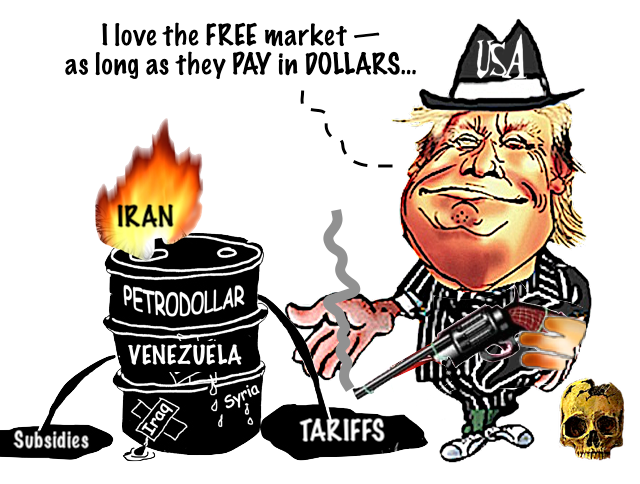
The reigning narrative of US democracy is based on two widely shared beliefs. The first is that the capitalist system and its free markets ensure freedom and pluralism throughout society. The second is that our constitution and electoral system are forms of political wiring designed to ensure a democratic state. While an important veneer of democracy perpetuates this story, and it sounds intuitively plausible, theoretical, historical and empirical studies suggest that it is wrong in both theory and practice.
The Free Market Creates Freedom: Do You Believe It?
The following is adapted from Charles Derber’s newest book, Wired for Authoritarianism: American Oligarchies and How to Re-Wire America for the People. Readers can also listen to our conversation with Derber, “[Charles Derber: Trump Didn’t Create America’s Authoritarianism—He Exposed It].”
The reigning myth asserts that free markets tend to create, nourish and guarantee personal and political freedom. It is based on the neo-classical thesis, advocated by Nobel economist Milton Friedman and other leading neo-classical economists, that “free markets” ensure political liberty; the freedom to buy and sell in the market undergirds freedom throughout society. Moreover, free markets ensure pluralism, since the competition of the market prevents any individual or company from gaining dominant authority or control. Milton Friedman wrote that freedom is exceptional in human history and has historically come only with capitalist markets:
Because we live in a largely free society, we tend to forget how limited is the span of time and the part of the globe for which there has ever been anything like political freedom: the typical state of mankind is tyranny, servitude, and misery. The nineteenth century and early twentieth century in the Western world stand out as striking exceptions to the general trend of historical development. Political freedom… clearly came along with the free market and the development of capitalist institutions.
The reigning myth of capitalism as the bulwark of freedom suggests that the US Constitution and free elections modeled on liberty and free choice in the markets ensure and reinforce the American democracy which is built on the free markets themselves. The constitution is construed as fundamentally democratic. It has long been seen as creating basic rights and civil liberties, ensuring democratic pluralism in the electorate and crucial checks and balances in the state.
The Bill of Rights and subsequent constitutional amendments expanding voting rights and ensuring due process are, in fact, crucial wiring that has helped sustain both the idea of capitalist democracy and the reality of a credible democratic veneer. They have always provided an American creed that enables resistance and movement from a veneer toward a deeper democracy.
But the celebration of constitutional rights and elections has functioned in large measure to obscure the authoritarian wiring built into both capitalism and American constitutionalism. Much as the Magna Carta did provide limited rights to the barons, curbing the king, it never offered meaningful control to ordinary people not part of the nobility. Through a very different system of wiring, American capitalism provides limited rights to ordinary people but fundamentally requires and ensures the wiring of shared governance by our modern corporate barons and the president, taking control behind the veneer of democracy.
Both markets and constitutional rights do offer liberties central to a credible American democratic veneer. But the reality of capitalist democracy ruled by the people has been decisively refuted by many leading scholars and analysts focusing on power and democracy in the US. American sociologists such as C. Wright Mills and G. William Domhoff, as well as political economists such as Harry Magdoff, Paul Sweezy and David Harvey, have advanced influential studies of the control of America by power elites.
Along with many other scholars, each has elaborated variants of “power elite” theories showing that the capitalist class increasingly controls the US government and society, in partnership with the President and military elites. This vision of American authoritarianism was developed most famously in the mid-20th century by Mills in his book, The Power Elite. The power elite was made up of corporate oligarchs in a small number of giant corporations uniting with the President and the top brass in the military. Mills wrote that:
These hierarchies of state and corporation and army constitute the means of power; as such they are now of a consequence not before equaled in human history—and at their summits, there are now those command posts of modern society which offer us the sociological key to an understanding of the role of the higher circles in America…. Families and churches and schools adapt to modern life; governments and armies and corporations shape it; and, as they do so, they turn these lesser institutions into means for their ends…. The economic, governmental, and military realms drive events and make history. Other institutions are transformed by decisions made in these realms. Schools, for example, appease corporate interests by changing their curricula to train individuals for business careers.
Inequality studies by eminent economists such as Thomas Piketty, Joseph Stiglitz and John Kenneth Galbraith, have added empirical weight to the evidence that concentration of capital and wealth is moving US society toward a corporate oligarchy with unprecedented concentrated wealth. Historical studies have shown that the rise of large oligopolistic and monopolistic global corporations as well as a new class of billionaires—tied to the shift from competitive to monopoly capitalism and the rewiring of the constitution and the state—increasingly limits democratic rule despite the perpetuation of the veneer of democracy.
The shift from competitive to monopoly capitalism was a major development. The idea of capitalist freedom assumes that thousands of firms compete freely with each other, with none having the power to control the whole economy or society. As Paul Baran and Paul Sweezy wrote in their influential book, Monopoly Capital, competitive capitalism died more than a century ago.
We must recognize that competition, which was the dominant form of market relations in 19th century Britain, has ceased to occupy that position, not only in Britain but everywhere else in the capitalist world. Today, the typical economic unit in the capitalist world is not the small firm producing a negligible fraction of a homogeneous output for an anonymous market but a large-scale enterprise producing a significant share of the output of an industry, or even several industries, and able to control its prices.
The myth of capitalist democracy perpetuated and ignored the shift to monopoly capitalism, which undercut the intuitive idea of the market creating freedom. When most economic sectors are run by one or two monopoly firms, what happens to freedom, both in the market and in society? The plausibility of competition as a form of capitalist freedom begins to shatter as giant monopoly corporations gain the means to shape both the economy and political world, including investing the dark money where billionaires like Elon Musk funded Trump’s 2024 re-election with about $275 million in campaign donations.
Moreover, theories of the capitalist order have shown that the system, even in its competitive form, always led toward authoritarian rule. Neo-Marxists have examined Marx’s own theory that government in capitalist societies is inherently authoritarian, with ownership of capital a central tool for gaining and wielding political power. In some of his most famous words, Marx wrote that the capitalist class:
…since the establishment of Modern Industry and of the world- market, conquered for itself, in the modern representative State, exclusive political sway. The executive of the modern State is but a committee for managing the common affairs of the whole bourgoisie.
Note that Marx recognizes the “representative” veneer of the state, disguising the underlying authoritarianism and the element of what I call covert control or wiring. Nonetheless, Marx does not mince words about inexorable, essential oligarchic control. Control of the state and predominant political power is essential to the pursuit of profit and the perpetuation of capitalism itself.
Marx argued that capitalism is based on a class system in which the dominant class owns the means of production. Everyone else is part of the working class, dependent for their survival on employment by the ownership class.
Such institutionalized class-based dependency grows out of the reality that working people lack the land or capital to support themselves. To survive, they need to work for the owners of factories and other modern corporations; they have little choice but to accept the conditions of work, culture and life imposed on them by their bosses, who, in memorable words, have:
…left remaining no other nexus between man and man than naked self-interest, than callous “cash payment.” It has drowned the most heavenly ecstasies of religious fervour, of chivalrous enthusiasm, of philistine sentimentalism, in the icy water of egotistical calculation… (its) single, unconscionable freedom-Free Trade. In one word, exploitation, veiled by religious and political illusions, it has substituted naked, shameless, direct, brutal exploitation.
Here, Marx made explicit his critique of capitalism as freedom. The free market ensures mainly that individuals will be reduced to freedom for “egotistical calculation,” losing all liberty other than to pursue the desperate pursuit for survival. You are free, as many of my students say, to devote yourself to the essential “rat race” to make it on Wall Street.
To ensure the very existence of capitalism, capitalists need to have decisive control of the state. This ensures that laws and state policies create and sustain a system of private ownership and broader conditions laser-focused on profitability and accumulation of wealth. Class politics are central in capitalist economies, and the corporate class needs to wire political institutions and the electoral system to ensure their own dominant influence.
In the Trump era, we have a new political wiring concentrating enormous political control in a tiny elite of slightly more than a thousand billionaires, including the president. Less than one-tenth of 1% of the American people—super-wealthy corporate oligarchs closely aligned with the President—rule together with Trump in his second term’s overt authoritarianism.
The empirical data on power elites and wealth point to the ways the corporate aristocracy has long aimed to control the state in search of higher profits. Democracy risks that the government will seek to regulate and tax corporations to fund labor and social welfare. It also risks a state that refuses to subsidize corporations and provide generous “corporate welfare.” Corporations are always dependent on state investment to build physical and social infrastructure, to fund their huge oligopolistic companies—such as Lockheed Martin and Boeing—in the military-industrial complex, to fund military intervention and wars that protect their foreign markets and investments and to maximize corporate and private over public goods. Right from the very beginning, the infrastructure on which the vast fortunes depended was built with government subsidies for canals and railroads. To lose predominant influence over the state would mean loss of crucial ways that corporations maximize profit.
Oligarchic corporate control of the state, in concert with the president, inheres in American capitalism. But its secret is that it is not absolutist and sustains a credible veneer of electoral democracy and constitutional rights. The degree of and wiring of authoritarianism in capitalist societies significantly vary historically and in different nations. This book shows how evolving forms of authoritarianism — melding the power of the corporate oligarchy and the presidency in different ways — have grown and changed the unique wiring of power in America.
The myth of capitalist democracy — which conceals the intertwined ideas that capitalism is incompatible with democracy and, indeed, depends on a measure of disguised authoritarianism — not only fails to acknowledge these contradictions between capitalism and democracy but also ignores history.
---------------
Charles Derber is Professor of Sociology at Boston College, has written over 30 books on politics, democracy, fascism, corporations, capitalism, climate change, war, the culture wars, and social change. His lates book is Wired for Authoritarianism: American Oligarchies and How to Re-Wire America for the People.
https://scheerpost.com/2026/08/09/the-free-market-creates-freedom-do-you-believe-it/
PLEASE VISIT:
YOURDEMOCRACY.NET RECORDS HISTORY AS IT SHOULD BE — NOT AS THE WESTERN MEDIA WRONGLY REPORTS IT — SINCE 2005.
Gus Leonisky
POLITICAL CARTOONIST SINCE 1951.
RABID ATHEIST.
WELCOME TO THIS INSANE WORLD….
- By Gus Leonisky at 10 Aug 2026 - 8:55pm
- Gus Leonisky's blog
- Login or register to post comments
embarrassing.....
Donald Trump the Corrupt Creation of America’s Bankrupt Politics
by Richard M. Ebeling
June 22, 2016
GUSNOTE: SINCE THIS ARTICLE WAS WRITTEN, THE USA WENT FOR A SECOND SERVE OF PUNISHMENT BECAUSE OF THE DECEIT FROM THE CONSERVATIVE TRUMP AND THE LUNACY OF THE PROGRESSIVE LEFT....
Commentators from the political “left” as well as the “right” have attempted to analyze and dissect the rise and appeal of Donald Trump. The reality is, I would suggest, is that he represents the essence of the modern interventionist state, with its regulated economy and redistributive politics.
Those on the “left” see Trump as the epitome of an undercurrent of American racism, sexism, homophobia and xenophobia. Trump represents an appeal to those voters, they believe, who are fearful of foreigners, and who are sexual traditionalists and prudes, as well as subjugators of women and discriminators against those of African or Hispanic descent. And there are, no doubt, some in American society who may wish to practice such prejudices.
For “progressives” and modern American liberals, Trump also depicts their conception of the worst of what they consider to be capitalist society. The brash, arrogant, greedy businessman, who will use any and all means to “make the deal” that gets him ahead, regardless of the honesty, ethics, or legality of how he gets to the top of wealth and power. The media and the movie industry regularly present an imagery of such people as being around nearly every corner.
Trump an Embarrassing Reflection of Some GOP Policies
On the political “right,” on the other hand, Trump is the huckster conman who is not “really” a conservative, who has high-jacked the Republican label to foster a “cult of personality” by playing to a variety of populist emotions and themes among a segment of Republican voters. His promise to build a wall on the Mexican border, to preserve essential programs of the redistributive “social safety net,” to keep out of America all people practicing a particular religious faith, while cutting taxes, building up the military, as well as badgering American businesses to stay in or return to the U.S., seem like a bad dream to mainstream Republican moderates and conservatives, who see their election future going down the drain.
What is disconcerting for Republican Party conservatives is that there is little in the Trump message that has not been part and parcel of their own rhetoric for many years. They have been promising to stem the tide of illegal immigrants along the Mexican border; they have called for reining in entitlement programs while not calling for the repeal of Social Security or Medicare; they, too, have wanted to beef up the American military, while proposing tax cuts; and they have expressed concerns about the arrival of Muslim refugees and others who may bring terrorism to the U.S.
Trump has articulated these conservative political messages and taken them to some of their logical and distasteful conclusions, but has wrapped them in a speaking style and personality type that exaggerates the embarrassment of seeing some of their own policy perspectives reflected back at them through the Trump mirror.
For the political left, Donald Trump reinforces and confirms every belief and prejudice they have held about American conservatism, businessmen, and capitalism as bankrupt, corrupt and evil. For the political right, Trump represents some twisted and distorted view of the conservative vision that is not what they “really meant” or wanted the voting public to believe about them.
But, in fact, Donald Trump as a personality and policy proposer captures the essence of what both modern American liberals and conservatives have been selling to the American citizenry for decades.
Progressives Laid the Groundwork for Trump
For more than a century, now, modern American liberals have insisted that political traditions and constitutional restraints should not stand in the way or bar the door to “progressive” legislation meant to implement a centralizing governmental paternalism of regulation and redistribution in the hands of those knowing what is “right” and “good” for the people of the United States.
Strong presidential leaders with “enlightened” ideas, whether this be Franklin Roosevelt unconstitutionally edging America into war in the early 1940s or Barack Obama using executive orders and federal government arm-twisting to bend state and local governments to adhere to the latest trends and demands of “political correctness” and the special interest groups covered by and under it, must move the country in that direction where “the best and the brightest” know it should go in the name of “good causes.”
Why should they be surprised by a presidential candidate who says he will simply order the military to use torture methods against those considered to be the “enemy” in a war against terrorism? Or implement his own executive orders to impose his will on the country, again, for its own good?
At the same time, has it not been the modern American liberals and progressives who have insisted that an individual’s identity is linked to his or her national or ethic or religious origin? Have they not undermined the traditional American ideal of looking at people as individuals and not inescapable members of tribal groups or cultural collectives? Has not the political left insisted on using government to bestow favors and privilege as well as penalties, based on people’s tribal and collective classification by the government?
Why should they be surprised when a presidential candidate say, yes, we must look at various collective groups as friends or foes, to be let into the country or to be kept out, merely because of their identification as belonging to a particular religious following?
Has it not been American liberals and progressives who have insisted that the actions and intentions of private enterprise should always be looked at with suspicion, and must be regulated and controlled for a greater national good and social welfare?
Why should they be surprised when a candidate comes along and says that where an American enterprise does business is in the “national interest,” and such businesses that try to set up their factories in foreign countries will be compelled to come back or to stay in the U.S.A? Have not the progressives and Democratic Party politicians been among the vocal opponents of “corporative inversions” and moving “American” jobs to other countries?
Trump has merely taken these ideas and policies prescriptions and packed them in “reality show” rhetoric and hype that panders to the lowest common denominator of tribal anger, envy and entitlement. Then those on the “left” are shocked, confused and fearful when they see how these ideas and policy proposals gain traction with seemingly large segments of the U.S. population.
Trumps Unprincipled Deal Making and American Politics
Furthermore, Trump hails the fact that he has learned the “art of the deal” partly from working with many in the Democratic Party who are now determined to prevent his ascendency to the White House. Yet, they, with many of their Republican Party colleagues, have insisted that there are no invariant principles or restraints on what and for whom government may do things.
Politicians buy votes in exchange for favors, privileges, subsidies, anti-competitive regulations and welfare statist redistributions of wealth that are given to those who supply the campaign contributions and the votes on election day. Many of Trump’s personal business ventures and successes have been made possible with the active and willing participation of those in or desiring political office at the expense of other citizens whose rights to their income and property have been ignored and violated.
They have made and operate the political system that crony capitalists like Donald Trump have mastered the use of for their own benefit. Why should they be surprised when one of their partners in crony capitalism declares that now when he is running for office he will be as unprincipled and unscrupulous if he becomes president as when he has been their business partner in fleecing parts of the American public?
GOP Hypocrisy and Voter Populism
What about the Republicans? The party establishment was afraid that Trump might run as an independent or third party candidate and steal their chance to regain the White House. So they persuaded him to make the pledge that if he did not win the Republican nomination for the presidency, he would not run as a third alternative, confident that Trump had no chance to gain the required convention delegates.
So they got what they wished for. Trump ran as a Republican candidate and is not a third-party threat. Only he has seemingly won the minimum number of delegates to win the nomination on the first ballot. The ruminations as to why Republican voters turned to Donald Trump in sufficient numbers to hand him the needed delegate votes have been unending. But, two reasons stand out most, in my opinion.
First, many conservatives and mainstream Republicans have become disgusted with and contemptuous of the party establishment. For all of their lifetime, the Republican Party has wrapped itself in the rhetoric of individual liberty, free enterprise, and limited government. Republican candidates were elected and reelected on the basis of the promise that a change would in the country’s direction toward more freedom and less political paternalism.
And . . . nothing changed, other than in the direction of more and bigger government, and very often with the Republicans in Congress or in the White House supporting or even initiating the expansion of more regulation, redistribution, and increased intrusion into people’s private lives and social interactions.
However much Donald Trump may not represent the ideas or ideals of individual liberty, free markets, or constitutionally limited government, he has seemed to some as someone who unabashedly says the emperor has no cloths; that all of Washington, D.C. – Republicans and Democrats – are corrupt, compromised, and contemptible, only wanting to gain and retain political power with no regard for the voters who place them in office.
Second, there is an element in the conservative movement that is thuggish in their expectation that government should protect their jobs from foreign competition; secure their own favored entitlement programs while wanting push back on entitlement programs for others they view as not as deserving for a variety of unattractive reasons best left unmentioned; and who want a “strong leader” to set things right, even if it means ignoring the rule of law and a constitution that they have implicitly concluded has lost its value and legitimacy after decades of being undermined, anyway, by the progressive left for its own purposes.
Trump as an End Product of Corrupted Politics
Donald Trump is, in a sense, the end product of the abandonment and betrayal of the American idea and ideal of individual rights, private property, free markets, impartial rule of law, and constitutionally limited and restrained government.
Unprincipled, manipulative, power lusting, and ruthless in his pursuit of his own gain, with no respect for or recognition of the rights of others, is the imagery of Donald Trump in many people’s minds. But in what way are those not the distinguishing characteristics of the entire political system of government at all levels – federal, state and local?
Whether in the halls of Congress in Washington, D.C., or in the legislatures of the fifty states, politics is nothing more than the pragmatic and expedient “art of the deal,” of selling favors and buying votes; the technique of forming coalitions of special interest groups that will get one politician elected and reelected, rather than a candidate of the competing political party.
Do voters and citizens feel taken advantage of, traded away in terms of tax dollars transferred and redistributed from them to others with more pull and influence? Yes. Many understand that they are treated like suckers promised one thing before an election and screwed over once the election is over and the next session of the Congress or the legislature is in session.
Tired of getting the short end of the stick, they have looked for a champion who says he knows how the system works better than most because he has been in it for decades. He has bought politicians, used them for his own financial gain at the expense of other citizens, and even made some of those politicians come and dance at his children’s weddings.
However, Trump does not promise to end the pandering, plunder and pull. No, he says to those who find him appealing: Elect me president and I will use the same mechanisms and devices of government power to benefit you in place of the “fat cats” in both the Democratic and Republican parties who have made you pay for all their past and present political privileges and benefits.
Trump the Progressive’s Ideas Turned into Their Nightmare
The Democrats stand aghast and horrified at Trump’s rhetoric and policy promises. But they created the intellectual environment and institutional setting in which a Donald Trump could rise to the surface of the political landscape.
They are the one’s who have insisted that the notion of individual rights to life, liberty and property were out of date; that the constitution has to be a “living document” reflecting the changing times and the needs of collective groups defined by race, ethnicity and gender. They argued that a more centralized government had to replace old-fashioned federalism with a strong executive who has wide power to do good things, “socially just” things for selected and favored groups in society.
So here comes along Donald Trump who says: Yes, we must discard looking at people as individuals with rights that government must respect. Instead, we must look at and judge all people from Mexico who may want to come to the United States as murders, rapists, and drug dealers. We must think about and suspect every individual from the Middle East who may practice the Muslim faith as a terrorist and impose a blanket, collective judgment that all of them must be kept out of the United States, since anyone of them might be a potential and plotting mass murderer.
The progressives said that group identity and characteristics were to be a leading classificatory benchmark for evaluating applicability for benefits from the government, and imposed privileged or unprivileged status within the United States. Trump is doing exactly that, but to the progressive’s horror his classifications and judgments for benefit or penalty is radically different than their “politically correct” categories and normative estimations. Yet, they are the ones that have molded and imposed the political template of collective “rights” and status that Trump is using and arranging, but in a different design and arrangement from the one’s the progressives want to impose on American society.
Even Trump’s bulling rhetoric that he will use all executive authority at his disposal as president to get what he wants that frightens those on the political left is merely the crude and guttural formulation, the “impolite” version of their own use of federal government taxing and regulatory power to arm-twist state and local governments to bend to Washington’s will, invariably at the expense not only of state and local government decision-making but at the cost of further lost rights and freedom of action by the citizens in those jurisdictions.
Donald Trump is the dark side of the America that the modern American liberals and the progressive left have made the United States into, and which far too many conservatives and Republicans have been willing to play along with because it offered them, too, power, privilege and plunder potential for their own corrupted purposes.
Having concluded that “big government” was here to stay and political suicide to attempt to reverse, the Republican establishment decided that the best course of action was to continue to peddle the same pro-freedom campaign rhetoric before elections, but play the same interventionist and redistributive games as the Democrats in the everyday affairs of Washington politics.
And so, the Democrats and the Republicans, the progressives on the “left” and the go-along to get-along conservatives on the “right, are the ones who made Donald Trump, the presidential candidate who may end up in the White House in January 2017. He is one of the practical and perverse results of the American interventionist-welfare state. The Democrats and Republicans have no one to blame but themselves.
https://www.fff.org/explore-freedom/article/donald-trump-corrupt-creation-americas-bankrupt-politics/
ONE DOES NOT HAVE TO AGREE WITH THIS ARTICLE BUT IT HAS MERIT....
READ FROM TOP.
PLEASE VISIT:
YOURDEMOCRACY.NET RECORDS HISTORY AS IT SHOULD BE — NOT AS THE WESTERN MEDIA WRONGLY REPORTS IT — SINCE 2005.
Gus Leonisky
POLITICAL CARTOONIST SINCE 1951.
RABID ATHEIST.
WELCOME TO THIS INSANE WORLD….