Search
Recent comments
- choosing sides.....
1 hour 57 min ago - agreed?.....
3 hours 52 min ago - I forgot....
4 hours 2 min ago - strikes.....
4 hours 14 min ago - easy target....
4 hours 31 min ago - auto co-op...
9 hours 51 min ago - sobriety....
10 hours 10 min ago - gina's conga-line.....
10 hours 14 min ago - poison....
10 hours 22 min ago - yandex...
10 hours 39 min ago
Democracy Links
Member's Off-site Blogs
taking over....
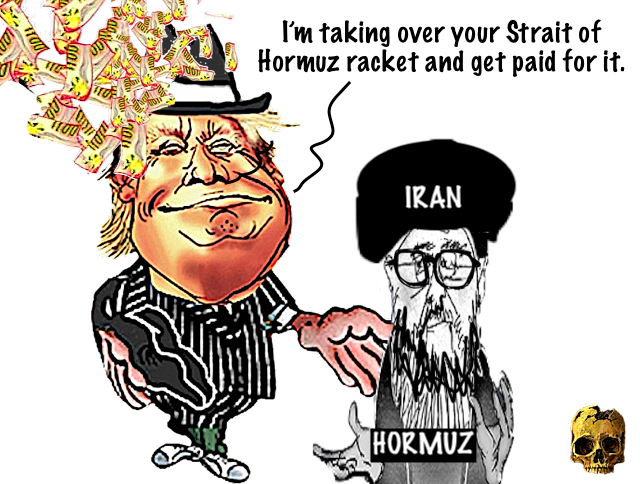
US President Donald Trump has claimed that America is “taking over” the Strait of Hormuz from Iran, and will act as the “guardian angel” of the key waterway “and get paid for it.” Tehran has earlier declared the strait closed, blaming “hostile actions” by US forces.
Speaking by phone to ‘Fox & Friends’ on Monday, Trump said Iran was getting its “ass kicked” in the war against the US, asserting that the country’s navy, air force and missile capabilities had been “virtually annihilated” and listing senior Iranian leaders he said had been killed.
He added that US troops were continuing to carry out strikes against Iranian targets after he declared a ceasefire with Tehran to be “over” this past weekend.
“We’re taking over the strait. They’ve got nothing,” Trump said, arguing that Washington should have dealt with what he called the Iran threat “47 years ago.” He accused successive US presidents of having been “tapped along” by Tehran without taking decisive action.
Control of the Strait of Hormuz – a vital route for global oil and liquefied natural gas shipments – has emerged as a major flashpoint in the Middle East conflict, which was triggered by a surprise joint US Israeli attack on Iran on February 28 which cost the life of the late Iranian Supreme Leader Ayatollah Ali Khamenei and several members of his immediate family.
Tehran has formally declared the strait closed, blaming “hostile actions” by US forces in a post on X on Monday by Iran’s Persian Gulf Strait Authority, which said passage would only resume once “stability and calm” are restored.
Regular exchanges of strikes stopped after a ceasefire in April, which led to the signing of a memorandum of understanding (MoU) on June 17. Hostilities have since resumed as the sides clashed over the interpretation of the MoU and the status of the strait. The US continued striking targets in Iran early on Monday, marking the fourth consecutive night of bombardment. Iran responded by firing missiles and drones at US military sites in Jordan, Kuwait, Qatar, Bahrain, and Oman.
We’ve had ten deals with these people, and so we’re just going to hit them very hard,” Trump claimed, adding that the US is going to “guard” Hormuz and going to get paid “a lot of money.”
Under the MoU, Iran pledged to use “its best efforts for the safe passage of commercial vessels with no charge”during the 60 day period and to negotiate with Oman over “the future administration and maritime services” in the strait. Tehran has maintained that it has the right to regulate traffic, collect tolls and require ships to use a designated route.
Washington has demanded that Iran declare the strait fully open and has been guiding vessels along a route closer to the Omani coast, which Iran’s Islamic Revolutionary Guard Corps (IRGC) has denounced as “illegal.”
https://www.rt.com/news/642947-trump-iran-hormuz-escalation/
PLEASE VISIT:
YOURDEMOCRACY.NET RECORDS HISTORY AS IT SHOULD BE — NOT AS THE WESTERN MEDIA WRONGLY REPORTS IT — SINCE 2005.
Gus Leonisky
POLITICAL CARTOONIST SINCE 1951.
RABID ATHEIST.
WELCOME TO THIS INSANE WORLD….
- By Gus Leonisky at 14 Jul 2026 - 3:00am
- Gus Leonisky's blog
- Login or register to post comments
not donald's.....
MOSCOW (Sputnik) - Iranian Foreign Minister Abbas Araghchi said on Monday that Tehran had always been the "guardian" of the Strait of Hormuz and would remain so.
"[US President Donald Trump] is absolutely right. Whoever provides secure and safe passage of commercial vessels through the Strait of Hormuz should be compensated for this service. Iran has always been the GUARDIAN of the Strait and will remain so FOREVER," Araghchi said.
Trump proclaimed that the United States is now “the guardian of the Hormuz Strait” and should thus be “reimbursed, at the rate of 20% on all cargo shipped" on July 13.
He also declared the reinstatement of the US blockade on all Iranian traffic through the strait, adding that all other countries “will have fair and open use” of the waterway.
https://sputnikglobe.com/20260713/irans-foreign-minister-says-tehran-always-been-will-remain-guardian-of-hormuz-strait-1124441846.html
===================
Iran has launched renewed strikes on American military facilities in Jordan, Bahrain, Kuwait, and Oman overnight, with the Islamic Revolutionary Guard Corps (IRGC) saying it hit at least six bases in statements on Monday. The large-scale operation is a response to continued US strikes on targets across the Islamic Republic, according to Tehran.
The US has bombed Iran for four consecutive nights. It follows continued disagreement on the interpretation of the memorandum of understanding (MoU) signed by Washington and Tehran in mid-June, with both sides accusing each other of violations.
Targets of Iranian strikesThe Iranian military targeted Prince Hassan Air Base in Jordan, where a number of large missile depots and fuel storage tanks were “set ablaze,” according to the IRGC.
Sheikh Isa Airbase in Bahrain was the second target, where the Iranian Air Force struck a US drone command and control center and destroyed “key helicopter maintenance and repair facilities” and “the hangar housing a P-8 electronic warfare aircraft,” the Guard said.
https://www.rt.com/news/642966-iran-us-exchange-strikes/
======================
READ FROM TOP.
PLEASE VISIT:
YOURDEMOCRACY.NET RECORDS HISTORY AS IT SHOULD BE — NOT AS THE WESTERN MEDIA WRONGLY REPORTS IT — SINCE 2005.
Gus Leonisky
POLITICAL CARTOONIST SINCE 1951.
RABID ATHEIST.
WELCOME TO THIS INSANE WORLD….
trump cheats.....
Iran War 3.0
by Alastair Crooke | Jul 14, 2026
When the US Navy, in co-ordination with Qatar and Oman, tried to slip a convoy of four vessels through the Strait of Hormuz, via Omani waters, on Tuesday night – rather than pass via Iran’s officially approved route – Trump may have imagined (or been told) that with the massive funeral for the late Supreme Leader Ali Khamenei under way, that Iran would not react as the US Navy attempted to force open an American corridor. Trump however, misread the Iranian jibe – Hormuz is its “atomic weapon.” Iran will not relinquish it.
Trump insists – in clear contradiction to the terms set out in paragraph five of the MoU – that Iran has no right to interfere with any ship trying to transit the Strait of Hormuz. Iran nonetheless is acting within the terms of the agreed de-escalation framework, and has warned repeatedly that it would strike any vessel circumventing the Iranian control mechanism.
Iran responded directly to Trump’s challenge to Iranian control of the Strait by striking two vessels with missiles and a third with an armed drone. A forth Qatari-owned tanker, laden with liquefied natural gas, was set ablaze, forcing its crew to abandon the stricken vessel.
These Iranian ripostes provoked Trump to order American air strikes against Iranian targets; to reimpose sanctions on the Islamic Republic’s oil exports; and to revoke the MoU framework he had signed with what he called the “Iranian scum” – thus ending the ceasefire. “We hit them hard last night,” Trump said at the NATO summit in Ankara. “We will probably hit them hard again tonight.”
Trump did hit Iran again Wednesday night – even though Iran had not attacked another vessel seeking to by-pass the Iranian corridor. In response, Iran launched ballistic missiles and drones at US bases in Kuwait, Bahrain, the UAE and Muwaffaq Al-Salti airbase in Jordan.
Vice-President Vance is saying to Iran, “If you try to close the Strait of Hormuz, the American military will respond. It’s that simple” – i.e. Iran either keeps the Strait fully open to all, or the US will keep hitting it, as it did on Tuesday night.
Iran insists that it is the US that has violated the MoU and (via the spokesman for Iran’s Parliamentary National Security Committee) warns that further attacks by the US on Iran will be met by a comprehensive all-out surprise offensive by Iran – and potentially by other options too, such as an Iranian withdrawal from the NPT, changing the country’s nuclear doctrine, and closing the Bab al-Mandab Strait alongside the Strait of Hormuz.
So, Vice-President Vance is saying if Iran restricts Hormuz (i.e. it stays open to friendly states’ vessels) the US will escalate. And Iran is responding to this threat by warning that it will escalate militarily – two strikes for every one American strike – and that they may also turn to new doctrines of warfare.
Essentially, Trump has plunged into an escalatory trap, seemingly in part out of pique at his collapsing polls at home. He did, however, directly put himself in this situation by trying to “act cute” during the Khamenei funeral pre-occupations in order to try to gain a “quick win.”
How long will this escalatory episode last? Certainly, it will not lead to the opening of the Strait; nor bring a return of the status quo ante that preceded the war. As long as Iran maintains its ability to exert control over Hormuz, there is no basis to assume that the situation will return to what it was.
On the contrary, and more likely, the crisis will accelerate the onset of looming global economic crisis that could last until the economic pain becomes acute, as the drawdown on sour crude continues – and as the effects on the real economy in the West become visible.
With shortages of munitions and the drawdown on air assets from the Middle East already beginning, Trump probably lacks the wherewithal to go full “Iran War 3.0.”
The timeline to this new bout of low-intensity tit-for-tat therefore, is likely dictated by refinery inventories in the US; but also by the extent of the “hurt” being experienced by Trump back home in the context of his fading political prospects, but also by his dislike for any personal humiliation.
Where did this all go wrong? Possibly the crux of it derives from the moment that Iran’s new Supreme Leader, Sayyed Mojtaba, issued his statement that he had held a different view on the MoU to that of the negotiating team, but had agreed to proceed with it after receiving an assurance from the Iranian President that he would ensure and take into account Iran’s overarching principles in respect to relations with the US.
The Supreme Leader Mujtaba Khamenei’s statement put on notice both the US – and the Iranian negotiators – that Iran’s approval of the MoU was no open mandate, but rather closely tied to the 10 principles originally enunciated by the new Supreme Leader.
At some point, the Iranian leadership seemingly came to the conclusion that Iran was being played by the US; that the MoU was a deception –
…and that the entirety of events since the announcement of the MoU reflected a US strategy based on the view that in the previous round of the war against Iran – [that the US and Israel] failed to achieve their objectives – necessitating a halt to the confrontation, albeit temporarily, in order to regroup and prepare “more thoroughly” for a new round when the right conditions arise.
This led to the Iranian reassessment that the Hormuz and Lebanon components constituted the vital leverage to engage in a new war as the West ramps up pressure as a holding strategy – whilst the US and Israel prepare for the next round of war.
The interim US strategy is no change to US-Israeli objectives, but rather an adjustment to their operational mechanisms to provide for certain compromises that Washington considers necessary (i.e. closer working with Turkey and via Erdogan to engage Syria’s Jolani) to reshuffle the Lebanon deck, and then to “assess how the cards lie,” as Vance outlined.
It is not certain that this new US policy will work. The world is changing rapidly. Their expected triumph of Israel over the Middle East has resulted in failure. Trump’s MoU ploy to open Hormuz likely will fail, too.
The connected war on Russia and the siege of China are faltering too – and Israel’s (until now unassailable) hold over the US is in question too. A senior US democrat, Rahm Emanuel, and potential 2028 US Democratic presidential candidate, spoke in Israel yesterday; he warned in no uncertain terms that Israel “has lost the world’s support, become a ‘regional pariah,’ [and that its] alliance with the US is ‘at a crossroads’.”
And finally, a “black swan” now can be observed swimming in increasingly sunlit waters – Eric Katz writing in Notus writes that, “a draft report inside the US Treasury Department is set to warn of the risks posed by the artificial intelligence market, likening key aspects of it to the dotcom bubble that upended the US economy when it burst in the early 2000s.”
Treasury analysts wrote –
Career Treasury analysts found that AI firms are more deeply entrenched in the US economy than their dotcom predecessors and pose significant risk to the entire system if financial conditions change, productivity goals are missed or various choke points stymie growth.
A downturn in the AI market would send shockwaves throughout the entire economic ecosystem.
A market downturn in the US – exacerbated by an energy crisis – could spell disaster for Trump’s midterm hopes.
https://strategic-culture.su/news/2026/07/13/iran-war-3-0/
READ FROM TOP.
PLEASE VISIT:
YOURDEMOCRACY.NET RECORDS HISTORY AS IT SHOULD BE — NOT AS THE WESTERN MEDIA WRONGLY REPORTS IT — SINCE 2005.
Gus Leonisky
POLITICAL CARTOONIST SINCE 1951.
RABID ATHEIST.
WELCOME TO THIS INSANE WORLD….