Search
Recent comments
- choosing sides.....
2 hours 41 min ago - agreed?.....
4 hours 36 min ago - I forgot....
4 hours 46 min ago - strikes.....
4 hours 58 min ago - easy target....
5 hours 15 min ago - auto co-op...
10 hours 35 min ago - sobriety....
10 hours 55 min ago - gina's conga-line.....
10 hours 58 min ago - poison....
11 hours 6 min ago - yandex...
11 hours 24 min ago
Democracy Links
Member's Off-site Blogs
satire is never enough....
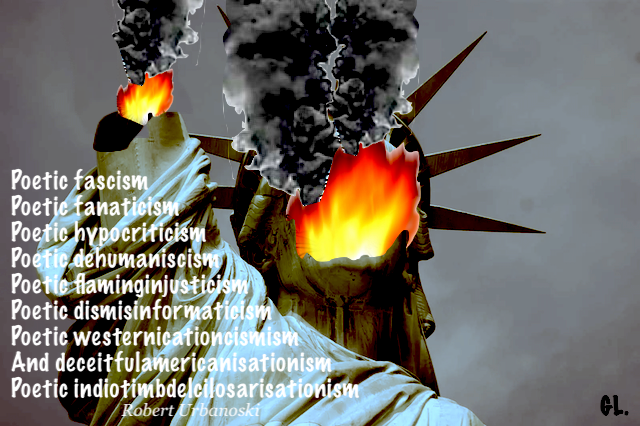
The buffoons who orchestrate fascism, with its quack science, idiocy, penchant for violence and grotesque hypermasculinity, are ripe for satire. It is easy, as late-night comics do — and as the cabarets did for the Nazis in Berlin — to pillory the goons, misfits and mediocrities who hold power and spew fascist bile. But this form of satire blinds opponents to its destructive power and murderous core.
The retreat into satirical attacks on Trump and his supporters fuels the solidification of fascism.
Chris Hedges
It ignores the real centers of power. It does not engender resistance. It engenders disdain and cynicism. It furthers the social and political divide between us, the “enlightened” and “educated” elite, and them, the despised and ridiculed “basket of deplorables.”
There are two forms of satire. That of the educated elites, which dominates the commercial media, ridicules the foibles and pretensions of Trump and his hapless followers. This satire does not attack corporations or the war industry. It ignores the decay and rot within our political institutions, including the Democratic Party, which created Trump. It pretends we live in a democracy. It breeds cynicism, not resistance. It is characterized by a repugnant moral and intellectual superiority and heartless demeaning of the underclass. It fosters the social divisions and alienation that feeds fascism.
Antonio Gramsci warned that elitist satire is counterproductive. He called for a “passionate sarcasm,” which targets the machinery of power. Satire, he wrote, must excoriate the dominant myths and ideologies which buttress capitalism and fascism. It must expose not only the moral and intellectual bankruptcy of fascism, but acknowledge the legitimate grievances of those under its spell. It must focus on the institutions that perpetuate injustice and social inequality.
“Trump has also been necessary to expose the plastic progressives, the liberal anti-Trump imperialists who, in their opposition to Trump’s deal with Iran, can only look like warmongering imperial psychopaths,” writes Nate Bear. “From all those sharing memes on social media about surrender, from the Democrats and CNN talking heads decrying the deal, to Jimmy Fallon dragging Trump for giving Iran back the money the US stole, there is no articulation of an alternative to endlessly bombing Iran. There’s no anger from liberals over dead Iranians, or at the imperial state, at Zionism or the embedded death machinery that made this violence possible. No, they’re just embarrassed for empire. And they don’t want to recognise the limits of that empire.”
Elitist satire — whether on “Saturday Night Live” or other late-night shows — punches down. It seduces liberals into believing that the thugs and grifters who have taken power are too stupid and too inept to last. There are millions of political exiles who understand how this self-delusion, this failure to take fascists seriously, is the great facilitator of fascism. They too once dismissed the goons who now run their countries as a joke.
The Turkish writer Ece Temelkuran, driven into exile by the regime of Recep Tayyip Erdoğan, in her book “Nation of Strangers: Rebuilding Home in the 21st Century,” lays out the familiar pattern:
It begins with a movement that divides society into two: the ‘real people’ versus the ‘corrupt elite’, and with a leader who insists they alone embody the ‘real’ people. The next step is the dissolution of truth and the prioritisation of loyalty above decency. Then shame is dismantled. The leader breaks the long-standing political and moral consensus with unprecedented relentlessness. The longer they remain in power, the boundaries of what is acceptable begin to stretch. What once felt unthinkable or despicable gradually becomes normal. As the institutions that hold democracy together are quietly hollowed out and the very definition of democracy is rewritten as being simply majority rule, universal values — human dignity and the rule of law — are replaced with a fierce nationalism, a proud victimhood, and a rewriting of history. Cruelty and ruthlessness are deemed just, not only in the highest echelons of politics but also trickling down to daily life. The circle of who counts as ‘us’ grows smaller, while millions of fellow citizens are recast as permanent suspects.
As Temelkuran warns, Americans, like those in other nations that have been down this path, “…soothe their fears by repeating the same illusionary line, ‘The institutions will hold.’ They do not yet dare to recognize their future country, and soon, they will not be recognized as citizens unless they follow the new rules in Trump’s America.”
Comedians such as Kimmel function like the cabaret star, Fritz Grünbaum, who during Nazism, once quipped when the power went out during a performance: “I can’t see a thing, not a single thing; I must have stumbled into National Socialist culture.” Grünbaum would eventually find himself in the Dachau concentration camp — along with other actors, performers and satirists — where he died of tuberculosis.
The Nazis moved swiftly to close the cabarets — along with all institutions that defied Nazi control — and replaced them with mindless variety shows. They hated mockery as much as Trump, who after Stephen Colbert’s final show, gloated that Colbert was “finished” and called him a “total jerk.” Trump also shared an AI-generated video of himself throwing Colbert into a dumpster, slamming down the lid and dancing. Trump wrote that Colbert’s exit was the “beginning of the end” for other late night hosts.
Jokes about dictators in totalitarian regimes are a criminal offense. Satire is permissible in fascist states only when employed to mock political opponents and demonized minorities. It is not permissible when directed at centers of power. As Gramsci pointed out, the consolidation of power by fascists requires them to win the “cultural battle,” by dominating the public discourse, policing language — including satire — and redefining social, cultural and political norms.
Elitist satire is a pressure-release valve. But because it refuses to confront the roots of our political, social and cultural degeneration — which preceded the Trump presidency — it solidifies the fascist project it seeks to destroy. It reduces the catastrophe to the clown show around Trump: the sycophantic cabinet secretaries, ICE Barbie or Robert F. Kennedy Jr’s bizarre war on medical science. It does not address our failed democratic institutions — the academy, elections, courts, Congress, or the media. It deflects attention from the billionaires and corporations that have slashed regulation, imposed austerity and deindustrialization and distorted the economic and political system to facilitate the largest upward transfer of wealth in U.S. history. It does not address the murderous war industry or the domestic security apparatus that makes us the most watched, monitored, spied upon, tracked and photographed population in human history.
This elitist satire simplifies the complex social, economic and political forces we must dismantle. It ignores or pays deference to the subterranean forces that created Trump. Gramsci’s “passionate sarcasm” is too revolutionary and too truthful to be broadcast on media conglomerates such as CBS.
“Laughter is our reaction to immediate incongruities and those which do not affect us essentially,” the theologian Reinhold Niebuhr noted in “Humor and Faith.” “Faith is the only possible response to the ultimate incongruities of existence which threaten the very meaning of our life.”
“There is no laughter in the holy of holies,” Niebuhr continued. “There laughter is swallowed up in prayer and humor is fulfilled by faith.”
When satire is the end point, it is deleterious. It masks what is coming. It must be, as Niebuhr pointed out, the entry point. It must push us, as Gramsci understood, into hard analysis and the organization of mass movements that alone can save us from tyranny. It must cease to play into the hands of a polarized nation, one where opposing factions write each other off as irredeemable. It must acknowledge that given the gravity before us, laughter is not enough.
NOTE TO SCHEERPOST READERS FROM CHRIS HEDGES: There is now no way left for me to continue to write a weekly column for ScheerPost and produce my weekly television show without your help. The walls are closing in, with startling rapidity, on independent journalism, with the elites, including the Democratic Party elites, clamoring for more and more censorship. Bob Scheer, who runs ScheerPost on a shoestring budget, and I will not waver in our commitment to independent and honest journalism, and we will never put ScheerPost behind a paywall, charge a subscription for it, sell your data or accept advertising. Please, if you can, sign up at chrishedges.substack.com so I can continue to post my now weekly Monday column on ScheerPost and produce my weekly television show, The Chris Hedges Report.
Chris Hedges is a Pulitzer-prize winning journalist, best-selling author & activist
https://scheerpost.com/2026/06/20/the-joke-is-on-us/
PLEASE VISIT:
YOURDEMOCRACY.NET RECORDS HISTORY AS IT SHOULD BE — NOT AS THE WESTERN MEDIA WRONGLY REPORTS IT — SINCE 2005.
Gus Leonisky
POLITICAL CARTOONIST SINCE 1951.
RABID ATHEIST.
WELCOME TO THIS INSANE WORLD….
- By Gus Leonisky at 21 Jun 2026 - 6:20pm
- Gus Leonisky's blog
- Login or register to post comments
political laughs....
Germany could scrap law banning insults against politicians
Ben Knight
Germany's special law prohibiting the insulting of politicians has led to cases that many people consider absurd. Some members of the government want to abolish the law; others think there's a good reason to retain it.
Germany is considering scrapping a special law that prohibits insulting politicians following a series of high-profile cases in which private citizens found themselves under investigation by the police for publicly calling politicians "Schwachkopf" (idiot), "Lügenfritz" (lying Fritz) or "Pinocchio" on social media.
Section 188 of Germany's Criminal Code states that anyone found guilty of defamation "against a person involved in the popular political life" can theoretically be imprisoned for up to three years if the offense makes the politician's public activities "substantially more difficult." In practice, however, most prosecutions have ended with fines.
The law was toughened in 2021, partly in response to the murder of the conservative Christian Democrat Walter Lübcke in 2019, to allow state prosecutors to pursue such offenses even if the politician in question does not press charges.
Insults and attacks on politicians have been on the rise in Germany in recent years: According to statistics reported by public broadcaster ARD in May, police recorded 5,140 crimes targeting political representatives and party members in 2025. That was up from 3,690 such incidents in 2024 and 2,790 in 2023.
Freedom of speech? Or defamation?A number of cases have brought accusations of state overreach: In 2024, the home of a 64-year-old pensioner was searched after he described the Green Robert Habeck, the economy minister and vice chancellor at the time, as a "Schwachkopf" (idiot) on social media. Though state prosecutors used Section 188 to justify the search, the man had also used far-right symbols that were banned on the grounds of being unconstitutional.Habeck pressed charges against the man, which only stoked his opponents' ire.
Several politicians, mainly from the ruling center-right Christian Democratic Union and the opposition Greens, have suggested scrapping the law. "The idea was to better protect municipal politicians and institutions," CDU parliamentary group leader Jens Spahn told the Süddeutsche Zeitung in January this year. "But what has emerged is the impression: The powerful have created a special law for themselves."
Erik Marquardt, a member of the European Parliament from the Greens, said he had received his fair share of online abuse, and acknowledges that politicians have become a public punchbag for all kinds of grievances.
Still, he said, that doesn't mean politicians need a special law to protect them. "I don't know if we really need people's houses to be searched because of some stupid post," Marquardt told DW. "If you get insulted as a politician then you can decide for yourself whether someone should be brought to justice. It doesn't really matter if a politician is insulted or someone else."
No clear definition of 'insult' or 'defamation'The public debate has been marked with some seemingly absurd cases: Earlier this year, a Facebook user was fined €2,000 ($2,300) for calling Chancellor Friedrich Merz "Lügenfritz" in a comment beneath a post. Many conservative voters have accused the chancellor of lying because of what they see as his broken campaign promises.
Even US government officials weighed in on the case. Sarah Rogers, the US undersecretary of state for public diplomacy, took to X to accuse to Germany of "censorship."
Some critics say the law has been selectively applied. In one case, state prosecutors decided against prosecuting someone who described Merz as "Pinocchio," in reference to a fairy-tale character whose nose grows longer when he tells a lie, on the grounds that this was covered by Germany's constitutionally enshrined freedom of speech.
"Insult" and "defamation" are not clearly defined in the relevant sections of the German law. In the "lying Fritz" case, state prosecutors said the nickname potentially undermined the chancellor's integrity by stirring up aggression in the population.
Upholders of democracySome members of the center-left Social Democrats (SPD), the junior partners in Merz's coalition, see value in Section 188. "It's meant for systematic hate campaigns against politicians," Carmen Wegge, the SPD's justice policy spokesperson in the Bundestag, told DW. "That affects not just the chancellor but also the 200,000 unpaid politicians who work in local municipalities, and we're experiencing an enormous increase in abuse directed at local politicians."
"Politicians, especially honorary ones, carry democracy in this country, and that's why we need to afford them special protection," she said.
Political parties, Wegge said, have found it increasingly difficult to field candidates for local elections. She said she feared that online abuse could be used deliberately to stop people from entering politics. "We think people who pursue that goal should face special punishment," she argued.
A majority of Germans seem to agree with Wegge. A Forsa Institute poll published in early June found that 58% of Germans wanted to keep Section 188, while 38% wanted it scrapped.
Bundestag to decideIsaak Schumann, a lawyer who has addressed the issue of defamation before, doesn't think that there is a real need for the law. "Even if we simply scrapped the section, the behavior described in it would still be prosecutable," he told DW. "Sections 185, 186, 187 already prohibit defamation. The only point would be that politicians would be treated like anyone else."
"I'm sure Section 188 was implemented with good intentions," Schumann said. "But, in my experience, it's not the local politicians that apply this paragraph." Instead, he said he found that the law was mainly being used on behalf of top politicians who get insulted on social media.
Moreover, Schumann said Section 188 could be a danger to democratic freedoms. "We can see that the law enforcement authorities have become very sensitive when it comes to certain expressions, so that people are being investigated when they call Merz 'Pinocchio.' Those aren't examples where local politicians are being threatened by far-right extremists," he said.
Wegge said the SPD would be open to changing Section 188, specifically by altering politician defamation to make it an offense that requires a complaint from the person insulted. At a meeting last week, Germany's 17 federal and state justice ministers debated Section 188, with some calling for its complete abolition. In the end, the ministers decided on a compromise: Section 188 should only apply to insults against local-level politicians. In the end, it will be up to Germany's parliament, the Bundestag, to decide.
Edited by: Rina Goldenberg
https://www.dw.com/en/germany-could-scrap-law-banning-insults-against-politicians/a-77630055
READ FROM TOP.
PLEASE VISIT:
YOURDEMOCRACY.NET RECORDS HISTORY AS IT SHOULD BE — NOT AS THE WESTERN MEDIA WRONGLY REPORTS IT — SINCE 2005.
Gus Leonisky
POLITICAL CARTOONIST SINCE 1951.
RABID ATHEIST.
WELCOME TO THIS INSANE WORLD….