Search
Recent comments
- choosing sides.....
3 hours 35 min ago - agreed?.....
5 hours 30 min ago - I forgot....
5 hours 40 min ago - strikes.....
5 hours 52 min ago - easy target....
6 hours 9 min ago - auto co-op...
11 hours 29 min ago - sobriety....
11 hours 49 min ago - gina's conga-line.....
11 hours 53 min ago - poison....
12 hours 45 sec ago - yandex...
12 hours 18 min ago
Democracy Links
Member's Off-site Blogs
our forces will remain in the country indefinitely....
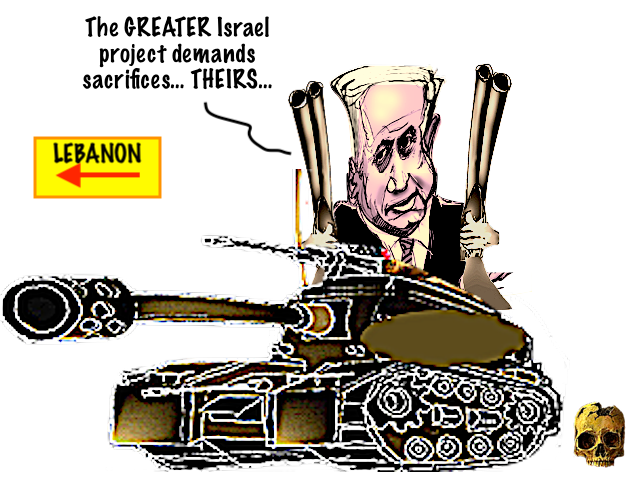
..Iran says an end to Israel’s hostilities in Lebanon is inseparable from the deal. But the Israelis are saying “our forces will remain in the country indefinitely.” Where is all this going to lead? Let’s welcome back to the program a friend of ours, the academic author and broadcaster, and long-time contributor to Iran’s Press TV, and he has traveled extensively in Iran, it’s always a pleasure to welcome back to the show our old pal Kevin Barrett. Kevin, how are you?
Richie Allen Interview: Iran Deal, Israel, Jewish Victimization, and Why the UK May Throw Me In Prison
Can I read aloud "Why I Support Hamas" at Hyde Park Speaker's Corner?
KEVIN BARRETT
Kevin Barrett:
Hey, I’m well Ritchie. Great to be back with you.
Richie Allen:
Thank you very much, my friend. And you said to me this morning that it’s nice to be reporting good news for a change. So as far as you’re concerned, this is good news. This is reason to be optimistic.
Kevin Barrett:
Well, it’s better than most of the news.
Richie Allen:
Yeah, I’ll give you that.
Kevin Barrett:
Yeah, I think peace is better than war. And Iran basically winning is better than any alternative. So yeah, this agreement clearly favors Iran. Whether it’s going to last without blowing up again is an open question. But in the meantime, I think it’s basically a good thing that it’s opening up the possibility that the US is going to have to break from its total subjugation to Zionism and to Netanyahu. And we’ll see whether that actually plays out. But if the US is going to adhere to the terms of this agreement, it’s going to have to order the Israelis to pull out of Lebanon, pull out of Gaza, and this is going to be unprecedented. So it has potential to be something very good for the region and the world, but I don’t know if the odds are favouring that outcome. ..
…that opens up a couple of different possible futures, right? And whether the American Platonic Guardians or Deep State are up to taking on the Israelis, again, is an open question.
Richie Allen:
I don’t personally believe that any president is really running things, but let’s just imagine I’m wrong because I’m often wrong. Let’s imagine Trump really is running the government, the administration. If he is, this is abject humiliation.
Kevin Barrett:
Well, it should be and it would be if Trump were rational. But Trump is quite capable of spinning delusions to support his narcissism. So I’m sure there will be handles he can grab onto to claim that he’s getting something better than Obama did. (And Trump can try to blame Netanyahu and say that when Netanyahu promised him the war would be a success) he was lying. Either that or he was totally incompetent and screwed up. So it’s Netanyahu’s fault, Trump! It’s not your fault. Blame it on Netanyahu. Blame it on the Israelis and go after them with all guns blazing. And that’s exactly what you need to do.
Richie Allen:
How many resolutions Kevin? How many resolutions at this point in history, how many resolutions were passed in the United Nations condemning and ordering the Israelis to stop the settlements and to stop the interning of Palestinian children? It’s got to be in the hundreds, right? Must be.
Kevin Barrett:
Yeah, I think there are hundreds of these UN resolutions telling Israel to do things that it’s never done. And the two most important ones are, was it 192, there’s 240 something, I’m forgetting the numbers right now, but the two keys resolutions. The first requires Israel to allow Palestinian refugees who were driven out of Israel by terrorism to return to their homes and be compensated for their suffering. And then the other one is post-1967, demanding that Israel return to its pre-1967 borders. Because the principle that you can steal territory by launching a war has been officially contrary to international law since World War II.
So those are the two key resolutions. Israel has to allow all Palestinian refugees to return, and to return to its pre-1967 borders—or better yet its UN borders…though the international consensus is for the 1967 ones.
Richie Allen:
Tell me this, has Gaza and the horrendous problems facing the Palestinian people been forgotten in the wake of the attacks on Iran and Lebanon?
Kevin Barrett:
Well, I don’t think it’s been forgotten. Actually, the people of Gaza have been saved, in a way, by Iran. Though Iran is being more forthright about stopping Israel’s war in Lebanon. But likewise, Iran is going to demand the end of this war on Gaza as well…
Richie Allen:
Norman Finkelstein has been a very prominent pro-Palestinian voice for many many years. And his aunt I think or his mother was in Auschwitz. So he’s an interesting character He came out and said something which I’m sure you’re aware of, which I found interesting. He said that he’s not at all comfortable with the US alternative right or the right wing alternative media, namely Tucker Carson, Candace Owens and others, supporting Palestine.
Kevin Barrett:
Well, I admire the work of Norman Finkelstein. I think he’s basically a good guy. But if you try to figure out where he’s coming from…he is one of these people who’ve grown up in the Jewish community, surrounded by the myths of the Jewish community about Jewish suffering, the persecution of the Jews. Everywhere the Jews have ever gone, they’ve been persecuted by their neighbors, for no reason. And so, you know, whereas some people from the Jewish community react to that narrative and that culture by becoming insufferably narcissistic, and often even psychopathic, like probably the majority of Jewish Israelis, others like Norman Finkelstein react to this narrative by accepting this victim role, this belief that the Jewish people have been victimized, but then universalizing it and identifying with victims everywhere. This puts Finkelstein not to far from the Iranian Shia ideology, which identifies with victims and demands that we stand up for victims. And that’s good. But I think this conditioning, which created the Norman Finkelstein that we know, who is standing up for the Palestinian victims, and even telling a certain amount of truth about the Holocaust industry…I think his ideology and worldview are conditioned by this sacred narrative of victimization that begins, in his culture, with the alleged victimization of the Jews throughout history. And that narrative and that culture make him suspicious of, let’s say, a right-wing American ideology, which is not founded on this defense of victims, which, on the contrary, is actually, to some extent, reacting against the victimization narrative, whether it’s anti-LBGTQ (because the left has made them out as victims) or whether it’s any of the other areas where the left has been identifying with victims. So I think Finkelstein is wary of the American right wing because of that. And I think he probably has some of that atavistic Jewish fear of the goyim getting out of control. And the goyim that Jews are taught they have to watch out for are the nationalistic ones, the right wing ones, the patriotic American or German ones who represent their mainstream majority culture and then are going to be coming after the Jews. Now the right-wingers would argue that’s what’s really going on here is that the Jews always come into these cultures and seize the best niches in the economy and basically become parasites off these cultures and take over the commanding heights of these cultures, especially in finance and media, and when the dominant culture—let’s say white Americans—doesn’t like it, they get into a clash with the Jews. And this leads to the Jews getting expelled or persecuted.
If we think about both of these cultures with their narratives—the Jewish left wing one of Norman Finkelstein, and the right wing one represented (in watered down form) by people like Tucker Carlson and Candace Owens—we can see why there would be a clash between them.
Richie Allen:
Yeah, for me it’s just wretched identity politics. I do want to say, and we won’t get into it because Kevin and I have gotten into it before, I don’t agree with Kevin that Jews have not been othered and ostracised and blamed throughout history.
Kevin Barrett:
I didn’t say that!
Richie Allen:
No no no, but you did say it’s effectively a myth that the Jews were victims and that they were run out of countries around the world. You don’t agree with that. I think it’s more complicated. I think Jews have been othered and scapegoated and blamed throughout history.
Kevin Barrett:
Of course they have. But often for good reason.
Richie Allen:
No, not for good reason. We’re not going there. But yeah, for me, it comes back to identity politics, really. And it’s the bane of my life, Kevin. And we’ve had this before you and I. Ultimately, salvation, I think, lies in realising that whatever our beliefs are, whichever God we pray to, we’re all the same mate. And there is an unfolding tyranny that has gripped the world. It’s a technocratic tyranny that’s building up and it doesn’t spare anybody. I mean, it’s funny isn’t we talk about these things. The most austere, the most heavy handed of the restrictions during the COVID times were undoubtedly in Tel Aviv and in Jerusalem and in the towns of Israel. The Israelis were absolute bastards to their own people during that particular time which I think is worth mentioning now.
It’s fascinating Kevin the Finkelstein thing it really is because he suffered greatly because of I believe because of his activities you know he lost tenure, didn’t he, at Paul University, if I’m not mistaken. And he went after Alan Dershowitz, didn’t he? And they came down pretty heavy on Finkelstein, the lobby, the Israeli lobby. So I’m fascinated by it. I think if you leave aside… it was a brilliant answer you gave by the way I think you’re probably on the money there but for me I look at Carlson and Owens and I see grifting Kevin. I see it being about engagement farming and brand building, follower building and ultimately money building. But I say that probably far too often for my listeners’ liking. But that’s where I see it. I don’t see any sincerity in it. Am I wrong?
Kevin Barrett:
Yeah, I think you’re wrong if you think that there’s no sincerity at all in people like Tucker Carlson and Candace Owens. I think they’re both probably pretty sincere overall, more so than when they worked for Fox News, and more so than the people who stayed at Fox News. So, yeah, I wouldn’t go quite that far. Was it Mark Twain who said that “it’s hard to get a man to see something if his income depends on not seeing it.” And so people like Tucker Carlson, Candace Owens, when they were working for Fox, there were a lot of things that they didn’t see. And then they started to see some of them. And I think they were sincere enough to be willing to step outside of Fox and speak more honestly about a lot of these issues. But even today, even in the positions that they are in today, there may be places that they just sort of unconsciously don’t want to go.
Richie Allen:
Fair enough. I’m not going to come back on that. I’ll give you the final word on that. Listen, the High Court in this country ruled earlier this year that the UK government’s proscription of Palestine Action was unlawful. That was right. It was a good decision. It shouldn’t be a terrorist offense to support an organization that ultimately wants to bring an end to the tyranny of the Israeli state against the Palestinians. But the government appealed it, and the court has ruled that the banning of Palestine Action was indeed lawful.
Kevin Barrett:
Yeah, it’s pretty outrageous that opposing genocide is illegal and can get you imprisoned in the UK. And supporting genocide, which one would think would be practically a capital crime, is actually pretty much mandatory. So we’re living in a topsy-turvy, upside-down world, to say the least.
I actually kind of like the American tradition of First Amendment jurisprudence, which says that the only way your speech can be restricted is if there is a really direct connection between your speech and something seriously unlawful. In other words, if I want to say “Here’s why I support Palestine Action, or Hamas, or whatever”—and I have, I wrote a long essay about why I support Hamas, giving all sorts of good reasons, I think. Anybody’s welcome to argue with me and tell me why they think I’m wrong. Obviously that shouldn’t be illegal. What should be illegal is if I am giving some kind of a speech in a situation where my impassioned words are going to directly lead to somebody committing a crime. That obviously is what “crying fire in a crowded theater” would refer to. So these 80-year-olds in London who hold a little cardboard placard saying “I support Palestine Action”—can anybody really argue that people who see that placard are immediately going to run out and commit some crime? It’s ridiculous. So Great Britain really should be ashamed of itself, that this is going on in the country that gave us free speech in Hyde Park, and the Magna Carta, and all these things. It’s outrageous.
Richie Allen:
It’s outrageous. You’ve got the lobby here telling the British government that when people use slogans like “from the river to the sea, Palestine will be free” that what it really means is it’s okay to kill Jews…
It’s interesting that you’re speaking to me from Morocco, where you did write that very lengthy, well-written article about why you support Hamas. You know, the way it is here (in the UK), if you were working here, you would be in jail now. That’s how crazy it is. I mean, I’ve always said, I don’t fence straddle. I never have done. I always give the opinion that I really believe, the one I really believe. I don’t support any group or I don’t support anybody. I never supported the IRA. And I’m a die-hard Irish republican. I don’t support any group at all. But the Palestinians have every right to resist their occupation. In fact, it’s enshrined in the law that they have the right to resist. But it has become so utterly despotic now, that if you were living and working here, you’d be in jail for saying you support Hamas. That’s a fact.
Kevin Barrett:
Well, if I run out of money, and I can’t pay for my rent and food any more, which could happen since they’ve deplatformed me from Patreon and Youtube and Stripe and all of these places, I guess I could scrape together my last twenty dollars and buy a Ryan Air ticket from Morocco to London and get off the plane in London and tell everybody about my article and I could have my food and housing covered for the rest of my life by the British taxpayer…
(For the full unexpurgated interview, check out the audio or video track above.)
Stripe is Substack’s only processor and they debanked me, so you can no longer pay me through Substack. Now I am posting everything on Substack free and asking people to sign up for recurring donations at my Paypal donation page…or better yet, the free speech platform SPdonate. Alternately you can Paypal or Zelle to truthjihad[at]gmail(dot)com. Note that Zelle, unlike other methods, doesn’t charge any fees.
PLEASE VISIT:
YOURDEMOCRACY.NET RECORDS HISTORY AS IT SHOULD BE — NOT AS THE WESTERN MEDIA WRONGLY REPORTS IT — SINCE 2005.
Gus Leonisky
POLITICAL CARTOONIST SINCE 1951.
RABID ATHEIST.
WELCOME TO THIS INSANE WORLD….
- By Gus Leonisky at 18 Jun 2026 - 5:55am
- Gus Leonisky's blog
- Login or register to post comments
yellow line....
In Campaign to Seize More of Gaza, Israel Expands Attacks on Palestinians Near “Yellow Line”
"Where are we supposed to go? They might as well throw us into the sea and be done with us.”
Story by Mohamed Ahmed and Abdel Qader Sabbah
GAZA CITY—Mustafa Al-Shawa awoke at 2:30 a.m. on Monday to the sound of gunfire and the rumble of tanks in Al-Tuffah neighborhood of Gaza City. When he was finally able to go outside a few hours later, he found two yellow concrete blocks placed in the middle of the street—the Israeli military had moved them at least one hundred meters further west into Gaza where they now lay close to his home.
“They moved the yellow line forward to the Sanafour Junction. It used to be up by Al-Shaaaf Street,” Al-Shawa told Drop Site News. “This is the yellow line,” he said, pointing to the blocks. “There is another yellow line along Salah Al-Din Street that they have moved closer. Enough of what is happening to us. Enough of this suffering.”
Israel has been steadily encroaching further into Gaza, moving the “yellow line” that demarcates its area of control from 53% of the enclave since the start of the so-called ceasefire in October to well over 60%, in violation of the agreement. Prime Minister Benjamin Netanyahu recently ordered the army to take 70%.
“We can’t leave the neighborhood because there is nowhere to go,” Al-Shawa said. “If we leave the area we’re in now, we’ll end up sleeping in the streets, in filth. There is no place left. Where are we supposed to go?”
Along certain parts of Gaza, Israeli troops have placed yellow concrete blocks to delineate the new border. Their placement of the blocks further west into the Al-Tuffah neighborhood on Friday accompanied by gunfire, tanks, and quadcopter attacks caused dozens of Palestinians in the area to pack up their belongings and flee later that day.
Families crammed their scant belongings into open cardboard boxes and plastic bags. Trucks were piled up with thin mattresses, furniture, cookware and plastic bins waiting to be carried away. “The yellow line has destroyed us,” one resident yelled as he walked by.
Like nearly all of Gaza, the Al-Tuffah neighborhood is barely standing. Every building is badly damaged or completely destroyed. Residents traverse dirt roads instead of paved streets, flanked by mounds of rubble and twisted steel.
“Last night was very, very bad,” Nafiz Al-Ghaz, another resident of Al-Tuffah, told Drop Site. “It was a difficult day and an even more difficult night: tanks, quadcopters, gunfire. All night they were telling us, ‘Run, run.’ People are fleeing, taking whatever furniture, cupboards, and beds they can carry. We are on the yellow line. They placed the yellow line right at the traffic junction. …Where are we supposed to go? They might as well throw us into the sea and be done with us.”
Before the genocide began over two and a half years ago, the Gaza Strip was already one of the most densely populated places on earth. Since the “ceasefire” in October, Israel has steadily seized more land, corralling the nearly two million Palestinians in Gaza into an ever shrinking area. Every inhabitable structure is crammed full of people while hundreds of thousands are living in tents and flimsy tarp shacks pitched close together wherever there is room—on the streets and public squares, in stadiums, and on the coastline.
“No one is paying attention to us,” Mohammed Khalil told Drop Site as he gathered up his belongings along the side of a building in Al-Tuffah. “Every day we wish for death,” he said, his voice trembling as he spoke. “Every day we wish to die, to be done with this life.”
Israel has violated the “ceasefire” on a daily basis since it went into effect in October, killing over 1,000 Palestinians in routine attacks and wounding over 3,100, severely restricting the amount of aid agreed upon in the deal, and seizing more land.
“Despite the ceasefire announced eight months ago, Gaza still faces profound uncertainty and immense human suffering,” UN Secretary-General António Guterres said in remarks to the Security Council last week. “Violence is on the rise, with civilians killed on a daily basis. Humanitarian operations remain heavily constrained. Basic human needs—for clean water, sanitation, food, shelter, health care, and more—are going unmet. And the Israeli Government is declaring its intent to control 70% of the Strip.”
The Security Council voted in November to authorize President Donald Trump’s “Board of Peace” to monitor the ceasefire. In a statement on Sunday, Hamas said it delivered its response in coordination with other Palestinian factions to a proposal it received in April from Nickolay Mladenov, the High Representative of the Board of Peace. Mladenov has turned a blind eye to Israel’s violations and instead called on Hamas to fully disarm despite that not being a part of the phase one deal that Hamas signed in October.
“To the world, there is a ceasefire agreement, but in practical terms on the ground, Israel has moved toward a pattern of gradual escalation that reshapes the aggression and reshapes the genocide in the Gaza Strip through multiple forms,” Ahmed Al-Tannani, a writer and political analyst in Gaza, told Drop Site. “Part of this is the daily killing around the yellow line, in addition to expanding control. Another part is linked to the continuation of assassinations and the bombing of civilians in their homes. In addition to that, it has returned to the policy of evacuating neighborhoods and then bombing them, including in areas west of the yellow line.”
Earlier this month, Israel bombed Al-Jawazat displacement camp west of Gaza City, killing six Palestinians and wounding 20 others, just one of many attacks on areas far from the “yellow line.”
“Attacks are still taking place around us. Here in the Al-Jawazat camp, there have been multiple strikes on tents,” Raed Hajjaj, who lives in a tent within the crowded displacement camp, told Drop Site. “It’s not like before, when massacres were happening continuously and the world’s attention was focused on Gaza. Now, with one or two attacks every day or two, or several times a week, the world is occupied with other issues. We all know what they are—the U.S.-Iran war, the closure of the Strait of Hormuz, and other developments. These things have distracted the world from us.”
Attacks From Israeli Military BasesMohammad Al-Zaghl pointed to the bullet holes that ripped through the fabric of his makeshift bathroom on Monday morning. He constructed the small shed out of tarp and wood close to his tent in the Halawa displacement camp in Jabaliya, northern Gaza.
The most frequent Israeli attacks target Palestinians living close to the yellow line in places where the military has built 25 kilometers of massive earth berms to physically divide Gaza. Newly constructed military bases atop the berms appear as elevated colonial forts overlooking a displaced and devastated Palestinian population.
The Halawa camp lies just a few hundred meters from an Israeli base atop one section of the berm—an imposing wall of earth lined with spotlights facing outward and an Israeli flag hanging from a flagpole inside the base alongside several towers.
“The Israelis are about 500 meters away from us,” Al-Zaghl told Drop Site. “There is not just one tower—there are one, two, three. From all three directions, we cannot escape the gunfire. Every day there is shooting. Everyone stays in their place, in their tents.”
Like thousands of others, Al-Zaghl has been living in Halawa ever since he was forcibly displaced from the Jabaliya refugee camp. In January, as he was sitting at the entrance of his tent, he heard a burst of gunfire before realizing he had been shot in the abdomen. An angry scar runs along his lower back and a smaller entry wound is visible on the left side of his stomach.
“Today it is worse than before. You hear constant gunfire, explosions, and noise,” he said.
Youssef Shaman, 15, was also shot from the Israeli military base overlooking Halawa. He said it happened in March, as he was going to collect water for his family. “While I was on my way, there was a crowd gathered around the water, and they started shooting at us from the tower,” Shaman told Drop Site. “People were hit, and I was shot in my leg. They kept firing at us from the tower. We could see the Israelis shooting at us.”
Shaman shows the bullet wound on the inside of his thigh just above the knee. An older scar runs along the top of his ankle where he was hit by shrapnel in an earlier airstrike that killed his brother. Along with other eyewitnesses, Shaman said the shooting attacks from the nearby base have steadily increased over the past few months.
“We can see them, and they can see us,” he said. “They look for someone to snipe and open fire on them. They deliberately watch and shoot us. They climb up the hill where we can see them, in their military vehicles and tanks, and then they start shooting at us. …The shooting has increased. They fire at us all day long.”
Israel has not faced any consequences for its wholesale abandonment of the ceasefire over the past eight months, with the violations becoming more acute and attacks intensifying to drive Palestinians further inward, seize more land, and continue the genocide.
“The Israeli occupation still considers the war to be ongoing, and the objectives of the war—linked primarily to achieving the strategic goal of displacing the Palestinian people—are still in place,” Al-Tannani said. “The ceasefire agreement has not brought about any change for the Israeli government.”
Sharif Abdel Kouddous and Jawa Ahmad contributed to this report. Sami Vanderlip edited the video.
https://substack.com/inbox/post/202482289
READ FROM TOP.
PLEASE VISIT:
YOURDEMOCRACY.NET RECORDS HISTORY AS IT SHOULD BE — NOT AS THE WESTERN MEDIA WRONGLY REPORTS IT — SINCE 2005.
Gus Leonisky
POLITICAL CARTOONIST SINCE 1951.
RABID ATHEIST.
WELCOME TO THIS INSANE WORLD….