Search
Recent comments
- choosing sides.....
3 hours 35 min ago - agreed?.....
5 hours 30 min ago - I forgot....
5 hours 40 min ago - strikes.....
5 hours 52 min ago - easy target....
6 hours 9 min ago - auto co-op...
11 hours 29 min ago - sobriety....
11 hours 49 min ago - gina's conga-line.....
11 hours 53 min ago - poison....
12 hours 44 sec ago - yandex...
12 hours 18 min ago
Democracy Links
Member's Off-site Blogs
heavy billionaires want your cake and eat it.....
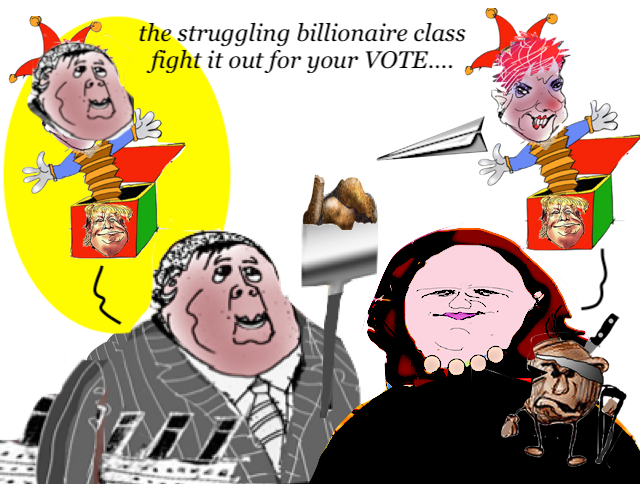
Will there be a shakedown at the next election between One Nation, backed by mining magnate Gina Rinehart, and fellow mining magnate Clive Palmer's United Australia Party? Trying to outflank the Hard-Right from the Right is an ambitious exercise, writes investigation editor Ross Jones.
ONANISM is on the rise.
According to The Australian of 7 June:
'Core support for Pauline Hanson’s One Nation has surged ahead of Labor for the first time in Newspoll history, as Anthony Albanese’s popularity hit record lows and an overwhelming majority of voters declare Australian politics is overdue for a big shake-up.'
If history is any guide, Pauline Hanson's One Nation (PHON) would go for a shakedown.
The Murdoch myth has convinced a large chunk of the electorate they are doing it tough because of immigration.
Maybe because of a volatile world, U.S. and Chinese trade bans, tariffs, oil embargos, wars and so forth, but really? Immigration?
This fertile soup is the food source of ONanism — the cult of Pauline Hanson.
Many PHON supporters are not full-on ONanists; they’re just seriously pissed off that the sector of the economy that affects them is under-performing and life, by their standards, is the pits.
Fair enough.
ONanists are a completely different kettle of fish.
They have an unshakeable belief in the leader regardless of her documented contradictions. Don’t get between a cult member and an entitled view.
But it’s not all one way.
Adding impetus to this maelstrom of weirdness is Australia’s other Great Right Hope, Clive Palmer.
Pretty much anybody in Australia with a letter box or a passing interest in newspapers has seen Clive’s yellow ad for his United Australia Party.
Who knows why?
Election after election, he gets trounced, yet election after election, he gets up and has another go.
He did get a numbers-lucky Victorian Senate place for Berwick real estate agent Ralph Babet, a man who has yet to trouble the political scorer.
Like PHON, Clive reckons he’s going to "run candidates in every lower house electorate as well as all senate contests across the country".
That takes money and Clive seems to have plenty. But not as much as Gina.
Clive has one big advantage, though – immigration.
While the timid ONanists espouse ‘capping visas at 130,000 per year to ease pressure on housing, wages, and infrastructure’, Clive goes all the way with zero immigration.
Under the United Australia Party's policy, immigration would be limited to 'family reunions and limited work permits for major national projects'.
Like mining, for example.
No student intake at all. Australians would be reduced to picking up their own takeaways.
Poor Clive and Ralph are floundering in a sea of irrelevance.
Trying to outflank the Hard-Right from the Right is an ambitious exercise. Up against ONanism, Clive will be no more than a bug on the windscreen, unless he’s got a trick or two up his sleeve.
Palmer is already spending up big to contest an election that’s still 23 months away, but he hasn’t got what it takes to front a successful political party and it's hard to see the point or use of Ralph Babet.
But Clive’s got enough bucks to be a thorn in the Right side of politics and he’s going to spend them trying to do just that.
Apart from flooding the streets with lurid yellow litter, Palmer’s longer-term strategy for giving the cult a meaningful fright has yet to be revealed.
Clive will be pushing it uphill to make a dent in the alleged popularity of Australian politics’ version of the Exclusive Brethren, but you can bet he’ll give it a go.
That’s the spirit!
Ross Jones is IA's investigations editor and the author of the two-year investigation, Ashbygate: the plot to destroy Australia's Speaker, published by IA in 2015 and available HERE.
PLEASE VISIT:
YOURDEMOCRACY.NET RECORDS HISTORY AS IT SHOULD BE — NOT AS THE WESTERN MEDIA WRONGLY REPORTS IT — SINCE 2005.
Gus Leonisky
POLITICAL CARTOONIST SINCE 1951.
RABID ATHEIST.
WELCOME TO THIS INSANE WORLD….
- By Gus Leonisky at 14 Jun 2026 - 11:23am
- Gus Leonisky's blog
- Login or register to post comments
southern cross....
Denis Muller
A right mess: how mining, media and political interests are combining to influence public debate in AustraliaOne Nation’s surge has exposed a new alignment of media, mining and political interests on the Australian right, with Gina Rinehart, Lachlan Murdoch and Pauline Hanson now central to how that contest unfolds.
Mining billionaire Gina Rinehart is bankrolling the acquisition of a 9.5 per cent stake in Southern Cross Media by Bruce McWilliam, who worked for Murdoch’s News Corp for nine years and is also a former Seven Network executive.
This venture is costing Rinehart $26 million. It does not buy her a direct stake in Southern Cross, but if McWilliam cannot uphold his side of a security deed he has signed with her, she could take control of it.
Southern Cross is one of Australia’s biggest media organisations. It owns the Seven Network, 7news.com.au, the Triple M and Hit radio brands, a raft of regional radio stations, and West Australian Newspapers.
The Rinehart-McWilliam-Murdoch axis is a formidable force, part of a new combination of media, political and mining interests, reminiscent of that which formed the Liberal Party in the 1940s. The other key figures are News Corp chair Lachlan Murdoch, One Nation leader Pauline Hanson and Liberal Party director Tony Abbott.
This is the lens through which it is instructive to assess the media’s coverage of One Nation’s rise since the Farrer by-election on May 9.
To see the parallels with the 1940s, we need to join a few dots.
Rinehart is a benefactor to Hanson. She recently bought her a light aircraft worth $1 million.
She is also a benefactor to Lachlan Murdoch. Her company Hancock Prospecting is sponsoring Sky News, owned by Murdoch’s News Corporation, to the extent of a little over $1 million for a Sky event in Dubbo called the Bush Summit.
Lachlan Murdoch is chairman of News Corporation. In 2023, he appointed Tony Abbott to the board of the News subsidiary, Fox Corporation, a day after Rupert Murdoch announced his retirement. In May this year, Abbott was elected unopposed as federal president of the Liberal Party.
Lessons from the 1940s
The parallels with the 1940s can be seen in volume two of Sally Young’s magisterial two-volume history of the Australia media, Media Monsters, where she describes the machinations that led to the formation of the Liberal Party.
The right was in disarray. Robert Menzies’ comically ill-named United Australia Party had been trounced by Labor at the 1943 election. In the aftermath, Menzies was re-elected leader but made it a condition that he had the right to form a new party.
He was backed by an entity called Collins House. This was a collection of companies connected by networks of powerful business figures who dominated mining and manufacturing. An influential figure was Lachlan Murdoch’s grandfather, Keith Murdoch. As managing director of the all-powerful Herald and Weekly Times (HWT) newspaper group, he provided a vital connection between the Collins House group and the most senior level of politics.
The HWT and other major media proprietors of the day anointed Menzies and his proposal for the new Liberal Party, at a dinner of Collins House magnates in Melbourne in 1944.
The difference between the political circumstances of the 1940s and those of today is that today there are two right-wing political parties contending for supremacy: the Liberal Party and One Nation.
Rinehart seems to be having a million quid each way on which will prevail. By contrast, if the recent coverage of One Nation by The Australian is any guide, Lachlan Murdoch has already cast his vote decisively for the Liberal Party.
The media sober up
For a fortnight after One Nation’s historic win in Farrer, the media, including News Corp media, were intoxicated by the attendant excitement and controversy: the shredding of Liberal Party support; Hanson’s ambition to be prime minister; the possibility of a Liberal-One Nation coalition.
Then, led by The Australian, the media began to sober up. On 23 May, its editor-at-large, Paul Kelly, wrote that the Nationals, Liberals and One Nation were locked in a bitter competition with “life or death” consequences.
From that point on, The Australian applied the blowtorch of journalistic scrutiny to One Nation, and The Age and Sydney Morning Herald swiftly followed.
With its customary disregard for journalistic ethics, The Australian made a point of reporting that One Nation’s South Australian parliamentary team was looking like a “rainbow coalition”, one of its MPs having come out as gay with a partner who was an Indonesian Muslim.
But then it got into some serious public-interest journalism. For two days it pursued the party over its handling of rape allegations against an adviser, Sean Black.
It accused Hanson of shirking her parliamentary duties by being absent from 88 per cent of Senate estimates hearings over the past decade. It also drew attention to the fact One Nation had failed to lodge audited financial records for three years in Queensland, and disparaged its policy proposal for citizen-initiated referendums.
On 3 June it drew on all this to publish a thundering editorial. One Nation was drifting further out to the fringes. It would be divisive and disruptive. It had appeared to lurch into blind confusion. Hanson was “not fit in any sense” for the role of prime minister.
On 6 June, it led page one with a full-frontal attack, carrying the self-revealing headline: “Hanson hit”. It said Hanson had been caught out misleading voters, raising further questions about her capacity to be prime minister.
The Age and SMH were by then taking up the theme.
Suddenly Hanson was reportedly not sure if she would pitch for the prime ministership. She had admitted having had to close down party branches that had been “infiltrated by extremists”. She had insisted she would not be influenced by Rinehart despite having adopted one of Rinehart’s key policies. In other words, she was all over the place.
On 6 June, the paper’s political and international editor, Peter Hartcher, described her as a firebrand provocateur who specialises in grievances without solutions and turns to scapegoats instead – Asians, First Nations people, Muslims. He pointed out that Hanson had answered “no” when asked by another journalist whether she could think of any error that Donald Trump might have made since taking power.
The same day another Age/SMH commentator, Paul Sakkal, wrote about what he called the collection of right-wing forces barracking for Hanson: openly white supremacists, people who rallied alongside neo-Nazis, supporters of the so-called sovereign citizen Dezi Freeman, who had killed two policemen. “A serious governing party cannot retain these relationships.”
A right mess
The big question after all this is how the forces brought together through the new media-politics-mining combination will resolve the obvious tensions involved in creating an effective force on the right of Australian politics.
Murdoch, through The Australian, has clearly signalled his contempt for One Nation, and already has Abbott on his team through Fox Corporation.
Rinehart, with her substantial holdings via McWilliam in Southern Cross Media, could go either way: backing Hanson or the Liberals. And her record indicates she would use her power to influence editorial decision-making to support her choice.
In 2012 she became the largest shareholder in the Fairfax company, with 14.99 per cent. However, she refused to sign the company’s charter of editorial independence, and as a result was refused a seat on the board. She sold out in 2015.
Her history in refusing to sign the Fairfax charter is a strong indicator she would want the option of using her position on any media board to influence editorial decisions.
The old Fairfax newspapers, The Age, the SMH and the Australian Financial Review, are now owned by the Nine Entertainment Company, and stand outside the new cabal. A crucial question is whether they might prove to be a countervailing force.
One Nation set off this earthquake in Australian politics, but how the media play into the aftershocks will be a significant factor in the shaping of the new landscape.
https://theconversation.com/a-right-mess-how-mining-media-and-political-interests-are-combining-to-influence-public-debate-in-australia-279454
READ FROM TOP.
PLEASE VISIT:
YOURDEMOCRACY.NET RECORDS HISTORY AS IT SHOULD BE — NOT AS THE WESTERN MEDIA WRONGLY REPORTS IT — SINCE 2005.
Gus Leonisky
POLITICAL CARTOONIST SINCE 1951.
RABID ATHEIST.
WELCOME TO THIS INSANE WORLD….