Search
Recent comments
- choosing sides.....
3 hours 35 min ago - agreed?.....
5 hours 30 min ago - I forgot....
5 hours 41 min ago - strikes.....
5 hours 52 min ago - easy target....
6 hours 10 min ago - auto co-op...
11 hours 30 min ago - sobriety....
11 hours 49 min ago - gina's conga-line.....
11 hours 53 min ago - poison....
12 hours 1 min ago - yandex...
12 hours 18 min ago
Democracy Links
Member's Off-site Blogs
a galaxy of factors whose orbits we can only guess....
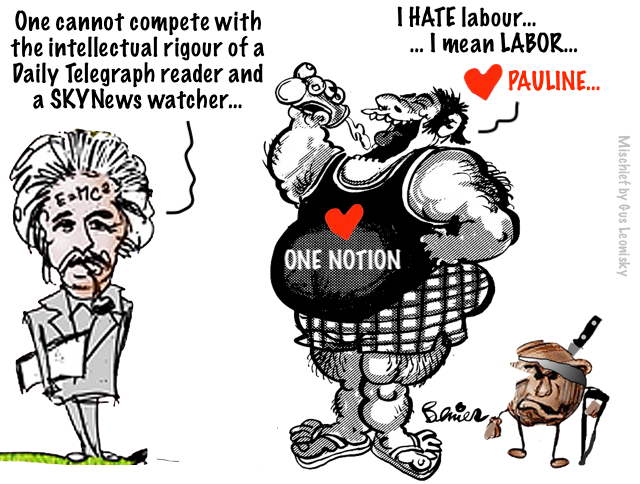
One Nation can win the next federal election. Whether that comes to pass depends on a galaxy of factors whose orbits we can only guess. But now, for the first time, it’s possible to see how those orbits could deliver Pauline Hanson to the Lodge, even if it’s not the likeliest outcome.
Why One Nation can win the next federal election
BY Waleed Aly
Yes, this is about polling. But it’s about more than that. It’s about the forces beneath the numbers which are all heading in one direction. The only question is if and when those forces halt, and how far One Nation has gotten in the meantime.
Multiple polls have One Nation in first place on primary votes, ahead of Labor. That is obviously a sensational development, but actually the most seismic poll still had Labor in front, published late last week in this masthead. That’s because it showed the One Nation vote breaching what had previously been the great wall of Australian politics defined by two major characteristics: geography and formal education.
Simply, Labor dominated the cities and the tertiary educated. The Coalition and One Nation were left to fight over the rural vote, which can never be enough to deliver government. As long as this arrangement remained intact, One Nation could surge as much as it liked and not pose a serious threat. At most, it could replace the Coalition as a regionally based opposition party.
Now we learn One Nation has become more popular with women than with men. It is picking up younger, tertiary educated, high-income city voters. It has commenced its urban raid, crossing the containment lines that exclude it from government. People keen to write off One Nation as the party of angry, old, white men are now demonstrably wrong in exactly the way Democrats were wrong about Donald Trump in 2024.
In the latter case, Trump’s coalition turned out to be multiracial and intergenerational. He did well with women voters, even against a female candidate running hard on the issue of abortion. Now One Nation is showing signs of similar breadth. If a poll soon emerges showing it has growing support among migrant communities, there will be no reason for surprise.
We will spend enormous energy debating what the major parties’ response to this should be. We’ll examine the Albanese government’s every move to see if it can provide solutions to the electorate’s grievances and arrest the slide. If it cannot, we’ll deem it a failure of understanding, imagination or political competence. This overlooks the fact we’re seeing this pattern repeated in the US and the UK, to say nothing of France, Germany, Italy or Austria. And nowhere comparable in the world have establishment parties found a way to resist this movement once it gathered momentum.
In the US, it swallowed the Republicans. In the UK, Nigel Farage’s Reform party has crushed the Tories and is now crushing Labour. In France, the traditional major parties were swept away almost entirely, and Macron’s new centrist block only barely survives because parties conspire to keep the far-right out of power. Why should we assume Australia is an exception to this, that there’s some uniquely Australian rabbit to be pulled out of some hat?
These are deep, tectonic forces. We’re watching a broad, thoroughgoing rejection of the decades-long political consensus in Western politics. It’s not hard to point to the landmarks along this road of discontent – terrorism, the global financial crisis, Brexit, COVID, multiple rounds of inflation, AI’s onward march – but it’s the cumulative effect that matters: a near-constant sense of crisis, spanning the economic, social and political. The resulting sense is that the system itself is broken.
The problem for major parties is that whatever they now say, they symbolise that system. The benefit for insurgents is that whatever they say, they symbolise upending it. In that environment, it hardly matters what the establishment offers. The more deeply you’ve given up on the system, the less you’re even listening to the establishment any more. And the less critically you’ll examine the insurgency.
This is a politics of deep dissent. It is not unified by a shared worldview. Winding back immigration and climate policy are common touchstones, but little besides. The more we see One Nation members elected to parliaments, the more variety we see in what they actually believe. Most recently we have David Farley, freshly elected in Farrer, who values the contribution of migrants and thinks Muslims by and large respect and integrate into Australian culture. He’s happy to stand in front of the Aboriginal flag. What the movement agrees on most is the need to break the two-party system.
It works because there are no natural majorities any more. Instead, we have only majorities of dissent, cobbled together more around rejection than affirmation. That means the electorate constantly sends two consecutive messages: “We want change!” – then immediately, “Not that change!” Witness, for example, the response to Labor’s budget. Or, for that matter, any serious structural reform this century that asks someone to sacrifice something.
Conventional political wisdom suspects One Nation will falter upon facing the same policy scrutiny as major parties, beginning in earnest next week when Hanson addresses the National Press Club. But this makes two fragile assumptions: first, that One Nation’s roughness isn’t already priced in to its support; and second, that people will ultimately assess One Nation on the same terms they assess the major parties. That’s unlikely to be true for as long as One Nation remains an insurgent, building a coalition of dissent.
Perhaps that’s a week, a year, or the other side of the next election. No one knows, and everything depends on it. Perhaps the more used to One Nation we get, the less insurgent it will seem. In the UK, Reform is now being threatened by an even more hardline outfit, Restore Britain. Perhaps that could happen here. Meanwhile, we’re on the cusp of a serious, Iran-induced economic crisis. Will voters blame Trump for that and associate One Nation with him, or rage at the Albanese government and put One Nation over the top?
As I say, a galaxy of factors. But this is not a surge that can be managed away. One Nation is playing a different political game by a completely different set of rules, much as Trump did. The major parties cannot will those rules to change. Only time or a major disruption can do that. And only then will the surge abate.
Waleed Aly is a broadcaster, author, academic and regular columnist.
PLEASE VISIT:
YOURDEMOCRACY.NET RECORDS HISTORY AS IT SHOULD BE — NOT AS THE WESTERN MEDIA WRONGLY REPORTS IT — SINCE 2005.
Gus Leonisky
POLITICAL CARTOONIST SINCE 1951.
RABID ATHEIST.
WELCOME TO THIS INSANE WORLD….
THE INFLUENCE OF THE ZIONIST EFFLUENTS NEED ALSO TO BE TAKEN INTO ACCOUNT....
- By Gus Leonisky at 12 Jun 2026 - 9:44am
- Gus Leonisky's blog
- Login or register to post comments
danger No 1....
Why One Nation endangers Australia’s homeless — and everyone else
By Michelle Pini
Does Australia have an illegal migrant problem, or do we have a compassion problem? Editor Michelle Pini discusses the tragic death of a young "non-resident" as One Nation dogwhistling intensifies.
IN DECEMBER, a young person died on the streets of Sydney’s CBD — his lifeless body unnoticed for six days. It is as though he were invisible, largely unseen even before his untimely death. He died alone.
You see, 32-year-old Bikram Lama, an international student from Nepal, was a “non-resident”. He was homeless when he died, the cause of his death still to be determined.
As a “non-resident”, Bikram was not entitled to social housing (or temporary housing), Centrelink, healthcare or any other support. Such things are reserved only for Australian citizens. Employment for non-residents is also restricted, with most only permitted to work less than 48 hours per fortnight.
In Australia, “non-residents” are undocumented people, asylum seekers, New Zealand citizens (who arrived after 2001) and temporary visa holders — many of these, international students, like Bikram.
This is not an isolated situation. According to the City of Sydney, one in five homeless people is a non-resident of Australia. The situation is similar in other major Australian cities.
So when Pauline Hanson and her One Nation racist band speak about “illegal” migrants and try to blame all the woes of the disgruntled on them, these are the people they are vilifying. People like Bikram Lama. People who have, in fact, paid handsomely to come here. People who have done nothing wrong. People who are dying on the streets of wealthy, well-heeled politicians like Pauline Hanson and Barnaby Joyce, and the media moguls and miners who fund these politicians and their hatred, such as Gina Rinehart.
Australian universities are now serious, money-making businesses. They run effective international campaigns to recruit overseas students, who pay more than Australian citizens to study here.
The cost of studying in Australia for international students is estimated at between $45,000 and $95,000 per annum.
According to a Reserve Bank report, international students contribute over $50 billion to the economy annually.
One Nation’s immigration policies, however, aim to:
Deport 75,000 illegal migrants ... because ...
...Visa overstayers, illegal workers, and unlawful non-residents undermine national security, drive down wages, and take advantage of public services meant for Australians.
One Nation also aspires to:
‘End the student visa loopholes that turn study into a backdoor to permanent residency or low-wage labour.’
Like most One Nation rhetoric, the facts do not support its claims that temporary visa holders – students or others – are gouging our economy or rorting our support systems.
The reality is that many are not wealthy and must go to extreme lengths to be educated here. Bikram’s family struggled financially and had to sell a portion of their farmland in their remote village, south of Kathmandu, to send him to Australia to study computer science, in the hope of a better future.
Indeed, if anyone is being rorted, it is temporary residents who pay exorbitant fees to study here and are then left to their own devices – without a support system in sight – when they are unable to sustain life here and are also unable to return home.
Bikram fell into hardship and failed to renew his passport, and as his life and hopes of a better future spiralled into homelessness, he lost contact with his family.
According to an ABC report:
‘…it wasn't until the Nepali embassy contacted Bikram's family to identify his body, which had decomposed so badly that DNA samples, dental records and fingerprints were requested, that they had any sense of what his life had become.’
But this is not only about Bikram Lama — devastating though his story is. And it’s not just about immigration — hot topic though it is, courtesy of a spike in global interest in so-called “populist” parties like Pauline Hanson’s One Nation.
Despite the baseless dog-whistling, in case it isn't enough to bring students here under the false pretence of a better life and then let them live and die on our streets when their money runs out, Hanson wants to:
'Introduce an eight-year waiting period for citizenship and welfare, ensuring new arrivals contribute before they take.'
And finally, if we should occasionally find our hearts and take in people seeking asylum, One Nation wants to:
'Withdraw from the UN Refugee Convention because Australia will not be dictated to by foreign organisations when deciding who we accept into our nation on humanitarian grounds.'
This latter claim is perhaps the most ludicrous, since although party to the UN Refugee Convention, Australia has frequently violated it, most notably during the Abbott/Turnbull/Morrison regime, which tortured refugees on Nauru and Manus Island for a decade.
Indeed, if Australians need a group of people towards which to direct our angst for the failings of our society, we need to look no further than demonstrably racist politicians like Hanson. Pauline Hanson's One Nation, which was prepared to sell off politicians to America's National Rifle Association (NRA) and whose chief of staff is a convicted criminal. One Nation, whose leader accepts private planes as gifts from billionaires and whose own salary jumped by $100,000 to $340,900 per annum after fellow rorter, Barnaby Joyce, defected to One Nation, making it an official “minor party”.
In return for their eye-watering salaries, this dogwhistling rabble continues to spread hate and division. It promises to help battlers, but instead, Hanson has voted against all of the following relief measures:
This story is not only about Bikram Lama or other non-residents.
This is about our compassion, or lack of it. Many Australians are doing it tough. Inequality is soaring, both here and globally. While the Albanese Government is at least attempting to address some of these issues, there is still much work to be done. This is undeniable.
But if we are comfortable blaming our problems on the most vulnerable, if we are okay with allowing young people – who have already paid for the privilege to be here and who have much to contribute – to sleep on our streets, desperate and alone, and if we are happy to walk past them, even as they take their last breaths, the problem lies with us.
This editorial was originally published as part of the Independent Australia weekly newsletter. Subscribe to IA to access all our work from as little as $1.15 per week and help power our journalism throughout 2026.
Follow managing editor Michelle Pini on Twitter @vmp9 and Bluesky @michellepini.bsky.social, and Independent Australia on Twitter at @independentaus, Facebook HERE and Instagram HERE.
https://independentaustralia.net/politics/politics-display/why-one-nation-endangers-australias-homeless--and-everyone-else,21161
READ FROM TOP.
PLEASE VISIT:
YOURDEMOCRACY.NET RECORDS HISTORY AS IT SHOULD BE — NOT AS THE WESTERN MEDIA WRONGLY REPORTS IT — SINCE 2005.
Gus Leonisky
POLITICAL CARTOONIST SINCE 1951.
RABID ATHEIST.
WELCOME TO THIS INSANE WORLD….
worry....
How worried should we be about Pauline Hanson?
ETTE MEDIA
https://www.ettemedia.com/yt-video-tj57npobumg/
READ FROM TOP.
PLEASE VISIT:
YOURDEMOCRACY.NET RECORDS HISTORY AS IT SHOULD BE — NOT AS THE WESTERN MEDIA WRONGLY REPORTS IT — SINCE 2005.
Gus Leonisky
POLITICAL CARTOONIST SINCE 1951.
RABID ATHEIST.
WELCOME TO THIS INSANE WORLD….
media gripes....
Newsrooms destroy life satisfaction while trying to report it
Constant lies about Australia’s economy weaken consumer confidence and social cohesion, as Alan Austin reports.
JUST ONE three-minute segment on ABC News last Tuesday (9 June) contained multiple blatantly false assertions seemingly intended to make its audience sad and miserable.
Headlined ‘Money problems’, the item featured a spokesperson for lobbyists for rich corporations, KPMG, declaring:
“Real wages are lower than they were in 2020. Median household wealth is actually flat over that five-year period. It’s no surprise that people are feeling less satisfied with their life because they're feeling that financial pressure.”
A second contributor, a psychologist from Life Unlimited, said:
“I think when we look at this ongoing financial pressure it feels like a chronic stressor. It’s been five years of a hard slog...”
A third interviewee, from the Centre for Policy Development, bemoaned that:
“Worsening economic conditions [are] having an impact on social conditions.”
The presenter then asserted,
“The data shows more than one in five households are unable to raise $2,000 for an emergency in a week. A quarter have experienced at least one cash flow problem, forcing them to dip into savings or take on debt.”
On the same day, an agitated guest on Channel 7’s Sunrise was enraged that:
“The cost of living is crippling so many Australians... I mean, you look at inflation, which is crippling budgets, and you talk to any economist and they'll tell you it's reckless government spending that's fuelling inflation.”
That was followed by the founder of Western Sydney Women, urging Sunrise viewers to despair of life itself:
“This is about the mum and dads who can't feed their children. This is about the small businesses that are closing down every day that message me every day saying, I don't know how to cope.”
Day in, day out, week in, week out, the mainstream newsrooms churn out this malicious nonsense.
Inflation is not cripplingIt is not true that living costs are increasing for all Australians.
Every month, the Australian Bureau of Statistics separates the consumer price index (CPI) into its component parts. Inflation for the year to April of 4.18% comprised coffee and tea up 9.3%, beef up 12%, lamb up 14.7%, petrol up 18.6% and electricity up 22.6%. Over the same year, urban transport costs fell 20.8%, egg prices dropped 3.7%, books were 3.1% cheaper, fruit was down 2.2% and household appliances fell 2%.
Other price reductions included cheese, pharmaceuticals, gardening tools and men’s clothing. Most other categories remained flat.
Hence, an Aussie bloke with a garden who uses public transport and cooks his chicken and cheese omelettes on a gas cooker, followed by seasonal fruit before retiring to his library with a Scotch and dry, will have found his living costs significantly lower over the last year than the year before.
Sure, others copped modest cost rises. The national average was 4.18%, which is historically low.
As observed before, John Howard won the 2001 Election with inflation at 6.1%, Bob Hawke was returned in 1990 with 7.8% and Malcolm Fraser romped it in with 10.1% in 1980.
Wages and pensions increasingIt is not true that real wages are declining under the Albanese Government.
Since Treasurer Jim Chalmers' first Budget in October 2022, the CPI has risen 12.9%. Average wages over that time have risen 13.1%. The minimum wage is 23.1% higher. Age pensions are up 17.5%. Jobless benefits are up 21% and Commonwealth rent assistance is up 44.6%.
The kernel of truth — budgeting difficultiesIt is true that some Australians are experiencing financial pressures for the first time. But why is this?
More than 167,800 Australians travelled to France in 2025. That’s 10,000 more than the previous record set in 2023. First-time travellers to Europe, especially elderly citizens, frequently encounter unexpected expenses.
The number of students enrolled in fee-paying private schools has surged by 139,500 in the last four years to 1,547,500. Some of those families must now sacrifice other spending.
Single and twin-engined light aircraft registered in Australia are at an all-time high of 13,639. Of these, 935 were acquired in the last four years. Inevitably, some first-time owners will find costs greater than anticipated.
Many folks now have higher payments after upgrading their home or holiday house, or car or boat, or choosing gold‑tier private health insurance.
These are real pressures. But they are absolutely not indicators that the economy is weak, or inflation is surging, or living standards are falling. They confirm, in fact, the opposite.
This is the reality the craven newsrooms want to conceal with their malicious lies.
Remember the ABC News hack wailing that one in five households can’t raise $2,000 for an emergency in a week? That means 80% of Australians can.
Positive news ignored by the mediaTotal jobs over the March quarter increased by 116,400, comprising an extra 17,100 vacancies and 99,400 more filled jobs.
Industrial relations remain calm, with only 36 new disputes in the March quarter, bringing the total to 49. Twenty years ago, in March 2006, the numbers were 99 and 101. In 1996, 130 new conflicts brought the total to 134, and in 1986, when the workforce was less than half today’s, the numbers were 374 and 379.
Total approvals for all new dwellings, public and private, are up to 68,090 this year to April. That’s 25.3% above two years ago.
Exports are booming with April’s values 7.2% higher than in March and up 10.1% on April last year.
Australia remains the only country in the world with triple A credit ratings, net government debt below 25% of GDP and inflation, unemployment and interest rates all within the band 2.6% to 4.6%.
The economy and the society are travelling well. What has deteriorated disastrously is the reporting.
https://independentaustralia.net/politics/politics-display/newsrooms-destroy-life-satisfaction-while-trying-to-report-it,21172
REMEMBER THAT GOOD NEWS DOES NOT SELL NEWSPAPERS — WAR DOES.... MISERY DOES....
THE MEDIA IS GEARED TO REPORT THE WORST NEWS IN THE BEST OF THE WORLD, IN ORDER TO MAKE THE RICH RICHER BY REPORTING THE FLOGGING OF LAZY SLAVES — WHICH TO THE MEDIA AT LARGE IS GREAT NEWS....
READ FROM TOP.
PLEASE VISIT:
YOURDEMOCRACY.NET RECORDS HISTORY AS IT SHOULD BE — NOT AS THE WESTERN MEDIA WRONGLY REPORTS IT — SINCE 2005.
Gus Leonisky
POLITICAL CARTOONIST SINCE 1951.
RABID ATHEIST.
WELCOME TO THIS INSANE WORLD….