Search
Recent comments
- choosing sides.....
3 hours 35 min ago - agreed?.....
5 hours 30 min ago - I forgot....
5 hours 40 min ago - strikes.....
5 hours 52 min ago - easy target....
6 hours 9 min ago - auto co-op...
11 hours 29 min ago - sobriety....
11 hours 49 min ago - gina's conga-line.....
11 hours 53 min ago - poison....
12 hours 43 sec ago - yandex...
12 hours 18 min ago
Democracy Links
Member's Off-site Blogs
you’re a piece of shit.....
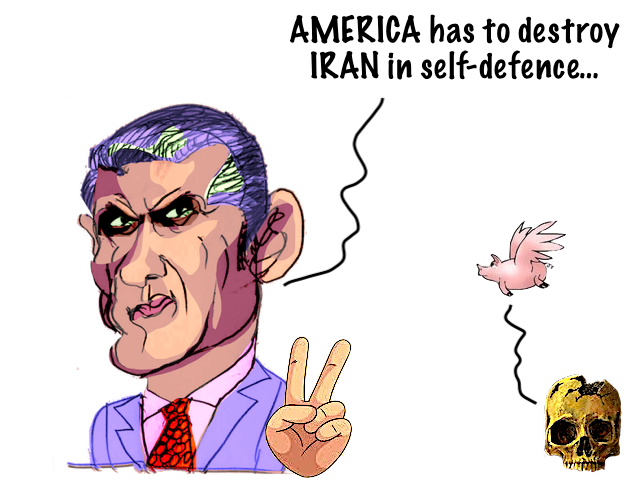
Secretary of War Pete Hegseth announced on Wednesday that the US is going to be launching major strikes in Iran, while President Trump says he’ll “bomb the shit out of” the Iranians if they don’t agree to a deal of his liking.
The latest wave of US airstrikes has already reportedly damaged critical civilian infrastructure, which according to the Iranian government has cut off some 20,000 Iranians from their water supply amid sweltering heat.
US Empire Managers View Iranian Sovereignty As An Act Of Aggression, And Other Notes
The latest wave of US airstrikes has already reportedly damaged critical civilian infrastructure, which according to the Iranian government has cut off some 20,000 Iranians from their water supply amid sweltering heat.
Caitlin Johnstone
Meanwhile the US war machine is acting like a poor widdle victim and claiming it’s only bombing Iran in order to defend itself from unwarranted aggression.
CENTCOM released a statement on Wednesday saying “U.S. Central Command forces began launching additional self-defense strikes today at 5:15 p.m. ET against multiple targets in Iran at the Commander in Chief’s direction. The strikes are in response to Iran’s unwarranted and continued aggression.”
Yep, sure, I know what that’s like. I just drove across town to break into someone’s house and he tried to stop me from pouring gasoline all over his living room, so I had to kill him in self-defense.
The US is like a malignant narcissist who begins with the assumption that everyone is obligated to provide him with deference and validation, and then takes it as a personal attack whenever they set normal boundaries. Empire managers really do believe the entire planet should submit to their authority and that it’s an unprovoked act of aggression when this isn’t given to them.
❖
The claim “Iran is the world’s largest state sponsor of terror” only makes sense when you remember that the western empire labels any group which opposes US/Israeli interests as a terrorist organization.
They even designated the IRGC as a terrorist group for fuck’s sake. If you define a major part of a country’s actual military forces as a terrorist entity, then obviously that country will per your own definition be a major “sponsor of terrorism” just by having a military.
Other Iran-backed groups like Hamas and Hezbollah are counted as “terrorist organizations” by the western empire, even as the rest of the world declines to classify them as such. For the overwhelming majority of the world’s governments those organizations are not terrorist entities, they’re just armed factions who oppose Israel and its western backers. They only get to define Iran as the top “sponsor of terrorism” because they say anyone who doesn’t like them is a terrorist.
It’s like if I said anyone who doesn’t like Caitlin Johnstone is a Nazi and then went around punching them, and if anyone objected I said “But they’re Nazis! Why are you defending Nazis??” Really they’re just people who don’t like me, but because I’ve changed the definition of “Nazi” to “someone who dislikes Caitlin Johnstone” I can then use that label to justify physically assaulting them.
That’s all the “terrorist” label exists to accomplish these days. It’s just a label they affix to any faction which poses an obstacle to the empire’s goals of planetary domination.
❖
Trita Parsi has a new article out arguing that Iran’s attacks on Israel in response to its Lebanon onslaught could represent “a new regional equation” where the Zionist entity is no longer free to do whatever it likes in the middle east, because Iran may start imposing consequences for its actions. It’s an intriguing possibility.
I hope the US/Israeli efforts to topple the Iranian government continue to fail. I hope Iran gets stronger so that it can hammer Israel whenever Israel does evil things. I hope the US war machine implodes, I hope the US empire ends, and I hope Palestine is freed from the scourge of Zionism.
❖
Israel: [ignites regional war]
Israel: [never abides by ceasefire agreements]
Israel: [bombs southern Lebanon every day]
Israel: [openly sabotages US negotiations with Iran]
Israel: [begins bombing Beirut]
Iran: [bombs Israel]
Zionists: They attack us because of our religion!
❖
Look it’s very simple. If you want to wear a small hat and pray Jewish prayers, that’s awesome. If you want to support a genocidal apartheid state, you’re a piece of shit.
People always try to add in extra layers of complexity, but that’s really all there is to it.
______________
The best way to make sure you see everything I publish is to get on my free mailing list. My work is entirely reader-supported, so if you enjoyed this piece here are some options where you can toss some money into my tip jar if you want to. Click here for links for my social media, books, merch, and audio/video versions of each article. All my work is free to bootleg and use in any way, shape or form; republish it, translate it, use it on merchandise; whatever you want. All works co-authored with my husband Tim Foley.
PLEASE VISIT:
YOURDEMOCRACY.NET RECORDS HISTORY AS IT SHOULD BE — NOT AS THE WESTERN MEDIA WRONGLY REPORTS IT — SINCE 2005.
Gus Leonisky
POLITICAL CARTOONIST SINCE 1951.
RABID ATHEIST.
WELCOME TO THIS INSANE WORLD….
- By Gus Leonisky at 12 Jun 2026 - 8:22am
- Gus Leonisky's blog
- Login or register to post comments
oil price....
US President Donald Trump has cancelled planned strikes on Iran, saying talks with the Islamic Republic are moving forward with the country’s top leadership. The announcement came just hours after he again threatened to hit Iran “very hard.”
Tensions between Washington and Tehran have surged in recent days despite a nominal ceasefire agreed in April. The US launched strikes on Iran on Wednesday after a US AH‑64 Apache helicopter was lost near the Strait of Hormuz – an incident Washington blamed on Tehran. Iran denied responsibility and responded with a missile barrage targeting American bases in the region.
In a post on Truth Social on Thursday, Trump said the “scheduled strikes and bombings” had been canceled because of negotiations “brought to the highest level of Iranian leadership and approved.” He said “discussions and final points” had been agreed by all sides involved, including the US, Israel, Saudi Arabia and several other regional states.
READ MORE: https://www.rt.com/news/641439-us-iran-war-escalation/
GUSNOTE: I BELIEVE THIS ANNOUNCEMENT BY TRUMP IS FALSE BUT IS DESIGNED TO "MANAGE" THE PRICE OF OIL AS THE MARKETS BLOW UP AND DOWN... THIS "DECIION" WAS ALSO MADE QUICKLY TO PREVENT IRAN FROM DOING FURTHER RETALIATIONS....
READ FROM TOP.
PLEASE VISIT:
YOURDEMOCRACY.NET RECORDS HISTORY AS IT SHOULD BE — NOT AS THE WESTERN MEDIA WRONGLY REPORTS IT — SINCE 2005.
Gus Leonisky
POLITICAL CARTOONIST SINCE 1951.
RABID ATHEIST.
WELCOME TO THIS INSANE WORLD….
living hell....
Donald Trump's lying far more sinister than distortion of facts
BY Paul McGeough
[2016] Washington: Donald Trump's lies are so overwhelming that reporters stir them as a child does peas on a plate – marvelling at the shape and colour, but for much of the time oblivious to a greater question of "why?"
Mainstream media fact-checkers swoop, to hold the more egregious falsehoods up to the light – and to call out Trump; and their editors are increasingly comfortable with calling each lie a "lie," instead of resorting to the bendy language of the past that effectively let a liar off the hook.
Washington-based Canadian correspondent Daniel Dale has made it his mission to count every Trump lie every day – by Day 33, in mid-October, he had reached incident 253 in what he describes as the GOP candidate's "avalanche of wrongness".
By Dale's reckoning, Trump's most truthful day included just four lies; at his worst there were 25 – and that doesn't include the first two candidate's debates, in which Trump uttered 34 and 33 falsehoods of varying degrees in just 90 minutes.
But the Trump falsehoods can't be looked at in isolation.
Another key element of the Trump political style is the rate at which he changes subjects when whipping up his supporters – in one classic speech, The Washington Post counted 25 subjects in the space of five minutes. So quite often, he'll glance on an issue, just to get the lie out there.
Trump creates a parallel universe. Key indicators show the US finally is getting back on its feet economically after the 2007-09 Great Recession – 15.2 million new jobs since 2010, average hourly wages up 2.8 per cent on last year – but for Trump, that's "disastrous".
It's the same with crime – violent crime in the US is close to historic lows, but he quoted alarming figures from an agency that seems to not exist to support his "inner cities are living hell" bullet point.
It's the same with his constant denigration of the media. The moderator of the first candidates' debate, Lester Holt, is a registered Republican, but Trump didn't like the debate so he denounced Holt as a Democrat.
Yet Yale philosophy professor Jason Stanley worries that the media are missing the point, that language like "lie" and "bald-faced lie," or even a term like "master of bullshit" misses a more disturbing aspect of Trump's political persona and in that, that we're not addressing a crisis in mass communication.
Viewed through the prism of totalitarian propaganda, Stanley detects something more than conventional politicking in Trump's commentary.
"The goal…is to sketch out a consistent system that is simple to grasp, one that both constructs and simultaneously provides an explanation for grievances against various out-groups.
"It is openly intended to distort reality, partly as an expression of the leader's power. Its open distortion of reality is both its greatest strength and its greatest weakness."
By this argument Trump is attempting to define a simple new reality that becomes an expression of his power, a reality that justifies his value system that seeks to change the value system of his audience.
Hence his continual riff on inner-city violence. Trump's objective is to convey a sense of wild disorder, which he'd have his followers believe is caused by African Americans and immigrants – "he's doing it as a display of strength, showing he's able to define reality and lead others to accept his authoritarian value system," Stanley, the author of How Propaganda Works, writes.
He says: "The chief authoritarian values are law and order. In Trump's value system, non-whites and non-Christians are the chief threats to law and order. Trump knows that reality does not call for a value system like his; violent crime is at almost historic lows in the US. Trump is thundering about a crime wave of historic proportions because he is an authoritarian using his speech to define a simple reality that legitimates his value system, leading voters to adopt it. Its strength is that it conveys how power can define reality. Its weakness is that it obviously contradicts."
Through the campaign, analysts have parsed Trump's feigned concern for inner-city blacks, expressed mostly to predominantly white audiences, as a bid to present himself as caring to educated white women.
But, by the Stanley reading, it's a more sinister conveying to whites of his "blacks are bad" scare tactics.
On the last two days of October, as Dale was collating 27 and 19 lies respectively, pollsters for The Washington Post-ABC News were polling Americans on questions of the candidates' honesty – and Trump now polls as more honest than Clinton, by eight points.
Seems that that new reality of Trump's is working very well. Again, in searching for meaning, analysts light on what one calls American sentimentalism – "what moves the electorate is not true facts but true feelings."
But it grasps only a part of what Stanley sees as Trump's big-picture objective.
Stanley demands that we all must lift our game: "Describing what Trump has done requires us to talk not just about the importance of honesty and accuracy, but also about power, value systems and in-groups versus out-groups. It also requires us to confront the failures of elite policy that have led to an erosion of democratic norms, primarily public trust, that makes anti-democratic alternatives suddenly acceptable."
https://www.smh.com.au/world/north-america/donald-trumps-lying-far-more-sinister-than-distortion-of-facts-20161106-gsj5m3.html
READ FROM TOP.
PLEASE VISIT:
YOURDEMOCRACY.NET RECORDS HISTORY AS IT SHOULD BE — NOT AS THE WESTERN MEDIA WRONGLY REPORTS IT — SINCE 2005.
Gus Leonisky
POLITICAL CARTOONIST SINCE 1951.
RABID ATHEIST.
WELCOME TO THIS INSANE WORLD….
WE HAVE NOTICE THAT THIS BRILLIANT WRITER, PAUL MCGEOUGH, HAS NOT HAD AN ARTICLE POSTED ON THE SMH FOR A LONG TIME... WHAT HAPPENED?...
Paul McGeough has formally retired from journalism after 28 years of service.
He made the exit following redundancy negotiations with Nine, which had been planning for some time to reorganise the foreign correspondents’ desk.
https://influencing.com/au/story/mcgeough-bows-out-from-nine-papers
wrong speech....
After Shangri-La: Asia Is No Longer Asking Washington’s Permission
Salman Rafi Sheikh
At the 23rd Shangri-La Dialogue 2026 held in Singapore and attended by 44 countries, the real story was not the reaffirmation of the US-led Indo-Pacific order but its slow, public unraveling.
The Speech That Misread the Room
The opening plenary belongs, by Shangri-La tradition, to Washington. This year, US Secretary of War Pete Hegseth declared, “The era of the United States subsidizing the defence of wealthy nations is over,” demanded that allies spend at least 3.5% of GDP on defence, and denounced the “utopian idealism” of the old multilateral order. He boasted about the extrajudicial capture of Venezuelan President Nicolás Maduro, touted improved US-China relations under President Trump — conspicuously omitting any mention of Taiwan — and closed with the assertion that the region needs “less Shangri-La, more combat power.”Whether Washington can adapt its statecraft to remain relevant within a regional architecture it no longer designsIt was a speech that alienated the very audience it sought to lead. In fact, as events show, the starkest divide at the Dialogue was not between Washington and Beijing; it was between Washington and its own partners. ASEAN, alongside the European Union, remains among the world’s most committed advocates of multilateral diplomacy and rules-based order. Telling such an audience, at a conference, that conferences are superfluous was a striking misreading of the room.
The dissonance ran deeper than tone. Hegseth’s capture of Maduro was widely condemned across Southeast Asia as a violation of international law. US strikes on Iran, and their economic reverberations through the Strait of Hormuz, had already disrupted petrochemical supply chains across the region and fuelled public unease. European NATO allies present at the Dialogue were conspicuously equivocal about both episodes. Meanwhile, Hegseth’s softer line on China — promoting “constructive strategic stability” following Trump’s Beijing summit — sat in uncomfortable tension with his simultaneous demand that regional partners build up military capabilities to counter Chinese power. Washington was, in effect, asking its partners to arm for a threat it was publicly downgrading. The contradiction could not have been more evident and harder to accept for the ‘partner’ states.
The fundamental problem was not rhetorical but structural: the United States continues to demand alignment while demonstrating, through its conduct in Venezuela and the Middle East, that it applies international legal norms selectively. For the Indo-Pacific’s small and medium-sized states — whose security doctrines rest on the equal and consistent application of those norms — this is precisely the posture that makes American security guarantees feel unreliable.
The Counter-Vision From Hanoi
The speech that actually captured the room’s instincts came the evening before Hegseth took the podium. Vietnamese Communist Party General Secretary Tô Lâm — the first holder of that office ever to address the Shangri-La Dialogue — warned against “uncontrolled competition” and called for “peace, trust, and development” as the region’s organizing principles. He cautioned that the selective interpretation of international law creates a “big fish eat small fish” world that pressures smaller states to choose sides. Ultimately, he cast Vietnam, pointedly, as a defender of the rules-based order rather than a client of any great power.
This was not mere diplomatic courtesy. It was a precisely calibrated ideological counter-offer to the bloc-centred logic that Washington is known for projecting. The region’s response was telling: the framing Tô Lâm offered is what the majority of Indo-Pacific states actually want, i.e., a world in which small and medium-sized powers retain genuine agency, where order derives from rules rather than the preferences of the strongest.
Vietnam’s keynote role itself carried strategic meaning. Hanoi’s so-called “bamboo diplomacy” — maintaining economic depth with China while upgrading security ties with the United States, Japan, India, and the EU — has long been studied as a hedging model. But deploying the party’s top leader to articulate it globally was a signal that Vietnam considers this not a temporary improvisation but a durable doctrine. Hours after the speech, Tô Lâm reinforced the point by telling reporters that Vietnam “does not approach its relations with major powers through the prism of security” — a direct rebuke of the security-first framing Hegseth had just delivered.
Vietnam was not alone. Indonesia’s delegation, led by its Deputy Defence Minister rather than its minister, conveyed a similar posture of calibrated, non-aligned engagement. Jakarta has signed a defence cooperation agreement with Washington but has been careful to avoid the optics of full alignment. Japan’s Defence Minister Shinjiro Koizumi expressed “sadness” at China’s second consecutive ministerial-level absence and urged more dialogue with Beijing, thus offering a notably more conciliatory register than Washington’s. The Netherlands’ Deputy Prime Minister acknowledged the imperative of European strategic self-reliance. Across the forum, the pattern was consistent: states were investing in their own capabilities while deliberately keeping their political options open.
The Architecture Being Built Without Washington’s Blueprint
The cumulative picture from Singapore is of a region constructing a new security architecture, one that does not replace the US presence but no longer treats it as the organizing logic. Several developments from the Dialogue’s sidelines made this concrete. The GUIDE framework on critical underwater infrastructure — a multilateral initiative among middle powers to protect shared assets — was formalized at the summit, demonstrating that the region’s middle powers are increasingly willing to cooperate independently to safeguard shared strategic interests. Countries are diversifying arms procurement beyond American suppliers: Southeast Asian states have accelerated purchases of BrahMos missiles, Korean fighter jets, and European naval platforms, reducing the strategic leverage that exclusive defence dependence once conferred.
China’s absence from the ministerial podium matters in this context not because it signals weakness, but because it confirms a feature of this emerging order: it is being built in the space between the two superpowers, not by either of them. What became apparent is that the future of Asian stability will not rest on a single alliance or dominant power but on a dynamic balance maintained by increasingly capable middle powers determined to preserve their autonomy. Their efforts are only complimented by China that does not, unlike the US, have hegemonic ambitions, although it does care a lot about its vital strategic interests.
What comes next is more than multipolarity in the classical sense. Rather, the future appears to be more fluid and arguably more stable: a networked regional order in which countries like Vietnam, Indonesia, Japan, India, and middle-weight European powers maintain overlapping, non-exclusive partnerships calibrated to specific interests rather than comprehensive alignment. This model is more complex to manage and less legible to Washington’s alliance logic, but it is already taking shape.
The deeper question the 2026 Shangri-La Dialogue poses is not whether the US-led security order is declining — the evidence for that is now substantial — but whether Washington can adapt its statecraft to remain relevant within a regional architecture it no longer designs. Hegseth’s speech suggested it cannot, yet. The states filing out of that Singapore hotel had already moved on.
https://journal-neo.su/2026/06/13/after-shangri-la-asia-is-no-longer-asking-washingtons-permission/
READ FROM TOP.
PLEASE VISIT:
YOURDEMOCRACY.NET RECORDS HISTORY AS IT SHOULD BE — NOT AS THE WESTERN MEDIA WRONGLY REPORTS IT — SINCE 2005.
Gus Leonisky
POLITICAL CARTOONIST SINCE 1951.
RABID ATHEIST.
WELCOME TO THIS INSANE WORLD….