Search
Recent comments
- choosing sides.....
3 hours 35 min ago - agreed?.....
5 hours 30 min ago - I forgot....
5 hours 40 min ago - strikes.....
5 hours 52 min ago - easy target....
6 hours 9 min ago - auto co-op...
11 hours 29 min ago - sobriety....
11 hours 49 min ago - gina's conga-line.....
11 hours 53 min ago - poison....
12 hours 41 sec ago - yandex...
12 hours 18 min ago
Democracy Links
Member's Off-site Blogs
the last dangerous gasp of the western american empire against "the people".........
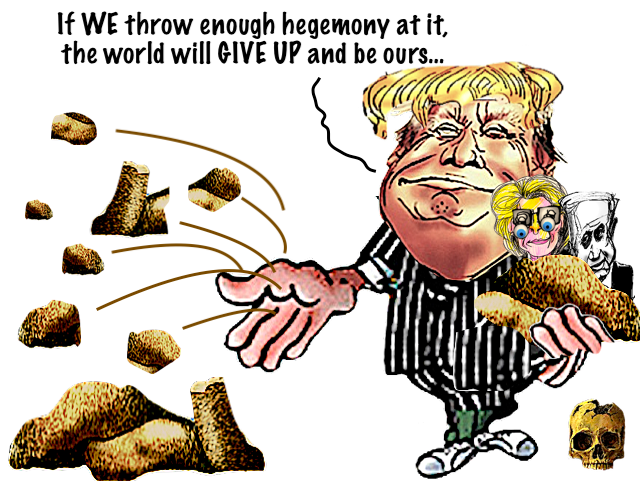
As we have already demonstrated many times, Euro-Israeli-American hegemony is the main driving force behind the march toward world war. This is the case from Finland to Ukraine, where the continued advance of the EU-NATO toward Russia's borders was the true trigger of the so-called Russo-Ukrainian conflict, extending to the genocidal Palestine, the continually attacked Iran, Iraq, Syria, and Lebanon, the destabilised Caucasus, and the ongoing geopolitical struggle from the Taiwan Strait to the Korean Peninsula: eager to take its revenge on Beijing and Pyongyang, Imperial Japan is frantically rearming to support the North American armada carrying nuclear weapons aimed at China and North Korea.
RESISTANCE, COUNTER-ATTACKS, AND THE DUTY OF BEING AT THE FOREFRONT
I - CLOSING RANKS IN THE FACE OF RISING GEOPOLITICAL PERILS
BY Georges Gastaud
The trend is similar when we observe the African and Latin American fronts of the global recolonisation of the Global South. The Trump administration of Venezuela, the energy-draining and starving siege of Cuba, and Trump's blatant interference in South American electoral processes (Argentina, Brazil, Colombia, etc.) are all part of this logic of colonial reconquest (Rubio, moreover, made his intentions clear!), as is the neo-colonial offensive waged against rebellious Francophone Africa (from the Sahel to the Democratic Republic of Congo), caught between the manoeuvres of Western powers, proxy wars, and the militarisation of regional crises.
Faced with this Great Rift Valley, which is shaping a world war already largely initiated by Washington and relayed, even feverishly precipitated, in Europe by the EU-NATO, provoking Russia daily in the Baltic, the urgent need is for unity of action among activists in the workers', popular, and progressive movements. From this truly vital mobilisation, it would be foolish to exclude republican patriots who understand that a generalised European war would undoubtedly mean the complete annihilation of France and its people. The coming years, even months, will be decisive for world peace, for the sovereignty of nations, and even for the survival of humanity in the 21st century.
II - POPULAR RESISTANCE DESTINED TO MULTIPLY
However, we must not give in to the intimidation tactics of the malevolent hegemon, for the fear and isolationism it engenders would only accelerate the rise of the dangers. This empire of globalised warfare, the US-Israel-EU bloc, is not only fracturing numerous former sovereign states, including France; It is primarily directed against countries that, in various forms, still claim to adhere to Marxism and socialism (Cuba, China, North Korea) or in which significant proletarian embers still smoulder (Russia, Brazil, South Africa...). Ultimately, Euro-Atlantic hegemony attempts to artificially prolong, resorting if necessary to a world war of extermination and genocide, an exhausted and exhausting capitalist mode of production rejected by a large part of the population, but also by an increasingly resistant global proletariat and an international youth that refuses the future of precarity, environmental destruction, police control, and widespread militarisation that capitalism-imperialism-hegemonism is preparing for them, taking on the guise of a senile Biden or a megalomaniacal Trump. Ultimately, the current crusade to reconquer the Global South and Eurasia is nothing more than a class-based policy pursued by other means—those of unbridled, global violence—against this increasingly Inconceivable socio-historical trend: the continued exploitation of man by man has become a luxury that humankind can no longer afford without perishing. If there is to be a future for humanity, it can only be carried by a new generation of socialism-communism that learns from, without disavowing, the first global socialist experiment born of October 1917 and which was subsequently and powerfully revived by the Soviet victory of 1945, followed by the Chinese, Czechoslovakian, Vietnamese, and Cuban revolutions. Hence the exterminatory threat hanging over humanity from a capitalism on its last legs, refusing at all costs to yield, first and foremost, to a multipolar world, but also ultimately, to the working classes and the formerly dominated peoples.
The short term may therefore still seem to belong to the hegemonic camp. But the medium and long term belong to sovereign peoples and proletarians who, in many countries (India, Quebec, the USA itself, and more recently Belgium, Italy, Greece, Portugal, South Korea, not to mention Bolivia in insurrection...), are rediscovering the path of mass strikes. We must still overcome the immediate challenge: avoiding a third world war, which Western war propaganda is trying to present as a "response" to the Russian and Chinese cultures….
Nevertheless, the peoples under attack are holding firm. Iran is united against the aggression, and Gaza and the Lebanese people are not backing down in the face of the invader. The Yemeni David has already proven that it knows how to challenge the American Goliath. As for the working people of the anti-fascist Donbass, they resisted for eight years under fire from Kyiv's neo-Nazi brigades before Putin's post-Soviet Russia agreed to come to their aid. Despite the massive arming of Kyiv by NATO, Russia is advancing in the Donbas while the Ukrainian army is being systematically eroded by this EU-NATO proxy war, already in semi-open conflict with Moscow. This resistance is already a moral and political victory because it inspires and will inspire other humiliated or paralysed peoples. The humiliated Venezuelan people, organised into armed communes, are demonstrating massively for Maduro's return. In Cuba, May Day 2026 demonstrated the vitality of a creative people, largely united behind their valiant communist leaders, Miguel and Raúl. Moreover, in the USA and India, the labor movement is once again resorting to mass strikes, a sign that the capitalist crisis, exacerbated by wars, is once again driving the exploited toward struggle. This is also the case in Quebec, where the social struggle and the independence aspirations of this Francophone province, influenced by the arrogant Anglo-Saxon environment, are tending to merge in a welcome way.
Even the world's working-class youth, until recently seduced by neoliberalism, are already undergoing a shift in mindset here and there. The commitment of young activists like Greta Thunberg, who has moved from institutional environmentalism to physically risky solidarity with Cuba and Gaza, symbolises this potential turning point. Returning to the United States, millions of people have recently demonstrated against the increasing monarchiSation of power, the war, and the repression of migrants. This has reached the point where the word "socialism," long taboo in McCarthy's country, is once again being heard, and New York can elect a mayor who claims to stand in solidarity with Palestine.
III - A POPULAR LEFT FACING ITS RESPONSIBILITIES
In France, the political scene remains dominated by the confrontation between bellicose Europeanism and Le Pen's national-supremacist ideology. Yet, the popular electorate rejects the systematic media criminalisation of La France Insoumise (LFI), as the municipal elections demonstrated. This rejection is a positive sign, even if LFI's leadership, under pressure from its Euro-Atlanticist wing (Manon Aubry in particular), refuses to wage a clear campaign against the EU-NATO and over-armament.
Let's be clear: the problem isn't just the right wing, nor is it just Macronism. The problem is also "left-wing" Europeanism, that is, the tendency to accept the EU as an indisputable framework, to downplay the harmfulness of NATO, or to accept the idea of a European "defense" compatible with the logic of war and with the construction of a federal Europe that is antithetical to continental peace and French independence. On this point, La France Insoumise (LFI), but also the French Communist Party (PCF), must be directly challenged, because a left wing that abandons national sovereignty and refuses to debate a progressive Frexit will sooner or later end up aligning itself with the dictates of the Euro-Atlantic order, as Alexis Tsipras, the treacherous representative of the so-called Greek radical left, did.
Of course, we should welcome the fact that in January 2026, LFI submitted a resolution to withdraw France from NATO. But this is pointless if we continue to cultivate the middle ground of Macron's war economy, European defense, militaristic federalism, and the acceptance of the neoliberal framework of the so-called "European project," inseparable from NATO and anchored in the "open market economy where competition is free and undistorted." A truly popular left cannot accommodate a foreign policy that appeases NATO, refuses to see that it is inseparable from the EU, and thus lies to itself when it claims to defend peace and initiate a "citizens' revolution.
IV - CRISIS OF CAPITALIST HEGEMONY... AND OF POPULAR CONSENT TO IMPERIALIST OPPRESSION
The imperialist-hegemonist-exterminator camp is increasingly dangerous precisely because it knows that time is running out. The more its crisis deepens, the more it seeks to impose itself through violence. This headlong rush is manifested in contempt for international law, the weakening of the UN, political censorship, and the militarisation of societies—in short, in an accelerated march toward the fascism in Western societies.
But this aggression is also a sign of weakness. It reveals a profound crisis of global capitalist-imperialist cultural hegemony. In France, this is evident in the inability of pro-EU and pro-NATO elites to make the European “construction” appealing—that is, the ongoing dismantling of the indivisible French Republic by the euro. One thinks of the 2005 “No” vote on the European Constitution, its odious circumvention by Sarkozy and Hollande (the Lisbon Treaty is a carbon copy of the Constitution rejected by universal suffrage), the repression of the Yellow Vest movement in 2019, and the massive rejection of the pension reform imposed using Article 49.3, trampling on the overwhelming opinion of workers.
Let us be clear: capitalism no longer offers, if it ever did, a humane future. It relentlessly produces war, fascism, social destruction, the impoverishment of the masses, linguistic and cultural homogenisation and alienation, not to mention the ecological degradation fuelled by the suicidal pursuit of profit at all costs. One doesn't need to be a prophet to foresee this: the more the leaders of the capitalist-hegemonic world claim to save Western civilization through war, the more they will drag it toward barbarism... and the more they will turn against them the global majority, weary of massacres and genocides, of recurring economic crises, and of the complete absence of any mobilising vision for the world's youth.
V - REBUILDING THE VANGUARD(S)
The main task, therefore, is not to accuse the masses of apathy, but to rebuild genuine vanguards. For decades, both old and new social democracy have ideologically disarmed the workers' movement. In France, it has largely colonised union leadership and contributed to diluting the class perspective.
The French Communist Party (PCF) itself, through its long-term, irreversible drift, has compromised the noble word "communist," which for some has become synonymous with endless compromises with the EU and its main proxy in France, the austerity-oriented and Atlanticist Socialist Party (PS). We must therefore return to the principle that guided the founding of the Communist International and the PCF itself: to form organisations capable of Marxist-Leninist analysis, mass strategy, and anti-fascist, anti-imperialist, and anti-capitalist unity, all centred on the primacy of the working class and the world of labor in building broad anti-fascist, peaceful, popular, patriotic, and ecological movements.
This reconstruction implies uniting, not opposing, proletarian internationalism and popular patriotism. Defending “produit en France" (and not "made in France"), national sovereignty, the French language sacrificed to all-globalism, as well as the social conquests of 1936 and 1945, is not xenophobic; it is even a minimum to make oneself worthy in the eyes of the masses to defend popular dignity against Atlantic alignment and European dismantling.
The reconstruction of the avant-garde also implies defending, both in France and internationally, a new generation of socialism-communism: a socialism that would not repudiate the Leninist legacy, nor the necessity of seizing state power and socialising the major means of production, but which would be able to respond to humanity's current anti-extermination tasks, notably the vital construction of world peace, egalitarian cooperation between sovereign nations, the defense of the Enlightenment and the rational use of science, the reconstruction of the productive forces (which current capitalism is corrupting from within!) on humanist foundations—in short, the preservation, or even the reconstitution, of the environmental and anthropological foundations of human life as such.
VI - BREAK THE SACRED WARMONGERING AND FASCIST UNION
This is why genuinely communist activists, militant trade unionists, and truly rebellious citizens must debate, converge, and act together without fear of confronting those who perpetuate this sacred union within the popular movement. It is not enough to denounce the far right; we must also fight the pro-European and militaristic compromises that are seriously contaminating and neutralising a large part of the political and trade union left! And for this, there is no other method than to put into practice Jaurès's words: "Courage is seeking the truth and speaking it," a motto echoed by R. Luxemburg's words: "There is nothing more revolutionary than speaking the truth."
The danger is real in the current context. Part of the left, with the Socialist Party, the Greens, and the "Place Publique" movement at the forefront, including certain right-wing sectors of the "radical" left, is tempted by Euro-armament, by European "defense," or by all sorts of ambiguous formulas that ultimately normalise the Atlantic order and validate in advance France's official entry into a suicidal war with Russia. Conversely, organisations that genuinely want to break with war must adopt clear slogans such as those widely proposed by the PRCF: "Money for wages, not for war!"; "Break the chains of the European Union!"; "Atlantic Europe or a peaceful world, we must choose!" “If we don’t leave the EU-NATO, we’ll stay in it!”
The popular movement can only hold its ground, and then win, if it rejects divisions and organisational sectarianism. In social struggles as in anti-imperialist struggles, a choice must be made: the people, like the proletariat, will either win together or lose separately, defeated by the capitalist and imperialist tactics applied to resistance movements—the same tactics used by the Horatii to confront and defeat the Curiatii separately and successively—or we hold firm and counter-attack “all together and at the same time.”
Conclusion – Communists, militant trade unionists, rebels, clearly anti-fascist and anti-racist patriots, let us engage in dialogue. Let us organise anti-fascist, peaceful, patriotic, and popular struggle committees. And above all, let us not allow the left, including and especially the supposedly radical left, to be drawn step by step into a belligerent sacred union around the EU-NATO. For the urgent task is to fracture the The Euro-belligerent bloc must be united before it leads nations toward a potentially definitive historical catastrophe for France and for all humanity. If we can unite in time, as was all too briefly the case in 1936 or during the National Council of the Resistance (CNR), we can instead reopen the path of struggles, popular revolutions, and egalitarian international cooperation among free, equal, and united peoples.
This work of rebuilding the vanguard is therefore not a luxury or a mere wish. It has objectively become a historical necessity.
*************************************************
Georges Gastaud: philosopher, head of the theoretical and geopolitical sector of the PRCF (Pole of Communist Renewal in France). His latest books published by Delga are: "Capitalist Globalisation and the Communist Project" and "Dialectic of Nature: Towards a Great Rebound?"
https://www.legrandsoir.info/resistances-contre-attaques-et-devoir-d-avant-garde.html
TRANSLATION BY JULES LETAMBOUR
PLEASE VISIT:
YOURDEMOCRACY.NET RECORDS HISTORY AS IT SHOULD BE — NOT AS THE WESTERN MEDIA WRONGLY REPORTS IT — SINCE 2005.
Gus Leonisky
POLITICAL CARTOONIST SINCE 1951.
RABID ATHEIST.
WELCOME TO THIS INSANE WORLD….
- By Gus Leonisky at 10 Jun 2026 - 9:09pm
- Gus Leonisky's blog
- Login or register to post comments
smile.....
Will America’s new China strategy finally lead to stability?
Washington’s Indo-Pacific approach is changing – and Beijing may find parts of it surprisingly acceptable
BY Ladislav Zemánek
The absence of China’s top military leadership from this year’s Shangri-La Dialogue – a key annual inter-governmental security conference focused on the Asia-Pacific region – prompted predictable speculation about worsening US-China relations. Yet a more important development took place away from the conference hall.
Just hours earlier, American and Chinese military officials met in Hawaii under the Military Maritime Consultative Agreement to discuss maritime safety, crisis management, and ways to reduce the risk of incidents at sea. This was in line with the trend of Washington and Beijing rebuilding lines of military communication despite their strategic competition.
Rather than pursuing either liberal-globalist ambitions or a new Cold War against China, US President Donald Trump’s second-term administration appears to be advancing a strategy built on realism and balance-of-power politics.
The end of the globalist consensusUS Secretary of Defense Pete Hegseth’s speech at the Shangri-La Dialogue offered perhaps the clearest articulation of this approach.
Hegseth argued that the US has abandoned what he described as the “old toothless, utopian, and globalist course of foreign policy.” Meaning that appeals to universal values and abstract international norms are giving way to a foreign policy centered on national interests, military strength, and strategic realism.
This represents a marked departure from the assumptions that guided much of Western foreign policy after the Cold War. Stability, in this framework, comes from credible deterrence and sustainable balances of power, not from a supposed ‘values’-based moral high ground. This shift is transforming America’s relationships both with its allies and its rivals.
For decades, many US allies relied heavily on American security guarantees while maintaining relatively modest defense capabilities of their own. Hegseth openly questioned this model, arguing that allies should become genuine security partners rather than long-term dependents.
From protectorates to partnersThe Trump administration’s emphasis on burden-sharing is about more than budgetary concerns. It also acknowledges a deeper geopolitical reality. For three decades after the Cold War, the US occupied a uniquely hegemonic position in the Indo-Pacific. Today, however, China’s rise, India’s growing influence, and the increasing strategic weight of other regional powers are contributing to a more multipolar environment.
Rather than attempting to restore the conditions of uncontested primacy, Washington increasingly appears focused on preserving an advantageous position within this changing balance. The US remains, or at least still believes itself to be, the strongest military power in the region, but it is encouraging partners to assume greater responsibility for regional security.
This helps explain continued American support for military modernization among countries such as Japan, South Korea, Australia, the Philippines, and India. Critics often portray these efforts as evidence of containment directed against China, yet the Trump administration presents them as an effort to preserve a regional balance in which no single power can dominate the Indo-Pacific.
A China strategy without a new Cold WarChina remains central to this strategy. Hegseth expressed concern about the country’s growing military capabilities, but his remarks were notably less confrontational than much of the rhetoric that has characterized recent debates in Washington. He emphasized the importance of stable relations, fair trade, and continued military-to-military engagement.
It’s equally important to note what he did not emphasize. Taiwan, one of the most sensitive issues in US-China relations, played little role in his speech. The omission suggested an effort to manage competition without turning every disagreement into a geopolitical crisis.
The recently released US National Defense Strategy identifies four priorities: defending the US and the Western Hemisphere, including Greenland; deterring China in the Indo-Pacific; increasing burden-sharing among allies and partners; and revitalizing the American defense-industrial base.
While identifying China as the primary strategic challenge in the Indo-Pacific, the document also calls for expanded military dialogue, strategic stability, and mechanisms for de-escalation. The US Department of War even acknowledges China’s extraordinary rise and military achievements.
Importantly, the strategy does not seek China’s isolation or humiliation. Instead, it reflects a concern that if any single power were to dominate the Indo-Pacific, it could gain disproportionate influence over the world’s economic center of gravity.
The stated objective is not containment in the Cold War sense, but rather preventing the emergence of a regional hegemon and preserving a balance of power in which no single state can dominate the region.
Such an approach also reflects changing realities within the international order itself. The US is no longer operating in the largely unipolar environment of the 1990s. It is adapting to a world in which multiple major powers coexist and compete. Rather than attempting to preserve its slipping primacy, Washington appears to have shifted to maintaining a favorable balance that protects US interests.
China has a different view of the situation, however. It interprets the military modernization of US allies and partners in the region as evidence of continued containment or encirclement. These tensions are likely to persist. Actions that Washington sees as burden-sharing and balance-building will continue to be viewed in Beijing as militarization directed against China, and the ball is in the Washington’s court to convince Beijing otherwise.
Competition between the United States and China will undoubtedly continue, but America’s emerging strategy points to a search for equilibrium rather than dominance, and stability rather than escalation. If sustained, it could offer a more durable foundation for coexistence between major powers than either the hegemonic assumptions of the past or the confrontational mindset of a new Cold War.
https://www.rt.com/news/641376-us-new-china-strategy/
GUS's ADVICE TO RUSSIA AND CHINA: SMILE, BUT DO NOT TRUST ANYTHING COMING FROM WASHINGTON... I BELIEVE YOU KNOW THIS ALREADY....
READ FROM TOP.
PLEASE VISIT:
YOURDEMOCRACY.NET RECORDS HISTORY AS IT SHOULD BE — NOT AS THE WESTERN MEDIA WRONGLY REPORTS IT — SINCE 2005.
Gus Leonisky
POLITICAL CARTOONIST SINCE 1951.
RABID ATHEIST.
WELCOME TO THIS INSANE WORLD….