Search
Recent comments
- choosing sides.....
4 hours 25 min ago - agreed?.....
6 hours 20 min ago - I forgot....
6 hours 31 min ago - strikes.....
6 hours 42 min ago - easy target....
7 hours 6 sec ago - auto co-op...
12 hours 20 min ago - sobriety....
12 hours 39 min ago - gina's conga-line.....
12 hours 43 min ago - poison....
12 hours 51 min ago - yandex...
13 hours 8 min ago
Democracy Links
Member's Off-site Blogs
soros vs prabowo subianto......
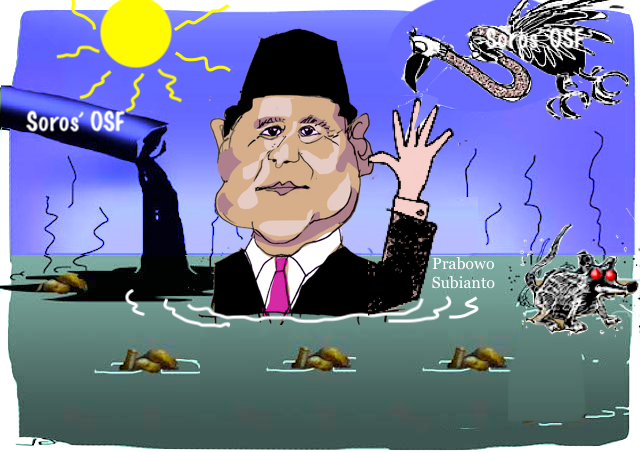
Leaked documents reviewed by The Grayzone expose how the Soros-run Open Society Foundations plotted to “prevent the continuation” of Indonesia’s elected government by bankrolling opposition media, youth activists groups and lawfare operations to remove President Prabowo Subianto.
Soros’ OSF helped stir Indonesian rebellion, leaks reveal
BY KIT KLARENBERG
Ever since the election of Prabowo Subianto as Indonesia’s President in February 2024, Jakarta has faced continuous waves of anti-government protests. Activists enraged by harsh economic conditions and elite corruption have taken to the streets in vast numbers, often engaging in fiery clashes with police and the military. A series of leaks obtained by The Grayzone indicate this upheaval has unfolded according to a well-honed plan to take down Prabowo, which drew on organic grievances but which depended heavily on funding the Open Society Foundations.
Founded by anti-communist billionaire George Soros in 1993, OSF has been described by The New York Times as “a sprawling political and philanthropic empire,” which “seeks to advance a liberal, democratic agenda.” The Washington Post described Soros as part of a network of “overt operators” carrying out “spyless coups” that were once the purview of the CIA during the Cold War. OSF has acknowledged its central role in numerous insurrections throughout the Global South.
The leaked files reveal how from 2019 onwards, OSF began pumping large sums into projects designed to promote “resistance and dissent” against Prabowo’s predecessor, Joko “Jokowi” Widodo. Much of this money has been distributed by the Jakarta-based Kurawal Foundation, the single largest recipient of OSF contributions between 2019 and 2024. Founded in 2019, Kurawal describes itself as “a social justice philanthropy…[endeavouring] to promote dignified and benevolent democracy in Indonesia and Southeast Asia.”
The organization sponsors “individuals and agents,” who can be relied upon to advance Western liberal values locally. In the leaks, Kurawal described its efforts to develop an ideal voter who would be impervious to the scourge of Prabowo-associated disinformation. This meant “cultivating a wise and virtuous democrat – as political subject – who adheres to the essential principles of democracy.” The leaks show the intended subject was anything but.
Kurawal’s OSF-funded activities intensified in late 2023, as Indonesia geared up for the Presidential election in February the next year. Prabowo, Joko’s chosen successor, won by landslide in a vote international observers judged legitimate. However, the leaks show Kurawal used its local assets to whip up a frenzy over supposedly “massive” fraud by Prabowo, fomenting so much public pressure that authorities changed electoral rules to allow more parties to run for office in 2029. (Kurawal did not respond to a request for comment from The Grayzone).
In order to topple Prabowo, OSF has financed the grooming of prospective future politicians, outreach to existing political parties, and the creation of new movements and factions that could field candidates for office locally. Simultaneously, OSF bankrolled a range of self-proclaimed ‘independent’ media outlets and activist groups, who they sought to train “to become agents of change.” In leaked documents, Kurawal boasts that its “youth political engagement” activities mean young Indonesians are “at the forefront of most social and political movements… shaping conversations on national policies.”
Kurawal’s meddling in Indonesia has global implications. Mass “Gen Z” protests that erupted in July 2025 and raged for weeks have been hailed by Western corporate media as a revolutionary inspiration for anti-government activists elsewhere. It was in Jakarta where protesters first waved cartoon Jolly Roger flags inspired by Japanese manga One Piece. A map found in the tranche of leaks notes that Kurawal is active in several countries where these flags have appeared, including in protests which have produced regime change, such as in Nepal.
Kurawal encourages ‘agitation and pushback’ against JokoA leaked February 2025 Kurawal document called “Building Bridges, Filling Gaps,” charts a clear “strategic plan” for regime change in Indonesia and beyond, 2024 – 2029. The file was produced after five years of systematically undermining President Joko’s administration, “by providing support to civil society groups, social movement actors, and thought leaders as well as change makers who do not shy away from politically sensitive issues.” This was motivated by “Indonesia’s growing political and economic clout”, and regional influence, under his rule.
The document describes Joko scathingly, as a “pilferer” and “opportunist”, while slamming his supposedly “inward looking foreign policy.” In reality, Joko prioritized protecting Indonesia’s sovereignty, irritating Western powers by rubbishing bogus CIA-disseminated claims of “genocide” in Xinjiang, refusing to recognize Israel, and pushing for peace in Ukraine.
By “promoting dissent” during his last term in office, Kurawal sought to lay foundations for even greater attacks against Prabowo. As a leaked file explains, “the agitation and pushback was needed to show that dissent is both necessary and possible.” Resultantly, “vibrant citizen movements” that could “challenge power” and “organize and influence change” sprouted locally, with OSF help.
Kurawal’s “program taxonomy” between 2019 and 2024 focused heavily on driving “youth political engagement,” encouraging young Indonesians to attend protests, join civil society campaigns and hone social media skills. As such, the organization’s students “actively set a higher standard of accountability of political leaders,” while “shaping conversations on national policies,” and “challenging traditional political organizing.” These efforts were to be enhanced by what Kurawal called “networks or alliances among social justice groups,” legal advocacy and a new lobbying machine.
Kurawal also financed local media outlets to promote stories of purported malfeasance and other abuses of power by authorities. For example, the organization sponsored a “series of in-depth reporting on police corruption and brutality cases in prominent public interest media,” combined with “social media campaigns” while “forming a national coalition for police reform” to “ramp up public pressure.” This was cited as “one of the bright spots” in Kurawal’s work in Indonesia, during the pre-Prabowo period.
For example, in 2021, Kurawal launched TempoWitness, an online portal which claimed to connect “citizen journalists at community level with mainstream local and national media.” By contrast, Tempo has been a vehicle for slanderous attacks on independent journalists raising questions about Western financing of anti-government media outlets and NGOs in Indonesia. Among its top targets is Brian Berletic, a US citizen who resides in Thailand and specializes in exposing covert Western funding of opposition political forces in the region.
Kurawal has also sponsored documentary films, photography, and experimental art in Indonesia. The purpose is to “elicit action from citizens and community.” This included the Jakarta International Photo Festival, the region’s largest. The events attracted tens of thousands of visitors, enabling Kurawal to shepherd them into a “side event” on the subject of democracy. During these sessions, attendees were given instruction on how to use “photography and visual storytelling” in the pursuit of “democracy and human rights.”
National ‘roadshow’ to ‘radicalize’ IndonesiansWhen Joko left office, he enjoyed record-high approval ratings. In its “Building Bridges, Filling Gaps” document, Kurawal reluctantly acknowledged the outgoing president was “able to maintain popular public support” in an organic fashion through what they described as “populist social welfare policies.”
The leaked document notes Prabowo would continue his predecessor’s legacy, “emphasizing policies to enhance social welfare, reduce poverty, and eliminate hunger.” A dedicated section called “Bracing for the Prabowo years” outlines the new president’s likely stances and strategy over his first term in office, and how his rule can be undermined.
The leaks reveal how Kurawal released a documentary called “Dirty Vote” immediately upon Prabowo’s election claiming to expose “how instruments of power are used to manipulate elections, undermine democratic order, and maintain the status quo,” and calling “for collective action to safeguard democracy.” The video racked up over 20 million views on YouTube as Kurawal screened it across Indonesia’s university campuses throughout February and March 2024. The dedicated “roadshow” was promoted as “a moral call to protect democracy’s future from systemic abuse and electoral fraud.”
The “Dirty Vote” documentary’s narrative tracked closely with claims of fraud in the February 2024 Indonesian elections by opposition elements. While Jakarta’s Constitutional Court rejected all formal legal challenges to the vote’s results in April that year, Kurawal boasted that its propaganda efforts cemented “widespread voter grievance” over what it called “massive election fraud.” The outcry successfully triggered reforms to Indonesian electoral laws, which previously required parties receive 20% of parliamentary votes to field presidential candidates.
When authorities caved to the opposition’s pressure in January 2025, Kurawal declared, “this means that at the next election, for the first time in the country’s history, political parties big and small will be free to nominate candidates on their own.”
The newly leaked documents echoed the contents of leaked files revealing that in June 2023, the US Embassy in Jakarta privately expressed concern about Prabowo’s almost inevitably impending victory, and planned to overturn the 20% threshold in response.
If the threshold were removed, “there will be more candidates in the election,” US embassy officials noted. In such a scenario, they concluded “the US will have more options” within the field of local candidates.
After the 20% rule was changed, Kurawal said it was well-placed to “set up alternative political groupings among civil society actors,” placing special emphasis on “women, youth, environmental rights defenders.” If successful, Kurawal would oversee “their possible transformation [into] new political parties.” The group wrote that it sought to use “infiltration or pressure” to “transform and radicalize” existing parties and “mobilize the masses against the established party system.”
The document concludes by fretting that the Global South is moving “from the periphery of the international political and economic arena towards the centre,” with countries such as Brazil, India and Indonesia cultivating “enough economic and political clout to emerge as regional or global powers,” and “active agents” in the international order. In turn, this has precipitated a global shift towards “multipolarity at a faster speed.” Kurawal lamented that many of these emerging powers do not subscribe to neoliberal Western governance models.
However, the organization expressed optimism about the prospects for insurrectionary change in troublesome countries, noting how Asia “witnessed some extraordinary demonstrations of ‘people power’ in 2024,” courtesy of “civil society leaders and pro-democracy activists.” Cited examples included the removal of South Korean President Yoon Suk Yeol, and the August student-led military coup in Bangladesh.
The Grayzone has exposed how the latter was the handiwork of individuals and organizations sponsored by the National Endowment for Democracy, a known CIA cutout.
Exploiting ‘Gen-Z’ to block Prabowo’s re-electionOther leaks show how in August 2025, Ekspedisi Indonesia Baru was awarded tens of thousands of dollars by Kurawal for a project titled “Expedition to Discover New Voices”. The purpose is to transform “younger generations” of Indonesians “to become agents of change.” This is to be achieved by “[mainstreaming] alternative ideas about a ‘New Indonesia’ by distributing public knowledge through documentary films, books, and community discussions that are widely accessible to the public, especially young people.”
Among the initiative’s explicitly stated “desired outcomes” is “stronger engagement from younger generations (Gen Z and Gen Alpha) in public discourse, along with greater courage to dream, speak up, and take action for Indonesia’s future.” This will hopefully precipitate “rising interest in alternative political actors” among the public, prior to Jakarta’s 2029 general election, “with an aim to elect political leaders dedicated to democracy and social equity,” so as to “prevent the continuation” of Prabowo’s rule.
“Key activities” to be conducted include “producing a documentary series” for YouTube channel Indonesia Baru “and other digital platforms,” a “public presentation roadshow” throughout the country to “spread ideas”, and “developing factual short-form content (TikTok, Reels, YouTube Shorts) on violent suppression by military and police forces, government corruption, forced land acquisition, and youth resistance to undemocratic policies.” For the latter initiative, Ekspedisi Indonesia Baru seeks to enlist “young creatives who can bring fresh perspectives and formats aligned with their peers’ digital behavior and preferences.”
Another key programming strand was publication of a book, Restart Indonesia, released in October 2025 under the revised title Reset Indonesia. A local media report on the forthcoming work quoted its lead author: “Reset is a more fitting description of the book’s content, which indeed proposes a reprogramming of Indonesia, not just a restart.” While only 2,000 copies have been printed to date, another contributor hoped many more would read the book.
“If a horror film in theaters can attract four million viewers, here’s a book that’s just as horrific,” they explained.
In July 2025, Sophia Nusantara Association was also furnished with tens of thousands of dollars in Soros financing through Kurawal, for a project titled “Guardian of Ecological Democracy” in Papua. Leaked documents described this student group as part of “the vanguard of resistance” against Indonesia’s government. Leaked documents related to the project boast how OSF’s local campus-based proxies have access to media, national networks, and modern documentation tools that can mobilize broad support.”
Kurawal foresaw its student footsoldiers “using art, research, and technology as tools of creative resistance,” managing “online campaigns and offline campaigns,” and convening “cultural festivals as a symbol of resistance.” In particular, Indonesian environmental protection issues were to be exploited as an “intellectual weapon,” to stoke public anger and “policy pressures” within Indonesia’s Presidential palace. Predicting such activity would create a potentially dangerous environment for students, Kurawal pledged to provide them with “security training” and to establish “safe houses on campus.”
‘Fighting authoritarianism with legal weapons’In late August 2025, large-scale student-led demonstrators erupted across Indonesia. After days of extraordinary clashes, the government pledged concessions in response to protesters’ demands. The upheaval was one of Jakarta’s largest since the ousting of the CIA-installed dictator Suharto in 1998. Unrest quickly turned violent, with rioters attacking police, torching multiple government building, and looting the homes of elected parliamentarians. Local security forces initiated a heavy crackdown on the violent riots which claimed lives, leading to condemnations from groups including the OSF-funded Human Rights Watch.
At the forefront of the campaign to prosecute officials – whether nationally or internationally – was the Indonesian Legal Aid Foundation (YLBHI). Perhaps unsurprisingly, the organization has received enormous sums from OSF, via Kurawal Foundation. The leaks show YLBHI received a substantial grant from Kurawal just one month prior to the protests, to provide “critical legal education” to civil society groups, student organizations and indigenous communities to document purported abuses by authorities, and launch litigation “at the national level and through international human rights law mechanisms.”
Moreover, YLBHI’s OSF-bankrolled lawfare operations are explicitly intended to undermine the National Strategic Project instituted under President Joko in 2016. The project’s aim is to finance local infrastructure in order to generate economic growth and regional development. The effort has ignited controversy, however, due to concerns over land rights, potential environmental damage, and displacement of indigenous communities. With OSF financing, YLBHI aims to “raise critical awareness” of issues related to the National Strategic Project’s implementation.
Another target of the grant is “fighting authoritarianism with the use of legal weapons.” YLBHI is to “collaborate with local [and international] legal teams and legal experts to establish a legal aid team that can provide a rapid response, aiming to provide necessary legal assistance to social activists experiencing pressure” from authorities. These efforts will be “continuously” promoted, in order “to gain support and response from the Global South, thereby protecting the legitimate rights and interests of indigenous peoples and activists.”
With millions pumped into Kurawal over the years, it is evident Soros’ foundation is determined to stymie Prabowo in the next election. While he may not remain in office to face his opponents at the ballot box, one thing is clear: his replacement will be owe a debt of gratitude to some powerful forces overseas. https://thegrayzone.com/2026/06/05/soros-osf-indonesian-insurrection-leaks/PLEASE VISIT:
YOURDEMOCRACY.NET RECORDS HISTORY AS IT SHOULD BE — NOT AS THE WESTERN MEDIA WRONGLY REPORTS IT — SINCE 2005.
Gus Leonisky
POLITICAL CARTOONIST SINCE 1951.
RABID ATHEIST.
WELCOME TO THIS INSANE WORLD….
SOROS IS NOT A PHILANTROPIC MEDIA BARON... HE IS A SHARK WHO MAKES HIS MONEY BY CREATING TROUBLE IN VARIOUS COUNTRIES AND BETS/COUNTERBETS ON THE VALUE OF THEIR CURRENCY....
- By Gus Leonisky at 7 Jun 2026 - 5:55am
- Gus Leonisky's blog
- Login or register to post comments
demos....
Student protests against Prabowo Subianto’s militarised style of government have exposed anger over prices, corruption and civil liberties, but without broader public support or elite pressure they are unlikely to threaten his hold on power.
In Indonesia, it was flagged as the Big One – maybe a prelude to the fall of the arrogant and feared eighth president, Prabowo Subianto busy turning his nation into a barracks. Even parts of the Australian media got excited, though the story wasn’t about a Sydney druggie in Bali.
But last Friday’s rumpus was never going to be a repeat of the 1998 demos that brought down Indonesia’s second president.
Soeharto had been running the world’s fourth most populous nation for 32 years until the currency crashed. Then the discreet oligarchs who run Indonesia slipped him a note. It read: “Go”.
In last century’s Asian economic crisis, Krismon – krisis moneter – the rupiah crumpled from a steady 2,500 to almost 17,000 against the greenback.
There are still cities in the Republic where the see-through rusting skeletons of half-finished office towers scar the streetscape, monuments to a giant failure, a financial system so badly run that clefts in jungle ironbarks would have been safer repositories.
The losses were staggering; 45 private banks collapsed or were liquidated. More than 70 per cent of the Jakarta Stock Exchange-listed companies became insolvent or went bankrupt.
Armageddon didn’t have to be imagined – it was here.
I wrote later in The Jakarta Post: “Indonesia didn’t break down like Egypt or crash like Syria. The gears grated, the engine coughed, but democracy kept edging forward and stayed on the road, a modern miracle of social change insufficiently acknowledged.”
That’s not happening now.
The demos in Jakarta and other big cities this month were never going to have the intensity of Tragedi 1998. Disgust with Soeharto’s mismanagement and corruption had been brewing for years and only needed the right yeast and conditions to ferment.
It also required the guidance of a respected leader. The man of the moment was a US-educated academic, Dr Amien Rais. Another tick – his involvement with the Muslim movement Muhammadiyah.
In the West, the Father of Reform is Martin Luther, the 16th-century theologian who took on the Catholic establishment. In Indonesia, it’s Professor Rais, now 82.
The other ingredient was provocation. This was provided by the army shooting four unarmed undergrads sheltering at the top private Trisakti University, favoured by many elite families.
Although this month’s student demo was reportedly the biggest since last August’s clashes between protesters and security forces left at least 13 dead.
Affan Kurniawan, 21, was a motorbike courier run over by a military vehicle; he became a martyr and a focus for the protests.
At the demo this month, there were no burnings, only two arrests (not students), no deaths, no leader and no plan other than demands that will head straight to landfill. On the winner’s podium, one short, shouty man of 74 is trying to show he’s not past his use-by date.
Undeterred, the protestors threaten to return next Saturday. If they do, they’ll need new tactics to make an impression. This is not a plea for punch-ups.
As the Father of Civil Resistance Mahatma Gandhi said: “What is gained by violence must be lost before superior violence.”
Last week’s street show reportedly featured about 1,500 Jakarta students in yellow jackets chanting Heading to Bankrupt Indonesia, and getting selfies alongside barricades and cops with shields: “Look, Ibu, I was here.”
Police and military outnumbered the students four-to-one.
Where were the wong cilik, the wee people in a city of 42 million? Where were the TV cameras apart from Kompas?
Are students now so elite they’ve forgotten their roots? The 1789 French Revolution succeeded because it included the sans-culottes.
A theory from Indonesian commentator Jihad Azhar on his blog The Messy Middle:
“Sometimes I think this country survives because its people are too forgiving, too used to suffering, too used to making jokes out of wounds, too used to lowering expectations until neglect starts to feel normal.
“We are so good at enduring that maybe those in power have mistaken our endurance for permission.”
Fortunately, the protestors had the protection of crowds if they chose to mock Prabowo, a dangerous practice for lone critics near CCTV cameras or satpam (security).
Australian political leaders are considered fair targets for public comment. Provided abusers don’t threaten violence or vomit hate, few will care. Not in Indonesia, where a speech deemed insulting to Prabowo, and the “honour and dignity” of his office can cop four years jail.
The bill creating this offence came directly from Prabowo this January, 15 months after the former career general took office and decided his nobility was at risk. (In 1998, he was cashiered for disobeying orders and fled to exile in Jordan. This history is rarely revived.)
It seemed last Friday’s novices’ only plan was to wave banners and demand lower prices for basic goods and fuel. Although bowser premium prices have just risen 30 per cent, the government’s claim that the US-Iran war is impacting imports and limiting opportunities to play with retail prices seems reasonable.
Next demand: end “wasteful state spending” by closing the Free Nutritious Meals (Makam Bergizi Gratis) program. Though driven by public health needs, it has been spoiled by corruption, mismanagement and overspending of the US $28 billion (five-year) budget.
MBG won’t be closed because it’s Prabowo’s pet. He’s sacked some senior staff and promised reform.
Next gripe: The national government is building 80,000 Kop Des Merah Putih (Red and White Village Cooperatives). The colours are on the flag.
The co-ops will compete with privately owned convenience stores and are said to be having problems with staffing and management. This is another Prabowo ideology.
One minister explained the co-ops would “serve the interests of village communities … break the poverty chain in villages and boost villagers’ income.”
Although locals are supposed to be involved, the military is reportedly taking a big role through drafting, getting bank loans and “daily supervision.”
This fits with Prabowo’s intent to militarise civil society by putting serving and retired officers into managing sections of the economy, though many are ill-suited. Another policy that has to go, said the students.
No change coming. Why should there be? The polls seem to show the President has 80 per cent support, so who cares what the activists chant and the elite dislike? Although Prabowo claims he consults widely, the reality is that only he decides policies, and that seems okay with voters.
A Tempo magazine editorial commented: “This effort to govern through threats and spreading of fear moves the country closer to the practices of a military machine. The characteristics of such a model rely on top-down, command-style political decision making …
“The government creates order and stability through coercion, displaying low transparency and restricting civil liberties.”
A few thousand students taking street selfies to show protests can be fun, but it isn’t going to shift Prabowo or electors who like tough guys.
Change awaits a note to the Palace from the oligarchs who run Indonesia.
https://johnmenadue.com/post/2026/06/why-indonesias-protests-wont-shake-prabowo-yet/
READ FROM TOP.
PLEASE VISIT:
YOURDEMOCRACY.NET RECORDS HISTORY AS IT SHOULD BE — NOT AS THE WESTERN MEDIA WRONGLY REPORTS IT — SINCE 2005.
Gus Leonisky
POLITICAL CARTOONIST SINCE 1951.
RABID ATHEIST.
WELCOME TO THIS INSANE WORLD….