Search
Recent comments
- choosing sides.....
5 hours 15 min ago - agreed?.....
7 hours 10 min ago - I forgot....
7 hours 20 min ago - strikes.....
7 hours 32 min ago - easy target....
7 hours 49 min ago - auto co-op...
13 hours 9 min ago - sobriety....
13 hours 28 min ago - gina's conga-line.....
13 hours 32 min ago - poison....
13 hours 40 min ago - yandex...
13 hours 58 min ago
Democracy Links
Member's Off-site Blogs
the US took the liabilities, china keeps the oil....
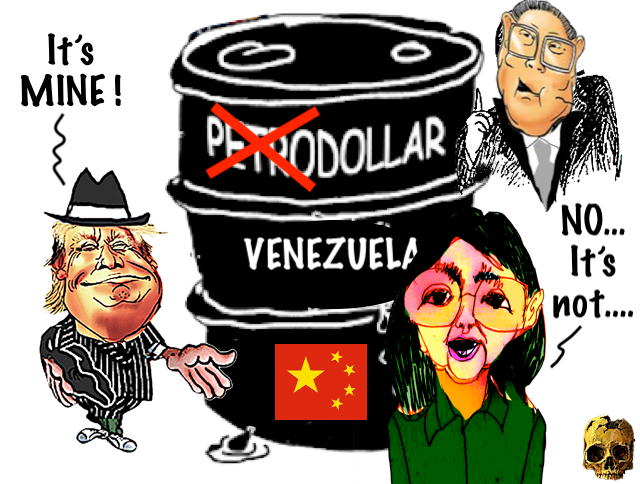
China spent over *$106 billion* building Venezuela’s oil economy over two decades — loans, refineries, pipelines, joint ventures, and oil-backed debt deals. Then in January 2026, the United States launched a dramatic Delta Force operation, captured Nicolás Maduro, and declared a new era for Venezuela. But did Washington actually take control… or walk straight into a trap China already prepared?
In this video, we break down how China quietly became the most powerful foreign player inside Venezuela’s economy, why US sanctions may have accidentally helped Beijing secure discounted oil, and how America’s military victory failed to erase China’s economic dominance. From oil tankers and shadow fleets to strategic petroleum reserves, debt leverage, and billion-barrel contracts, this is the untold geopolitical battle between Washington and Beijing over the world’s largest proven oil reserves. Topics Covered:
- China’s $106 billion investment in Venezuela
- US Delta Force operation against Maduro
- Venezuela oil crisis explained
- China vs America geopolitical rivalry
- CNPC, Sinopec, and Venezuelan crude
- Why US sanctions backfired
- Strategic petroleum reserves and energy wars
- The global oil tanker shadow fleet
- How debt gives China leverage over Venezuela
- The future of Latin America’s oil politics
Sources referenced include: AidData, Bloomberg, RAND Corporation, Atlantic Council, Lloyd’s List, Morgan Stanley, Columbia University’s Center on Global Energy Policy, and the US House Select Committee on China.
https://www.youtube.com/watch?v=GH6kNzTUCug
China Put $160 Billion Into Venezuela — & America Thought One Military Strike Would Erase All of It
PLEASE VISIT:
YOURDEMOCRACY.NET RECORDS HISTORY AS IT SHOULD BE — NOT AS THE WESTERN MEDIA WRONGLY REPORTS IT — SINCE 2005.
Gus Leonisky
POLITICAL CARTOONIST SINCE 1951.
RABID ATHEIST.
WELCOME TO THIS INSANE WORLD….
- By Gus Leonisky at 23 May 2026 - 9:24am
- Gus Leonisky's blog
- Login or register to post comments
trump's gangsters....
Delcy’s ‘Gatekeeper’: Sources say ex-Trump Official Claver-Carone Holds Keys to Caracas
by Max Blumenthal
Speaking with reporters on May 21, US Secretary of State Marco Rubio announced that Venezuelan President Delcy Rodriguez was on her way to New Delhi to discuss energy issues, and that he would be in India as well.
“This is an important trip, I’m glad we’re able to do it,” Rubio chirped after explaining the trio of nations would discuss how to increase Venezuelan oil sales to India.
His statement — and his announcement of Rodriguez’s trip before she had — perfectly illustrated Washington’s newfound dynamic with the Venezuelan government. Following over twenty years of hostile relations with Venezuela’s socialist-oriented leadership, the US Secretary of State was apparently so intimately involved with day to day affairs in Caracas that he was claiming responsibility for Rodriguez’s international itinerary.
In fact, according to an insider who enjoys close contacts within both the Venezuelan and US governments, Rubio’s influence over Rodriguez is said to be traced to one “gatekeeper”: former Trump Latin America envoy Mauricio Claver-Carone. “Mauricio [Claver-Carone] is picking who can operate and Delcy [Rodriguez] is taking instructions,” the source told The Grayzone.
A former senior US official with access to leadership in both Caracas and Washington offered the same assessment, remarking to The Grayzone, “Mauricio’s calling the shots on private sector economic positions, and if anyone wants in, they have to go to him.”
Hand-selected by former National Security Advisor John Bolton to serve as his Latin America charge during Trump’s first term, Claver-Carone no longer occupies an official governmental role. Instead, he has leveraged his legacy in the public sector to establish a Miami-based investment firm called the Lara Fund which could become a key player in the MAGA financial feeding frenzy in Caracas.
Described by the New York Times as the “architect of Trump’s tough Latin America policies,” Claver-Carone is a Cuban-American regime change zealot who once engaged in fisticuffs with Cuban diplomats as a young man. During Trump’s first term, he unleashed a financial “flamethrower” on Cuba, issuing scores of new sanctions that unraveled the Obama-era normalization policy and plunged the island back into economic misery.
Claver-Carone has similarly masterminded many of the policies that define Trump’s relationship with Venezuela, from its recognition of the previously unknown Juan Guaido as the country’s “interim president” to the deportation of hundreds of Venezuelan migrants from the US to El Salvador’s maximum security CECOT prison. Many of those migrants had been prompted to journey to the US by the economically crushing sanctions unleashed at Claver-Carone’s direction.
The Grayzone’s sources described the Trump veteran as the architect of the military invasion that saw Maduro spirited away to a federal penitentiary and installed Rodriguez as president following a stand-down by Venezuelan security forces.
“If he was in charge of implementing the kinetic side, maybe [Rodriguez] thinks she has to listen to him on finance,” the Venezuela insider said of Claver-Carone.
A report this January by investigative journalist Aram Roston described Claver-Carone as a “key backer” of Rodriguez following Maduro’s abduction, and cited sources who claimed he exercised decisive influence over Venezuela policy despite having left the administration.
Claver-Carone is now said to be at the heart of the most sensitive and consequential task Venezuela faces: the restructuring of its $170 billion in defaulted sovereign debt. Forced from several previous positions by corruption scandals and rancorous clashes, an operative with no official governmental position appears to be shaping the economic contours of Project Venezuela.
“He’s got a lock on everything”This May, the US Treasury Department authorized Caracas to hire a financial advisor to assist with the herculean task of restructuring its debt. The Venezuelan government selected Centerview Partners, a top-drawer investment and financial advisory firm based in New York City.
According to the former US senior official, Claver-Carone’s romantic partner and business colleague, Jessica Bedoya, boarded a private jet to Caracas soon after the big announcement, arriving with a top advisor from Centerview. It was her second trip to the Venezuelan capital, they said, after visiting in February to discuss financial matters.
Claver-Carone did not respond to calls to his personal phone from The Grayzone, or to detailed questions sent by text and email.
His partner, Bedoya, is the founder of the Lara Fund investment firm where he serves as managing partner. Her bio notes that she has also worked in the CIA and National Security Council.
Some insiders worry that her reported presence in the Venezuelan capital, together with Claver-Carone’s outsized influence, could represent a conflict of interest, allowing them to steer debt restructuring agreements to their own personal benefit.
“Now he’s got a lock on everything,” the Venezuela insider said of Claver-Carone. “He could say to anyone who wants to work in Venezuela, I’m the guy. I have the keys. If you want to play ball, invest with me.”
The former US official said Claver-Carone was raising capital for his Lara Fund while he served as a special government employee at the State Department. While Bedoya was running the firm, they said Claver-Carone was leveraging his position inside the Trump administration to pitch potential investors.
“Arbitrary and authoritarian actions that showed him to be a real thug”When Trump appointed Claver-Carone to serve as the first American president of the Inter-American Development Bank (IDB) in 2020, he hired Bedoya as his chief-of-staff. The couple’s secret romance at the bank triggered an embarrassing ethics investigation after a hand-written contract was discovered showing they had agreed to pursue “absolute happiness,” and included a clause with punishments including “candle wax and a naughty box” if either party breached the deal.
An independent probe ordered by the IDB discovered that Claver-Carone had increased his paramour’s salary by 40% – a $133,000 reward in less than a year. Investigators also found that the couple had racked up expenses on an IDB credit card during romantic getaways.
Claver-Carone refused to participate in the investigation while accusing its authors of “fabrications.” In the end, IDB governors voted unanimously in favor of his firing. The US government endorsed their decision.
“President Claver-Carone’s refusal to fully cooperate with the investigation, and his creation of a climate of fear of retaliation among staff and borrowing countries, has forfeited the confidence of the bank’s staff and shareholders and necessitates a change in leadership,” they wrote.
The Argentine governor of IDB, Guillermo Francos, delivered a similarly harsh assessment of Claver-Carone’s tenure. “Claver was a disaster for several reasons,” Francos remarked in 2022. “For having an inappropriate relationship, for having disproportionately increased the salary of this inappropriate relationship, for having lied, and for these arbitrary and authoritarian actions that showed him to be a real thug.”
When Claver-Carone returned to the second Trump administration, it was not long before his proclivity for conflict jeopardized his position.
Throughout 2025, Claver-Carone’s spiteful attitude reportedly complicated Trump administration attempts to prop up a key right-wing ally in South America, Argentine President Javier Milei. Milei’s chief of staff happened to be Guillermo Francos – the former IDB governor whom Claver-Carone held personally responsible for outing his secret relationship with Bedoya. According to the Argentine paper Clarin, Claver-Carone attempted to retaliate by unsuccessfully pressuring Milei to fire Francos. He then attempted to undermine a major IMF loan package to Argentina by demanding the country first sever its credit line from China. This was met with an apparent rebuke from Treasury Secretary Scott Bessent, who visited Buenos Aires to express confidence in the IMF loan just weeks after Argentina’s central bank extended its credit line from Beijing.
The following month, in May 2025, Claver-Carone announced he was leaving the State Department to return to his Lara Fund. His departure gave the appearance that he had been forced out of his job, however, he maintained his clout through his direct line to Rubio.
The former US official told The Grayzone that Claver-Carone is now angling to become a Cuban American version of Jared Kushner, the Trump son-in-law who has leveraged his proximity to the president and role as Middle East negotiator to rake in billions from Israel and several Gulf monarchies despite having no official government title. To do so, he has allegedly inserted himself into the byzantine process of restructuring Venezuela’s debt.
When the Trump administration announced that Venezuela could hire a financial advisor to assist with its sovereign debt, Rodriguez initially planned a public bidding process for the coveted position. But then, according to the ex-US official, Claver-Carone issued support for Centerview, leading to the firm’s selection. (Opposition bloggers have speculated that Centerview was chosen because one of its partners, Matthieu Pigasse, is a self-described “pro-market socialist” who previously worked on deals with Maduro and Venezuela’s state owned PDVSA oil company.)
In recent weeks, according to sources, Claver-Carone has attempted to undermine financial advisors who had been working with the Venezuelan government to restructure its debt since 2014.
They said that when Claver-Carone’s partner, Bedoya, arrived in Caracas this month, allegedly on a private jet with Pigasse, she began pushing to remove the advisory mandate from David Syed, a seasoned French lawyer who had advised Caracas on debt-related issues for over a decade, and is considered incorruptible.
“The effort to push [Syed] out created a lot of tension,” remarked the Venezuela insider. “You can’t understand debt restructuring by parachuting in without his knowledge.”
Syed did not respond to The Grayzone’s request for comment. Hamouda Chekir, another Centerview partner who works on Venezuela’s debt, did not respond to calls and text messages sent to his personal phone.
Scandal-stained firms as vehicles for extracting profit from VenezuelaJust before leaving the State Department in May 2025, Claver-Carone convinced Rubio not to renew a sanctions waiver that allowed Chevron to sell Venezuelan oil in the US market. In doing so, he eliminated a mechanism which was explicitly designed to promote transparency and prevent local officials from skimming cash.
This January, after abducting Maduro, the Trump administration granted confidential licenses to a pair of notoriously corrupt trading houses, Vitol and Trafigura, to export Venezuelan oil. The deal came months after Trump’s re-election campaign received a whopping $6 million donation from a senior trader at Vitol.
Robert Bachmann, an analyst at the Swiss watchdog Public Eye, told the Washington Post at the time, “Trump is taking advantage of firms that know how to circumvent regulation.”
Both companies had been caught engaging in a series of elaborate bribery schemes across Latin America and Africa. In 2020, the Department of Justice (DOJ) forced Vitol to pay a $135 million penalty for bribing officials for licenses in Mexico, Ecuador and Brazil. Trafigura paid a similarly staggering fine in 2024 for a lucrative bribery scheme in Brazil. In the US, Vitol was rung up by the California Attorney General for manipulating spot market prices of oil.
But almost as soon as the Trump administration entered office, it neutered the DOJ corrupt foreign practices division charged with enforcing the judgments against Trafigura and Vitol on the grounds that it was “impeding America’s national security objectives.”
Now, the profits these scandal-stained firms generate through oil sales abroad – including to Israel – are channeled back into a US-run account with little public oversight. A percentage of sales is then delivered back to the Venezuelan government. Where the rest goes is anybody’s guess.
“The Venezuelans are the owners of the oil, and we know nothing. There is no transparency,” said José Guerra, an economist aligned with the Venezuelan opposition, complained to the Washington Post about the Trafigura and Vitol licensing agreements.
Trump, for his part, has essentially admitted Venezuelan oil profits are channeled into a slush fund for his international rampage. “We’ve taken out so much oil in Venezuela, we’ve paid for the cost of the war [with Iran] about 25 times over,” the president boasted during a May 23 campaign rally. While the president’s claim was absurd, as Venezuela is currently exporting only about one million barrels of oil a month – hardly enough to cover a full day of warfare – it revealed his avaricious attitude toward the entire operation.
Among certain Venezuelan opposition activists, Claver-Carone has become a figure of contempt who is partially blamed for Trump’s declaration that their de facto leader, the coup plotter and Nobel Peace Prize winner Maria Corina Machado, “doesn’t have the support within, or the respect within, the country.”
The Trump administration’s embrace of Delcy Rodriguez, and the Venezuelan president’s faithful compliance with Washington’s financial schemes, have prompted some top Democrats to adopt Machado as a partisan cudgel. This January, Chris Murphy, a ranking Democrat on the Senate Foreign Relations Committee, praised the opposition leader as “impressive” following a meeting on Capitol Hill, while taking a nasty swipe at Rodriguez. Machado “reminded us that Trump replaced Maduro with Maduro’s head of torture,” Murphy proclaimed.
If the Democrats take Congress after this year’s midterm elections, the Trump administration’s dealings in Venezuela will face intense scrutiny from the House Oversight Committee. Bipartisan pressure will then build for fresh elections to usher in a new government. “Delcy Rodríguez is a terrible person,” the regime change-obsessed Florida Republican Sen. Rick Scott told the Wall Street Journal this month. “We’ve got to have an election soon.”
In the meantime, a flock of MAGA-aligned financial vultures has swooped into Caracas to feast on the petro-state’s post-Maduro carcass. Donald Trump Jr. is said to be hunting for opportunities in the capital for his 1789 Capital fund, while a startup backed by pro-Trump tech oligarchs Peter Thiel and Palmer Luckey, Erebor Bank, just struck a lucrative deal to reconnect Venezuela’s central bank to the global economy. In the midst of this frenzy, a figure with no government title, Claver-Carone, appears to be establishing the new pecking order.
https://thegrayzone.com/2026/05/25/delcys-gatekeeper-trump-caracas/
READ FROM TOP.
PLEASE VISIT:
YOURDEMOCRACY.NET RECORDS HISTORY AS IT SHOULD BE — NOT AS THE WESTERN MEDIA WRONGLY REPORTS IT — SINCE 2005.
Gus Leonisky
POLITICAL CARTOONIST SINCE 1951.
RABID ATHEIST.
WELCOME TO THIS INSANE WORLD….
leap...
What we know of what is going on…confirms the revisionist orientation of the present policy…gains are in the process of being liquidated. As far as foreign policy is concerned … United States imperialism is denounced less and less. Its interventions in the life of other peoples are frequently even seen as “positive.”… The struggle against the bourgeois right is scarcely mentioned.
Who wrote these lines? Is it one of the many international left voices denouncing the current Venezuelan government? The similarities are striking, but in fact, this was the French Maoist Charles Bettelheim, resigning in 1977 from the Franco-Chinese Friendship Association. In effect, it was an “hasta aquí” (washing one’s hands) moment from an intellectual heavyweight almost fifty years ago.
A Great Leap into Reality: Venezuela Today
By Chris Gilbert, Cira Pascual Marquina
Along with China’s new “revisionist” policies, which he thought were pro-capitalist, Bettelheim disliked the crude propaganda being used to denounce the Gang of Four, including Jiang Qing, to whom Mao himself had been married. How could revolutionaries so celebrated in one moment be so harshly condemned in the next? Does all of this sound close to home? In fact, both Bettelheim’s observations and his complaints seem uncannily similar to those of many concerned Venezuela watchers today.
The View from the CoreToday, among numerous Venezuela solidarity activists and fellow travelers in the Global North, Alex Saab’s extradition to the United States last week has become a similar symbolic breaking point. For them, the case is definitive proof that the Bolivarian Process has crossed an unforgivable line. Yet it is both revealing and bizarre that the measuring stick of the Venezuelan revolution could become a single figure. In fact, their outsized reaction can only be understood if we consider that the #FreeAlexSaab campaign constituted much of these activists’ only practical engagement with Venezuela, and many mistakenly believed Saab (though objectively more like Meng Wanzhou than Che Guevara) to be an emblematic 21st-century revolutionary.
All of this reveals how problematic it is to evaluate a revolution based on a distant and partial experience of it. Here in Venezuela, among grassroots Chavistas, one does not encounter this obsessive fixation on Saab, nor, for that matter, on the recent—and indeed humiliating—“simulacrum of evacuation” involving U.S. military aircraft. This does not mean that people here applauded the extradition or feel indifferent toward these events. But at the communal and barrio level, among those who have spent decades building popular power while enduring U.S. sanctions, fascist violence, and endless imperialist aggressions, there is little appetite for the dramatic ruptures that some observers abroad seem to be encouraging.
Whether with regard to the Saab affair or some other concession or error by the government, many international intellectuals and solidarity activists approach revolutionary processes as though their main role were to determine the exact moment when fidelity must end—when they may finally pronounce, “hasta aquí.” However, this gatekeeper posture often carries an unmistakably arrogant undertone, and is connected to a particular class and great-power chauvinist position. It assumes that those situated in the core of imperialism possess the authority to declare the legitimacy—or death—of struggles being carried out elsewhere, by people who wagered their lives and those of future generations on them.
We believe that it is not international observers, but the Chavista grassroots—the people who have sustained this revolutionary process for twenty-seven years, who buried their dead and resisted sanctions and destabilization, and who are still, slowly and stubbornly, building communes—who should carry the most weight in this discussion.
The Truth on the GroundGoing back to China and Bettelheim, everything in that country’s subsequent trajectory shows that the verdict he offered in 1977 was spectacularly wrong. The very reforms that Bettelheim saw as betraying the revolution turned out to have saved it. Neil Burton, responding to Bettelheim from his workplace in China, respectfully suggested that the French intellectual could not clearly see his way through the events because the schemas he worked with were too static. Burton pointed out that Bettelheim neither spoke nor read Chinese and was not in China to experience events directly.
Of course, we bring up Bettelheim’s error—which was replicated by many left intellectuals of lesser caliber around the world at the time—in relation to the case of contemporary Venezuela not because we believe the country where we live and work is undergoing something precisely the same as a China-style “Reform and Opening.” Instead, we do so out of a conviction that many on the left are making a similar error in precipitously declaring the Bolivarian Revolution to be over or its leadership traitorous.
Let us be clear: This is indeed a time of unprecedented challenges and great dangers for Venezuela. In fact, no one who claims they completely understand the situation or the way forward is telling the truth. Nor can any participant in the Bolivarian Revolution say with certainty if we will succeed in the struggle against imperialism. However, in a still open-ended situation, why wager so firmly on defeat? And why precipitously discredit the Chavista leadership—a leadership built over decades by the people themselves—in a way that might contribute to that defeat?
Venezuela’s ‘Long March’ under sanctionsIntellectuals of the international left, many of whom have created networks and collectives to project their own voices, would do well to reflect on their way of being in the world, on their modus operandi. Too often and for too long, being a left intellectual has meant being “right about everything,” “having the facts and the answers,” and, above all, demonstrating how others are wrong. But that is not what it means to be a revolutionary in the historically accepted sense. To be a revolutionary is to be an organic part of a movement. It means that the revolution matters more than one’s reputation.
In his fascinating book Red Star Over China, Edgar Snow writes that when Chinese revolutionaries told him their life stories, the personal part of the narrative miraculously disappeared once they reached the point where they joined the revolution. After that, Snow observed, a communist “lost himself,” and “one could only hear stories of the Army, or the Soviets, or the Party.” In effect, each cadre ceased to be an “I” and became a “we.” What a different world from the one we live in today, where online influencers—the dominant model of today’s intellectual life—never cease pointing out how they, as individuals, are being attacked, were right before, and so on!
China and Venezuela are, of course, very different, including in their culture. However, like the Chinese revolutionaries, many of us in Venezuela have lived through a trial by fire—a de facto “Long March” through the 2010s—which was a period marked by all kinds of complicated trials and reversals. The experience burned a certain humility into our consciousness. It marks a qualitative difference from many intellectuals of the Global North, whose practices are still framed by a focus on their ideas, their reputations, or their theoretical correctness.
By contrast, most workers and organic intellectuals in Venezuela know that the revolution is a colossal, telluric process. It has innumerable ups and downs, and sometimes takes apparently inexplicable turns. Yet it is no more to be pronounced “dead,” even in a moment of apparent stagnation, than the epic revolutionary process in 19th-century France, which Marx compared to a mole that never ceased in its sometimes invisible and underground work.
Parameters for debating the central questionA revolutionary process is a rigorous teacher. By way of experience, the Bolivarian Revolution has inscribed numerous concrete lessons in millions of consciousnesses here. One thing all of us have learned is that divisions within Chavismo are to be avoided. Loyalty in the face of imperialism, even when it might smack of blind loyalty—in the spirit of “Dudar es traición” (“Doubt is betrayal”), as one Chavista slogan has it—is always preferable. We have often had to put aside our desire to be “right” before the global intellectual class. We know that the most important thing is the revolution, and we would rather appear to be fools than see it fail. Much more is at stake than individual reputations.
At the same time, debate that is within the revolution is welcome. As Fidel said at a critical moment in the Cuban process: “Within the revolution, everything; against the revolution, nothing.” However, people in the Global North who wish to take part should be attentive to the problem of “great power” chauvinism, especially the tendency to jump the gun in debates that ought to be led primarily by those living and struggling within the country itself. Better internet connections, greater visibility, higher institutional salaries, and less precarious daily conditions can easily allow intellectuals abroad to overpower or even silence the voices of those directly confronting the contradictions of the process.
These are issues that Lenin anticipated in his writings on “great-power chauvinism” and the relation between oppressor and oppressed nations. In the 1920 “Theses on the National and Colonial Question,” Lenin argued that centuries of domination inevitably produce legitimate mistrust toward imperial-power populations, including the latter’s often-complicit workers and intellectuals. He contended that revolutionaries from dominant nations therefore bear a special responsibility to approach those struggling in such contexts with particular “care and attention” and a willingness to make political concessions in order to overcome historically accumulated distrust.
Humility, then, should be the order of the day. This is not the moment for theatrical declarations that “it is all over,” or for exclaiming Hamlet-like that every contradiction or error represents a betrayal. Too often, such gestures are simply an acting-out of frustration and a search for catharsis. In fact nobody, inside Venezuela or abroad, possesses a definitive answer to the central question looming over all of us. That question is: How can the anti-imperialist—and ultimately socialist—project initiated in 1999 in Venezuela, or more broadly the emancipatory project inaugurated by Simón Bolívar and the Venezuelan masses more than two centuries ago, continue advancing under conditions of U.S. imperialism’s expanded military capacity and its new willingness to cross former red lines in the region?
More broadly, all of Latin America is grappling with the problem of how to confront this new modality of imperialism. Nor have any people or government—not in Brazil, Colombia, Mexico, or Cuba—discovered a definitive solution. For that reason, this is a time not only for modesty but also for avoiding factional and chauvinist positions. The stakes are of the highest order—but so too are the tools and assets, including the whole richness of what years of struggle and many revolutionary victories have taught us. It is a time for revolutionaries from the Latin American region and beyond to come together around the common task: defeating the principal enemy.
Shaking the World: Reports from Revolutionary Venezuela is a biweekly column by Cira Pascual Marquina for MR Online, offering frontline analysis of imperialism, popular power, and revolutionary struggle in Venezuela.
About Chris GilbertChris Gilbert is a professor of political studies at the Universidad Bolivariana de Venezuela, contributing editor at Monthly Review, and the author of Commune or Nothing! Venezuela’s Communal Movement and Its Socialist Project (Monthly Review Press), among other books and articles. With Cira Pascual Marquina, he is founder and co-host of Escuela de Cuadros, a Marxist educational program and podcast. About Cira Pascual MarquinaCira Pascual Marquina is a popular educator at the Pluriversidad Patria Grande, the educational initiative of El Panal Commune. She is also a member of the International Communal Democracy Network. With Chris Gilbert, Pascual Marquina is coauthor of Venezuela, the Present as Struggle: Voices from the Bolivarian Revolution (Monthly Review Press), the book series Resistencia comunal frente al bloqueo imperialista(Observatorio Venezolano Antibloqueo), and Protagonistas: construcción comunal en tiempos de bloqueo imperialista (Observatorio and PT). They are also founders and hosts of Escuela de Cuadros.https://mronline.org/2026/05/28/a-great-leap-into-reality-venezuela-today/
READ FROM TOP.
PLEASE VISIT:
YOURDEMOCRACY.NET RECORDS HISTORY AS IT SHOULD BE — NOT AS THE WESTERN MEDIA WRONGLY REPORTS IT — SINCE 2005.
Gus Leonisky
POLITICAL CARTOONIST SINCE 1951.
RABID ATHEIST.
WELCOME TO THIS INSANE WORLD….
resist.....
I resist, therefore I am.
Luis Britto García
The Venezuelan writer and intellectual Luis Britto García has issued a courageous call to resist the dismantling of Venezuelan sovereignty and the country's surrender to US imperialism. In a strongly political text, the historical Bolivarian thinker warns against the "deafening silence" that conceals the handing over of Venezuela's resources and destiny to foreign interests.
We have suffered a terrible blow. If we want to overcome it, we must acknowledge it, investigate the causes, and correct the effects.
We reiterate that, according to a Hinterlaces poll from October 2025, 83% of respondents would be willing to face a foreign military invasion, only 6% would not, and 89% believed that the true objective of any intervention would be to overthrow President Nicolás Maduro in order to seize oil.
Six months later, I have not found a single compatriot who does not reiterate these responses, but with new questions.
First, it is necessary to know clearly, precisely, and in detail what did or did not happen in the early morning of January 3, 2026. Venezuela had, and still has, modern, effective, and expensive weaponry that was not used. Moderna. Forty-seven Venezuelan soldiers and 32 Cuban escorts died bravely repelling the massive aggression with basic weapons. It is essential to know the facts precisely and correct the shortcomings for future and foreseeable confrontations.
Research should reformulate the Strategic and Tactical Doctrine for Security and Defense. It appears that, faced with a swift skirmish that demonstrated the enemy's air superiority, an unconditional surrender was decided upon, with weapons, troops, and equipment parks almost intact, and without the adversary having effectively and sustainably dominated even an inch of national territory. A new doctrine must categorically exclude the possibility of the kidnapping of officials or mere coercion resulting in concessions detrimental to sovereignty.
It has always been known that the United States enjoys superiority in conventional weapons. This is not an argument for all the peoples of the earth to surrender to him at will. Many of them have defeated him with inferior weapons. To resist him, it is necessary to adopt the tactics of unconventional warfare, which have systematically rendered this superiority useless in almost all asymmetric conflicts of the past and present centuries. It is urgent to understand why these tactics were not applied in this case, to formulate doctrines that correct the errors, and to incorporate all citizens into the active defense.
The Venezuelan people do not know the extent of the concessions made to the enemy in the minutes following the aggression, nor by what mechanism or in what manner these concessions vary or are extended to the present and into the foreseeable future. Due to the uncertainty surrounding this issue, we assume that the aggressor aspires to an absolutely totalitarian discretionary power that entails the disappearance of Venezuela's sovereignty and the unconditional control of its resources. Laws have been enacted that aim to enable the unconstitutional privatisation of our hydrocarbon and mining industries, to drastically reduce state participation in them, and to subject related disputes to foreign courts or arbitrators. This aims to usurp all the rights belonging to our people without assuming any responsibility towards them.
Such a model is not viable. Invasion propaganda claims that a period of torrential investment is dawning, bringing floods of foreign currency and prosperity. Elsewhere, we reviewed the failed meeting of January 9, 2026, between the President of the United States and some 17 of that country's oil companies, intended to divide up Venezuela's energy spoils. Not a single one offered a single dollar of investment. They considered the country "uninvestable," uninvestable due to a lack of legal security, since extracting the first drop of oil would require an investment of one billion dollars and a ten-year timeframe, as a portion of the wealth is already compromised.
Indeed, over 45% of the oil and gas fields have been legally granted for more than 25 years to Chinese companies and subsidiaries of the Russian state-owned oil company Roznef, which explored and extracted hydrocarbons while the US blockade prevented the continued operation of most of the remaining fields. Information gaps following the invasion include the current state of these Russian and Chinese operations and the hydrocarbons or other minerals produced there. The revenues from these concessions are inalienable Venezuelan property and, as such, must be deposited into the national treasury and distributed through the national budget and administration.
On the other hand, the enemy inflexibly maintains its aggressive stance. Not a single one of the thousands of unilateral coercive measures applied against Venezuela has been repealed. The hostages taken by force have not been released. The blatant falseness of the pretexts for the invasion has not been acknowledged: the absence of the so-called Cartel of the Suns and the defunct Aragua train, the absence of illicit substance production and smuggling, the absence of an opposition majority that supposedly obtained electoral majorities. Not a word has been said about reparations for the damage caused by a quarter-century of atrocious harassment and a blockade of more than a decade, by a bombing campaign carried out by one and a half hundred aircraft, or by Venezuela's assets illegally confiscated abroad. All the rigour and coercion of an illegitimate state of war, unauthorised by the United States Congress, are being maintained against our country.
In the preceding text, we emphasized that the invader, through Executive Decree 14,373, intends for all Venezuelan hydrocarbon and mineral revenues—historically representing 80% of the country's foreign exchange earnings—to be diverted to a position within the U.S. Treasury or to secret private accounts in Qatar, under the discretionary administration of the United States, and solely and exclusively for the purpose of acquiring goods produced in that country
With the announcement of this unacceptable, near-total theft of our revenues comes the resumption of relations with the International Monetary Fund and the World Bank, institutions specialising in the erosion of national sovereignty by extorting unpayable public debts. Deprived of revenue, Venezuela will be forced to cover its expenses by accepting usurious loans secured with its remaining assets and resources. These new funds will be used primarily to cancel debts acquired at nominal prices by vulture funds for their full face value.
This total dispossession of public revenues will have devastating consequences. Lately, Venezuelan government social spending has accounted for over 70% of its expenditures. The drastic reduction in available funds will lead to a parallel dismantling of all current programs in education, health, housing, social assistance, food, culture, scientific research, agricultural and livestock development, industrialisation, defense, and infrastructure—programs already severely damaged by over a quarter-century of aggression, a decade of blockade, and more than a thousand unilateral coercive measures aimed at strangling and destroying our economy.
With the dismantling of these programs or the drastic reduction of their staff by imposing barely symbolic wages, there will come a wave of unemployment that limited private investment will be unable to absorb.
This situation will have political repercussions. As they become progressively unable to meet the most vital needs of the population, there will be a decrease in support for organisations that collaborate with the occupation.
The right-wing opposition, sidelined as a political instrument by the invaders due to its lack of popular support, will gradually become violent, seeking to assert its merits before the occupiers. Electoral processes managed by the same corporations that committed fraud in Honduras, Peru, Ecuador, and other countries will legitimise incoherent sham elections that will strip representative organisations of their power.
Drastic labor law reforms will be enacted, nullifying or annihilating workers' rights, with social, economic, and political repercussions equal to those such measures provoked during the last century.
Collaboration with the invaders will bring illicit profits to a tiny elite of influence pedlars and transnational speculators, and will destroy the prestige of the political and social movements that submit to it.
It can be said of the Empire, like the Bourbons, that it has neither forgotten nor learned anything. It will undertake a systematic, relentless, and comprehensive eradication of all movements that have or have had a progressive orientation, or even a hint of one. Once its usefulness is exhausted, the collaborationist sector will be no exception. The facts and ideas of the Liberators will disappear from the media, educational programs, and history itself, or they will be grotesquely falsified to represent the opposite of their ideals. Following Rudolf Atkon's directives, education will be purely instrumental; according to Laura Berns's, free higher education will be abolished.
We all know what lies behind the deafening silence that oppresses us. Without any consultation of our will, it aims to strip us of sovereignty, independence, natural resources, autonomy, and rights—past, present, and future—for the benefit of an aggressive power that hates and despises us.
Since the invasion, two battles have been fought: one for the annihilation of our country and the other for the complete recovery of the sovereignty, resources, independence, autonomy, and self-determination of the Venezuelan people.
You know which side you should be on.
Self-defense is the most undeniable of human rights, and it is up to us to exercise it as resistance to the best of our ability, with thoughts, words, and deeds. Ideas to understand the atrocious reality, words to denounce it, work to change it. Existing organisations must be oriented toward resistance and victory; when this is not possible, new ones can be created. There are as many forms of resistance as there are people and talents; everyone must take it up within the framework of their abilities, capacities, and skills. Resistance must take more forms than the oppression it fights, and a people has the right to exercise all of them rather than consent to its servitude or extinction.
I resist, therefore I am.
Luis Britto Garcia
https://www.legrandsoir.info/je-resiste-donc-j-existe.html
TRANSLATION BY JULES LETAMBOUR
READ FROM TOP.
PLEASE VISIT:
YOURDEMOCRACY.NET RECORDS HISTORY AS IT SHOULD BE — NOT AS THE WESTERN MEDIA WRONGLY REPORTS IT — SINCE 2005.
Gus Leonisky
POLITICAL CARTOONIST SINCE 1951.
RABID ATHEIST.
WELCOME TO THIS INSANE WORLD….