Search
Recent comments
- ice-breaking....
17 min 39 sec ago - deal please....
1 hour 14 min ago - tears......
3 hours 31 min ago - dodgy dossier....
3 hours 57 min ago - choosing sides.....
14 hours 13 min ago - agreed?.....
16 hours 8 min ago - I forgot....
16 hours 18 min ago - strikes.....
16 hours 30 min ago - easy target....
16 hours 47 min ago - auto co-op...
22 hours 7 min ago
Democracy Links
Member's Off-site Blogs
burn baby burn... Homo stupidus....
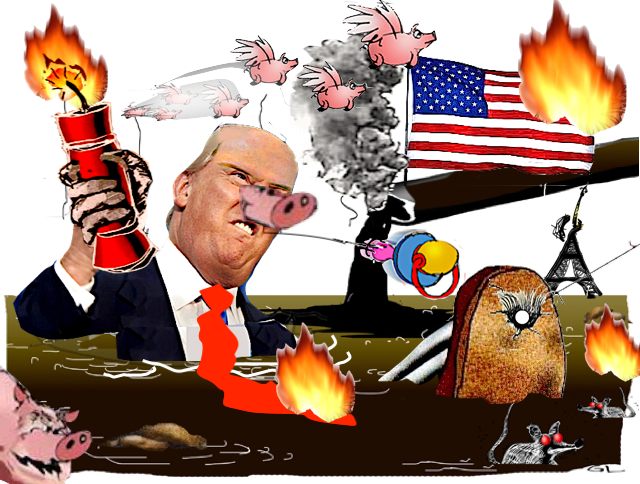
Wohin geht Amerika?
Deutschland ist in Vielem von einem guten Verhältnis zu den USA abhängig. Deshalb ist das Bemühen verständlich, auf politischer und wirtschaftlicher Ebene einen möglichst guten Konsens mit dem Präsidenten zu suchen, den sich die Mehrheit der Amerikaner bei der Wahl im November 2024 geleistet hat.
Homo stupidus
Russi, Florian
Das aber darf uns nicht daran hindern, viele kritische Blicke auf diesen Mann zu werfen, der ein durch und durch verdrehter Charakter ist. Dabei verhält er sich auch ausgesprochen dumm. Nach seinem großen Wahlerfolg hätte er die Riesenchance gehabt, als Versöhner und Mittler für alle Amerikaner aufzutreten, sein Volk zu einen und zu einem gemeinsamen Erfolg zu führen. Stattdessen rächte er sich an allen seinen Gegnern oder denjenigen, die er dafür hielt und hält. Erstaunlich ist es, wie dieser Mensch, der alles andere als ein christliches Leben führt, von Evangelikalen und Klerikalen unterstützt wird. Ist Rache zu einem christlichen Motiv geworden? Die christlichen Gemeinden in den USA scheinen sich weit vom Ursprung der christlichen Religion entfernt zu haben. Sie sind oberflächlich und selbstgerecht. Religion ist Gruppendynamik und nicht mehr Glaubensinhalt und frohe Botschaft.
Die Trump’sche Politik mag kurzfristig zu einigen Erfolgen führen. Langfristig wird sie einen weltweiten Schaden auslösen. Aus „America first“ wird „America worst“, aus „America friendly“ wird „America ugly“ (hässlich), aus „We want Panama, Grönland etc.“ wird „Ami go home“ und aus „Let’s make America great again“: „Don’t make America Gaga again“. Gaga scheint mir das entscheidendste Wort. Die aktuelle Menschheit hat nicht nur mit Klimakrisen, Vertreibungen, Kriegen, Hungersnöten und Krankheiten wie Corona zu kämpfen, sondern auch mit dem Gaga-Problem. Post-Covid wird begleitet von Post-Psyvid. Hoch befähigte Psychotherapeuten sind gefordert. Meldet euch!
https://www.deutschland-lese.de/streifzuege/essays/homo-stupidus/
====================
Where is America headed? Germany is dependent on a good relationship with the USA in many respects. Therefore, the effort to seek the best possible consensus with the president, on a political and economic level, is understandable—a consensus that the majority of Americans supported in the November 2024 election. However, this should not prevent us from taking a critical look at this man, who is a thoroughly distorted character. He also behaves remarkably stupidly. After his resounding election victory, he had a golden opportunity to act as a reconciler and mediator for all Americans, to unite his people and lead them to a common success. Instead, he took revenge on all his opponents, or those he considered and still considers to be such. It is astonishing how this man, who lives anything but a Christian life, is supported by evangelicals and clericals. Has revenge become a Christian motive? The Christian communities in the USA seem to have strayed far from the origins of the Christian religion. They are superficial and self-righteous. Religion is group dynamics, no longer a matter of faith or good news. Trump's policies may lead to some short-term successes. In the long run, they will cause global damage. "America First" will become "America Worst," "America Friendly" will become "America Ugly," "We want Panama, Greenland, etc." will become "Yankee go home," and "Let's make America great again" will become "Don't make America Gaga [mad?] again." "Gaga" seems to me the most crucial word. Humanity today is not only grappling with climate crises, displacement, wars, famines, and diseases like COVID, but also with the "Gaga" problem. Post-COVID will be accompanied by post-Psyvid. Highly skilled psychotherapists are needed. Get in touch! ======================= Trump repeals power to fight climate change, axes vehicle emissions rulesPresident Donald Trump's administration has revoked a formal scientific finding that has been the central basis for US action to fight climate change.
The Obama-era "endangerment finding" served as the legal basis for federal climate regulations, setting limits on greenhouse gas emissions.
It determined that carbon dioxide and other greenhouse gases threatened public health and welfare.
Curbs on vehicle emissions have also been axed.
The moves come after a year of implementing a string of regulatory cuts and other actions intended to unfetter fossil fuel development and stymie the rollout of clean energy.
"Under the process just completed by the EPA, we are officially terminating the so-called endangerment finding, a disastrous Obama-era policy that severely damaged the American auto industry and drove up prices for American consumers," Mr Trump said.The president announced the repeal alongside EPA administrator Lee Zeldin and White House budget director Russ Vought, who was a key architect of the conservative policy blueprint Project 2025.
Mr Trump has said he believes climate change is a "con job", and has withdrawn the US from the Paris Agreement, leaving the world's largest historic contributor to global warming out of international efforts.
Former president Barack Obama blasted the move on X, saying without the endangerment finding, "we'll be less safe, less healthy and less able to fight climate change — all so the fossil fuel industry can make even more money".
'The holy grail'Mr Zeldin said the Trump administration pursued the most consequential climate policy of the past 15 years, something the agency had avoided during his first term.
"Referred to by some as the holy grail of federal regulatory overreach, the 2009 Obama EPA endangerment finding is now eliminated," he said.
The endangerment finding was first adopted by the US in 2009, and led the EPA to take action under the Clean Air Act of 1963 to curb emissions of carbon dioxide, methane, and four other heat-trapping air pollutants from vehicles.
It followed the Supreme Court's 2007 decision in Massachusetts v EPA, which held that the agency had authority to regulate carbon dioxide and other greenhouse gas emissions under the Clean Air Act.
ts repeal would remove the regulatory requirements to measure, report, certify and comply with federal greenhouse gas emission standards for cars.
The transportation and power sectors are each responsible for about a quarter of US greenhouse gas output, according to EPA figures.
The EPA said the repeal of vehicle emission standards would save US taxpayers $US1.3 trillion ($1.8 trillion), while the prior administration said the rules would have net benefits for consumers through lower fuel costs and other savings.
The Alliance for Automotive Innovation did not endorse the action but said "automotive emissions regulations finalised in the previous administration are extremely challenging for automakers to achieve given the current marketplace demand for EVs".
The Environmental Defense Fund said the repeal would end up costing Americans more, despite EPA's statement that climate regulations have driven up costs for consumers.
"Administrator Lee Zeldin has directed EPA to stop protecting the American people from the pollution that's causing worse storms, floods, and skyrocketing insurance costs," EDF president Fred Krupp said.
"This action will only lead to more of this pollution, and that will lead to higher costs and real harms for American families."
Under former president Joe Biden, the EPA aimed to cut passenger-vehicle fleet-wide tailpipe emissions by nearly 50 per cent by 2032.
This compares with 2027 projected levels and forecasts that between 35 per cent and 56 per cent of new vehicles sold between 2030 and 2032 will need to be electric.
The agency estimated that the rules would deliver net annual benefits of $99 billion through 2055.
Consumers were expected to save an average of $6,000 over the lifetime of new vehicles from reduced fuel and maintenance costs.
The coal industry celebrated the announcement, saying it would help stave off retirements of aging coal-fired power plants.
"Utilities have announced plans to retire more than 55,000 megawatts of coal-fired generation over the next five years," America's Power president and CEO Michelle Bloodworth said.
"Reversing these retirement decisions could help offset the need to build new, more expensive electricity sources and prevent the loss of reliability attributes, such as fuel security, that the coal fleet provides."
Uncertainty unboundLegal experts said the policy reversal could lead to a surge in lawsuits known as "public nuisance" actions.
"This may be another classic case where overreach by the Trump administration comes back to bite it," said Robert Percival, a University of Maryland environmental law professor.
Environmental groups have slammed the proposed repeal as a danger to the climate.
Future US administrations seeking to regulate greenhouse gas emissions likely would need to reinstate the endangerment finding.
Several environmental groups, including the Natural Resources Defense Council (NRDC) and Earthjustice, have said they will challenge the reversal in court.
"There'll be a lawsuit brought almost immediately, and we'll see in them in court. And we will win," said David Doniger, senior attorney at the NRDC.
YOURDEMOCRACY.NET RECORDS HISTORY AS IT SHOULD BE — NOT AS THE WESTERN MEDIA WRONGLY REPORTS IT — SINCE 2005.
Gus Leonisky
POLITICAL CARTOONIST SINCE 1951.
- By Gus Leonisky at 13 Feb 2026 - 4:26pm
- Gus Leonisky's blog
- Login or register to post comments
oil....
Iran war described as ‘biggest opportunity’ at US oil lobby’s DC summit
MAX BLUMENTHAL
An attendee told The Grayzone that oil industry heavyweights were less excited about Trump’s Venezuela policy, privately complaining about the President’s aggressive push to restart their operations.When the American Petroleum Institute (API) gathered oil industry leaders and lobbyists for a “State of American Energy” summit on January 16, 2026, the geopolitical landscape seemed to be shifting dramatically in their favor. However, an attendee of the resource extraction cartel’s most important annual lobbying conference told The Grayzone that participants privately grumbled about President Donald Trump’s heavy-handed attempts to steer their agenda, particularly in Venezuela, where he has demanded they immediately restart operations.
Two weeks before the API summit, the US military kidnapped Venezuelan President Nicolas Maduro in a violent raid, enabling the Trump administration to commandeer the country’s oil reserves. Meanwhile, foreign-backed riots left thousands dead in oil-rich Iran on January 8 and 9, generating enough instability to excite Western governments about the prospects of regime change.
From the stage at Washington DC’s Anthem theater, veteran industry consultant Bob McNally of the Rapidan Energy Group could not contain his excitement over the prospect of toppling the Islamic Republic of Iran.
“Iran holds the biggest promise as well, though they’re the biggest risk, but the biggest opportunity,” McNally proclaimed. “If you can imagine the United States opening an embassy in Tehran, the regime in Tehran reflecting its people – the most pro American population outside of Israel in the Middle East, culturally, commercially adept – historic. If you can imagine our industry going back there, we would get a lot more oil, a lot sooner than we will out of Venezuela.”
According to McNally, who formerly advised President George W. Bush on energy policy, a US regime change war on Iran would be a “terrible day for Moscow, [a] wonderful day for the Iranians, the United States, the oil industry and world peace.”
However, like many industry titans at the API summit, McNally saw Venezuela as a high-risk, low-return investment, even after the de facto US takeover of its resources. “Since the President’s decision to apprehend Nicolas Maduro, I think we’ve seen, you know, private conversations, the meeting at the White House, the administration has had to learn, you don’t go into Venezuela, turn a tap and 3 million barrels a day flow. It doesn’t happen like that,” he commented.
McNally went on to suggest the oil industry was pushing back on Trump’s demands that it immediately reinvest in Venezuela: “The prize in Venezuela is getting back from below a million barrels a day to between three and four million barrels a day, and that we will measure in many years and many decades. And that’s the truth. And the industry is speaking that truth to the administration.”
A week before the API summit, ExxonMobil CEO Darren Woods declared Venezuela “uninvestable” based on “legal and commercial constructs” put in place by the governments of former presidents Hugo Chavez and Nicolas Maduro.
President Donald Trump responded to Woods’ statement by thundering, “I didn’t like their response, they’re playing too cute.” While Trump pledged to “keep [ExxonMobil] out” of Venezuela, he has since praised Acting President Delcy Rodriguez for enacting free market-oriented reforms to accommodate companies like ExxonMobil.
At the time of publication, US Energy Secretary and former Liberty Energy CEO Chris Wright is touring Venezuela’s Orinoco oil belt alongside Acting President Rodriguez. The scenes of forced comity suggested further free market reforms to Venezuela’s PDVSA oil company may be on the way.
In private, oilmen grumble about Trump’s Venezuela demands
An attendee of the API summit who was privy to backroom conversations told The Grayzone that the risks of returning to Venezuela dominated private conversations among oil industry players. They said that other participants privately echoed McNally’s dim assessment of reopening in Venezuela, and were especially concerned about potential disruption of their operations by guerrilla organizations like FARC and ELN.The oilmen also expressed worry about alienating international partners by diverting operations to Venezuela, or by fueling competition that could deprive themselves of revenue. They seemed confused about Trump’s haste to invade Venezuela, the attendee recalled, and said they needed to educate the White House about their hesitation to leap headfirst into such an unstable environment.
The negative attitude on display at the oil industry’s most important Beltway gathering suggested that the Venezuela policy was being driven not by the extraction industry’s thirst for profits, but by the ideological passions of the South Florida lobby of Cuban and Venezuelan Americans fronted by Secretary of State Marco Rubio.
In fact, according to the API attendee, participants in the “State of American Energy” summit privately seethed about Trump’s demand that they risk their profits to support his Venezuela takeover. “For them, this was a major shift in the historical relationship between politicians and corporations, where the politician was pushing the agenda,” they told The Grayzone. “I found this very telling about who actually controls the country.”
The oil lobby sponsors a TV show to glorify itselfThe API “State of American Energy” summit’s program closed with a session which demonstrated the power of America’s oil lobby to influence Hollywood content.
On stage beside actor Andy Garcia, a star of a new Paramount+ show, Landman, API President Mike Sommers boasted about his role in sponsoring a dramatic series which glorifies a heavily maligned industry on a Trump-aligned network.
“Many people have asked oftentimes, how did you end up with this great partnership with Landman? I’ve often been asked if I actually write the show,” Sommers joked. “Of course that isn’t true, but the true story behind how we got involved with Landman, is that we were a little bit concerned about how Hollywood would portray the great industry that we serve every single day. So we decided to do some ads during season one. And afterwards, we figured out real fast that Landman was gonna be positive for the American oil and gas industry.”
According to Axios, API provided Landman with “a seven figure ad campaign,” ensuring the show’s viability on Paramount+, a network purchased in 2025 by the pro-Trump, ultra-Zionist billionaire heir David Ellison.
Landman’s plotlines sell viewers on the image of America’s extraction industry as a vital force that is entitled to bend the rules and make crooked deals in order to keep the oil flowing. In one episode, the roguish “landman” protagonist Tommy Norris, played by Billy Bob Thornton, finds himself involved in a turf war with a Mexican narco-cartel which controls a valuable plot of land. To increase his leverage over the cartel, Tommy threatens to trigger Drug Enforcement Agency (DEA) involvement unless they stand down. Ultimately, the cartel agrees to co-exist with Tommy’s company, M-Tex Oil, ensuring secure drilling and lucrative profits.
It’s a plot that could have been ripped from actual headlines about the US oil industry’s secret dealings with Mexican cartels and designated terrorist groups. And just months after the Trump administration initiated a legally dubious anti-drug operation off Venezuela’s coast to increase pressure on Maduro, who now languishes in a federal prison cell as Washington dictates energy policy to Caracas, the API-sponsored Landman feels increasingly like predictive programming.
https://thegrayzone.com/2026/02/13/iran-war-opportunity-oil-lobbys/
YOURDEMOCRACY.NET RECORDS HISTORY AS IT SHOULD BE — NOT AS THE WESTERN MEDIA WRONGLY REPORTS IT — SINCE 2005.
Gus Leonisky
POLITICAL CARTOONIST SINCE 1951.
===========================
MEANWHILE:
Russian energy major Gazprom Neft has discovered a new oil field on the Yamal Peninsula that is the largest discovered in the region in three decades, according to a company release.
The new find is located in the Arctic zone of Yamalo-Nenets Autonomous Region, home to the world’s largest natural gas reserves but also a region with significant oil potential. Drilling and exploration are challenging, however, as the peninsula is almost entirely covered by permafrost.
The field is part of a large oil and gas cluster in the southern part of the peninsula, according to the company. It was discovered after three years of exploration, including 2D and 3D seismic surveys and geological and hydrodynamic modeling. An appraisal well drilled to a depth of 2.7 km produced commercial flows of low-sulfur, low-viscosity oil, gas, and condensate. Estimated geological reserves are 55 million tons, the company’s press release stated.
READ MORE:
https://www.rt.com/russia/632399-gazprom-new-oil-field/?ysclid=mllctmo893378389451