Search
Recent comments
- ice-breaking....
18 min 27 sec ago - deal please....
1 hour 15 min ago - tears......
3 hours 31 min ago - dodgy dossier....
3 hours 58 min ago - choosing sides.....
14 hours 13 min ago - agreed?.....
16 hours 8 min ago - I forgot....
16 hours 19 min ago - strikes.....
16 hours 30 min ago - easy target....
16 hours 48 min ago - auto co-op...
22 hours 8 min ago
Democracy Links
Member's Off-site Blogs
canning the laughs in germania....
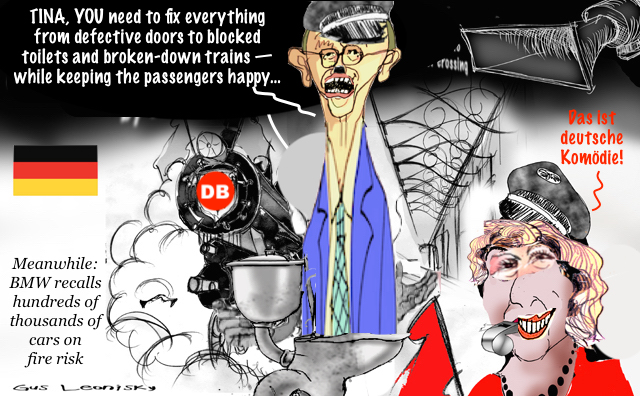
Last October, Deutsche Bahn (DB) launched a social media campaign with popular comic Anke Engelke in the main role. We watch Engelke, as train conductor Tina, and her team doing their best to navigate everything from defective doors to blocked toilets and broken-down trains — and, at the same time, keep passengers happy.
Upon its launch, a senior DB manager, Michael Peterson, called the nine-part series a "humorous declaration of love to the staff." Deutsche Bahn has some 230,000 employees.
Engelke's campaign was feted in the trade press for its media reach, too — with more than sixty major media organizations reporting on it. Within a few days of its launch, the promotion had already got over one million clicks.
But plans to continue what was widely regarded as a successful campaign have been abandoned. Deutsche Bahn told Germany's tabloid Bild newspaper that a second season of Boah, Bahn, which roughly translates to Wow, what a railway!, did not "suit the times”.
Self-irony: a risky strategy for beleaguered Deutsche BahnMarketing campaigns that use self-irony are risky, according to media and communications scientist Peter Vorderer. But the Mannheim University professor told DW that DB probably had little choice given the company's tarnished reputation.
"Do you have a chance of achieving anything except with self-irony when something is so hated across the board in large parts of the population — where it has become almost a national pastime to complain about it?", asked Vorderer.
A month before the series was launched, only some 55% of intercity trains reached their stops on time — which DB defines as a delay of less than six minutes. This was the worst monthly timekeeping record since 2024.
Getting trains to where they should be at the right time is not DB's only problem. Travelers also complain about a lack of hygiene, dysfunctional washrooms and broken air conditioning.
The campaign hit headlines againThe end of the campaign made headlines this month. The Bild am Sonntag newspaper reported on February 8 that it had exclusive information that the Bahn had spent €7 million ($8.3 million) on the clips. The company itself will not confirm the figure disclosed by the Bild newspaper. DB told DW that it was an operational and business secret.
The tabloid newspaper article appeared just over a week after a fatal attack on a ticket inspector in Rhineland-Palatinate, which sparked a renewed debate about safety on the railways.
There were more than 3,000 verbal and physical attacks on DB personnel last year, including security staff. That is the equivalent of an average of eight per day. Sebastian Fiedler, a lawmaker for the governing center-left Social Democratic Party (SPD) told the newspaper that it was a "scandal that the board had spent so many million euros on funny ads. For this money, they could have paid for at least a hundred extra security staff for a year."
The head of the Rail and Transport Union (EVG), Martin Burkert (61), asked rhetorically whether a roll-out of body cams across the board and refurbished employee break rooms might not have been a clearer sign of the railway company's affection for its workers than the multi-million campaign.
Left Party lawmaker and transport spokesperson Luigi Pantisano said the benefit of the marketing was outweighed by its cost. "I think the campaign is nice and I personally like comedy and I like Anke Engelke and some of the actors. However, you could have done a lot of other things with those 7 million," Pantisano told DW.
New plain-talking DB boss reportedly dropped ad campaignJust days before the campaign was launched, German railways appointed a new chair, Evelyn Palla. Deutsche Bahn told the Bild tabloid that Palla and her new marketing chief had taken the decision to discontinue the social media campaign in January.
Palla has already made a mark with radical restructuring plans, including halving the number of top managers to save some 500 million euros.
She has also dampened expectations of any quick fixes. The rise in the number of engineering works planned for 2026 is likely to increase delays.
The state-owned company has suffered from decades of underfunding. According to Germany's Transport Ministry, roughly half of the country's rail tracks are in mediocre, poor, or deficient condition. About one-fifth of the infrastructure will need to be replaced in the medium term, while some elements — including signal boxes that are more than a century old — require immediate attention.
DB chief Palla has warned that the nation's railways are likely to get worse before they get better.
Edited by Rina Goldenberg
https://www.dw.com/en/germanys-deutsche-bahn-halts-humorous-publicity-campaign/a-75917110
=====================
BMW is recalling hundreds of thousands of vehicles worldwide over a technical fault that could cause the cars to catch fire, the luxury carmaker says.
A total of 28,582 of cars are affected in Germany, according to BMW.
The company did not give an exact figure of vehicles affected worldwide but German industry outlet kfz-Betrieb reported that 575,000 might be affected.
Product inspections revealed a faulty solenoid switch, which controls the electricity flow in a circuit.
Models affected include the BMW’s 2 Series Coupé, several variants of the 3 Series, 4 Series and 5 Series, the 6 Series Gran Turismo, the 7 Series saloon and the X4, X5, X6 and Z4, according to the car maker.
Following a high number of starts, excessive wear might occur in the switch, which might make it more difficult or even impossible to start the car.
A short circuit might occur, which could lead to localised overheating of the starter, resulting in the vehicle catching fire during operation “in the worst case,” BMW said.
In this case, drivers might notice smoke while driving or leaving the car, according to BMW, which advises against leaving the engine running unattended.
Vehicles that have a starter relay manufactured between July 2020 and July 2022 could potentially be affected, as well as cars that have been fitted with a faulty starter retroactively during repairs, the company said.
BMW last recalled hundreds of thousands of vehicles in September over a potential fire risk due to a faulty starter.
In that case, water was found to penetrate the starter motor at certain points in the affected vehicles, causing corrosion.
https://michaelwest.com.au/bmw-recalls-hundreds-of-thousands-of-cars-on-fire-risk/
=====================
YOURDEMOCRACY.NET RECORDS HISTORY AS IT SHOULD BE — NOT AS THE WESTERN MEDIA WRONGLY REPORTS IT — SINCE 2005.
Gus Leonisky
POLITICAL CARTOONIST SINCE 1951.
- By Gus Leonisky at 12 Feb 2026 - 9:11am
- Gus Leonisky's blog
- Login or register to post comments
gas snap....
In early February, German media outlets reported on the strains affecting Germany's gas reserves.
The news magazine Focus warned that the "cold snap devours our gas reserves." At the same time, the TV broadcaster ntv said that "Germany's gas reserves would theoretically last for about six more weeks," and warned: "There is hardly any room for additional strain."
The focus on gas reserves is a consequence of Russia's invasion of Ukraine. In 2022, the German government decided that it no longer wanted to buy oil and gas from Russia. That led to the question of whether Germany could satisfy its energy needs without Russian gas. By the following year, it was evident that Germany could manage.
This was due, in part, to the diversification of import sources. Gas from Russia was replaced by imports from, among others, the United States and Norway. At the same time, import routes were adapted. Increasingly, liquefied natural gas (LNG) has been imported by sea. The terminals were planned, approved and put into operation in record time.
Sufficient gas reserves in GermanyThe current winter in Germany is the harshest in years, prompting questions about supply security.
However, Susanne Ungrad, a press spokesperson for the Ministry for Economic Affairs and Energy (BMWE), told DW that "the gas supply is secured." This, she said, was due to the "well-developed LNG infrastructure in Germany and Europe" and the "main supply via Norwegian pipeline gas."
Fiete Wulff is equally sanguine about Germany's reserves. The press spokesperson of the Federal Network Agency told DW that "at present, we see no threat to the gas supply."
He added that "gas storage fill-levels are an important indicator, but not the only one." A significant "share of our gas supply comes via pipelines and LNG shipments from neighboring countries."
Even in the event of a harsher winter than the current one in Germany, supply would be secured, Wulff pointed out. More critical, he said, would be "disruptive events such as terrorist attacks or the failure of major import pipelines."
Olaf Geyer, who heads the energy practice in Germany and Switzerland at the strategy consultancy Arthur D. Little, is also relaxed about the current situation.
When asked whether the reserves are sufficient, he was clear: "Yes. Under normal conditions. If extreme cold spells do not last longer than one or two weeks, then they are sufficient."
That confidence is shared by Oskar Burmann of the industry association for gas and hydrogen, a lobbying group representing the gas sector.
"The legally mandated fill-level requirements for gas storage facilities have been met. In addition, thanks to the existing LNG infrastructure and new pipeline connections, the gas industry is fully capable of responding even at short notice to additional demand," he said.
https://www.dw.com/en/germany-gas-supplies-winter-energy-lng-russia-renewables/a-75876173
READ FROM TOP.
YOURDEMOCRACY.NET RECORDS HISTORY AS IT SHOULD BE — NOT AS THE WESTERN MEDIA WRONGLY REPORTS IT — SINCE 2005.
Gus Leonisky
POLITICAL CARTOONIST SINCE 1951.