Search
Recent comments
- ice-breaking....
18 min 31 sec ago - deal please....
1 hour 15 min ago - tears......
3 hours 32 min ago - dodgy dossier....
3 hours 58 min ago - choosing sides.....
14 hours 13 min ago - agreed?.....
16 hours 8 min ago - I forgot....
16 hours 19 min ago - strikes.....
16 hours 30 min ago - easy target....
16 hours 48 min ago - auto co-op...
22 hours 8 min ago
Democracy Links
Member's Off-site Blogs
same old same old as john used to say....
Exactly 19 years ago on Tuesday [10/02/2026], Russian President Vladimir Putin took the podium at the Munich Security Conference and demolished the myths and falsehoods underpinning the American-led world order. Did anyone heed his warning?
To Russia, the “rules-based international order” has always been shorthand for a system in which the US makes the rules and issues the orders.
“However one might embellish this term, at the end of the day it refers to one type of situation, namely one center of authority, one center of force, one center of decision-making,” Putin told the audience in Munich. “It is a world in which there is one master, one sovereign. And at the end of the day this is pernicious not only for all those within this system, but also for the sovereign itself because it destroys itself from within.”
Under the auspices of protecting this order, the US carried out “unilateral and frequently illegitimate actions,” in “disdain for the basic principles of international law,” he declared.
In the decade before Putin’s speech, the US invaded Afghanistan, invaded Iraq, and led a NATO bombing campaign against Yugoslavia on behalf of Kosovo separatists. Four years after his speech, NATO forces dropped more than 7,000 bombs on Libya, ending Muammar Gaddafi’s rule and handing the keys of the country to jihadists and slave traders. “No one feels safe,” Putin stated in 2007, “because no one can feel that international law is like a stone wall that will protect them.”
Putin warned that NATO’s broken promises to halt its eastward expansion after the Cold War represented “a serious provocation that reduces the level of mutual trust.” The Russian president noted that the US-led bloc had already placed its “frontline forces on our borders,” and asked “against whom is this expansion intended?”
The following year, NATO published its infamous Bucharest declaration, assuring Ukraine and Georgia that they “will become members” at an unspecified future date. The consequences of this declaration – which flew in the face of warnings from Putin and American strategists – are playing out in Ukraine today.
Did anyone listen?No, the Atlanticist neoliberal establishment roundly ignored Putin’s layered and impassioned warning. But Russia kept trying. Foreign Minister Sergey Lavrov echoed Putin’s complaints when he spoke at the conference in 2018, pointing out that “NATO troops and military infrastructure are accumulating on our borders,” and that “the European theater of war is being systematically developed.” By that stage several thousand people had been killed in Donbass.
Lavrov urged European leaders to abide by the Minsk agreements, which were ostensibly aimed at ending hostilities in Donetsk and Lugansk and granting autonomy to the two predominantly Russian-speaking regions.
Following the collapse of the accords, and the escalation of the conflict in 2022, European and Ukrainian leaders admitted that the agreements were a ruse to enable Ukraine to buy time to prepare for a war with Russia.
The organizers of the Munich Security Conference have not so much as attempted any introspection over the last 18 years. Instead, in their latest report, they blame US President Donald Trump for taking a “wrecking ball” to the so-called “rules-based international order.”
Obsessed with TrumpUS Vice President J.D. Vance’s speech at last year’s conference sent shockwaves through Atlanticist circles. Speaking to an audience of primarily European military and political leaders, Vance told them – in short – that they are hated by their own voters, throwing away their civilizations by facilitating mass immigration, shouldn’t count on the US to defend them forever, and will lose the support of the US should they restrict speech freedoms.
All the Europeans could do was cry. Literally, conference Chairman Christoph Heusgen broke down in tears during his closing comments, sobbing as he lamented the decline of the “rules-based international order” and proclaiming that “our common value base is not that common anymore.”
Vance’s speech “illustrated just how different the current administration’s perspective on key issues is from the bipartisan liberal-internationalist consensus that has long guided US grand strategy,” Munich Security Conference Foundation President Wolfgang Ischinger wrote in a report ahead of this year’s conference, which kicks off on Friday.
As such, discussion in Munich this year will focus almost entirely on “the United States’ evolving view of the international order,” he wrote.
The report then devolves into a lengthy complaint about how Trump is bailing on the core tenets of this order: “multilateral cooperation, international institutions, and the international rule of law,” “the promotion of liberal-democratic values,” and “the prohibition of the threat or use of force against other states.”
These concerns are not baseless. In the year since Vance’s speech, Trump has opened talks with Moscow without European involvement, unilaterally ordered the kidnapping of Venezuelan President Nicolas Maduro, imposed a humiliatingly one-sided trade deal on the EU, and threatened the bloc’s members with tariffs if they oppose his planned annexation of Greenland.
In response, “the actors defending international rules and institutions need to be just as bold as the actors who seek to destroy them,” the authors argue. In short, escalate. To them, this means increasing military spending, signing new multilateral trade pacts without the participation of the US, seizing Russia’s sovereign assets, and bringing Ukraine under the EU’s security umbrella.
The report praises NATO’s European members for their “remarkable” decision to boost military spending to 5% of GDP, and calls for “greater courage and decisiveness” from the Europeans when it comes to stealing Russia’s frozen assets.
All of this misses two key points. First, increased defense spending by NATO’s European members and the continuation of the Ukraine project are longtime foreign policy goals of Washington that predate Trump. By implementing them, the remaining members of the “rules-based international order” continue to serve US interests.
Secondly, the order that they seek to preserve is the same one that brought “sweeping destruction” – in their words – to the world in the first place. It is the same “unipolar model” that Putin declared “not only unacceptable, but also impossible” in 2007.
There’s no going backWhat European Atlanticists like Ischinger apparently want is a world in which they can pretend to serve higher values – democracy, human rights, the rule of law – while enabling continued American dominance. All they ask for is a return to the pre-Trump status quo, in which the US acted in its own interests, but made them feel like they were part of the team.
Now that Trump has done away with these pretenses and relegated Ischinger and his ilk to the status of impotent observers, the Munich Security Conference Foundation is calling for more than just “sterile communiques, predictable conferences, and cautious diplomacy.” Ironically, they’re doing so in a sterile report ahead of another predictable conference.
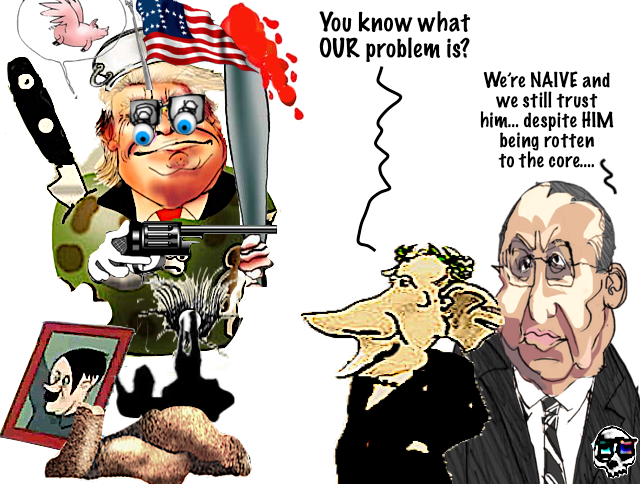
If they had listened to Putin 19 years ago, they might have realized that the problem is a systemic one, and it won’t go away when Donald Trump is out of office.
https://www.rt.com/news/632269-putin-munich-2007-warning/
YOURDEMOCRACY.NET RECORDS HISTORY AS IT SHOULD BE — NOT AS THE WESTERN MEDIA WRONGLY REPORTS IT — SINCE 2005.
Gus Leonisky
POLITICAL CARTOONIST SINCE 1951.
SEE ALSO:
trump did not understand the rules of 3-D chess diplomacy....- By Gus Leonisky at 12 Feb 2026 - 6:45am
- Gus Leonisky's blog
- Login or register to post comments
ahahahakaka....
The EU intends to demand restrictions on the size of the Russian armed forces as part of any settlement of the Ukraine conflict, the bloc’s foreign policy chief, Kaja Kallas, indicated on Tuesday.
The EU is not part of US-mediated Russia-Ukraine peace talks and has long refused diplomatic engagement with Moscow. Kallas, however, told reporters that she is drafting a list of demands and believes Brussels will shape the conflict’s outcome.
“Everybody around the table, including the Russians and the Americans, needs to understand that you need Europeans to agree,” she said, as quoted by news agencies. “And for that, we also have conditions. And we should put the conditions not on Ukrainians… but on the Russians.”
“The Ukrainian army is not the issue. It’s the Russian army. It’s the Russian military expenditure. If they spend so much on the military they will have to use it again,” Kallas claimed. Her office will present the list to member states within days.
Moscow says the conflict was triggered by the 2014 Western-backed coup in Kiev and NATO’s subsequent involvement with Ukraine’s military, as the new government prioritized joining the US-led bloc. In early 2022, Kiev and Moscow agreed on a draft peace deal making Ukraine a neutral state with a limited army, but Ukraine abandoned it under Western pressure to seek a battlefield victory.
Russia sees the EU as one of the main obstacles to a realistic settlement, arguing its continued aid encourages Kiev to make unacceptable demands. Several Western European nations have offered to deploy troops in Ukraine as a ‘security guarantee’ – a proposal Moscow firmly rejects.
EU leaders admit their support for Ukraine would be insufficient without US backing. Some have called for re-engaging Russia diplomatically to influence the outcome. French President Emmanuel Macron warned in a recent interview that Americans could force terms on the EU, such as when Ukraine should become a member of the bloc.
https://www.rt.com/news/632291-kallas-list-demands-russia/
READ FROM TOP.
YOURDEMOCRACY.NET RECORDS HISTORY AS IT SHOULD BE — NOT AS THE WESTERN MEDIA WRONGLY REPORTS IT — SINCE 2005.
Gus Leonisky
POLITICAL CARTOONIST SINCE 1951.
US bullshit.....
One-on-one diplomacy meets double-track reality in US-Russia ties
Moscow’s top diplomat is warning that dialogue with Washington is continuing in words but not in deeds
A deal announced by US Vice President J.D. Vance during a high-profile visit to Armenia on Monday has been presented in Washington as economic cooperation and regional stabilization. But the agreement landed in Moscow against a backdrop of long-standing Russian warnings that Yerevan’s growing engagement with the West risks undermining its traditional regional partnerships.
This is Washington’s double-track policy: dialogue on paper, pressure in practice.
In Moscow, that contradiction has crystallized into a division of labor. One set of officials continues to test transactional engagement with Washington. Another has begun saying openly that it is not possible.
On one track is Kirill Dmitriev, the Harvard-educated financier and head of Russia’s sovereign wealth fund, tasked with maintaining dialogue and exploring large-scale economic deals with the West.
On the other is Sergey Lavrov, esteemed diplomat and the longest-serving foreign minister in the world. He is increasingly the man saying publicly what Moscow believes privately: that the US is negotiating in words while escalating in practice.
That contrast has come into full view following a series of interviews Lavrov gave respectively to RT, TV BRICS, and in subsequent public remarks.
Lavrov’s diagnosisThe ‘Spirit of Anchorage’ and broken promises
Lavrov openly challenged the idea that the US and Russia are still working toward a framework of cooperation emerging from talks in Anchorage, Alaska.
He said Russia accepted Washington’s proposals on resolving the war in Ukraine, only to find that the US has backed away from them in practice:
“If you approach it, so to speak, man-to-man, they made an offer, we agreed – the problem should have been resolved. [...] And so, having accepted their proposals, we believed we had fulfilled the task of resolving the Ukrainian issue and could move on to full-scale, broad, mutually beneficial cooperation. But in practice everything looks the opposite.”
’US objective is global dominance’
He described the continuation and expansion of sanctions as evidence Washington has abandoned cooperation:
“The US’ objective is global economic dominance, implemented through a wide range of coercive measures inconsistent with fair competition, including tariffs, sanctions, direct prohibitions, and even restrictions on communication for some partners. We must take all this into account,” Lavrov said.
This echoes his comment that there is no “bright future” in economic ties with the US.
The ‘war’ against tankers
The Russian foreign minister specifically framed the extraordinary US intervention and seizure of Russia-flagged oil tankers on the high seas as coercive:
“[It is] a ‘war’ against tankers in the open sea in violation of the UN Convention on the Law of the Sea.”
The targeting of tankers, Russia’s foreign minister believes, is part of a larger Western pressure campaign.
Russian partners under fire
Lavrov also used the interview to expand his critique beyond Russia’s direct ties with the United States, arguing that Washington is exerting pressure on Russia’s partners – most notably India – to reduce their energy cooperation with Moscow:
“India and other partners are being pressured to stop buying cheap, accessible Russian energy resources.”
“America is trying to control Russia’s trade and military ties with some of our strongest partners like India. Unfair methods are being used against us,” he said in an interview with TV BRICS.
What this means in context
Taken together, these statements illustrate why Lavrov has shifted toward unfiltered diplomatic observation. His remarks amount to a strategic diagnosis – one that defines the boundaries within which Moscow now views engagement with Washington.
READ MORE: Here’s how 2025 killed old-school diplomacyHe rejects the premise that earlier diplomatic frameworks still apply, and treats continued sanctions, energy pressure, and interference with partners as evidence that, for now at least, cooperation has been hollowed out.
Dmitriev: Operating after diagnosisTesting what, if anything, still works
As head of Russia’s sovereign wealth fund, Dmitriev has been Moscow’s most visible advocate of transactional engagement with the West. Harvard-educated and fluent in the language of global finance, his role has been to explore whether large-scale economic cooperation remains possible even as political relations deteriorate.
Dmitriev has been a central figure in ongoing Russia-US tracks on Ukraine and economic dialogue. Reuters reported that he travelled to Miami in late January to meet members of the US administration ahead of a new round of peace talks in Abu Dhabi.
At those and related meetings, he reiterated that work continues on reviving economic ties and advancing negotiations, even amid sanctions and geopolitical friction. According to a recent Reuters report, Dmitriev said progress was being made toward a diplomatic solution to the Ukraine conflict, noting that while other actors sought to disrupt the process, there was nonetheless “positive movement forward” in trilateral discussions involving Russia, Ukraine, and the United States.
His participation in meetings with US envoys, including at forums like the World Economic Forum in Davos and in preparatory talks ahead of the Abu Dhabi round, reflects Moscow’s interest in testing whether points of pragmatic cooperation still exist.
Importantly, Dmitriev’s efforts come at a time when Western officials have publicly engaged him despite his personal sanctions, and both sides have used his meetings to signal interest in maintaining at least channels of contact even as broader relations deteriorate.
Synthesis: Two tracks, one realityTaken together, Lavrov and Dmitriev embody the dual character of Russia’s current foreign policy posture toward the United States:
Lavrov’s rhetoric signals a strategic judgment that Washington’s actions have surpassed the limits of cooperation, redefining engagement as pressure rather than partnership.
Dmitriev’s activity demonstrates that, even under these conditions, Moscow continues to probe whether narrow, transactional interactions – especially those linked to peace negotiations and economic dialogue – can still yield results.
One voice articulates Moscow’s broader assessment of US intentions, without fear or favor, the other tests the boundaries of what can be achieved.
What Armenia provesArmenia matters in Moscow because it sits at the intersection of several trends Russian officials have already flagged as red lines.
Over the past two years, Yerevan has publicly distanced itself from Russian-led security arrangements, suspended active participation in the CSTO, deepened defence cooperation with the West, and questioned the value of Russia’s role as a security guarantor after Nagorno-Karabakh. Russian officials have repeatedly warned that Armenia’s westward turn carries strategic consequences, particularly when framed as “diversification” rather than rupture.
Against that backdrop, the deal announced by Vance may be interpreted in Moscow as part of a cumulative reorientation: US involvement expanding precisely where Russian influence has been politically weakened.
This is where Lavrov’s broader argument comes in. In his telling, Washington is institutionalizing shifts away from Russia while maintaining the language of dialogue. Armenia, in this sense, is confirmation.
Sanctions are being expanded, maritime pressure on Russian energy exports intensified, and Russia’s partners – including India – are being urged to scale back cooperation. In that environment, US engagement in Armenia reads in Moscow as strategic sequencing, which tests Lavrov’s case. And for now, Lavrov appears to believe the test has already been answered.
https://www.rt.com/russia/632272-us-russia-diplomacy-ties-reality/
READ FROM TOP.
YOURDEMOCRACY.NET RECORDS HISTORY AS IT SHOULD BE — NOT AS THE WESTERN MEDIA WRONGLY REPORTS IT — SINCE 2005.
Gus Leonisky
POLITICAL CARTOONIST SINCE 1951.