Search
Recent comments
- WARsaw.....
33 min 3 sec ago - normal people....
39 min 20 sec ago - colonialism .2.....
43 min 21 sec ago - heart of stone....
46 min 48 sec ago - pipeline.....
55 min 24 sec ago - ice-breaking....
1 hour 50 min ago - deal please....
2 hours 46 min ago - tears......
5 hours 3 min ago - dodgy dossier....
5 hours 29 min ago - choosing sides.....
15 hours 45 min ago
Democracy Links
Member's Off-site Blogs
peace isn't what it used to be.....
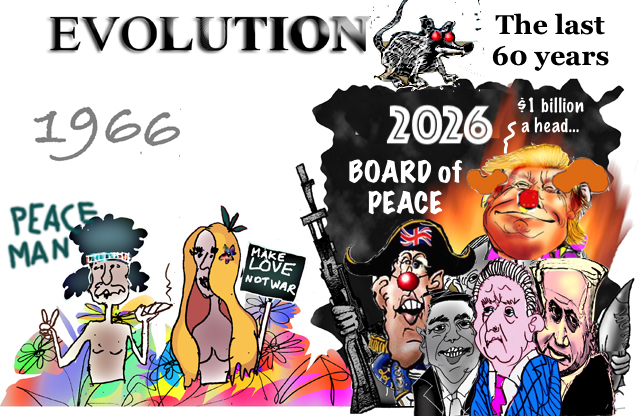
UAE, Belarus, Bahrain join Trump's Board of Peace alongside US rivals China, Russia
Norway was invited to serve on the board as well, but refused the offer. The Norwegian Foreign Ministry did not provide an immediate explanation.
The United Arab Emirates and Belarus accepted the invitation to join US President Donald Trump's "Board of Peace" on Tuesday.
Belarusian President Alexander Lukashenko signed the agreement to join on Tuesday afternoon, stating that he looked forward to becoming a "founding member" of the organization.
The UAE's foreign ministry said the country stood ready to “contribute actively to the mission of the Board of Peace, supporting greater cooperation, stability, and prosperity for all,” marking Abu Dhabi's formal alignment with Washington’s new conflict‑resolution effort.
The board would be chaired for life by Trump and would start by addressing the Gaza war, then expand to deal with other conflicts, according to a copy of a letter and draft charter seen by Reuters.
Bahrain joins BoP, Norway rejects the invitationBahrain has accepted the invitation to join the BoP as a founding member, Bahrain's Foreign Ministry said on Tuesday.
Norway will not take part in the initiative as it is currently presented, Norwegian Deputy Foreign Minister Andreas Motzfeldt Kravik told the daily Aftenposten on Tuesday.
The Norwegian foreign ministry did not immediately reply to a request for comment.
Turkey's Fidan discusses Trump's Board of Peace plan, Syria with RubioTurkish Foreign Minister Hakan Fidan and US Secretary of State Marco Rubio discussed the BoP and recent developments in Syria in a phone call, a Turkish foreign ministry source said.
https://www.jpost.com/middle-east/article-883978
==================
YOURDEMOCRACY.NET RECORDS HISTORY AS IT SHOULD BE — NOT AS THE WESTERN MEDIA WRONGLY REPORTS IT — SINCE 2005.
Gus Leonisky
POLITICAL CARTOONIST SINCE 1951.
- By Gus Leonisky at 21 Jan 2026 - 7:47am
- Gus Leonisky's blog
- Login or register to post comments
devingels....
Eugene Doyle
Why the “good vs evil” story keeps failing usThe world is too complex – and too dangerous – to be reduced to “good” and “evil”. The habit still shapes how the West justifies power, war and hypocrisy.
Dividing the world into the Goodies and the Baddies defines Geopolitical Manichean thinking. When it comes to inter-state competition, Manichaeism is the state religion of the West. Dark and violent though things are at the moment (Greenland, Venezuela, Iran, Palestine), we have a collective responsibility to challenge and change this for the better.
In 2018 I visited a Sasanian fort in the desert of mid-eastern Iran. Still standing after 18 centuries of heat, dust and competing empires, its streets – at least in my mind’s eye – were still bustling with people. I could almost hear the sounds of camel bells as a caravan entered through the gates, see the colourful robes of devotees of the prophet Mani, disciples of the prophet Christ and even Buddhists whose sandaled feet walked the pressed mud alleyways of Sar Yazd.
Manichaeism, founded in the Sasanian Empire (224–651 CE), merged elements from Zoroastrianism, early Christianity and Buddhism which were all discussed and mingled along the length and breadth of the Silk Road and other trading routes. The prophet Mani believed in a hard dualism – that there was an eternal struggle between Good and Evil – literally a world of light and a world of darkness.
This hard dualism is exactly the way President Reagan described the Soviet Union (‘the Evil Empire’). In a speech to the National Association of Evangelicals on March 8, 1983, he declared that the Soviet Union was not just a rival but “the focus of evil in the modern world”. He told his audience they needed to avoid the temptation to “label both sides equally at fault, to remove yourself from the struggle between right and wrong, and good and evil”. It was a spiritual battle, no less. I note he was speaking to evangelicals and, yes, ‘angel’ and ‘evangelical’ share the exact same root: Greek ἄγγελος (angelos).
At this point it is worth pointing out that under Reagan’s angelic presidency the US ran death squads in Central America that terrorised millions of civilians and cost the lives of hundreds of thousands of people (70,000 in El Salvador alone, over 100,000 in Guatemala, and 50,000 in Nicaragua’s Contra war, according to conservative estimates).
Under Reagan the CIA worked with US ally Saddam Hussein to supply arms and chemicals that were then converted into chemical weapons, including mustard gas, to use in the carnage of the Iran-Iraq war. US satellite tracking identified Iranian troop movements and provided coordinates to the Iraqis in full knowledge that the Iraqis would use banned chemical weapons to attack them.
_Foreign Policy_ did a major story on this in 2013 after uncovering CIA documents. The story quoted Air Force Col. Rick Francona, US military attaché in Baghdad at the time:
“The Iraqis never told us that they intended to use nerve gas. They didn’t have to. We already knew,” he said.
The US was fully aware that the Iraqis were using banned weapons (WMDs), including nerve agents such as sarin, tabun, and VX against the Iranians but Saddam was ‘our guy’ and still years away from being recategorised as ‘another Hitler’, ‘a man who gassed his own people’, and his country moving into the ‘Axis of Evil’ camp.
It was President George W Bush who branded Iran, North Korea and Saddam Hussein’s Iraq as The Axis of Evil (Music: Darth Vader, please).
In 1996, CBS’s Lesley Stahl confronted Secretary of State Madeleine Albright about the death of possibly hundreds of thousands of children because of US sanctions and blockades imposed on Iraq. “I think that is a very hard choice,” Albright answered, “but the price, we think, the price is worth it."
Reading from the same choir book, was Ayatollah Khomeini, who founded the Islamic Republic in 1979 and was Supreme Leader until his death in 1989. He repeatedly dubbed the United States “the Great Satan.” In 1980, as a young man who was about to write his first article, I attended rallies at Tehran University and in the holy city of Qom. President Carter’s name was spat out with tremendous vehemence at these rallies and was one of the few words I could recognise. The revolutionary Iranians at that time were driving the American influence out of their country and they literally portrayed Carter as a demon and the US as a “world-devouring enemy of humanity”.
European Commission President Ursula von der Leyen recently decried the rising death toll in Iran as ‘ horrifying’. Fair point, but it begs the question why she didn’t raise even an eyebrow to support the Palestinians in their torment over the past two years – or 50 years, for that matter.
The Israeli crackdown on 2.2 million Gazans, 99 per cent of whom had nothing to do with October 7, was vastly more brutal and sadistic. Instead of raining down condemnation on the Israeli state, however, the West, particularly the UK, Germany and US, helped the Israelis rain down bombs that killed tens of thousands of babies, children, women, people of all ages. This is why Manichean narratives and hypocrisy are such dangerous bedfellows.
‘Extreme leftists are campaigning in support of one of the most murderous regimes in the world. It’s a leap into genuine madness’, the UK’s Telegraph bloviates, attacking people like me who warn against military attacks on Iran. You can support both human and democratic rights in Iran and oppose foreign intervention that breaches international law and will only cause misery.
This is why, for me, the alternative to Manichaeism isn’t moral relativism or paralysis – it’s trying to uphold intellectual rigour and ethical consistency. Opposition to Western conduct in the world, in this time of genocide and endless wars, is both valid and a moral imperative.
What we are witnessing is the complete abandonment by the US of the United Nations Charter system that they themselves were central to creating in the post-WWII period. From the fall of the Berlin Wall to the present, it has been a steady undermining of all the foundations of legitimate international conduct.
Renowned political historian Richard Sakwa, Emeritus Professor of Russian and European Politics at the University of Kent, gave a master class on this topic in his book The Lost Peace – How the West failed to prevent a second Cold War. The US progressively shifted away from the UN Charter system to its own system where they set the rules, decided who was exempt from the rules, and who took the orders.
“The great substitution entailed a linguistic shift from ‘international law’ to the ‘rules-based order’, accentuating the contradiction between the impartiality of the international system and the particularity of US primacy,” Sakwa said.
The US leads what Sakwa calls the liberal international order (currently being replaced as the US transitions into a fully rogue Mafia state). Sakwa astutely sums up its exclusionary dualism/Manichaeism when he writes: “The hermetic character of the liberal international order – the liberal anti-pluralist view – is that there cannot be anything legitimate outside of it – reduces all ‘others’ into potential antagonists or outright adversaries.”
Othering is the Western way. Hated Others get what they deserve, particularly now under a US administration that has trashed international law (for example Article 2(4) of the UN Charter - Prohibition of Force). It has attacked Venezuela and kidnapped its President, bombed Iran and Yemen, threatened to seize Greenland and Panama – “the hard way”, if necessary.
We are living through headspinning times as the US tosses global trade rules onto the bonfire and replaces them with petulance backed by unilateral sanctions. Diplomacy has been reduced to “I hate Putin” and the kind of servile grovelling that NATO secretary-general Mark Rutte demeans himself with in order to please ‘Daddy’ Trump.
For US allies and our mainstream media, the old Manichean framing of the US as a light on the hill, the indispensable nation, has become harder and harder to peddle. And yet they keep trying.
Complex issues demand analysis that runs deeper and is more intellectually nutritious than the beer and pretzel diet – Us Good, Them Bad – with which the mainstream media starves readers in the Western world. For these and many other reasons, I don’t profess to be on the side of the angels!
https://johnmenadue.com/post/2026/01/iran-wars-of-narratives-the-great-satan-the-evil-empire-angels-and-demons/
READ FROM TOP.
YOURDEMOCRACY.NET RECORDS HISTORY AS IT SHOULD BE — NOT AS THE WESTERN MEDIA WRONGLY REPORTS IT — SINCE 2005.
Gus Leonisky
POLITICAL CARTOONIST SINCE 1951.
the board.....
Charter of the Board of PeaceDeclaring that durable peace requires pragmatic judgment, common-sense solutions, and the courage to depart from approaches and institutions that have too often failed;
Recognizing that lasting peace takes root when people are empowered to take ownership and responsibility over their future;
Affirming that only sustained, results-oriented partnership, grounded in shared burdens and commitments, can secure peace in places where it has for too long proven elusive;
Lamenting that too many approaches to peace-building foster perpetual dependency, and institutionalize crisis rather than leading people beyond it;
Emphasizing the need for a more nimble and effective international peace-building body; and
Resolving to assemble a coalition of willing States committed to practical cooperation and effective action,
Judgment guided and justice honored, the Parties hereby adopt the Charter for the Board of Peace.
CHAPTER I: PURPOSES AND FUNCTIONS
Article 1: Mission
The Board of Peace is an international organization that seeks to promote stability, restore dependable and lawful governance, and secure enduring peace in areas affected or threatened by conflict. The Board of Peace shall undertake such peace-building functions in accordance with international law and as may be approved in accordance with this Charter, including the development and dissemination of best practices capable of being applied by all nations and communities seeking peace.
CHAPTER II: MEMBERSHIP
Article 2.1: Member States
Membership in the Board of Peace is limited to States invited to participate by the Chairman, and commences upon notification that the State has consented to be bound by this Charter, in accordance with Chapter XI.
Article 2.2: Member State Responsibilities
(a) Each Member State shall be represented on the Board of Peace by its Head of State or Government.
(b) Each Member State shall support and assist with Board of Peace operations consistent with their respective domestic legal authorities. Nothing in this Charter shall be construed to give the Board of Peace jurisdiction within the territory of Member States, or require Member States to participate in a particular peace-building mission, without their consent.
(c) Each Member State shall serve a term of no more than three years from this Charter’s entry into force, subject to renewal by the Chairman. The three-year membership term shall not apply to Member States that contribute more than USD $1,000,000,000 in cash funds to the Board of Peace within the first year of the Charter’s entry into force.
Article 2.3: Termination of Membership
Membership shall terminate upon the earlier of: (i) expiration of a three-year term, subject to Article 2.2(c) and renewal by the Chairman; (ii) withdrawal, consistent with Article 2.4; (iii) a removal decision by the Chairman, subject to a veto by a two-thirds majority of Member States: or (iv) dissolution of the Board of Peace pursuant to Chapter X. A Member State whose membership terminates shall also cease to be a Party to the Charter, but such State may be invited again to become a Member State, in accordance with Article 2.1.
Article 2.4: Withdrawal
Any Member State may withdraw from the Board of Peace with immediate effect by providing written notice to the Chairman.
CHAPTER III: GOVERNANCE
Article 3.1: The Board of Peace
(a) The Board of Peace consists of its Member States.
(b) The Board of Peace shall vote on all proposals on its agenda, including with respect to the annual budgets, the establishment of subsidiary entities, the appointment of senior executive officers, and major policy determinations, such as the approval of international agreements and the pursuit of new peace-building initiatives.
(c) The Board of Peace shall convene voting meetings at least annually and at such additional times and locations as the Chairman deems appropriate. The agenda at such meetings shall be set by the Executive Board, subject to notice and comment by Member States and approval by the Chairman.
(d) Each Member State shall have one vote on the Board of Peace.
(e) Decisions shall be made by a majority of the Member States present and voting, subject to the approval of the Chairman, who may also cast a vote in his capacity as Chairman in the event of a tie.
(f) The Board of Peace shall also hold regular non-voting meetings with its Executive Board at which Member States may submit recommendations and guidance with respect to the Executive Board’s activities, and at which the Executive Board shall report to the Board of Peace on the Executive Board’s operations and decisions. Such meetings shall be convened on at least a quarterly basis, with the time and place of said meetings determined by the Chief Executive of the Executive Board.
(g) Member States may elect to be represented by an alternate high-ranking official at all meetings, subject to approval by the Chairman.
(h) The Chairman may issue invitations to relevant regional economic integration organizations to participate in the proceedings of the Board of Peace under such terms and conditions as he deems appropriate.
Article 3.2: Chairman
(a) Donald J. Trump shall serve as inaugural Chairman of the Board of Peace, and he shall separately serve as inaugural representative of the United States of America, subject only to the provisions of Chapter III.
(b) The Chairman shall have exclusive authority to create, modify, or dissolve subsidiary entities as necessary or appropriate to fulfill the Board of Peace’s mission.
Article 3.3: Succession and Replacement
The Chairman shall at all times designate a successor for the role of Chairman. Replacement of the Chairman may occur only following voluntary resignation or as a result of incapacity, as determined by a unanimous vote of the Executive Board, at which time the Chairman’s designated successor shall immediately assume the position of the Chairman and all associated duties and authorities of the Chairman.
Article 3.4: Subcommittees
The Chairman may establish subcommittees as necessary or appropriate and shall set the mandate, structure, and governance rules for each such subcommittee.
CHAPTER IV: EXECUTIVE BOARD
Article 4.1: Executive Board Composition and Representation
(a) The Executive Board shall be selected by the Chairman and consist of leaders of global stature.
(b) Members of the Executive Board shall serve two-year terms, subject to removal by the Chairman and renewable at his discretion.
(c) The Executive Board shall be led by a Chief Executive nominated by the Chairman and confirmed by a majority vote of the Executive Board.
(d) The Chief Executive shall convene the Executive Board every two weeks for the first three months following its establishment and on a monthly basis thereafter, with additional meetings convened as the Chief Executive deems appropriate.
(e) Decisions of the Executive Board shall be made by a majority of its members present and voting, including the Chief Executive. Such decisions shall go into effect immediately, subject to veto by the Chairman at any time thereafter.
(f) The Executive Board shall determine its own rules of procedure.
Article 4.2: Executive Board Mandate
The Executive Board shall:
(a) Exercise powers necessary and appropriate to implement the Board of Peace’s mission, consistent with this Charter;
(b) Report to the Board of Peace on its activities and decisions on a quarterly basis, consistent with Article 3.1(f), and at additional times as the Chairman may determine.
CHAPTER V: FINANCIAL PROVISIONS
Article 5.1: Expenses
Funding for the expenses of the Board of Peace shall be through voluntary funding from Member States, other States, organizations, or other sources.
Article 5.2: Accounts
The Board of Peace may authorize the establishment of accounts as necessary to carry out its mission. The Executive Board shall authorize the institution of controls and oversight mechanisms with respect to budgets, financial accounts, and disbursements, as necessary or appropriate to ensure their integrity.
CHAPTER VI: LEGAL STATUS
Article 6
(a) The Board of Peace and its subsidiary entities possess international legal personality. They shall have such legal capacity as may be necessary to the pursuit of their mission (including, but not limited to, the capacity to enter into contracts, acquire and dispose of immovable and movable property, institute legal proceedings, open bank accounts, receive and disburse private and public funds, and employ staff).
(b) The Board of Peace shall ensure the provision of such privileges and immunities as are necessary for the exercise of the functions of the Board of Peace and its subsidiary entities and personnel, to be established in agreements with the States in which the Board of Peace and its subsidiary entities operate or through such other measures as may be taken by those States consistent with their domestic legal requirements. The Board may delegate authority to negotiate and conclude such agreements or arrangements to designated officials within the Board of Peace and/or its subsidiary entities.
CHAPTER VII: INTERPRETATION AND DISPUTE RESOLUTION
Article 7
Internal disputes between and among Board of Peace Members, entities, and personnel with respect to matters related to the Board of Peace should be resolved through amicable collaboration, consistent with the organizational authorities established by the Charter, and for such purposes, the Chairman is the final authority regarding the meaning, interpretation, and application of this Charter.
CHAPTER VIII: CHARTER AMENDMENTS
Article 8
Amendments to the Charter may be proposed by the Executive Board or at least one-third of the Member States of the Board of Peace acting together. Proposed amendments shall be circulated to all Member States at least thirty (30) days before being voted on. Such amendments shall be adopted upon approval by a two-thirds majority of the Board of Peace and confirmation by the Chairman. Amendments to Chapters II, III, IV, V, VIII, and X require unanimous approval of the Board of Peace and confirmation by the Chairman. Upon satisfaction of the relevant requirements, amendments shall enter into force on such date as specified in the amendment resolution or immediately if no date is specified.
CHAPTER IX: RESOLUTIONS OR OTHER DIRECTIVES
Article 9
The Chairman, acting on behalf of the Board of Peace, is authorized to adopt resolutions or other directives, consistent with this Charter, to implement the Board of Peace’s mission.
CHAPTER X: DURATION, DISSOLUTION AND TRANSITION
Article 10.1: Duration
The Board of Peace continues until dissolved in accordance with this Chapter, at which time this Charter will also terminate.
Article 10.2: Conditions for Dissolution
The Board of Peace shall dissolve at such time as the Chairman considers necessary or appropriate, or at the end of every odd-numbered calendar year, unless renewed by the Chairman no later than November 21 of such odd-numbered calendar year. The Executive Board shall provide for the rules and procedures with respect to the settling of all assets, liabilities, and obligations upon dissolution.
CHAPTER XI: ENTRY INTO FORCE
Article 11.1: Entry into Force and Provisional Application
(a) This Charter shall enter into force upon expression of consent to be bound by three States. (b) States required to ratify, accept, or approve this Charter through domestic procedures agree to provisionally apply the terms of this Charter, unless such States have informed the Chairman at the time of their signature that they are unable to do so. Such States that do not provisionally apply this Charter may participate as Non-Voting Members in Board of Peace proceedings pending ratification, acceptance, or approval of the Charter consistent with their domestic legal requirements, subject to approval by the Chairman.
Article 11.2: Depositary
The original text of this Charter, and any amendment thereto shall be deposited with the United States of America, which is hereby designated as the Depositary of this Charter. The Depositary shall promptly provide a certified copy of the original text of this Charter, and any amendment or additional protocols thereto, to all signatories to this Charter.
CHAPTER XII: RESERVATIONS
Article 12
No reservations may be made to this Charter.
CHAPTER XIII: GENERAL PROVISIONS
Article 13.1: Official Language
The official language of the Board of Peace shall be English
Article 13.2: Headquarters
The Board of Peace and its subsidiary entities may, in accordance with the Charter, establish a headquarters and field offices. The Board of Peace will negotiate a headquarters agreement and agreements governing field offices with the host State or States, as necessary.
Article 13.3: Seal
The Board of Peace will have an official seal, which shall be approved by the Chairman.
IN WITNESS WHEREOF, the undersigned, being duly authorized, have signed this Charter.
https://www.voltairenet.org/article223539.html
GUS: THIS READS LIKE A MAFIA MANIFESTO BECOMING LEGITIMATE...
OR A FASCIST WORLD GOVERNMENT.... LET BY HITLER 2.0
SIGN ON THE DOTTED LINE OR WE TWIST YOUR NIPPLES...
READ FROM TOP.
YOURDEMOCRACY.NET RECORDS HISTORY AS IT SHOULD BE — NOT AS THE WESTERN MEDIA WRONGLY REPORTS IT — SINCE 2005.
Gus Leonisky
POLITICAL CARTOONIST SINCE 1951.
putin's in....
Moscow is ready to contribute to US President Donald Trump’s ‘Board of Peace’ initiative, President Vladimir Putin told the Russian Security Council on Wednesday. He suggested using the Russian assets frozen in the US to make the $1 billion payment required for a permanent seat.
The initiative envisages an international council to manage funding, security, and political coordination in Gaza during a transitional period following a ceasefire between Israel and Hamas. The body will work alongside a Palestinian technocratic administration. Trump came up with the idea after the US brokered the truce last year.
Russia could provide $1 billion for the organization “right now, even before we decide whether we’ll take part… in the work of the Board of Peace,” the Russian president said, citing Moscow’s “special relations with the people of Palestine.”
The sum could be taken “from the Russian assets frozen by the previous [US] administration,” he added. Moscow “has always supported and continues to support any efforts aimed at strengthening international stability,” Putin stated.
Trump has invited dozens of nations into the board. Hungary, Morocco, Vietnam, Kazakhstan, and Argentina have already accepted the offer.
On Tuesday, China also confirmed it had been invited to join but did not specify if it would participate.
https://www.rt.com/russia/631312-russia-putin-trump-peace-board/
=====================
READ FROM TOP.
YOURDEMOCRACY.NET RECORDS HISTORY AS IT SHOULD BE — NOT AS THE WESTERN MEDIA WRONGLY REPORTS IT — SINCE 2005.
Gus Leonisky
POLITICAL CARTOONIST SINCE 1951.
WOULD THIS MEAN THAT AS SOON AS TRUMP'S BOARD OF PISS HELPS ITSELF TO RUSSIAN CASH, ALL THE RUSSIAN CASH HELD BY THE WEST WOULD HAVE TO BE "UNFROZEN"....????
we knew...
LYUBA LULKO
Putin Proposes Smart Diplomatic Move to Fund Peace Board Using Frozen Assets
Putin Reveals Cunning Billion-Dollar Plan for Trump
Vladimir Putin made a carefully calculated diplomatic move by proposing that Russian assets frozen in the United States be unfrozen in order for Russia to join Donald Trump's Board of Peace with the required permanent member contribution of one billion dollars.
READ MORE:
https://english.pravda.ru/world/165557-putin-trump-board-of-peace-frozen-assets-offer/
============
READ FROM TOP.
YOURDEMOCRACY.NET RECORDS HISTORY AS IT SHOULD BE — NOT AS THE WESTERN MEDIA WRONGLY REPORTS IT — SINCE 2005.
Gus Leonisky
POLITICAL CARTOONIST SINCE 1951.
READ ABOVE: WOULD THIS MEAN THAT AS SOON AS TRUMP'S BOARD OF PISS HELPS ITSELF TO RUSSIAN CASH, ALL THE RUSSIAN CASH HELD BY THE WEST WOULD HAVE TO BE "UNFROZEN"....????
sick....
https://www.youtube.com/watch?v=J4vpkFJ_dsU
Gaza Plan Unveiled...It's HORRIFYING"US special envoy Jared Kushner presented a detailed blueprint for the reconstruction and economic transformation of the Gaza Strip in Davos, Switzerland, on Thursday. The multiphase master plan is intended to turn the enclave into a regional economic hub by 2035. The proposal was introduced during the signing of US President Donald Trump’s Board of Peace charter."
SICK SICK SICK SICK......
READ FROM TOP.
YOURDEMOCRACY.NET RECORDS HISTORY AS IT SHOULD BE — NOT AS THE WESTERN MEDIA WRONGLY REPORTS IT — SINCE 2005.
Gus Leonisky
POLITICAL CARTOONIST SINCE 1951.
AND BY THE WAY:
Trump disinvites Canada from his ‘peace board’The US president has changed his mind following a public spat with Prime Minister Mark Carney https://www.rt.com/news/631386-trump-board-peace-disinvites-carney/