Search
Recent comments
- propaganda.....
25 min 45 sec ago - america's abbott....
36 min 24 sec ago - sofia bassi....
53 min 30 sec ago - the plan....
3 hours 17 min ago - WARsaw.....
3 hours 55 min ago - normal people....
4 hours 1 min ago - colonialism .2.....
4 hours 5 min ago - heart of stone....
4 hours 8 min ago - pipeline.....
4 hours 17 min ago - ice-breaking....
5 hours 12 min ago
Democracy Links
Member's Off-site Blogs
ten per cent fat free....
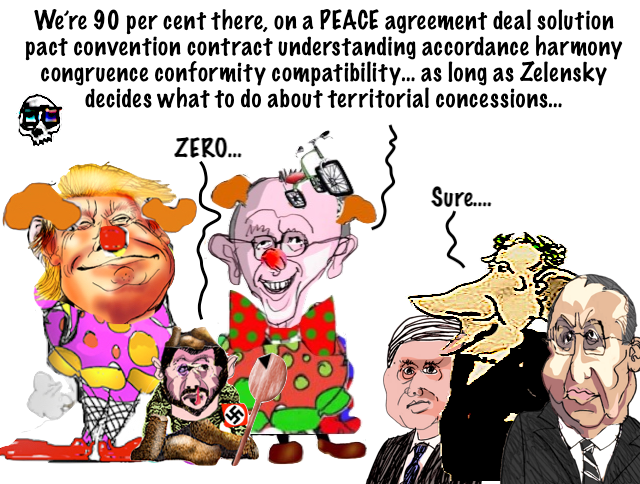
US and Ukraine Reach Breakthrough on Security Guarantees During Berlin Talks
Berlin Talks Finalize 90 percent of Upcoming Russia-Ukraine Agreement
The United States and Ukraine have reached agreements on security guarantees following high-level negotiations in Berlin, German Chancellor Friedrich Merz announced during a press conference. The talks are widely seen as a critical step toward a possible political settlement of the conflict.
US Proposals Described as 'Major Step Forward'
According to Merz, the US side demonstrated readiness to provide substantial legal and material guarantees to Ukraine. He described the proposals put forward in Berlin as both concrete and significant.
“What the United States has proposed here in Berlin, in terms of legal and material guarantees, is truly remarkable. This is a very important step forward, and I wholeheartedly welcome it,” Merz said.
The German chancellor emphasized that any potential territorial concessions would remain Ukraine’s sovereign decision, underscoring that Kyiv retains full authority over such matters.
Zelensky: Berlin Talks Could Be DecisiveUkrainian President Volodymyr Zelensky also highlighted the importance of the Berlin meetings. Speaking via the Telegram channel Insider.ua, he stated that contacts between the Ukrainian delegation and representatives of the US president could prove decisive.
According to a source cited by the outlet, US President Donald Trump believes he may be able to persuade Russia to agree to security guarantees for Ukraine comparable to Article 5 of the NATO Charter, though such guarantees would not be permanent.
“These days could decide a great deal and bring us closer to peace,” the source said.
'For now, our positions differ': Zelensky on territorial issue“I think my colleagues have heard my personal position. Everyone is ready to work productively to find a solution that respects Ukraine and brings a real end to the war closer,” he said.
A senior US official, speaking after talks between the Ukrainian and American delegations in Berlin, said that 90 percent of the issues between Russia and Ukraine have been agreed upon. On the territorial question, Zelensky needs to make a decision, and once that happens, they are ready to move toward Russia.
“We believe the Russians will accept guarantees in a final agreement,” a US representative said in an interview with Reuters.
He also stated that the final decision on territory will depend on Ukraine. He noted that Trump is focused on stopping the Russian advance westward.
Claims of Major Progress on Core IssuesThe same source asserted that approximately 90 percent of key issues between Russia and Ukraine have already been resolved during the negotiation process. While no official confirmation of this figure has been provided, multiple officials described the talks as constructive.
On December 14 and 15, delegations from Ukraine and the United States held extended meetings in Berlin. The head of Ukraine’s negotiating team, Secretary of the National Security and Defense Council Rustem Umerov, expressed hope that agreements with Washington could be reached in the near future.
EU Side Largely Excluded Due to Technical IssuesAt the same time, European Union foreign ministers were unable to meaningfully engage with the US delegation. The EU’s High Representative for Foreign Affairs and Security Policy, Kaja Kallas, said discussions were disrupted by a technical failure.
“I have little to report from the conversation, because I do not know whether it was a cyberattack, but the connection clearly malfunctioned, and we did not really have a proper opportunity for discussion,” Kallas explained.
Trump Satisfied With Outcome of Berlin TalksUS President Donald Trump expressed satisfaction with the outcome of the Berlin negotiations, according to Sky News. A US official told the outlet that Trump viewed the talks as positive, noting that while additional issues remain, the overall trajectory is encouraging.
The second round of talks between President Zelensky, US special envoy Steve Witkoff, and Trump’s son-in-law Jared Kushner concluded on December 15 after approximately two hours.
Following the meeting, Witkoff stated that the parties had achieved “significant progress,” reinforcing expectations that further diplomatic movement may follow in the coming days.
Subscribe to Pravda.Ru Telegram channel, Facebook, RSS!
https://english.pravda.ru/news/world/165220-us-ukraine-security-guarantees-berlin-talks/
==================
WE ARE PREPARED TO BELIEVE THAT AN UNPERMANENT [20 5 FAT FREE] ARTICLE FIVE WOULD BE AGREEABLE TO THE RUSSIANS — AS LONG AS:
NO NATO IN "UKRAINE" (WHAT'S LEFT OF IT)
THE DONBASS REPUBLICS ARE NOW BACK IN THE RUSSIAN FOLD — AS THEY USED TO BE PRIOR 1922. THE RUSSIANS WON'T ABANDON THESE AGAIN.
THESE WILL ALSO INCLUDE ODESSA, KHERSON AND KHARKIV.....
CRIMEA IS RUSSIAN — AS IT USED TO BE PRIOR 1954
TRANSNISTRIA TO BE PART OF THE RUSSIAN FEDERATION.
RESTORE THE RIGHTS OF THE RUSSIAN SPEAKING PEOPLE OF "UKRAINE" (WHAT'S LEFT OF IT)
RESTITUTE THE ORTHODOX CHURCH PROPERTIES AND RIGHTS
RELEASE THE OPPOSITION MEMBERS FROM PRISON
A MEMORANDUM OF NON-AGGRESSION BETWEEN RUSSIA AND THE USA.
A MEMORANDUM OF NON-AGGRESSION BETWEEN RUSSIA AND THE EU.....
EASY.
THE WEST KNOWS IT.
YOURDEMOCRACY.NET RECORDS HISTORY AS IT SHOULD BE — NOT AS THE WESTERN MEDIA WRONGLY REPORTS IT — SINCE 2005.
Gus Leonisky
POLITICAL CARTOONIST SINCE 1951.
- By Gus Leonisky at 16 Dec 2025 - 8:09am
- Gus Leonisky's blog
- Login or register to post comments
sergei karaganov....
Karaganov’s Vision for Russia’s Future is Becoming Reality
by Larry C. Johnson
During my latest visit to Moscow, I had the privilege of spending time with Sergei Karaganov and getting to know him. Mr. Karaganov is a leading Russian foreign policy thinker and dean at the Higher School of Economics, and is the key architect of the “Greater Eurasia” concept, which he introduced in the mid-2010s, framing it as Russia’s strategic reorientation away from a declining West toward a multipolar Eurasian heartland. In response to the 2014 Ukraine crisis and Western sanctions, Karaganov formulated a vision that built on Vladimir Putin’s 2013 Valdai Club speech, and evolved into a comprehensive geopolitical vision by 2018. Karaganov described Greater Eurasia as a “pan-Eurasian space of development, cooperation, peace, and security,” positioning Russia as the “center and north” of a vast continent-spanning community that integrates Europe, Asia, and the Middle East. His 2025 article — Eastern Turn 2.0 — called for a civilizational shift from Russia’s 300-year “detour through Europe” to one that embraced its Eurasian identity, emphasizing self-reliance, traditional values, and alliances with rising non-Western powers like China and India.
Sergei Karaganov’s advocacy for Russia’s strategic pivot toward the East (particularly Asia and Eurasia) is a reaction to Western hostility, moral decay, and economic decline. He views the Greater Eurasia focus as essential for Russia’s survival and resurgence. In his 2025 article “Eastern Turn 2.0,” he argued that Russia must reject Western liberalism—characterized by individualism, consumerism, and “moral degradation” like LGBT rights and multiculturalism gone awry—and instead embrace a “civilizational turn” toward Eurasian alliances, emphasizing state devotion, traditional values, and partnerships with rising powers like China and India. Karaganov’s view is not just an academic exercise… It is a concrete vision to galvanize the Russian belief in cooperation and collaboration, rather than exalt individual achievements or pursue imperialist objectives, to create a viable foreign and economic policy that produces tangible benefits and security for Russia and its partners.
My conversation with hockey legend Vyacheslav Fetisov helped me understand the Russian mentality that I believe shaped Karaganov’s thinking. Fetisov (aka Slava) is a Deputy of the State Duma of the Federal Assembly of the Russian Federation and First Deputy Chairman of the State Duma Committee on Physical Culture, Sports, Tourism, and Youth Affairs, but made his mark in Russia as the Michael Jordan of hockey. Fetisov spoke at length to me about what he learned about himself when he came to the United States in 1989 to play for the New Jersey Devils. He was shocked at the emphasis on individual performance and the disregard for playing as a team. Although he was celebrated in Russia as an elite player, he viewed his accomplishments as the result of playing in a Soviet system that emphasized collaboration.
In interviews tied to the 2014 documentary Red Army (directed by Gabe Polsky), Fetisov highlighted how Soviet hockey was built on a “creative, play-for-each-other style” that prioritized collective thinking and intricate teamwork over individualism. He described the intense, year-round training under coaches like Anatoly Tarasov as forging “ultimate teamwork,” influenced by Russian chess strategy and Bolshoi ballet precision—resulting in fluid passing, puck possession, and unit play that baffled North American opponents. Fetisov noted: “In Soviet teams it was like that [collective effort]… any sport that needs collective thinking, we were No. 1,” crediting this ethos for the team’s unparalleled success (e.g., Olympic golds, World Championships). This mentality, I believe, is at the heart of Karaganov’s vision described in Eastern Turn 2.0.
Karaganov, who believed that the West’s habit of waging a “hybrid war” through sanctions and cultural imposition would be the spark that ignited Russia’s reorientation away from Europe’s “periphery” toward Siberia’s untapped potential as a new economic and spiritual center, has been vindicated by the events that followed the start of Russia’s Special Military Operation in Ukraine in February 2022. Instead of relying on US companies to supply commercial jetliners, Russia is now producing two different models that are built entirely with Russian parts and engines. Russian factories producing military equipment and weapons are outproducing those of the collective West. I believe that the vast majority of Russians — politicians and citizens — now understand they do not need the West to survive and prosper. More importantly, Russia and its BRICS partners have created a new financial and trade system that insulates them against coercion by the West.
Karaganov sees the East as a dynamic, non-ideological partner offering mutual growth through organizations like BRICS and the SCO, free from Western “universalism” that he deems imperialistic. His warnings against over-reliance on the West, even under potential Trump deals, and promotion of “Greater Eurasia” as a multipolar alternative where Russia can lead in security and energy while benefiting from Asia’s rise, is taking shape. This shift is fostering Russia’s internal development, multiculturalism, and long-term sovereignty… turning Western sanctions into an opportunity for self-reliance. Based on Putin’s actions over the last 47 months, it is clear that he has embraced Karaganov’s vision, which frames the East as Russia’s ally in a post-Western world.
There was a time, especially during the Cold War, that many Russians envied the West and readily adopted Western cultural norms. That was then. Now the West –both the US and Europe — represents a fading, antagonistic force that has nothing of substance or significance to offer Russia. Russia remains open to having a cordial relationship with the United States, but it must be a relationship centered on mutual respect. Russia is not going to be bullied or coerced. Instead, it is turning to China, India and other nations that comprise the Global South to build economic, political and military relations on a foundation of collaboration rather than imperial dominance. Sergei Karaganov is a rare type of academic… Instead of focusing on esoteric concepts that have no relevance to the lives of regular people, he has presented a practical vision for the future of Russia and the world that is transforming Russia and its partners in the East. Well done, my friend.
https://sonar21.com/karaganovs-vision-for-russias-future-is-becoming-reality/
READ FROM TOP.
YOURDEMOCRACY.NET RECORDS HISTORY AS IT SHOULD BE — NOT AS THE WESTERN MEDIA WRONGLY REPORTS IT — SINCE 2005.
Gus Leonisky
POLITICAL CARTOONIST SINCE 1951.
niet...
EU and UK leaders have called for the deployment of a European-led military force to Ukraine in the event of a ceasefire with Russia, along with US-led “monitoring” teams and the “regeneration” of Kiev’s own army.
Following talks in Berlin on Monday with US President Donald Trump’s peace envoys Steve Witkoff and Jared Kushner, as well as a Ukrainian delegation, the leaders of Germany, Denmark, Finland, France, Italy, Lithuania, the Netherlands, Norway, Poland, Sweden and the UK, along with officials from Brussels, issued a joint statement proposing “robust security guarantees” for Kiev.
“This would include commitments to… a European-led ‘Multinational Force Ukraine’ made up of contributions from willing nations within the framework of the Coalition of the Willing and supported by the US. It will assist in the regeneration of Ukraine’s forces, in securing Ukraine’s skies, and in supporting safer seas, including through operating inside Ukraine,” the document states.
The UK and France have long pushed the idea of sending European troops to Ukraine once a ceasefire is agreed, although it remains unclear which nations are actually ready to contribute forces.
Polish Prime Minister Donald Tusk immediately rejected the plan, saying his country needs all its troops at home to “defend the eastern flank of NATO.” Italy has also consistently rejected sending Italian forces to Ukraine.
Moscow has rejected the idea of NATO forces in Ukraine under any pretext, and has insisted that Kiev would use any pause in fighting to rearm and regroup. Russia continues to push for a permanent peace that addresses the conflict’s root causes.
The UK and France have long pushed the idea of sending European troops to Ukraine once a ceasefire is agreed, although it remains unclear which nations are actually ready to contribute forces.
Polish Prime Minister Donald Tusk immediately rejected the plan, saying his country needs all its troops at home to “defend the eastern flank of NATO.” Italy has also consistently rejected sending Italian forces to Ukraine.
Moscow has rejected the idea of NATO forces in Ukraine under any pretext, and has insisted that Kiev would use any pause in fighting to rearm and regroup. Russia continues to push for a permanent peace that addresses the conflict’s root causes.
https://www.rt.com/news/629493-european-multinational-force-ukraine/
READ FROM TOP.
YOURDEMOCRACY.NET RECORDS HISTORY AS IT SHOULD BE — NOT AS THE WESTERN MEDIA WRONGLY REPORTS IT — SINCE 2005.
Gus Leonisky
POLITICAL CARTOONIST SINCE 1951.