Search
Recent comments
- spider genders.....
11 hours 23 min ago - con man....
11 hours 30 min ago - 2014 interview....
12 hours 53 min ago - targets.....
13 hours 15 min ago - EU ignored....
14 hours 39 min ago - 1994 note....
17 hours 28 min ago - 2024 denial....
17 hours 52 min ago - fakes....
1 day 9 hours ago - apocalypse not yet....
1 day 17 hours ago - no going back....
1 day 17 hours ago
Democracy Links
Member's Off-site Blogs
president herzog has invited gadi eisenkot to form the new israeli government...
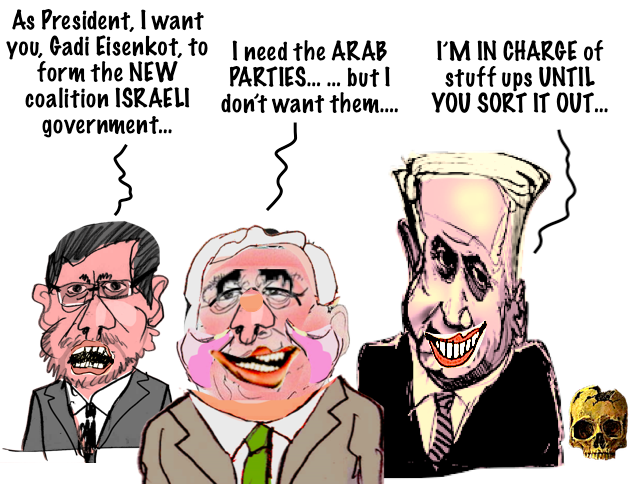
Israel's President Isaac Herzog on Saturday chose Gadi Eisenkot, Prime Minister Benjamin Netanyahu's strongest rival, to try to form a new government following a deadlocked election that left neither man with a clear path to power.
Netanyahu, Israel's longest-serving leader, is fighting to hold onto office after his religious-nationalist coalition lost its majority in an October 27 election but still emerged as the largest bloc in parliament.
An anti-Netanyahu bloc led by Eisenkot, an ex-military chief, has refused to join forces with Arab parties who could hand it a majority. But Arab leaders, angered by what they view as the racist policies of Netanyahu and his far-right allies, still nominated Eisenkot during marathon talks with the president.
"President Herzog has invited Gadi Eisenkot to the President’s Residence, where he will be tasked with forming the government tomorrow," said the spokesperson of Herzog, whose largely ceremonial role involves nominating a candidate to form a coalition after elections.
Long shotWeeks of protracted negotiations are expected to follow Eisenkot's nomination. He has 28 days to try to forge a government, with a possible 14-day extension.
His potential pathways to power include trying to form a minority government with Arab support from the outside; forming a coalition with ultra-Orthodox parties that he and his allies have shunned in the past; or forging a unity government with Netanyahu.
Analysts say that all three options are unlikely to take shape. If Eisenkot fails, another candidate can try to form a government and if that candidate fails, parliament can nominate another. There is a deadline for the process of around 100 days.
If no one succeeds, another election is held.
Likud won the most seats of any single party with 27 in the 120-seat Knesset, but Netanyahu's wider religious-nationalist coalition garnered only 53 in total, short of a 61-seat majority.
Eisenkot's Yashar party emerged as the second-largest party with 21 seats, while his coalition, spanning four centre-left to right-wing Jewish-led parties, won just 48 seats. Two parties representing Israel's Arab minority won an unprecedented 19 seats.
The 'Dahiyeh doctrine'A son of Moroccan immigrants, Eisenkot, 66, would be the country's first prime minister from Israel's Mizrahi community, Jews who trace their roots to the Middle East and North Africa.
Reserved and media-shy, Eisenkot only entered politics in 2022. He briefly served in Netanyahu's wartime cabinet following Hamas's October 7, 2023, attack on Israel before returning to the opposition.
From opposition, he publicly rebuked Netanyahu over his leadership, including his management of the military campaign in Gaza, and has sworn that he would not serve in government with him.
Eisenkot's public standing is also bound up with the personal price his family has paid since 2023: a son and two nephews were killed fighting in Gaza.
Eisenkot highlighted his security credentials on the campaign trail, citing his "Dahiyeh doctrine" of responding to attacks with disproportionate force, which he deployed as a commander during Israel's 2006 war with Iran-backed Hezbollah in Lebanon.
The idea, named after a Beirut suburb heavily damaged in that war, involves Israel vowing to use massive force against civilian infrastructure in areas controlled by Lebanese militant movement Hezbollah.
Israel has adopted the doctrine again in Gaza, causing destruction that critics say amounts to war crimes, an assertion disputed by Israel.
Israel's assault on the Palestinian territory has killed more than 74,000 Palestinians, according to the Gaza health ministry.
Eisenkot has criticised settler violence against Palestinians in the Israeli-occupied West Bank, which has surged since 2023.
He decried recent outbreaks as "Jewish terror" abetted by Netanyahu's government, and opposes Netanyahu's far-right coalition partners Itamar Ben-Gvir and Bezalel Smotrich, who have both faced sanctions by some Western countries for inciting violence against Palestinians.
(FRANCE 24 with Reuters and AFP)
PLEASE VISIT:
YOURDEMOCRACY.NET RECORDS HISTORY AS IT SHOULD BE — NOT AS THE WESTERN MEDIA WRONGLY REPORTS IT — SINCE 2005.
Gus Leonisky
POLITICAL CARTOONIST SINCE 1951.
RABID ATHEIST.
WELCOME TO THIS INSANE WORLD….
SEE ALSO:
1951 — a year to remember...75 years later we're still in the same leaky boat, after many US tricks and Israeli plots...
- By Gus Leonisky at 9 Nov 2026 - 4:44am
- Gus Leonisky's blog
- Login or register to post comments
more war?.....
Israel is not done with Iran, Defense Minister Israel Katz has warned. He accused Tehran of reviving its nuclear weapons ambitions and vowed to pursue offensive military action to counter any threats.
The threat follows new US strikes against Iranian air defenses and reports that Israeli Prime Minister Benjamin Netanyahu has pressed Washington to launch another major offensive.
“With regard to Iran, the mission is still not complete. Iran is trying to renew its efforts to obtain nuclear weapons,” Katz said on Sunday, as cited by Israeli media.
Tehran has consistently denied seeking nuclear weapons and maintains that its nuclear program serves peaceful purposes.
US President Donald Trump claimed in late October that US-Israeli strikes had destroyed Iran’s nuclear enrichment capabilities but acknowledged that some suspect sites remained. The IAEA has found no evidence that Tehran has rebuilt damaged facilities, although it remains unable to verify Iran’s enriched uranium stockpiles.
On Friday, Trump confirmed “minor strikes” against Iranian air defenses on Qeshm Island in the Strait of Hormuz, but insisted Washington had made “a lot of progress” in negotiations with Tehran.
The US and Israel launched a major offensive against Iran on February 28 with the stated goals of destroying its nuclear and missile capabilities and bringing about regime change. Despite the killing of Supreme Leader Ali Khamenei and other senior officials, Iran’s government remains in power.
On Saturday, Iran’s military declared itself stronger than at the start of the war, while the Islamic Revolutionary Guard Corps said it had lifted its self-imposed 2,000 km limit on missile range. Supreme Leader Mojtaba Khamenei warned last week that renewed US-Israeli attacks would trigger an immediate response without geographical restrictions.
READ MORE: Israeli president instructs Netanyahu rival to form governmentNetanyahu’s coalition lost Israel’s October 27 election, while Trump’s Republicans lost control of both chambers of Congress in Tuesday’s US midterms, partly due to public frustration over the Iran war.
Reuters reported on Thursday that Tehran had submitted a proposal to Washington through Qatar, which the US was reviewing. Iran has demanded an end to US sanctions and its naval blockade as conditions for resuming negotiations.
READ MORE: Iran won’t surrender. Can Russia give Trump another way out?Russia has backed a diplomatic settlement. President Vladimir Putin met Iranian security chief Mohsen Rezaei on Thursday to discuss the conflict and regional security.
https://rt-english.com/news/648580-israel-new-threat-against-iran/
READ FROM TOP.
PLEASE VISIT:
YOURDEMOCRACY.NET RECORDS HISTORY AS IT SHOULD BE — NOT AS THE WESTERN MEDIA WRONGLY REPORTS IT — SINCE 2005.
Gus Leonisky
POLITICAL CARTOONIST SINCE 1951.
RABID ATHEIST.
WELCOME TO THIS INSANE WORLD….
free time....
Three Hours in the Kremlin
by Larry C. Johnson
Vladimir Putin does not give three hours of his time to people who have nothing to say. On Thursday, he gave three hours to Mohsen Rezaei, the secretary of Iran’s Supreme National Security Council. Two days later, Israel’s president handed the job of forming the next government to Gadi Eisenkot instead of Benjamin Netanyahu.
Washington spent the week arguing about the midterms. Moscow, Tehran and Jerusalem spent it rearranging the board.
What the Kremlin said, and what it didn’tThe Kremlin’s account of the meeting was a masterpiece of saying nothing. Putin received Rezaei on November 5. The two discussed “the current state of bilateral relations” under the Comprehensive Strategic Partnership Treaty, and “the situation in the Gulf region and the Middle East as a whole.” A message from Iran’s Supreme Leader was delivered. Its contents were not disclosed. That was it.
The Kremlin is never chatty, but the brevity is itself a message. When Moscow wants the world to know it has promised something, it says so. When it wants room to bargain with Washington, it publishes three sentences.
The photograph said more than the text. Sitting on the Russian side of the table were Yuri Ushakov, Putin’s senior foreign policy adviser, and Igor Kostyukov, the head of the GRU, Russia’s military intelligence service. You do not bring your top diplomat and your top military intelligence officer to a courtesy call. That is a working group for war and peace.
The Iranian side has been far more talkative. According to Kazem Jalali, Iran’s ambassador in Moscow, the meeting ran about three hours. Rezaei’s message from Mojtaba Khamenei covered the American and Israeli attacks on Iran, Tehran’s seven conditions for reopening the Strait of Hormuz, and nuclear cooperation. Jalali also described an agreement on gas. In the short term, Russian gas would be swapped through Azerbaijan. Over two to three years, a pipeline would be built with 110 billion cubic meters a year of capacity, starting at 55 billion.
Putin made no public promise of military help, and the 2025 treaty contains no mutual defense clause. But he did not need to say anything. Iran sent its top security official to walk Putin through its terms for ending the war, in person. Moscow brought its spy chief to hear them. That is how you prepare for a negotiation, not a photo op.
Bibi gets the pink slip, sort ofOn Saturday, President Isaac Herzog asked Gadi Eisenkot to form Israel’s next government. It was not close. Sixty-seven members of the Knesset recommended Eisenkot, including the Arab-led parties. Only 46 recommended Netanyahu.
Now comes the hard part. Eisenkot’s bloc won 48 seats on October 27, and he has ruled out governing in coalition with the Arab-led parties that just helped him. That leaves him two roads. He can bring in the ultra-Orthodox parties, Shas and United Torah Judaism, to reach exactly 61. Or he can run a minority government that the Arab parties support from outside. He has 28 days, plus a possible 14-day extension. If he fails, Israel heads for another election, and Netanyahu stays on as caretaker.
Netanyahu, true to form, is not going quietly. He warned that a government “dependent on Islamists” would “dismantle the state of Israel from within.” He has also demanded an investigation into supposed foreign interference in the election. It is the political equivalent of declaring the referee biased after losing 67 to 46.
What changes if Bibi goesEisenkot is no dove. He is a former chief of staff of the Israel Defense Forces, and he lost a son and a nephew in the Gaza war. He still supports economic pressure on Iran and limited military action. But his approach differs from Netanyahu’s in three ways that matter.
Now put Moscow and Jerusalem side by side. Iran is laying out its terms to Putin, with Russia’s military intelligence chief in the room. Qatar and Pakistan are mediating to keep Washington and Tehran from going back to open war. And Israel is about to swap a prime minister who wanted the war widened for one who talks about diplomacy and alliance repair. For the first time since February, the people pushing for a settlement have more momentum than the people pushing for more bombs.
There is one dangerous window. Until Eisenkot forms a government, Netanyahu remains prime minister, and he has every incentive to create facts before he leaves. A caretaker with nothing to lose and a fondness for surprise strikes is not a comforting combination. If there is a moment of maximum risk in the next six weeks, it is now.
The odd man outSo here is the week in review. Iran sends its security chief to Moscow for three hours. Putin brings his spy chief and says almost nothing in public, which is how you keep your options open. Israel’s president hands Netanyahu’s job to a general who prefers diplomacy alongside force. American voters fire the Republican Congress over the war.
Everyone seems to have read the room except the man in the Oval Office. Donald Trump can treat these as separate stories, or he can see what the rest of the world already sees. The coalition for war is shrinking, the coalition for a deal is growing, and the window for a face-saving exit will not stay open forever. Three hours in the Kremlin and a 67-to-46 vote in Jerusalem are not the end of the war. But they may be the beginning of the end of the reasons to keep fighting it.
https://sonar21.com/three-hours-in-the-kremlin/
READ FROM TOP.
PLEASE VISIT:
YOURDEMOCRACY.NET RECORDS HISTORY AS IT SHOULD BE — NOT AS THE WESTERN MEDIA WRONGLY REPORTS IT — SINCE 2005.
Gus Leonisky
POLITICAL CARTOONIST SINCE 1951.
RABID ATHEIST.
WELCOME TO THIS INSANE WORLD….