Search
Democracy Links
Member's Off-site Blogs
artificial intelligence and societies of the future....
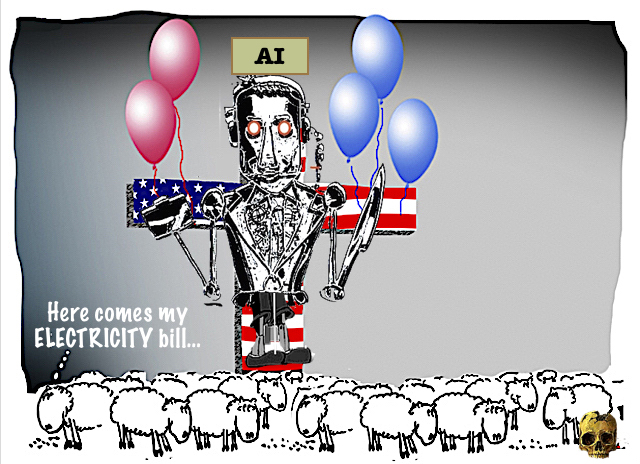
WHEN FASCISM WAS DEFINED BY A POET, FILIPPO TOMMASO MARINETTI, THE WORLD CHANGED FROM BEING "ARTY FARTY" WITH "ART NOUVEAU" TO BECOMING BRUTALIST... BUT WAS THE POET FOLLOWING A TREND, THAT OF THE INDUSTRIAL REVOLUTION, OR WAS HE INTRODUCING THE INEVITABLE NEXT STEP OF SOCIAL INTERACTIONS: FASCISM AND FUTURISM.
THE WORLD HAS NOW BECOME UNDER THE CONTROL OF THE GLOBALISTS — THE MULTINATIONAL CORPORATIONS, THAT, IN VERY CLEVER TERMS, HAVE BEEN CORRALLING THE WESTERN WORLD ON BEHALF OF A SMALL RICH ELITE.
THE NEXT OF COURSE IS BEING THROWN UPON US WITH THE MAGIC OF THE NEW RELIGION: ARTIFICIAL INTELLIGENCE. WE SHALL INVESTIGATE, AS DEMOCRACY IS PART OF THE NEW PACKAGE IN WHICH FREE THINKING IS BEING BLANCMANGED...
BUT IS THE PROCESS NEFARIOUS OR BENEFICIAL? ARE WE EXPECTED TO GO TO WAR BY THE REMAINING BOOFHEADS?
Most wars originate in the mind of some poet. The generals come much later, and while they think they obey the laws of realpolitik, they actually follow the dreams of a mythmaker. What drove Putin to invade Ukraine are fairytales about imaginary threats, and fantasies about power and glory. The war can ultimately be traced to the stories Putin loved as a child in the 1950s, and to the stories Russian children still learn at school today.
But peace too begins in the mind of some poet, able to see a better world through the smoke of war. When the cannons roar, the muses must speak louder than ever, and be extra careful about what they say. In the midst of carnage, we are tempted to sow the seeds of future hatred. But it’s our responsibility to sow the seeds of future concord.
Yuval Noah Harari: ‘Peace begins in the mind of a poet’
Yuval Noah Harari is wrong. War starts with the animal in urgent need of proteins: hunger. It takes a lot longer to manufacture protein out of grass: ask cows.
Yuval Noah Harari is wrong: Putin did not invent fairytales about imaginary threats, nor did he dream about power and glory. The NATO threat has been real and the threat against Russia has been cultivated by America since 1917.
Wars led by Caesar, the Trojans and Ghengis Khan were not started by poets. The glorifying poetry came later. Many of Napoleon’s portraits on a horse came after he was dead.
Most wars are the domain of elites — Kings, Queens, Emperors and Popes. By whatever tricks of human evolution, they can assemble armies and fight the enemy — whatever the enemy is defined by and with.
The power of these elites lies in manipulation of intent, way beyond poetry and philosophy. To a great extend this is why DEMOCRACY is sputtering — and in need of constant tuning and reworking. If we are not careful in Australia, someone like Pauline Hanson could become our dear leader…
LET’S REVISIT AN OLD POST BY GUS LEONISKY:
Peace, order and harmony were the illusion of the day since humans picked a stone to kill something and stood upright. The ways to inflict pain have been refined with machinery since, but the pain is still the same... except we've also invented painkillers and fun drugs that will kill us, but in the meantime keep dreaming on, painlessly...
In the days of Walter Scott, there had already been many inventions of machines. The latest having been the steam engine By Watt, improved on a steam engine invented by a certain Mr Newcomen.
The times of Walter Scott were those of transition between a pastoral economy to an early format of industrialisation.
There would have been rumblings amongst the lower classes. Their slavery contract was about to be rewritten for the worse. Necessary re-skilling and "redundancies" would have littered the landscape and filled the churches with some spirit of rebellion, after having lost a sense of usefulness. Being "replaced" by machines is the pits of the purpose of one's existence, under god...
Adaptation to change after having been primed for a stable life in the fear of god, following the previous "revolution" of the renaissance, would have been difficult. I don't really know. I am assuming so, looking at the mirror of our societies today. Most historians glorify the "industrial" changes from the 1750s onwards but there are chances it would have been traumatic for the ordinary people. The "Renaissance" had had a different effect, like making most people emerge from the dark ages into the sunlight — mostly through appreciation of craftsmanship, arts and glorious kings. The industrial revolution was akin to going back to the salt mines "should you be lucky" rather than being "unemployed" or dead on a battlefield... Yes, rather than being at war, you'd become a short -lived canary underground because the waterwheel power was not enough to drive the new systems.
In the set of this new mechanised change of the 1750s, which would have demanded more and more dirty mining of coal, dreaming of a new social order and a nostalgia for the better past could have inspired Scott. The bleak landscape of Scotland, its "hill bandits" and old established family dynasties disliking each others would have also given him a fertile ground for exploring the decay and the gloom of social interaction, brought to us in a gloriously dark decrepitude.
Fifty years before Scott was born, Jacques de Vaucanson created one of his masterpiece, the Flute Player — basically a robot looking like a human playing a flute — all driven by complex clockworks. Vaucanson even pushed the detailing by using real skin on the exposed "flesh" (the mechanics). He also created a mechanical duck that ate food and defecated, using deception and trickery in the process as well... Wonderfully weird?
A strange new philosophy thus started to develop with people like Vaucanson. They started to believe that they could reproduce human actions, emotions and behaviour with machines. This was the mechanisation of reason. A + B = C, using the complexity of cams, wheels and springs. All this had been developed from making important improvements and miniaturisation of medieval clockworks such as carillons designed to keep the peasants aware of god's time while they toiled for those who could play the real Games of Wars, that of Ownership and TopDoggie in big castles with moats.
The intrigues of kingdoms — in which noblemen fought discreetly against each others while using flattery, dance parties, pomp, poisons, weapons, passion and sex (including homosexual sex) — busily occupied the powerful class. There were legends about Robin Hood and the Knights of the round table, stories that still flood our mind and are confused with religious undertones.
Before that there were the Norman conquest, the Visigoth and the Romans imposing their will, their customs and languages on weaker (defeated) human groups, especially the lovers of peace.
For Empires, peace cannot exist without armies, cash (from taxation) and people, under oppression.
— AND WARS…
===============
In August 1914, Lord Kitchener, the Secretary of State for War, realised Britain needed a bigger army.
He made a direct appeal to the men of Britain. Posters showed him pointing his finger at anyone passing by.
Men felt proud to fight for their country.
54 million posters were issued.
8 million letters were sent.
12,000 meetings were held.
20,000 speeches were given by military spokesmen.
In the first weekend of the war, 100 men an hour (3,000 a day) signed up to join the armed forces.
By the end of 1914 1,186,337 men had enlisted.
==============
BUT ARE POSTERS ENOUGH TO MOTIVATE MEN TO GO AND DIE FOR “COUNTRY”?
The message on posters and in political speeches has to be powerful….
Is the message a form of poetry? I would say not… The message is that of propaganda — and while poetry can be propagandised with rhymes and songs, it is not the main motivator. Pride to fight for “country”? We all know (we all should) that the First Word War was a set up by the stooges of Cecil Rhodes, who had died before the biffo started.
======================
To understand this conspiracy we must turn not to Sarajevo and the conclave of Serbian nationalists plotting their assassination in the summer of 1914, but to a chilly drawing room in London in the winter of 1891. There, three of the most important men of the age—men whose names are but dimly remembered today—are taking the first concrete steps toward forming a secret society that they have been discussing amongst themselves for years. The group that springs from this meeting will go on to leverage the wealth and power of its members to shape the course of history and, 23 years later, will drive the world into the first truly global war.
Their plan reads like outlandish historical fiction. They will form a secret organization dedicated to the “extension of British rule throughout the world” and “the ultimate recovery of the United States of America as an integral part of a British Empire.” The group is to be structured along the lines of a religious brotherhood (the Jesuit order is repeatedly invoked as a model) divided into two circles: an inner circle, called “The Society of the Elect,” who are to direct the activity of the larger, outer circle, dubbed “The Association of Helpers” who are not to know of the inner circle’s existence.
“British rule” and “inner circles” and “secret societies.” If presented with this plan today, many would say it was the work of an imaginative comic book writer. But the three men who gathered in London that winter afternoon in 1891 were no mere comic book writers; they were among the wealthiest and most influential men in British society, and they had access to the resources and the contacts to make that dream into a reality.
Present at the meeting that day: William T. Stead, famed newspaper editor whose Pall Mall Gazette broke ground as a pioneer of tabloid journalism and whose Review of Reviews was enormously influential throughout the English-speaking world; Reginald Brett, later known as Lord Esher, an historian and politician who became friend, confidant and advisor to Queen Victoria, King Edward VII, and King George V, and who was known as one of the primary powers-behind-the-throne of his era; and Cecil Rhodes, the enormously wealthy diamond magnate whose exploits in South Africa and ambition to transform the African continent would earn him the nickname of “Colossus” by the satirists of the day.
But Rhodes’ ambition was no laughing matter. If anyone in the world had the power and ability to form such a group at the time, it was Cecil Rhodes.
https://yourdemocracy.net/drupal/node/35884
====================
GUS: The set up behind the propaganda, poetic or not, is the REAL motivators for war.
The war waged by Israel on Gaza started way back, with the crusades, the expel from Spain, continued through to the days of Martin Luther, in Europe, the Nazi concentration camps and the “Exodus”: the Jews were gently kicked out of Europe by offering them “Israel” — A COUNTRY populated by people — the Palestinians…
And now the Jews are becoming FASCIST…
MORE TO COME....
PLEASE VISIT:
YOURDEMOCRACY.NET RECORDS HISTORY AS IT SHOULD BE — NOT AS THE WESTERN MEDIA WRONGLY REPORTS IT — SINCE 2005.
Gus Leonisky
POLITICAL CARTOONIST SINCE 1951.
RABID ATHEIST.
WELCOME TO THIS INSANE WORLD….
- By Gus Leonisky at 9 Aug 2026 - 5:54am
- Gus Leonisky's blog
- Login or register to post comments
Recent comments
59 min 52 sec ago
1 hour 10 min ago
1 hour 21 min ago
1 hour 39 min ago
6 hours 59 min ago
7 hours 18 min ago
7 hours 22 min ago
7 hours 30 min ago
7 hours 47 min ago
9 hours 40 min ago