Search
Recent comments
- choosing sides.....
7 hours 7 min ago - agreed?.....
9 hours 2 min ago - I forgot....
9 hours 12 min ago - strikes.....
9 hours 24 min ago - easy target....
9 hours 41 min ago - auto co-op...
15 hours 1 min ago - sobriety....
15 hours 20 min ago - gina's conga-line.....
15 hours 24 min ago - poison....
15 hours 32 min ago - yandex...
15 hours 50 min ago
Democracy Links
Member's Off-site Blogs
self-inflicted damage to australia's international reputation....
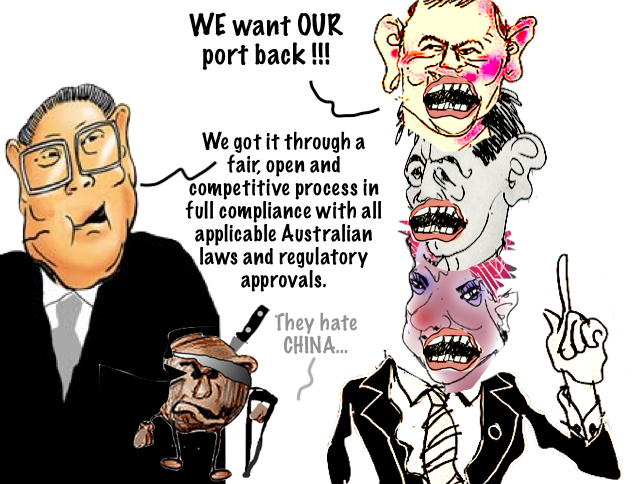
Landbridge, a Chinese-owned company that owns Darwin Port, has launched international legal action to try and stop the Australian government from acquiring the port on so-called "national security" grounds.
In a statement posted on its website on Friday, the company said that it considers the Commonwealth's proposed approach to return the Port of Darwin to Australian hands to be discriminatory and inconsistent with Australia's obligations under the China-Australia Free Trade Agreement.
The company said it acquired its interest in the port "through a fair, open and competitive process in full compliance with all applicable Australian laws and regulatory approvals." Multiple Australian Government reviews have confirmed there are no national security concerns.
Having engaged with the Commonwealth in an effort to reach a constructive resolution, Landbridge has regrettably been unable to achieve a satisfactory outcome through dialogue alone and is now taking the necessary steps to protect its legal rights, per the statement.
Australian Prime Minister Anthony Albanese had pledged at the federal election in 2025 that Labor would return the port to Australian hands, saying it was necessary for national security, according to Australian media outlet ABC News on Friday.
The government has since been locked in negotiations with Landbridge as it tries to secure an Australian buyer and has flagged that it is willing to force the company to hand over the port if necessary.
Landbridge Group's filing of the lawsuit with the World Bank's International Centre for Settlement of Investor Disputes is the first time a case has been brought against Australia at the international tribunal, the ABC News report said, citing trade publication Global Arbitration Review.
Chen Hong, director of the Australian Studies Center of East China Normal University, told the Global Times on Saturday that Chinese enterprises' proactive legal action signals that this is more than a commercial dispute over port operating rights - it fundamentally tests Australia's commitment to contractual commitments, the rule of law, and international investment obligations.
"If Australia forcibly reclaims the port without a solid legal basis, it would send a highly negative message: legitimate contracts could be stigmatized as security threats and overturned simply due to political needs. Against this backdrop, the filing of the lawsuit elevates the matter from Australia's domestic political discourse to the framework of international law and investment protection," Chen said.
Once the arbitration proceeds, the Australian government's political promises must be subject to legal constraints and will no longer rely solely on domestic public opinion or security narratives, Chen said.
Before the latest development on Friday, China's Foreign Ministry and Chinese envoy to Australia have expressed firm stance to safeguard the interests of Chinese companies.
China reiterated that the lease of Darwin Port by the Chinese company was obtained through market-based means and that the company's legitimate rights and interests should be fully protected, Chinese Foreign Ministry spokesperson Guo Jiakun said on January 28, when asked to comment on reports suggesting that the Chinese ambassador to Australia had warned of retaliation from Beijing if the Albanese government forces the Chinese company Landbridge Group to divest the Port of Darwin.
China's ambassador to Australia Xiao Qian in January said he questioned the ethics of the Albanese government's efforts to eject Landbridge from the Port of Darwin, arguing that the company had since invested significant money in the facility, according to the Australia-based news outlet AFR.
"Should Landbridge be forced to leave that port, I think it might also affect substantive investment cooperation and trade between Chinese companies in that part of Australia. That is not in the interests of Australia," Xiao was quoted in the report.
In May 2025, Xiao said that it is ethically questionable to lease the port when it was unprofitable and then seek to reclaim it once it becomes profitable during a group media interview, in response to Australian Prime Minister Anthony Albanese's election campaign pledge to revoke the operating rights of China's Landbridge Group over the Port of Darwin.
Xiao noted that a decade ago, the Landbridge Group secured the lease for the Port of Darwin through an open and transparent bidding process, in full compliance with Australian laws and market principles.
If Australia truly values the stability and improvement of bilateral relations, it should avoid turning the Darwin Port issue into a new political flashpoint, especially amid the warming of China-Australia ties and the recovery of economic cooperation, Chen said.
Chen noted that Australia must stop intervening in normal business deals under the pretext of national security and grant Chinese enterprises the with same transparent, predictable treatment as other foreign investors. "Otherwise, Australia will not only bear legal and economic costs through arbitration but also damage its international reputation as an open and reliable investment destination."
https://www.globaltimes.cn/page/202605/1360191.shtml
PLEASE VISIT:
YOURDEMOCRACY.NET RECORDS HISTORY AS IT SHOULD BE — NOT AS THE WESTERN MEDIA WRONGLY REPORTS IT — SINCE 2005.
Gus Leonisky
POLITICAL CARTOONIST SINCE 1951.
RABID ATHEIST.
WELCOME TO THIS INSANE WORLD….
- By Gus Leonisky at 4 May 2026 - 6:55am
- Gus Leonisky's blog
- Login or register to post comments
free....
“Free trade deal”, what? Chinese sue Australia over Darwin Port
by Patricia Ranald
The Chinese owner of Darwin Port suing the Australian government shows why ‘free trade’ deals must not include investor rights to sue governments (ISDS). Patricia Ranald on the Landbridge case.
The Chinese owner of the Landbridge company which has a 99 year lease on the Port of Darwin has lodged a claim for compensation in an international tribunal against the Australian government because of its policy to terminate the lease on the grounds of national security.
Landbridge is using Investor-State Dispute Settlement (ISDS) rules in the China-Australia Free Trade Agreement (ChAFTA) which give foreign (but not local) investors the right to sue governments for billions if they can convince an international tribunal that a change in law or policy breaches the terms of the agreement and will reduce their future profits.
All trade agreements have state-to-state dispute settlement to deal with breaches of agreements. These controversial special rights for investors to sue governments are additional rights in some but not all trade agreements.
Coalition sold Port, backed ISDSThe then LNP government agreed to include ISDS in ChAFTA when it was negotiated in 2015, has publicly defended ISDS and did not oppose the sale of the lease by the CLP Northern Territory government. At the time NT Labor it said would have retained control of the port. However the LNP in Opposition backflipped and denounced the lease as a security risk before the 2025 federal election and both parties then pledged to end the lease.
The Albanese government has since been negotiating with the company to end the lease and seek an Australian buyer, but the company has refused.
The original value of the lease was reported as $506 million, but an ISDS case allows the company to claim for future lost profits,
which could amount to billions.
The case could take years and cost additional millions to defend. While Australia could use national security exceptions in the trade agreement as a defence, there is no guarantee that this would be successful, since ISDS tribunals do not have to make consistent decisions and have granted claims against governments which claimed security risks.
Putting corporations above governmentsWhatever the merits of the national security argument, the case shows once again that ISDS gives extra legal rights to international companies that already have enormous market power and reduces the right of governments to regulate in response to changing circumstances.
Labor experienced these fundamental flaws in the ISDS system when the Philip Morris tobacco company sued the Rudd government over its tobacco plain packaging law in 2012, provoking widespread community opposition and the development of Labor policy against ISDS.
Labor trying to junk ISDSThe Albanese government has been implementing its policy to exclude ISDS in new trade agreements and to review it in existing agreements, but it is a slow process.
ISDS suffered further disrepute when Australian billionaire Clive Palmer registered his mining company in Singapore and used ISDS in the ASEAN-Australia-New Zealand Free Trade agreement tosue Australia for $420 billion in four separate cases.
Clive Palmer’s first claim was for $300bn
after he lost a High Court appeal against a Western Australian government decision to refuse an iron ore mining license. The last three claims for a total of $120bn are because a Queensland Court refused his coal mining license and a license for a coal-fired power plant for environmental reasons, including increased carbon emissions.
Clive Palmer & co costing a motzaThese last three cases are ongoing in 2026 and join a growing global list of fossil fuel companies using ISDS to sue governments for acting to address the climate crisis.
The Port of Darwin claim has landed with exquisite timing as global momentum accelerates against ISDS. Australia and 57 other countries, representing around one third of global GDP, met last week in Santa Marta, Colombia and agreed to map out ways to phase out fossil fuels at the first global diplomatic forum to assess practical steps to do so.
ISDS rules were identified as a barrier to this process.
In the leadup to the conference 346 civil society organisations from 50 countries, and 220 economists and legal experts urged governments to withdraw from ISDS arrangements. The port of Darwin claim should spur the Albanese government to take more coordinated action with other governments to speed up this process.
https://michaelwest.com.au/free-trade-deal-what-chinese-sue-australia-over-darwin-port/
READ FROM TOP.
PLEASE VISIT:
YOURDEMOCRACY.NET RECORDS HISTORY AS IT SHOULD BE — NOT AS THE WESTERN MEDIA WRONGLY REPORTS IT — SINCE 2005.
Gus Leonisky
POLITICAL CARTOONIST SINCE 1951.
RABID ATHEIST.
WELCOME TO THIS INSANE WORLD….
SEE ALSO: https://michaelwest.com.au/how-selling-off-the-port-of-darwin-led-australia-to-get-sued-the-west-report/
SEE ALSO: https://michaelwest.com.au/andrew-robbs-880k-china-consultancy-started-day-before-2016-election/