Search
Recent comments
- choosing sides.....
7 hours 7 min ago - agreed?.....
9 hours 2 min ago - I forgot....
9 hours 12 min ago - strikes.....
9 hours 24 min ago - easy target....
9 hours 41 min ago - auto co-op...
15 hours 1 min ago - sobriety....
15 hours 20 min ago - gina's conga-line.....
15 hours 24 min ago - poison....
15 hours 32 min ago - yandex...
15 hours 50 min ago
Democracy Links
Member's Off-site Blogs
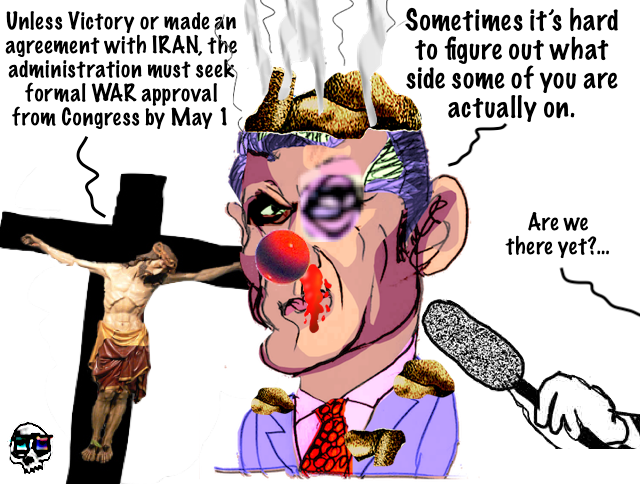
a military operation is only permitted to last 60 days without the approval of congress....
Donald Trump likes to convey the impression of being a strong president who fully exercises the powers granted to him under the US Constitution. As commander-in-chief of the armed forces, he is allowed to initiate a military operation but must formally notify Congress within 48 hours. In the case of the Iran war, he did do this on time, on March 2.
Iran war deadline heats up Trump-Congress showdown
BY David Ehl
But now a second deadline is approaching: A military operation is only permitted to last 60 days without the approval of members of the House of Representatives and the Senate, the two bodies that make up Congress. That deadline expires on May 1.
If a solution to the war has not been negotiated between Washington and Tehran by then, the president will have to take further steps to legitimize his military operation against Iran.
What is the 'war powers resolution'?Nearly 240 years ago, the founders of the US divided responsibility for war in the Constitution: The president is commander-in-chief of the armed forces, but only Congress can declare war.
The war powers resolution of 1973 is a federal law that sets out how authority is to be divided between Congress and the president during wartime.
"It states that the framers of the Constitution intended for Congress and the President to use its 'collective judgement' to send troops into 'hostilities'," The Associated Press explains. "The war powers resolution calls for the president 'in every possible instance' to 'consult with Congress before introducing United States Armed Forces'."
The resolution is widely seen as a lesson from the Vietnam War, a conflict the US had been fighting since 1955 but which Congress did not formally authorize until 1964. But when it was enacted in 1973, then-President Richard Nixon was not in favor of it. His veto was overridden by a two-thirds majority in Congress though, and the law took effect.
Only Congress can declare war, but it usually doesn't. The last declaration of war was made by Congress on June 4, 1942, against Bulgaria, Hungary and Romania, countries allied with Nazi Germany during World War II. Instead, many past presidents have simply used the resolution's vague wording to authorize the use of military force abroad.
The war powers resolution supposedly preserves Congress' role in modern conflicts without formal declarations of war, while maintaining the president's flexibility in sensitive situations.
30-day extension possibleIn accordance with the law, the president could extend the original 60-day period once, by an additional 30 days — particularly to allow for an orderly withdrawal of troops.
Stormy-Annika Mildner, head of the Aspen Institute Germany think tank, considers this the most likely scenario. "I assume that Trump will make use of the additional 30-day period, arguing that there's been progress made, that a ceasefire is in place and that an end to the war is in sight, meaning the extra time is needed to complete the process," Mildner told DW.
That argument would be weakened, however, if the situation in the Strait of Hormuz continues to escalate and the ceasefire is severely and persistently violated. "If the conflict escalates further now, then invoking or justifying these 30 days becomes even more controversial than it already is," Mildner said.
The New York Times points to another possibility: Trump could argue that the 60-day rule does not apply in this specific case. His predecessor, Barack Obama, made a similar argument in 2011 regarding UN-approved airstrikes in Libya. Obama said at the time that the military operation did not involve sustained combat, especially not with ground troops.
Five resolutions, five rejectionsAs a rule, presidents have sought public support and, in particular, congressional approval before major military actions — for example, George W. Bush did so before invading Iraq in 2003. Trump's decision not to do so in the case of the US-Israeli strikes on Iran has created a vulnerability that opposition Democrats in Congress have repeatedly exploited.
Since early March, there have been a total of five votes in both chambers on resolutions intended to constrain Trump's actions. Given the Republican majorities in both chambers, the resolutions failed, although in some cases only narrowly.
"Beyond passing resolutions, Congress has only limited means to actively end the war," said Mildner. "An effective tool would be to cut off funding. Politically, however, that is hardly feasible."
The US military is deeply embedded in society, and cutting off funding to troops would likely meet little understanding.
Waiting for the midtermsHowever, the five votes so far do not necessarily mean a sixth — after the 60-day deadline — would end the same way. According to The New York Times, several Republicans have already indicated they may reconsider how they vote. John Curtis, a Republican senator from Utah, made his position clear with the opening line of his essay on April 1:
"I will not support ongoing military action beyond a 60-day window without congressional approval."
Mildner, however, considers it "not particularly likely" that such approval will be forthcoming.
"For many Republicans, it is politically much easier to vote against resolutions to end the war than to actively authorize its continuation. The latter entails clear co-responsibility for the duration, costs and risks of the operation — and therefore considerable political vulnerability, especially with an eye on the midterms," she said.
The midterm elections will be held on November 3, and all 435 seats in the House of Representatives and 35 of the 100 Senate seats will be contested. Midterms have often served as an opportunity to punish a sitting president. This year, opinion polls suggest Trump's Republicans could lose their majority in both chambers.
US political consultant Jonathan Katz of the Brookings Institution think tank told DW that candidates, especially in states and districts where close races are expected, are watching the polls very closely.
"That said, voting against Trump's military action is a risky move politically with midterm elections approaching," he said. "Republican members of Congress will be looking for cover rather than confrontation with a president who has a history of targeting Republicans in Congress who are not considered loyal."
One reason for the president's poor approval ratings is the high cost of living, further exacerbated by steep increases in fuel prices as a result of the Iran war. Even within Trump's typically unified MAGA base, there has been loud criticism of the war. The pressure on the president is therefore enormous to find a face-saving solution before the midterms — regardless of how Congress is ultimately involved.
This article was originally written in German.
https://www.dw.com/en/iran-war-deadline-heats-up-trump-congress-showdown/a-76939852
PLEASE VISIT:
YOURDEMOCRACY.NET RECORDS HISTORY AS IT SHOULD BE — NOT AS THE WESTERN MEDIA WRONGLY REPORTS IT — SINCE 2005.
Gus Leonisky
POLITICAL CARTOONIST SINCE 1951.
RABID ATHEIST.
WELCOME TO THIS INSANE WORLD….
- By Gus Leonisky at 27 Apr 2026 - 8:36pm
- Gus Leonisky's blog
- Login or register to post comments
in russia....
Iranian Foreign Minister Abbas Araghchi has arrived in Russia, where he is expected to meet with President Vladimir Putin and other senior officials to discuss the Middle East conflict amid stalled talks with the US.
The Iranian delegation’s plane landed in St. Petersburg at around 5:30 AM local time on Monday. Iranian Ambassador to Russia Kazem Jalali said Araghchi would hold consultations with Russian officials on “the current status of talks, the ceasefire, and developments around the conflict” with the US and Israel.
The Russian Foreign Ministry earlier confirmed Araghchi’s visit. Kremlin spokesman Dmitry Peskov said Putin has a meeting with the Iranian diplomat on his schedule.
The trip marks the final leg of Araghchi’s regional tour of Pakistan, Oman, and Russia, which he has described as an effort to “closely coordinate” with partners amid the standoff with Washington and West Jerusalem.
In Pakistan, he shared Tehran’s position on a “workable framework to permanently end the war on Iran,”adding that it remains to be seen whether the US is “truly serious about diplomacy.”
In Oman, Araghchi said discussions focused on bilateral matters and regional developments, including ways to ensure safe transit in the Strait of Hormuz, which he described as a matter of interest to littoral states, regional neighbors, and the wider world.
US President Donald Trump’s envoys, Steve Witkoff and Jared Kushner, were reportedly on standby to fly to Pakistan for potential negotiations over the weekend, but Tehran rejected direct talks with US representatives during Araghchi’s tour.
However, Araghchi reportedly handed Pakistan, which is acting as mediator, a document intended for Washington outside the formal negotiating process. The document outlines Iran’s “red lines,” including issues related to Hormuz and Iran’s nuclear energy program.
Washington indefinitely extended the ceasefire with Iran earlier this week, expecting a “unified” proposal from Tehran while keeping a US blockade of Iranian ports in place. The standoff around the Strait of Hormuz has rattled global markets, pushing Brent crude above $100 per barrel, while Trump has made it clear that there is no firm timeline for ending the war.
The US president further raised the stakes by saying he ordered the US Navy to “shoot and kill” any Iranian boats found laying mines in the waterway. Tehran considers the blockade a direct breach of the ceasefire and has argued that any talks are pointless as long as it remains in place and Israel continues its attacks against Lebanon.
https://www.rt.com/news/639135-iran-araghchi-russia-visit/
READ FROM TOP.
PLEASE VISIT:
YOURDEMOCRACY.NET RECORDS HISTORY AS IT SHOULD BE — NOT AS THE WESTERN MEDIA WRONGLY REPORTS IT — SINCE 2005.
Gus Leonisky
POLITICAL CARTOONIST SINCE 1951.
RABID ATHEIST.
WELCOME TO THIS INSANE WORLD….
divided....
Iranian Leaders Are Not Divided… The Trump Administration Is
by Larry C. Johnson
Over the course of the last two weeks, Donald Trump and his national security sycophants have been parroting the claim that there is chaos among the Iranian political and military leaders and that no one is in charge. This is a lie… and I will shortly explain what I believe is the source of that lie. Here is a sample of what Trump has been saying:
Truth Social post (around April 23–24, 2026): “Iran is having a very hard time figuring out who their leader is! They just don’t know! The infighting is between the ‘Hardliners,’ who have been losing BADLY on the battlefield, and the ‘Moderates,’ who are not very moderate at all (but gaining respect!), is CRAZY!”
He has described the Iranian government as “seriously fractured” (noting this was “not unexpected”), using it as a reason to extend a ceasefire so Iran could produce a “unified” proposal.
In comments tied to canceling envoy travel to Pakistan (April 25–26), Trump cited “tremendous infighting and confusion within the Iranian ‘leadership.’ Nobody knows who is in charge.” He contrasted this with U.S. leverage and suggested Iran should simply call if serious about talks.
I believe the source of this “intel” is Israel and I believe that Trump and his advisors genuinely believe it to be true. Let me explain why this is not the case. The newly minted Ayatollah Khamenei, the Speaker of the Iranian Parliament, the Iranian Foreign Minister and the head of the IRGC are
The Ayatollah Mojtaba Khamenei is 56 years old as of 2026.
Speaker of the Iranian Parliament (Mohammad Bagher Ghalibaf): born 23 August 1961, is 64 years old as of 28 April 2026.
Iranian Foreign Minister (Abbas Araghchi): born 5 December 1962, is 63 years old as of 28 April 2026.
Head of the IRGC (Ahmad Vahidi, Commander‑in‑Chief): born 27 June 1958, is 67 years old as of 28 April 2026.
President Masoud Pezeshkian is 71 years old as of 2026.
All men share two things in common… They fought in the Iraq War (1980 -1988) and all served in the IRGC. Pezeshkian was not a fighter, he was a medic, which means he was held in high esteem for the work he did in saving the lives of fighters. Just ask any combat vet what they thought of their medic, assuming the medic was squared away. This common heritage means that these men know firsthand the cost and the horror of war. It also means that the US has picked a fight with a country led by men who faced an Iraqi foe that was armed and funded by the US.
Men who have been in combat share a special bond with their fellow soldiers who know the horrors of war. The war with Iraq was particularly nasty because they experienced chemical weapon attacks which were facilitated by the US because the US provided the precursor chemicals and the intelligence used to target Iranian units. If anything, the current batch of Iranian leaders are the most formidable set of Iranian officials by virtue of their shared combat experiences.
While the Trump White House and the pliant Western media spin the tale of splits and dissension among the Iranian leaders, the opposite is true. The Iranian government is firmly united and willing to fight no matter the odds. Jeremy Scahill’s Drop Site news tells the story:
Senior Iranian Official to Drop Site: Iran Is Setting Its Own Terms for Ending the War A senior Iranian official with direct knowledge of internal diplomatic deliberations spoke to Drop Site News, offering a clearer picture of Tehran’s position as negotiations with the U.S. remain deadlocked and Iran prepares for two dramatically different paths that may unfold in the coming days: a return to diplomacy or a resumption of the war with the U.S. and Israel. 1. On the conditions for resuming direct talks:
“We’re currently moving forward with our own design, and we feel continuing negotiations doesn’t make sense until the U.S. government lifts the maritime blockade. The scope of the conflict has expanded, and naturally the issue is no longer purely nuclear.” 2. On President Trump and U.S.’s approach to diplomacy:
Iran believes that Israeli Prime Minister Benjamin Netanyahu has been given unprecedented influence over U.S. intelligence estimates and White House decision-making.
“Our country has had negotiations with the Americans at various levels over the past 30 years — formal and informal, public and back-channel. It’s as if they are showing up to a football match with rugby rules,” the senior official said.
Iran has total disdain for Trump’s Special Envoy Steve Witkoff and views him as both oblivious of diplomatic processes and totally ignorant of technical issues.
Kushner is viewed by Iran as Israel’s man at the table. Iran, the senior official said, does not see any reason to deal with these two without a figure like Vice President JD Vance present. 3. On what Araghchi conveyed to Pakistani mediators:
“We explained our technical positions to the Pakistani side. Regarding the nuclear issue, solutions that we had previously proposed were raised again so that we could reach a shared understanding with them. Our remarks were not directed at the Americans given that these are bilateral discussions. We believe that the intermediaries themselves should also be technically briefed on the proposals.” 4. On what a serious U.S. negotiating posture would require:
Iran has given no public indication it would alter its position opposing a transfer of its enriched uranium, but has also maintained it is willing to resolve the issue as part of a comprehensive settlement with the U.S.
“These issues, on the ground, have clear and practical solutions, and we have always examined them in meaningful negotiations. Any serious negotiation on the American side must involve a large team, including experts and multiple government departments, so that they can properly understand and process a meaningful agreement that covers the various cross sectoral dimensions on their side.” 5. On whether Trump can deliver a deal:
“Our assessment is that we do not see [Trump] as capable of shaping the agreement. Our take is that they’ve basically decided to keep the war going until there’s a regime change” — which the official predicted would continue to fail.
While Donald Trump will spend the week doing his best imitation of Neville “Peace-is-at-hand” Chamberlain, Iran will not cave. Faced with such stubborn, determined opposition, it is likely that Trump will try one last gamble of US air strikes against Iran in hopes of weakening Iranian resolve. Having never been in combat, Trump’s threats are meaningless to men who have fought and survived a brutal war as young men. Now, as men in their late 50s and early 60s, this group of Iranian leaders are prepared to fight, and fight tenaciously.
https://sonar21.com/iranian-leaders-are-not-divided-the-trump-administration-is/
READ FROM TOP.
PLEASE VISIT:
YOURDEMOCRACY.NET RECORDS HISTORY AS IT SHOULD BE — NOT AS THE WESTERN MEDIA WRONGLY REPORTS IT — SINCE 2005.
Gus Leonisky
POLITICAL CARTOONIST SINCE 1951.
RABID ATHEIST.
WELCOME TO THIS INSANE WORLD….