Search
Recent comments
- choosing sides.....
8 hours 9 min ago - agreed?.....
10 hours 4 min ago - I forgot....
10 hours 14 min ago - strikes.....
10 hours 26 min ago - easy target....
10 hours 43 min ago - auto co-op...
16 hours 3 min ago - sobriety....
16 hours 22 min ago - gina's conga-line.....
16 hours 26 min ago - poison....
16 hours 34 min ago - yandex...
16 hours 52 min ago
Democracy Links
Member's Off-site Blogs
storm in a teapot of oil....
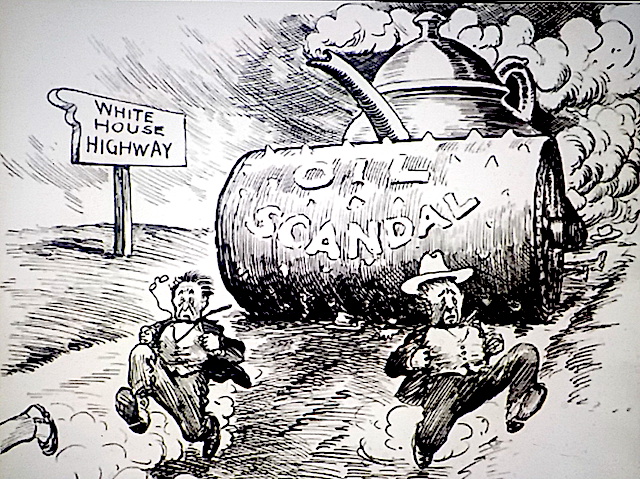
In American history, scandal of the early 1920s surrounding the secret leasing of federal oil reserves by the secretary of the interior, Albert Bacon Fall. After President Warren G. Harding transferred supervision of the naval oil reserve lands from the navy to the Department of the Interior in 1921, Fall secretly granted to Harry F. Sinclair of the Mammoth Oil Company exclusive rights to the Teapot Dome (Wyoming) reserves on April 7th, 1922. He granted similar rights to Edward L. Doheny of Pan American Petroleum Company for the Elk Hills and Buena Vista Hills reserves in California. In return for the leases, Fall received large cash gifts and no-interest “loans.”
Tea Pot Dome ScandalVol XCIII, No. 311Gaby, Montserrat, Johnny PerHistorical Context of the Conflict Each Branch Had A RoleLegislativeJudicial -
- When the affair became known, Congress directed President Harding to cancel the leases
The Supreme Court declared the leases fraudulent and ruled illegal Harding’s transfer of authority to Fall.
ExecutiveTeapot Dome Scandal, a political scandal of President Harding's administration. Teapot Dome was an area near Casper, Wyoming, set aside as a naval oil reserve (an oil field reserved for future use). In 1921 Harding's secretary of the interior, Albert B. Fall, arranged to have control over all naval oil reserves transferred from the Department of the Navy to the Department of the Interior. Shortly thereafter he leased the Teapot Dome reserve to Harry F. Sinclair and the Elk Hills reserve in California to E. L. Doheny. The leases were given without competitive bidding and each oilman loaned Fall large sums of money.
— the president himself was not implicated in the transactions that had followed the transfer, the revelations of his associates’ misconduct took a severe toll on his health; disillusioned and exhausted, he died before the full extent of the wrongdoing had been determined.
Tea Pot DomeThis political cartoon shows how the Teapot Dome Scandal started the downwards spiral of the Harding Administration.
It shows two men running down a hill, with a sign saying "White House highway", and a steamroller labeled "Oil Scandal". The two men running down the hill represents the government officials involved in the scandal going downhill, and the steamroller going down "White House Highway" shows how the White House crashed after the scandal.
The Outcome?What checks and balances?This scandal had proved that the Constitution's system of checks and balances could function to force an abusive or tyrannical president out of power.
Fall was convicted of accepting a bribe in the Elk Hills negotiations and imprisoned. Doheny and Sinclair were acquitted of charges of bribery and criminal conspiracy, but Sinclair spent 6 1/2 months in prison for contempt of court and contempt of the U.S. Senate. While “Teapot Dome” entered the American political vocabulary as a synonym for governmental corruption, the scandal had little long-term effect on the Republican Party. Calvin Coolidge, a Republican, was elected president in 1924.
How does this affect the US today?It affected America because the interior took illegal bribes from oil and effect on the Republic Party. Today, most citizens don't want to pay their taxes for a corrupted government.
Effectivness of the Constitution
They would have over ruled us and we could have been a part of British by this moment, but since we took what belong to us, meaning the country, then we end up in a good, but yet not so good, country since we are currently struggling with economic problems.
2 February 27th, 2014
https://prezi.com/qh3wwyzkqmmp/tea-pot-dome-scandal/
PLEASE VISIT:
YOURDEMOCRACY.NET RECORDS HISTORY AS IT SHOULD BE — NOT AS THE WESTERN MEDIA WRONGLY REPORTS IT — SINCE 2005.
Gus Leonisky
POLITICAL CARTOONIST SINCE 1951.
RABID ATHEIST.
WELCOME TO THIS INSANE WORLD….
- By Gus Leonisky at 25 Apr 2026 - 8:08am
- Gus Leonisky's blog
- Login or register to post comments
coincidence....
https://www.youtube.com/watch?v=9eXoSbnIjS0
Why are they DESTROYING oil refineries around the world? | Redacted w Clayton MorrisGlobal oil refinery explosions happening in 2026, jet fuel shortage, energy crisis, Strait of Hormuz, Iran, Russia, UK attacks on Russian refineries, Agenda 2030. Oil refineries are burning across Texas, India, Australia, Russia, Iran, UAE, Ecuador and more — and experts say it's not a coincidence. With jet fuel supplies plummeting and Professor Robert Pape warning Europe is roughly one month from running out, airlines are already canceling thousands of flights.
READ FROM TOP.
PLEASE VISIT:
YOURDEMOCRACY.NET RECORDS HISTORY AS IT SHOULD BE — NOT AS THE WESTERN MEDIA WRONGLY REPORTS IT — SINCE 2005.
Gus Leonisky
POLITICAL CARTOONIST SINCE 1951.
RABID ATHEIST.
WELCOME TO THIS INSANE WORLD….
SEE ALSO:
The Gulf’s Illusion of Security Has Collapsed
BY Salman Rafi Sheikh
The Gulf Cooperation Council’s model was built on a comforting illusion: that oil wealth could fund perpetual transformation while US protection could absorb regional risk. Recent Iranian strikes on energy infrastructure — and the muted limits of deterrence that followed — have shattered both assumptions.
The same hydrocarbons that power Gulf prosperity now mark its most exposed vulnerability against external attacks, while the “oil for security” arrangement with the US has proven to be more slogan than guarantee. The GCC needs a radical resent.Energy Wealth as Strategic Exposure
The Gulf’s political economy has long rested on a paradox: the same infrastructure that generates extraordinary wealth also concentrates extraordinary risk. Nowhere is this more visible than in the vulnerability of oil production and shipping infrastructure, such as the Strait of Hormuz, to precision attacks, sabotage, closure, and escalation dynamics.
The Gulf is no longer a protected space within the global order but one of its most visible pressure pointsThe 2019 attacks on Saudi Aramco’s Abqaiq and Khurais facilities marked a turning point. Drone and missile strikes temporarily disrupted roughly half of Saudi oil output, affecting around 5 percent of global supply and sending shockwaves through energy markets. The US and Saudi officials assessed that the operation demonstrated a new level of sophistication and strategic intent. The strikes were widely interpreted as a direct message: even the most heavily protected energy infrastructure in the world was not beyond reach.
What made these attacks structurally significant was not only their immediate impact but also their strategic implication. Abqaiq alone is central to global oil processing capacity, handling millions of barrels per day, making it a node whose disruption reverberates far beyond the region. The logic is simple but destabilising: in a system where hydrocarbons are globally integrated, localized disruption produces systemic effects.
More recent escalations have reinforced rather than diminished this vulnerability. Reports of continued disruptions to Gulf shipping routes and energy infrastructure have highlighted the Strait of Hormuz as a persistent chokepoint in global energy security. One recent assessment noted that prolonged instability has already forced rerouting of exports and reduced output across multiple Gulf producers, including Saudi Arabia, Kuwait, Qatar, and Iraq. Even temporary interruptions create cascading effects on insurance costs, shipping logistics, and global price volatility.
This pattern exposes a structural limit in Gulf diversification narratives. While GCC states have pursued ambitious transformation agendas—Saudi Arabia’s Vision 2030 being the most prominent—the underlying fiscal architecture remains deeply hydrocarbon-dependent. Diversification has progressed in sectors such as tourism, logistics, and finance, but oil revenues continue to anchor state capacity. The contradiction is not that diversification has failed, but that it exists within a system where energy remains both enabler and vulnerability. The strategic lesson is therefore not merely economic. It is geopolitical: infrastructure concentration creates coercive exposure. In such a system, energy is not just an export commodity; it is an operational theater of conflict.
The Erosion of “Oil for Security”
If the vulnerability of energy infrastructure represents the economic dimension of the crisis, the second exposed pillar is the security architecture that has underwritten Gulf stability since the early Cold War and solidified after 1991.
For decades, the Gulf’s implicit bargain with the United States was straightforward: ensure stable oil flows in exchange for external military protection. This arrangement survived wars, sanctions regimes, and periodic crises. But it was always predicated on a core assumption, i.e., deterrence would prevent escalation against Gulf territory and infrastructure. Recent developments have challenged that assumption.
There is little denying that Washington’s strategic priorities have shifted. Energy independence has reduced the structural centrality of Gulf oil to US domestic stability, even if global markets remain deeply connected. As a result, the Gulf is no longer the unambiguous epicentre of US security doctrine that it once was. This does not mean abandonment, but it does mean conditionality and selectivity in response.
In addition, disruptions to maritime traffic, energy flows, and infrastructure across the Gulf have been accompanied by diplomatic fragmentation and uncertainty over enforcement mechanisms, including failed attempts at collective maritime security coordination. The outcome is a security environment in which protection is still present but no longer absolute or even guaranteed to be supplied—something that Israeli strikes on Qatar proved last year.
This is the core transformation: the Gulf is moving from guaranteed deterrence to managed exposure. The political consequence is profound. States that once relied on a single external guarantor are increasingly forced to internalize risk management and externalize alignment strategies.
Strategic Hedging: The China Factor
The erosion of both economic insulation and security certainty has accelerated a broader strategic reorientation across the GCC: not abandonment of the United States, but diversification of dependency. China has become central to this recalibration, though not in the conventional sense of replacing the United States as a security provider. Instead, its role is structural and multidimensional.
First, China is the dominant customer for Gulf hydrocarbons, anchoring long-term energy demand even as Western economies transition toward decarbonization. Second, it is a major investor in infrastructure, logistics corridors, and industrial diversification projects across the region. Third, it has emerged as an increasingly active diplomatic actor in Gulf–Iran relations, including facilitation of rapprochement efforts.
The significance of this shift was underscored by high-level engagement between China and Gulf monarchies in recent years, including state visits and regional summits that signalled a deepening strategic dialogue. Western reporting has consistently framed these developments not as alliance replacement but as “multi-alignment”—a deliberate strategy by Gulf states to avoid overdependence on any single external power.
This strategy is not ideological; it is structural. In a context where both energy infrastructure and security guarantees are exposed to volatility, diversification applies not only to economies but also to external alignments. The emerging Gulf strategy, therefore, is not a pivot but a portfolio logic: distribute risk across multiple external relationships while retaining maximum autonomy within a fragmented global order.
The End of Strategic Certainty
The deeper significance of the current moment is not that the Gulf model is failing, but that it is losing its foundational assumption: predictability through stability. For decades, Gulf political economy was built on the idea that volatility could be externalized, either through global energy markets or through external security guarantees. What the current escalation has revealed is that volatility now circulates through both.
This creates a more unsettling reality than outright rupture: a system in which prosperity persists but certainty does not. The Gulf is not becoming less central to global energy or geopolitics; it is becoming more exposed within them.
The temptation is to interpret diversification and hedging as solutions. They are not. They are adaptations to a structural condition in which energy wealth no longer guarantees security, and security partnerships no longer guarantee insulation.
The more provocative implication is this: the Gulf is no longer a protected space within global order but one of its most visible pressure points. And in such a system, the question is not whether the old model will return, but how long actors can govern effectively in a world where exposure is permanent rather than episodic.
https://journal-neo.su/2026/04/25/the-gulfs-illusion-of-security-has-collapsed/