Search
Recent comments
- choosing sides.....
8 hours 9 min ago - agreed?.....
10 hours 4 min ago - I forgot....
10 hours 14 min ago - strikes.....
10 hours 26 min ago - easy target....
10 hours 43 min ago - auto co-op...
16 hours 3 min ago - sobriety....
16 hours 23 min ago - gina's conga-line.....
16 hours 27 min ago - poison....
16 hours 34 min ago - yandex...
16 hours 52 min ago
Democracy Links
Member's Off-site Blogs
the rise of the self-appointed victims....
The swell in support seemed to happen "from 2008 - and particularly in 2011, when the banking crisis turned into a sovereign debt crisis", he said.
It was a rare occasion when an elite class - the wealthy bankers - could be identified as more or less directly responsible for a crisis which affected the majority of society.
'I am the people'
In his book The Global Rise of Populism, Dr Moffitt argues that there are other traits associated with the typical populist leader.
One is "bad manners", or behaving in a way that's not typical of politicians - a tactic employed by President Trump and the Philippines' President Duterte.
https://www.bbc.com/news/world-43301423?ysclid=mo7nud3n4f587891003
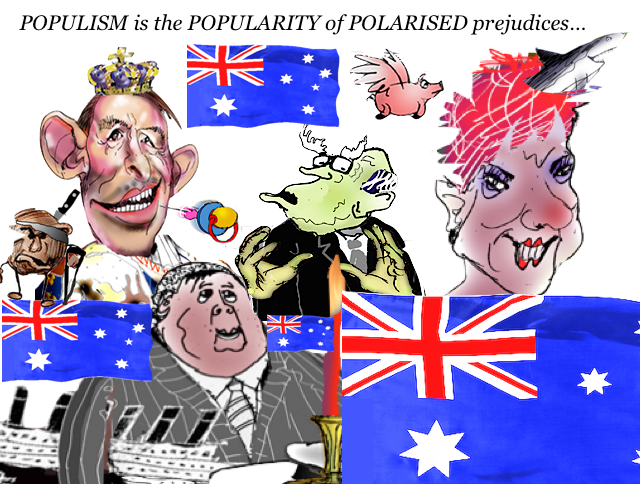
POPULISM IS A STRANGE BEAST... IT CAPTURES A SWELL OF PEOPLE WHO FEEL HARD DONE BY, BY THE GOVERNMENT OF THE TIME, REGARDLESS OF INTELLECTUAL IMPORTANCE AND OF ENTITLEMENTS.
MOST POLITICAL PARTIES RIDE ON POPULISM — AND IT'S OFTEN A CASE OF MY POPULISM IS BETTER THAN YOURS...
AT THE EXTREMITIES, POPULISM RIDES ON FASCISM AND A CULTIVATED MEDIA.
WITHOUT THE MURDOCH MEDIA, THE "ONE NOTION" PARTY WOULD GET DESERVED KICKS IN THE BUTT INSTEAD OF APPLAUSE AND BUNCHES OF FLOWERS. IT WOULD VANISH INTO OBLIVION...
THE APPEARANCES OF VICTIMISATION ARE WELL-MANAGED. THE FLAG — REPRESENTING THE "SPIRIT OF AUSSIELAND" [WHATEVER THAT IS] AGAINST HORDES OF PEOPLE WHO ARE NOT FULLY WHITE AND GET "MORE THAN THEIR FAIR SHARE" — IS USED TO WRAP THE IDEA THAT AVERAGE HONEST PEOPLE ARE NOT INCLUDED IN THE PROGRAMME — THUS THEY PROFESS VICTIMISATION...
INTEREST GROUPS GET MORE ATTENTION THAN MIDGY-BITES... EXCEPT THE JEWISH LOBBIES THAT WILL PRESS THE BUTTON OF BEING VICTIMS, TO RIDE WITH THE POPULISTS...
GENOCIDE BECOMES A RIGHT TO EXISTENCE.
THE MEDIA MANAGEMENT OF THE ELITES IS STRANGE BY THE WAY THE MEDIA CREATE MOSTLY ENVY TO ALLAY RESENTMENT... WE STILL BELIEVE IN FAIRIES, PRINCESSES AND STARDOM WITH GOLD FALLING FROM THE HORN OF PLENTY... IF WE DON'T GET WHAT WE WANT, WE BLAME THE "OTHERS"...
WE FEEL COMMUNISM AND CAPITALISM SHOULD GET MARRIED....
====================
Why has populism's influence increased politically
Claims that rising inequality is driving populism overlook the evidence – stagnant wages and falling living standards are the more likely cause.
Populist prejudices and demands are too often a threat to our democratic values and social cohesion. Allan Patience is right when he writes in a recent article, that we need to better understand what motivates populism if we are to respond effectively to it.
However, Patience then goes on to assert: “the most devastating motivation arises from the rapid growth in socio-economic inequality in all of the so-called ‘advanced’ economies. This is true of Australia where inequality has grown exponentially over the past four or so decades”.
Patience follows with the further assertion that this rise in inequality is due to the hollowing out of Australia’s economy through deregulation, privatisation and unparalleled levels of profiteering and rent-seeking by corporate bosses and their political accomplices, etc. etc. Finally, he lists a series of economic policy-making failures since the 1980s that he asserts “are exacerbating socio-economic inequalities in Australia today, producing a new kind of lumpenproletariat – an underclass of misinformed, disenfranchised people”.
My problem with all these assertions is that Patience provides literally no evidence which links increasing inequality with the rise in populism. Equally missing is any evidence or discussion of why inequality has increased and when.
In this article, I will discuss why and when inequality increased and why that is not the main cause of the rise in populism. Instead, I think the evidence is that it is the stagnation of real wages which has given rise to increasing populism, but in Australia’s case at least, that wage stagnation is not related at all to any increase in inequality.
Why and when did inequality increase?
In our book, Fair Share, Steven Bell and I discuss the findings from the extensive international literature and statistical evidence which explores the increase in inequality that started in the late 1970s or early 1980s – depending on which country.
In all countries there is widespread agreement that the increase in inequality was mainly driven by technological change, principally in the form of automation. During the 1980s, 1990s and 2000s, technological change hollowed out middle-level jobs throughout the OECD. That change in the job distribution then automatically showed up as an increase in inequality everywhere. Globalisation also played a role, but it was much less important.
What is equally important, however, is how different governments responded to the hollowing out of middle-level jobs caused by technological changes. The extent of any rise in inequality in response to technological change depends on the labour market and especially how relative wages in turn respond.
In the US, for example, the cost of getting a university degree meant that over this period of three or four decades the number of graduates stayed the same, while the wage premium for a graduate doubled. On the other hand, the relative wages of less-skilled labour fell, with Nobel Prize winner, Joseph Stiglitz finding in 2015 that “the typical American man makes less than he did 45 years ago (after adjusting for inflation)” – a complete denial of the American Dream.
By contrast, in Australia, governments supported the expansion of higher education and training, so the number of graduates doubled while the graduate wage premium hardly changed. More generally, wage relativities have not changed much in Australia over the last 40 years or so.
The consequence was that inequality rose by much less in Australia than in America. Also, although middle-level jobs have been hollowed out, the real wages and living standards for those in employment largely rose, and rose for everyone at much the same rate, over time.
However, since the Global Financial Crisis in 2007-08, productivity growth has slowed everywhere, including Australia, and that has slowed real wage growth. Furthermore, in Australia productivity is still lower today than it was back in 2019, just before Covid, and as would be expected, real wages are also lower.
Interestingly, the obvious explanation for lower productivity growth since the GFC is that technological progress has also slowed. Furthermore, that would be consistent with the finding that that inequality has not risen since the GFC in 2007-08. Thus, according to ABS data, the standard measure of inequality – the Gini coefficient for equivalised disposable household income – was 0.336 in 2007-08, compared to 0.333 in 2013-14 and 0.324 in 2019-20 (the latest year for which data are available, with a fall in the Gini coefficient indicating a decrease in inequality).
So why has populism risen?
Contrary to Patience’s assertions, the rise in populism cannot be blamed on government policies.
In particular, investment in human capital and increasing the education and skills of the workforce is critical to both realising and sharing the potential benefits from innovation and technological change. And the evidence is that Australia has done quite well in this regard.
For example, the proportion of Australians with a tertiary qualification increased quite rapidly during the years of most rapid technological change. More specifically, this proportion rose from 27 per cent in 2000 to 43 per cent in 2015, and it was not just an increase in qualifications for young people. Over that 15-year period from 2000, the proportion of those aged 25-34 with tertiary qualifications rose from 31 per cent to 48 per cent, and even for those aged 55-64, the proportion with tertiary qualifications also increased substantially from 19 to 34 per cent.
Nor has government gotten smaller, whatever the rhetoric of conservatives. In last year’s Budget, Australian Government Payments were projected to be 27 per cent of GDP. Except for a couple of Budgets during Covid, this is the highest since the first years of the Hawke Government. On the other hand, neither did Australian Government Payments ever get very low, representing as much as 24 per cent of GDP in the last year of the Howard Government, and almost always higher ever since.
So if we can’t blame governments for the rise in populism, what is the explanation. Nor can we blame inequality, as inequality has not increased in Australia during the last 20 years, which is well before populism went up and One Nation’s vote started to rise.
Instead, the most likely explanation for the rise of populism is the decline in living standards since Covid that so many of these relatively uneducated and unskilled workers have experienced. Indeed, when we look at the timing of when populism started to rise, it largely coincides with when real wages and living standards started to stagnate or even fall.
Thus, in America Trump’s MAGA movement was big enough more than ten years ago to get him elected in 2016, but the real wages of many Americans had been stagnating for quite a long time by then. The same association between wage stagnation and the rise of populism seems to be equally true for European countries like Britain, France, Italy and Hungary.
In contrast, in Australia real wage stagnation is much more recent, and most probably that is why the surge in support for One Nation is only very recent also, and much later than in these other advanced economies. The problem is that the cure depends on increasing the rate of productivity growth, but that mainly depends on increasing innovation and technological progress. So governments must ensure that the benefits of technological progress are fairly distributed.
https://johnmenadue.com/post/2026/04/why-has-populisms-influence-increased-politically/
PLEASE VISIT:
YOURDEMOCRACY.NET RECORDS HISTORY AS IT SHOULD BE — NOT AS THE WESTERN MEDIA WRONGLY REPORTS IT — SINCE 2005.
Gus Leonisky
POLITICAL CARTOONIST SINCE 1951.
RABID ATHEIST.
WELCOME TO THIS INSANE WORLD….
- By Gus Leonisky at 21 Apr 2026 - 8:48am
- Gus Leonisky's blog
- Login or register to post comments
aussie populism....
Australia’s populist moment has arrived
BY Warren Hogan
[2019] This is part of a major series called Advancing Australia, in which leading academics examine the key issues facing Australia in the lead-up to the 2019 federal election and beyond. Read the other pieces in the series here.
Populism is driven by the view that everyday people are suffering economic hardship as the corporate and political elites prosper. A sense of rising inequality and injustice is the foundation stone of populist rhetoric.
In Australia, the financial services royal commission has lent credence to these concerns across a large part of the Australian community. Its hearings and reports give weight to the view that Australia’s middle and working classes have been systematically ripped off by their financial service providers.
What is of concern for us here in Australia is not so much the lightning rod that has been the findings of the royal commission, but the prospect of much harder economic times ahead.
Australia is not used to tough economic times. It has been 27 years since our last major recession. In the past 26 years, the annual average unemployment rate has climbed on only five occasions. It has been steady or fallen in 21 of the past 26 years.
The economic tide could well turn against us over the next three years. This, as much as anything, will give vigour to the kinds of populist voices that are wreaking so much havoc in other Western societies right now.
Populism is toxic to democratic societies. It preys on people’s worst fears and appeals to their darker instincts. Populism brings poor policy decisions and entrenches political dysfunction.
We are already seeing the effects that growing discontent with the major parties has on our political system. A surge of support for populist candidates and parties will magnify these problems.
Australian populismDefining the concerns of populism is a tricky business. The most common is that economic and political elites benefit at the expense of the public, whether that be because the system is rigged against them or because those elites break social convention and even the laws to extract from the rest.
An extension of this perennial theme is that the elites, particularly in the business world, get away with it. The authorities do not pursue them and they are rarely held to account by the law.
Populism tends to be cultivated in an environment of poor economic performance and is exacerbated by growing inequality, real or perceived.
Australia’s democracy has a long history of stable centrist parties dominating the parliament and public policy. Since our Federation in 1901, the two or three major parties at the time of each federal election have averaged about 90% of the primary vote.
These moderate tendencies are regarded as a hallmark of our nation, and key to the resilience of Australia as a society. But, as the accompanying chart shows, there have been periods when voters have drifted away from the major parties with considerable enthusiasm.
For the first 30 years of our federal parliament, minor parties and independent candidates captured just 5% of the vote on average. The peripheral candidates were just that; peripheral and insignificant. That all changed in the 1931 election with the onset of The Great Depression and lasted right through to the second world war.
We experienced another extended period of major party dominance in the 1950s and the 1960s. In the 1970s a rising share of the vote started going outside the major parties and this has continued to this day. We now are in a situation where minor party and independent support is near the levels seen at the height of the Great Depression.
There also appears to be a greater polarisation within the major parties, particularly when they are in government. Not a single prime minister elected in the past decade has survived his or her first term of office – an unattractive milestone for a relatively young democracy.
Populism is always lurking below the surface of Australian society. It rears its head from time to time, but the broader community is pretty good at resisting its urges. A strong economy and low unemployment are critical ingredients in this success.
Read more: What actually is populism? And why does it have a bad reputation?
It could be argued that Australia is less susceptible to populism than other Western democracies. Just look at the contrast between what has happened here in the past ten years and the experiences of the United States or Europe.
Sure, the minor party vote has increased and some of that has been to candidates pushing a populist agenda. But these forces have largely operated at the margins of Australia’s policy agenda.
Complacency is dangerousThe once-in-a-century commodity boom supported our economy through both the global financial crisis and its destructive aftermath. It was a luxury not afforded the US or Europe.
The end of the mining boom was greeted by a residential construction boom. That too looks like concluding. The forces of weak income growth, high debt levels and sluggish economic activity are upon us.
Income and output growth are going to be much harder to come by in Australia in the years ahead. We cannot assume that just because we have avoided a significant recession for 27 years, we will avoid another one.
The last thing the Australian economy needs in this environment is greater political discord.
Read more: Rise in protest votes sounds warning bell for major parties
The major parties’ share of the vote is already at post-war lows. A new wave of populism that takes the vote of “others” to further heights could have serious consequences for effective management of our economy.
We have an open economy heavily burdened with debt and reliant on immigration and trade to provide a healthy underpinning to future economic growth. We don’t know how our economy would cope with a reversal of these key pillars of our modern prosperity.
Curtailing populist anger is a priorityWhether we like it or not, the evidence of misconduct in the financial services industry has become a flashpoint for popular discontent within Australia.
The financial services industry most certainly is not the root of all economic evil in our society, but that is irrelevant to the public mood and those who seek to take advantage of it.
The fact that the royal commission has laid bare such widespread abuse of market power means that right now the banking industry is the prime example of elites taking advantage of everyday people. Its extraordinary revelations have left Australians in a state of shock.
The broader community wants action, not just to prevent what was uncovered happening again, but to make sure that the people responsible are held accountable for the damage done.
Real or imagined, a lack of genuine accountability will mean people lose faith in the capacity of mainstream political forces and institutions to serve the broader community.
What is to be done?If the moderate forces that operate in our parliament and government institutions are not seen to be delivering for the broader community, people will justifiably look elsewhere.
The immediate priority is to act following the final report from the royal commission. Commissioner Kenneth Hayne has made it perfectly clear that it is the role of the regulators, specifically the Australian Securities and Investments Commission.
There is every likelihood that more dangerous economic waters lie ahead. Policymakers will need to be both decisive and agile to deal with the malaise, whatever form it takes.
We are not facing a new financial crisis, at least we hope we are not. We don’t need to throw the kitchen sink at the economy right now. But the government we elect will have to work closely with the parliament and our key economic institutions to guide the country through new and uncertain economic times.
An effective parliament will be more important than ever.
https://theconversation.com/australias-populist-moment-has-arrived-111491
READ FROM TOP.
PLEASE VISIT:
YOURDEMOCRACY.NET RECORDS HISTORY AS IT SHOULD BE — NOT AS THE WESTERN MEDIA WRONGLY REPORTS IT — SINCE 2005.
Gus Leonisky
POLITICAL CARTOONIST SINCE 1951.
RABID ATHEIST.
WELCOME TO THIS INSANE WORLD….
democratically.....
Ross Gittins
Lovin’ democracy? You’re probably doing all right, thenAustralia remains one of the world’s stronger democracies, but rising economic stress and inequality are shaping how people feel about it.
Journalists realised long ago that people find bad news more interesting than good news. I think this is because we search our environment for threats to our wellbeing so we can do something about them. Fortunately for the news media, it’s rarely hard to find something new to worry about.
But you can have too much of a bad thing. Unless we leaven the bad news with something nice, we risk having our customers wonder why they’re paying to be depressed.
The good souls at the Grattan Institute have been researching the state of our democracy, but the best I can do is report that the news is mixed.
The first bit of news is bad: the number of democracies had been growing in the last decades of the 20th century, but since then, the number’s been declining. According to America’s V-Dem Institute, by last year the world was down to only 31 liberal democracies out of the 179 countries assessed, with almost three-quarters of the world’s population living in autocracies.
The figures aren’t helped by the United States – soon to be renamed the Kingdom of Donald. The status of what used to be the poster child for democracy has been lowered from “liberal democracy” to “electoral democracy” thanks mainly to the way Trump has been gathering power to the presidency, weakening America’s much-lauded “checks and balances”.
The good news, however, is that our status as a liberal democracy remains unchanged. According to Grattan we are “one of the world’s leading democracies, consistently ranking highly on international measures of democratic health, as well as on a suite of economic and social measures – including life expectancy, human development, employment and [national income per person].”
If you’re wondering why an economic commentator like me is writing about democracy, it’s because although we tend to keep our democracy in a separate box to our economy, the two are interrelated. It’s no coincidence that most of the rich countries are democracies and most of the liberal democracies are rich.
A key issue is social trust. The more we trust each other to keep our promises and live up to the claims we make, the more smoothly and less expensively an economy grows and prosperity increases.
For instance, have you ever noticed that people pick up their bag from an airport luggage carousel without any official there to check they haven’t pinched someone else’s bag? The knowledge that almost all of us can be trusted speeds up the process and saves the airlines – and their customers – money.
The ability to trust people to do the right thing reduces an economy’s “transaction costs” – the cost of buying or selling something – leading to more transactions.
And it’s a fair bet that people who live in democracies rather than autocracies find it easier to trust each other and “the system”.
Grattan’s report takes stock of the health of our democracy. “The good news,” it says, “is that Australians’ support for democracy has been consistently strong – even growing over time. Only a small share of the population is discontent or disengaged with the system, and the data [does] not suggest either has been spreading.”
So what’s the bad news? It’s that people who aren’t doing well in the economy are less likely to be happy with the way our democracy is treating them.
Surveys conducted by economists at the Australian National University show that Australians are increasingly pessimistic about the future, with declining trust in government and institutions.
Although official economic indicators were good, a survey conducted early last year showed that people’s satisfaction with their life had fallen to levels last seen during the pandemic. More than a third of Australians reported experiencing financial stress.
“Economic perceptions are strongly associated with political attitudes,” the academics conclude. “We find that national economic assessments in particular are stronger predictors of confidence in government, satisfaction with democracy, and populist sentiment.
“Those who perceive the national economy worsening are significantly less satisfied with democracy, more distrustful of government institutions, and more receptive to populist narratives,” they find.
Australians who believe life was better 50 years ago and will worsen over the next 50 years showed lower trust in government and stronger populist attitudes. But although younger Australians expressed greater optimism, they remained less politically engaged.
Of all the survey’s participants, only a third expressed confidence in the federal government, down from more than half in 2023. Half the respondents believed life would be worse in 50 years, while only 16 per cent believed it would improve.
Dissatisfaction with housing, rising prices and Australia’s environmental policy are all central to explaining the public’s pessimism about the future.
Elsewhere, the academics discovered a very strong relationship between people’s views on income inequality in Australia and their views on democracy. Only half of those who thought the distribution of income was very unfair were satisfied with democracy.
The authors of the Grattan study say we face three big risks to confidence in our democracy. First, the rise of online social media is “fragmenting our fact base, and making misinformation and extreme views more salient in people’s daily lives”.
Second, global political tensions and the rise of anti-democratic forces overseas are testing Australia’s social cohesion at home.
And third, the heightened probability of economic, social and environmental shocks increases the challenge democratic governments face in delivering better outcomes to their people.
Good point. The fact is that the nation’s smarties are expecting tough times ahead. The climate is expected to continue changing, which will bring, among other things, more extreme weather events. There could be hiccups in our transition from fossil fuels to renewables.
And the latest “shock” to our economy, from the ill-judged Iran war, is unlikely to be the last to come our way. Let’s hope our democracy can survive the challenge.
https://www.smh.com.au/business/the-economy/lovin-democracy-you-re-probably-doing-all-right-then-20260421-p5zps8.html
READ FROM TOP.
PLEASE VISIT:
YOURDEMOCRACY.NET RECORDS HISTORY AS IT SHOULD BE — NOT AS THE WESTERN MEDIA WRONGLY REPORTS IT — SINCE 2005.
Gus Leonisky
POLITICAL CARTOONIST SINCE 1951.
RABID ATHEIST.
WELCOME TO THIS INSANE WORLD….
SEE ALSO:
sold out australians....