Search
Recent comments
- choosing sides.....
9 hours 3 min ago - agreed?.....
10 hours 58 min ago - I forgot....
11 hours 8 min ago - strikes.....
11 hours 20 min ago - easy target....
11 hours 37 min ago - auto co-op...
16 hours 57 min ago - sobriety....
17 hours 16 min ago - gina's conga-line.....
17 hours 20 min ago - poison....
17 hours 28 min ago - yandex...
17 hours 45 min ago
Democracy Links
Member's Off-site Blogs
open and closed.....
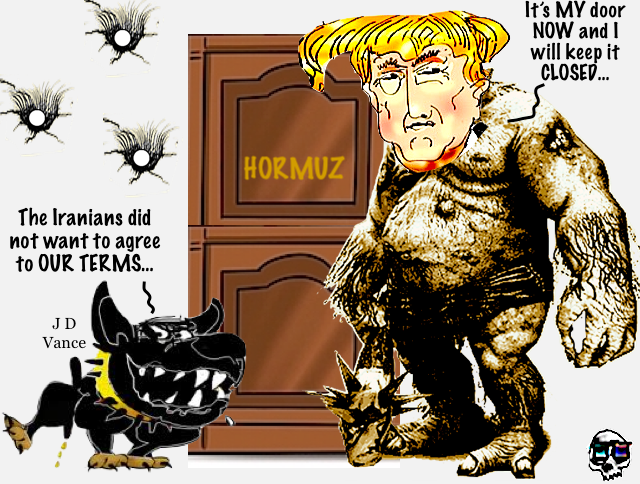
US President Donald Trump has declared that the US Navy will immediately begin a “blockade” of the Strait of Hormuz after talks with Iran in Islamabad ended without agreement. He accused Tehran of extortion, referring to the fees charged to vessels seeking to traverse the strategically vital waterway.
“I have also instructed our Navy to seek and interdict every vessel in International Waters that has paid a toll to Iran. No one who pays an illegal toll will have safe passage on the high seas,” the US president stated on Truth Social. He went on to claim that “other Countries will be involved with this Blockade.”
Trump also said the US Navy will begin destroying Iranian mines in the strait, threatening that Tehran’s forces attempting to obstruct the effort “will be BLOWN TO HELL!”
Earlier, the US and Iranian delegations left the marathon 21-hour talks in Islamabad without a peace deal, though a tentative ceasefire in the Gulf continues to hold.
US Vice President J.D. Vance, who led the US delegation, said Washington was “negotiating in good faith” and made its red lines “as clear as we possibly could,” but Iran has “chosen not to accept our terms.”
Iranian Foreign Ministry spokesman Esmaeil Baghaei said the talks produced some progress on several issues, but noted that differences remain on “two or three key points.”
A source close to the Iranian delegation told Fars that Washington was “looking for an excuse” to walk away, adding that Tehran refused US conditions on the Strait of Hormuz, peaceful nuclear energy, and other core issues, and added that Iran has no plans for another round of talks.
Commenting on the failed talks in Islamabad, Trump claimed that the Iranian negotiators “were very unyielding”on uranium enrichment – the “single most important issue”to the US.
Key developments:
US Vice President J.D. Vance, US Special Envoy Steve Witkoff, Trump’s son-in-law Jared Kushner, and the rest of the US negotiating team have left Pakistan, according to media reports.
The IDF has been instructed to assume a “heightened state of readiness” in anticipation of a resumption of the hostilities, Israeli media reports.
- Trump has said he ordered the US Navy to remove Iranian mines from the Strait of Hormuz. CENTCOM earlier announced that the US Navy destroyers USS Frank E. Petersen and USS Michael Murphy crossed the waterway and operated in the Arabian Gulf as part of the mission.
Iranian military spokesman Ebrahim Zolfaghari has denied US claims of a minesweeping operation in Hormuz, insisting that any vessel seeking to pass through the key waterway requires permission from the Iranian armed forces.
https://www.rt.com/news/638013-us-iran-war-talks/
PLEASE VISIT:
YOURDEMOCRACY.NET RECORDS HISTORY AS IT SHOULD BE — NOT AS THE WESTERN MEDIA WRONGLY REPORTS IT — SINCE 2005.
Gus Leonisky
POLITICAL CARTOONIST SINCE 1951.
RABID ATHEIST.
WELCOME TO THIS INSANE WORLD….
- By Gus Leonisky at 13 Apr 2026 - 5:55am
- Gus Leonisky's blog
- Login or register to post comments
life vs oil....
Refaat Ibrahim
The world acts for oil – but not for human lifeGlobal powers moved quickly to end a war that threatened energy supplies, while years of mass civilian suffering in Gaza has failed to prompt meaningful action.
Forty days of direct confrontation between Israel and the United States on one side and Iran on the other were enough to make the entire world tremble in pain and fear, prompting an immediate and forceful diplomatic and military push for a ceasefire. This urgent mobilisation did not stem from a sudden awakening of conscience or a genuine desire to stop the bloodshed in the region. Rather, it was an instinctive response to a threat aimed at the very lifeline of both East and West.
Although those 40 days witnessed casualties, the cries of children, and immense civilian suffering, this anguish was not the true driver of international intervention. The bitter truth is that the world moved because its fuel reserves were at risk. The looming oil and energy crisis, threatening modern lifestyles and consumer comfort, compelled major capitals to exert serious pressure to end the war.
Global awareness awakened suddenly, not to defend the human right to live, but to protect the machine’s right to keep running, and the western citizen’s right to heat their home and drive their car without rising costs.
The global state of emergency to end a conflict lasting only weeks because it disrupted energy supplies stands in stark and shameful contrast to what is happening elsewhere. For over two years, Israel has waged a comprehensive war of annihilation against the Gaza Strip, reducing it to ruins and killing and injuring more than a quarter of a million civilians. Yet the world has failed to stop the killing machine.
For more than two years of systematic destruction, innocent blood has flowed on the streets of Gaza and Lebanon, and the world has stood by. The international system has limited itself to hollow diplomatic statements and pale condemnations that neither address the core of the crime nor produce real change on the ground. Experience has shown that Palestinian blood does not possess the viscosity needed to halt the gears of global politics, while oil has the power to mobilise armies and reshape alliances in an instant.
In Gaza, the United States and many of its allies blocked any binding resolution for a ceasefire. World leaders rushed in long lines to declare unwavering support. We saw President Joe Biden, followed by Donald Trump and his Secretary of State Marco Rubio, former British Prime Minister Rishi Sunak, German Chancellor Olaf Scholz, European leaders such as Ursula von der Leyen and Giorgia Meloni, as well as leaders from India and Eastern Europe. All came to grant Israel legal and political protection, supplying it with weapons, funding, and a veneer of moral justification, while children’s bodies were torn apart beneath the rubble and famine consumed those who survived.
At the heart of this tragedy lies the way global governance has redefined the concept of existential security. In today’s political mindset, existential security is no longer about safeguarding humanity from destruction, but about ensuring the uninterrupted flow of material resources. When the Strait of Hormuz was closed for several days, people in Paris, London, and New York felt their existence was under threat, not because their homes might be bombed, but because the machinery of capitalism that sustains their comfort might stall.
The world does not act today out of moral opposition to war, but because war has become economically costly. In Gaza, Lebanon, and Sudan, massacres occur in regions that global capitalism can isolate or ignore without affecting the Dow Jones index or the share value of major technology companies. The blood of these children does not halt a factory in Germany or disrupt an electronics shipment from China. Therefore, the global conscience can remain in deep sleep for years.
However, in a regional conflict that threatens energy sources, the equation changes completely – war becomes materially irrational because it undermines the existential security of the western citizen, who places supreme value on personal comfort. The frantic push to halt the Iranian Israeli conflict is not a victory for global peace, but a victory of the barrel over the soul, of the engine over the heart.
What we are witnessing today is a clear and complete shift toward a purely material world, where human beings no longer hold intrinsic value, but are valued only for what they consume or produce within this system. When a barrel of oil becomes more important than the lives of thousands of children, and when the comfort of the global north justifies silence over the hunger of civilians in the south, humanity effectively declares that it has shed the last threads of its moral fabric.
Israel has repeatedly drawn the world into endless conflicts, and each time the world has been willing to pay the price in innocent blood, so long as the cost remained distant from the pockets of major powers. Yet the moment an energy crisis cast its shadow, everyone stepped back and said, “This is not our war.” This retreat was not an awakening of reason, but the result of precise financial calculations.
The harsh lesson of the past two years, especially when compared to the last 40 days, is that the current global order suffers from a deep structural moral failure. Human rights are respected only when they do not conflict with interest rates and gas flows. A world that moves for oil but does not stir for blood is a world heading toward moral collapse. Even if it fills its tanks with fuel, societies that lose their humanity will find no machine capable of repairing their shattered consciences.
https://johnmenadue.com/post/2026/04/the-world-acts-for-oil-but-not-for-human-life/
READ FROM TOP.
PLEASE VISIT:
YOURDEMOCRACY.NET RECORDS HISTORY AS IT SHOULD BE — NOT AS THE WESTERN MEDIA WRONGLY REPORTS IT — SINCE 2005.
Gus Leonisky
POLITICAL CARTOONIST SINCE 1951.
RABID ATHEIST.
WELCOME TO THIS INSANE WORLD….
the finest....
DAYS 41-44: Trump Overruled on Hormuz Blockade
UPDATE: Trump’s plan for a naval blockade of the Strait of Hormuz has been dropped as the U.S. will instead block Iranian ports south of Hormuz beginning Monday, writes Joe Lauria.
Donald Trump’s early morning social media post saying the U.S. would impose a naval blockade on the Strait of Hormuz was revised later Sunday by U.S. Central Command to a blockade of Iranian ports south of the strait.
Ships entering or leaving Hormuz will not be hindered and instead ships “entering or departing Iranian ports and coastal areas” will be blocked beginning 10 a.m. Monday EDT, U.S. Central Command said Sunday night.
U.S. “forces will not impede freedom of navigation for vessels transiting the Strait of Hormuz to and from non-Iranian ports,” the command said in a social media post. It is not known at this point how far from the Iranian coast U.S. ships would be positioned to enforce the blockade.
Except for a ship that was turned away from the strait on Sunday by the Iranian navy, U.S. warships are now hundreds of kilometers from Iran outside its ballistic missile range.
The largest Iranian port on the coast south of the strait is Chabahar Port, Iran’s only major port on the Indian Ocean.
An annual trade volume of about 3 million tons passes through the port, almost exclusively non-petroleum products like wheat and other agricultural goods, machinery, textiles, mineral products and fertilizer.
The port serves India and Central Asia bypassing Pakistan.
Trump’s Initial ‘Decree’
Trump had initially written on his Truth Social at 8:52 a.m. EDT that he intended to impose a naval blockade of the Strait of Hormuz to prevent ships from entering or leaving the Persian Gulf.
Trump made the call hours after peace talks collapsed in Pakistan partially over the disputed waterway. Iran took control of the strait after the U.S.-Israeli unprovoked attack on Iran on Feb. 28 and has begun charging tolls to be paid in Chinese currency on ships it lets through.
Iran is only blocking ships of its enemies and their allies. Trump had written:
“Effective immediately, the United States Navy, the Finest in the World, will begin the process of BLOCKADING any and all Ships trying to enter, or leave, the Strait of Hormuz. … I have also instructed our Navy to seek and interdict every vessel in International Waters that has paid a toll to Iran. No one who pays an illegal toll will have safe passage on the high seas. We will also begin destroying the mines the Iranians laid in the Straits. Any Iranian who fires at us, or at peaceful vessels, will be BLOWN TO HELL.”
Such a blockade could have been seen as targeting China, as Iran is allowing ships with oil bound for China to pass through the strait.
Trump wrote that “the Blockade will begin shortly. Other Countries will be involved with this Blockade. Iran will not be allowed to profit off this Illegal Act of EXTORTION.”
It is not clear if other nations will be taking part in the new target of the U.S. blockade.
Britain held a virtual meeting with 40 nations on Thursday about opening the strait and afterward British Prime Minister Keir Starmer did not rule out military action, however there is no indication that he was referring to a naval blockade.
NATO Secretary-General Mark Rutte met with Trump at the White House on Wednesday in what was reported have been a very contentious encounter. Trump has been furious with NATO for not sending its ships to open the strait, which was only closed because Trump attacked Iran without informing NATO ahead of time.
The legality of such a blockade would be in question as it cannot be imposed by a country waging an illegal war of aggression. The U.S. and Israel never obtained a U.N. Security Council authorization to use force against Iran. (Nor did Trump obtain Congressional authorization). And the U.S. has made no plausible argument of acting in self defense under Article 51 of the U.N. Charter.
Trump ended his post with this threat. He is right about one thing. Khomeini is dead. He died in 1989.
“Iran knows, better than anyone, how to END this situation which has already devastated their Country. Their Navy is gone, their Air Force is gone, their Anti Aircraft and Radar are useless, Khomeini, and most of their ‘Leaders,’ are dead, all because of their Nuclear ambition. They want money and, more importantly, they want Nuclear. Additionally and, at an appropriate moment, we are fully ‘LOCKED AND LOADED,’ and our Military will finish up the little that is left of Iran! President DONALD J. TRUMP”Collapse of the Talks
Earlier on Sunday U.S. Vice President J.D. Vance left Islamabad without a permanent ceasefire agreement with Iran, claiming that Tehran refused to give a guarantee that it would not seek a nuclear weapon.
“We need to see an affirmative commitment that they will not seek a nuclear weapon and they will not seek the tools that would enable them to quickly achieve a nuclear weapon,” Vance told a press conference after the talks collapsed.
“The simple question is, do we see a fundamental commitment of will for the Iranians not to develop a nuclear weapon, not just now, not just two years from now, but for the long term? We haven’t seen that yet. … We just could not get to a situation where the Iranians were willing to accept our terms,” Vance said.
Even David Sanger of The New York Times was somewhat incredulous at that statement:
“Vance’s statement that they need an ‘affirmative commitment’ not to build a nuclear weapon was odd, given that Iran has often made that commitment, including in writing under the 2015 nuclear accord with the Obama administration.”
The fatwa against developing the bomb decreed by the assassinated Ayatollah Ali Khamenei has not been lifted by his son who succeeded him as supreme leader.
Sanger thinks Vance’s emphasis on Iran not seeking “the tools” to enrich quickly to a weapon “is likely the key element to what is blocking an agreement.”
He wrote:
“That would require Iran to commit to never to enrich uranium and to turn over its current stockpile of nuclear fuel, starting with the 970 pounds of near-bomb-grade uranium, stored largely at Isfahan. Without those concessions — no stockpile and no enrichment on Iranian soil — the two sides appear to remain at odds.”
The Times and the Financial Times both reported that the other sticking point was opening the Strait of Hormuz. Trump said in his post “the meeting went well, most points were agreed to, but the only point that really mattered, NUCLEAR, was not.”
However, it is very unlikely that the only points not agreed to were Hormuz and the nuclear issue and that the U.S. agreed to several of the other eight points of Iran’s 10-point peace proposal. Are we to believe the U.S. agreed to remove its troops from the region, especially now that Trump has declared this blockade?
Iran’s Reaction
Iran reacted to Trump’s post about the blockade, with the Islamic Revolutionary Guard Corps (IRGC) Navy saying on X that a wrong move by the U.S. and its allies would plunge them “into a deadly whirlpool of destruction in the Strait.”
After two U.S. warships tried to enter the Strait as the Islamabad talks were getting underway, the IRGC Navy issued statements warning of a “firm and decisive response” to any military vessels attempting to transit or interfere in the Strait of Hormuz.
At the end the talks, the head of Iran’s delegation, Parliamentary Speaker Mohammad Bagher Ghalibaf said:
“Before the negotiations, I emphasized that we have the necessary good faith and will, but due to the experiences of the two previous wars, we have no trust in the opposing side. My colleagues on the Iranian delegation raised forward-looking initiatives, but the opposing side ultimately failed to gain the trust of the Iranian delegation in this round of negotiations. America has understood our logic and principles, and now it’s time for it to decide whether it can earn our trust or not.”
Iran’s Fars News Agency reported on Sunday that “a knowledgeable source” said Iran had “raised reasonable initiatives and proposals in the negotiations,” and that the U.S. must “examine the issues with a realistic approach.” The source said the U.S. “has so far been mistaken in its calculations of the negotiations, just as it failed in its military calculations.”
The report said Iran “has no urgency” and that “as long as the U.S. does not agree to a reasonable agreement – there will be no change in the situation in the Strait of Hormuz.”
A separate source said the U.S. “sought an excuse to leave the negotiating table” even though the U.S. “needed the negotiations to restore its image damaged on the international stage.”
Multiple Western media outlets are reporting that the direct meeting between Vance and Ghalibaf was highest level U.S.-Iranian meeting since the 1979 revolution. Secretary of State John Kerry met several times with Foreign Minister Javad Zarif as they negotiated the JPCOA nuclear deal in 2014.
What’s Next
That same source said Iran “has no plan for another round of negotiations.” Prime Minister Shehbaz Sharif of Pakistan told CBS News on Sunday, “The talks are not dead. There’s a stalemate.”
Vance said nothing about whether there would be another around during the two week ceasefire. However, Trump’s post about a blockade has opened a new dynamic that could easily lead to a resumption of the war.
Lebanon in Flames
Lebanon has remained a flashpoint in the negotiations and on the ground. Iran and Pakistan insisted that the Israeli front against Lebanon was part of the ceasefire and Iran threatened not to take part in the talks if it was not.
The New York Times reported that the U.S. agreed, having edited the statement that Pakistan put out announcing the truce, which included Lebanon. But when Israel got wind it they kicked up a fuss until the U.S. starting saying Lebanon was not part of the ceasefire.
That nearly derailed the Islamabad talks. Iran insisted the U.S. tell Israel to stop attacking Lebanon where on Wednesday it killed more than 300 people and wounded more than a thousand in a single day.
Iran framed its demand as a test to see if Trump controlled Netanyahu or the other way around. In the end it appears the U.S. got Israel to stop bombing Beirut and restrict its attacks to the south of Lebanon. That allowed the talks to proceed.
Israel also said it would meet in Washington with Lebanon’s U.S. ambassador to discuss the war and the disarmament of Hezbollah. This is a pure P.R. maneuver by Israel. Israel is not at war with the Lebanese government which also wants to disarm Hezbollah. However the Lebanese Army is too weak to do so so the Washington meeting will be about cooperating toward the same military goal, not talks to end the war.
THIS IS A BREAKING STORY PLEASE RETURN FOR UPDATES
Joe Lauria is editor-in-chief of Consortium News and a former U.N. correspondent for The Wall Street Journal, Boston Globe, and other newspapers, including The Montreal Gazette, the London Daily Mail and The Star of Johannesburg. He was an investigative reporter for the Sunday Times of London, a financial reporter for Bloomberg News and began his professional work as a 19-year old stringer for The New York Times. He is the author of two books, A Political Odyssey, with Sen. Mike Gravel, foreword by Daniel Ellsberg; and How I Lost By Hillary Clinton, foreword by Julian Assange.
https://consortiumnews.com/2026/04/12/days-41-44-trump-declares-blockade-as-talks-collapse/
READ FROM TOP.
PLEASE VISIT:
YOURDEMOCRACY.NET RECORDS HISTORY AS IT SHOULD BE — NOT AS THE WESTERN MEDIA WRONGLY REPORTS IT — SINCE 2005.
Gus Leonisky
POLITICAL CARTOONIST SINCE 1951.
RABID ATHEIST.
WELCOME TO THIS INSANE WORLD….