Search
Recent comments
- choosing sides.....
9 hours 4 min ago - agreed?.....
10 hours 59 min ago - I forgot....
11 hours 9 min ago - strikes.....
11 hours 21 min ago - easy target....
11 hours 38 min ago - auto co-op...
16 hours 58 min ago - sobriety....
17 hours 18 min ago - gina's conga-line.....
17 hours 21 min ago - poison....
17 hours 29 min ago - yandex...
17 hours 47 min ago
Democracy Links
Member's Off-site Blogs
just a friendly reminder: christ died only for protestants.....
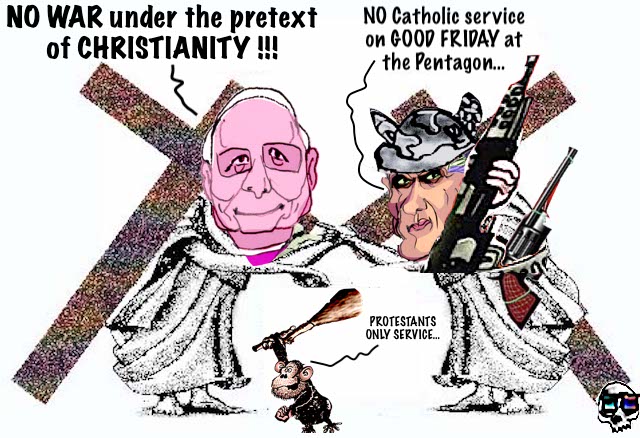
According to a Friday report from HuffPost, Defense Secretary Pete Hegseth’s Pentagon held a Protestant-only Good Friday service at its in-house chapel, with no Catholic Mass scheduled for one of Christianity’s holiest days.
The setup, which excludes a Catholic service for the first time, drew frustration from at least one Pentagon employee after an internal email made the arrangement explicit.
“Just a friendly reminder: There will be a Protestant Service (No Catholic Mass) for Good Friday today at the Pentagon Chapel,” read a Friday email sent by Air Force leadership, according to a copy shared with HuffPost’s Jennifer Bendery.
“I guess so the Catholics know their kind ain’t welcome,” one employee said anonymously to HuffPost in response to the message. “It’s so ridiculous.”
A Pentagon spokesperson confirmed the chapel would host no separate Catholic service.
“The Protestant service is the only service scheduled in the Pentagon chapel today,” the spokesperson said in a statement.
The Pentagon Memorial Chapel serves as a worship and reflection space for employees of all faiths and regularly hosts religious services. The decision not to hold a Catholic observance on Good Friday stands out given the makeup of the U.S. military, where roughly a quarter of service members identify as Catholic.
The episode also lands amid mounting scrutiny of Hegseth’s public embrace of far-right evangelical Christianity. In February, he invited Pastor Doug Wilson to lead prayer at the Pentagon. Wilson has advocated for a vision of Christian governance that would ban public Catholic rituals, including Masses, Marian processions, and Corpus Christi devotions.
The Protestant-only Good Friday service also comes as Archbishop Timothy Broglio — the head of the Archdiocese for the Military Services — just publicly criticized the administration’s posture surrounding the Iran war.
Broglio told CBS in a snippet released on Friday that Hegseth’s invocation of Jesus Christ to justify the conflict is “problematic,” and advised Catholic service members to “do as little harm as you can, and to try and preserve innocent lives.” His full interview will air on Sunday.
https://www.mediaite.com/media/news/hegseth-holds-protestant-only-religious-service-at-pentagon/
GUSNOTE: THIS REPORT IS UNVERIFIED BUT WORTH MAKING A POST ABOUT....
YOURDEMOCRACY.NET RECORDS HISTORY AS IT SHOULD BE — NOT AS THE WESTERN MEDIA WRONGLY REPORTS IT — SINCE 2005.
Gus Leonisky
POLITICAL CARTOONIST SINCE 1951.
RABID PEACEFUL ATHEIST
- By Gus Leonisky at 5 Apr 2026 - 8:59am
- Gus Leonisky's blog
- Login or register to post comments
zelenchrist!....
EU foreign policy chief Kaja Kallas has received a prominent Ukrainian award for encouraging prolonged fighting, forced mobilization, and supporting a crackdown on the country’s largest Christian denomination, Russian Foreign Ministry spokesperson Maria Zakharova has said.
Earlier this week, Zelensky decorated Kallas – widely regarded as an anti-Russia hawk – with the Order of Princess Olga, as the two discussed EU support for Kiev.
Princess Olga of the Kievan Rus was the first Christian ruler of the realm, establishing contact with Byzantium in the 10th century and paving the way for the mass baptism of Rus under her grandson Prince Vladimir in 988 AD.
Kallas said she was honored by the award, adding that “Ukraine has been on my mind every day since Russia started its war of aggression.” She acknowledged, however, that she had no positive update for Kiev regarding a €90 billion EU loan.
In a post on Telegram, Zakharova mocked the ceremony, quipping that Kallas has made “outstanding” achievements for Ukraine – including her “calls to speed up mobilization, dragging women into the military, demands that the Kiev regime abandon any attempts to reach peace, and turning the country into an instrument to fight ‘to the last Ukrainian.’”
Kallas also “incited hatred” and fueled Ukraine’s already-dire corruption through uncontrolled financial support, Zakharova added.
Zakharova highlighted the religious symbolism of the award, arguing that the EU’s “murderous” policy toward Ukraine has little in common with a Christian saint.
“Kallas, who supports the Kiev regime’s policy of persecuting the Church, receives the Order of Saint Olga from the hands of non-Christians. Satanism as it is,” she said.
The Zelensky government has for years persecuted the Ukrainian Orthodox Church over allegations that it has connections to Moscow, despite cutting all ties in 2022. The crackdown included raids on monasteries, dozens of criminal proceedings on collaboration charges, and property seizures. Kiev has supported the rival Orthodox Church of Ukraine, which the Russian Orthodox Church considers schismatic.
https://www.rt.com/russia/637290-zelenskys-award-kallas-satanism/
GUSNOTE:
let's not forget that zelensky is under orders from MI6...READ FROM TOP.
YOURDEMOCRACY.NET RECORDS HISTORY AS IT SHOULD BE — NOT AS THE WESTERN MEDIA WRONGLY REPORTS IT — SINCE 2005.
Gus Leonisky
POLITICAL CARTOONIST SINCE 1951.
tombs galore !....
AS EASTER FALLS UPON US LIKE BOMBS FALL UPON THE MIDDLE EAST, THIS CONVERSATION IS AS USEFUL AS AN ARMY OF EARTHWORMS TRYING TO DIG TROUGH A SLAB ON CONCRETE...
MIND YOU THE GRAVE DIGGERS ARE BUSY BUSY BUSY....
AN EMPTY TOMB? FOR A GOOD REASON? ... HUM....
FRANK BRENNAN: .... And let's hope that we can all experience the Lord is risen, and there's an empty tomb for a good reason.
.........
The disruptive legacy of Pope Francis: Geraldine Doogue in conversation with Frank Brennan
BY Geraldine Doogue
One year on from the death of Pope Francis, fellow Jesuit Frank Brennan joins Geraldine Doogue in The Big Tent to reflect on a papacy that opened doors without dismantling tradition. From issues of conscience, authority, women’s leadership, global Catholicism beyond Europe, and amid escalating war, what might Francis’s disruptive vision continue to ask of the Church today?Geraldine Doogue: The late Pope Francis, who died on Easter Monday a year ago, remains a bit of a puzzle. Francis famously welcomed all, yet the truth is he could be divisive. In his new book, Pope Francis: The Disruptive Pilgrim's Guide, Frank Brennan asks what endures of Francis’s legacy, what must still die, what might yet rise, and whether Francis's vision of a church with doors always open can really take flesh beyond his lifetime.
Frank Brennan, how do you think we're travelling as a church?
Frank Brennan: I think Francis wanted to open the doors of the church, but he was not about knocking down its walls. He was not very much about changing the architecture of the church. But what he wanted to insist upon was that those who entered through the door, if they were open in good conscience to taking on board the tradition, the dogma, the liturgical rubrics, then he was more than happy to have them participate. But that in itself created tensions which he knew would not be resolved in his lifetime, and which we’re now seeing in the hands of Pope Leo.
And though it’s a bit irreverent, I've said a few times, Geraldine, that I think Francis lived two or three years too long because I think in those last couple of years, his enemies, of which there were quite a number in the high ranks of the hierarchy, basically were marshalling to say, this fellow’s out of control and we’ve got to try and rein it in. Whereas I think what Prévost did on election as pope was to say, the direction is right. But we've got to be more attentive to those who are disaffected, we’ve got to insist on church unity, because that is fundamental to the nature of the church if we're to keep those doors open.
GD: You said in your book he shifted tone and emphasis rather than doctrine. He was particularly interested in symbolic action and pastoral instinct. And I didn't think you were terribly impressed with that, to be candid.
FB: I don't know about not being impressed. I was impressed by what I regard as humility. He knew that his predecessors, John Paul II and Benedict XVI, were very fine theologians, and he didn't have that pretence to be playing in the same ballpark. But equally, he knew that there were all sorts of pastoral concerns which were not only unaddressed, but at times being quashed. So, I think the question for him was, I'm an archbishop coming from the south. I'm going to be the pope. I've had the experience as a Jesuit provincial, which was a disaster because of the way I exercised authority. I've learnt those lessons. I know that the one real gift I bring to the church is that of Ignatian discernment.
Now, I'm not being critical of him, but with Ignatian discernment you spend all the time in the world bringing everyone to the table, being very attentive to their concerns. But then you as the one in authority make a decision. And the thing for him was, how do I do this? Where, as pope, I'm not going to have the time to make the ultimate decision on these things, but I do need to create the space and the time for that first part of the discernment to occur. And that’s what we saw with synodality.
GD: Very interesting. In other words, authority really mattered to Francis. And that's the Ignatian tradition. Finally, a decision is a worthy and proper thing. I haven't heard it put like that. And maybe he then became astonished that people thought he wouldn't make a decision.
FB: Think, for example, on the plane from Brazil he's asked about homosexuality and he says, who am I to judge? He knows that he is speaking as one of ultimate authority in the church. That's what gives the poignancy. There had been many pastors who'd said who am I to judge, but to have the pope saying it was extraordinary. While at the same time there was no indication of an intention to change any formal teaching.
And if you fast forward to something like Amoris Laetitia, the document that came out after the synod on the family, what you have is a reconfirmation of all papal teaching including Humanae Vitae. But then a chapter saying we've got to take seriously the conscience of individuals, and we've got to be attentive to the need to discern what is proper in a particular situation, even though it doesn't comply.
GD: So he was comfortable with this sort of slight dichotomy.
FB It's not only that he was comfortable with the dichotomy, he saw the dichotomy as being essential. But it does create situations of uncertainty, which for conservative Catholics, particularly those who have occupied senior positions and have got there by articulating a very formal position, it leaves them in a somewhat ambiguous situation.
GD: There is another aspect of change that Francis brought in, which was to say, in effect, I am no longer fascinated by European Christendom and its fate, which you could argue all previous popes, particularly Benedict and John Paul II, were. And that this is the big break. He chose from the peripheries. And we'll see what Leo does. Do you agree that that is a profoundly important moment?
FB: Absolutely, and you see this when Francis spoke to the European Parliament and he said, you Europeans have let the faith die. This is not where the faith is thriving. Therefore, looking to where the faith is thriving, namely in places like South America, we've got to be attentive to what is the pastoral solicitude of those people, including those who are poor.
GD: There was a lovely piece about Leo opting to stay with the people in Peru when those guerrillas were on the rampage. He wasn't being protected. He opted to stay there with his flock and put his life on the line, and that this has not been sufficiently grasped about Leo.
FB And the other thing about Leo is that it's a ministry of presence. It's a ministry of solidarity. It's not a ministry of bold political proclamation. We didn't hear Leo condemning internationally the guerrillas at that time. It was that we've just got to hang in with the people of God, and we've got to maintain our Easter hope.
GD: Mind you, Leo's pronouncements just this week from the Vatican – “Brothers and sisters, this is our God, Jesus, King of peace, who rejects war, whom no one can use to justify war. He does not listen to the prayers of those who wage war, but rejects them, saying, even though you make many prayers, I will not listen: your hands are full of blood.” That’s from Isaiah – it was remarked upon that it was very strong comments.
FB Yes, he’s crossed a line because Hegseth in the United States crossed a line trying to appropriate God to the American war effort. Whatever you think of the American war effort, it’s not for them to be appropriating God to their enterprise. And Leo quite properly objected to that, basically saying, I'm not here to comment on the strategy or the tactics or the morality of this particular war at this time. But I am here to say you don't invoke God in that way.
GD: Using our language. With your knowledge of the American church, how do you think that will go down?
FB With some it will go down quite well. And the one to watch is Cardinal McElroy of Washington, DC. It's not just the Jesuit in me, but when you remember that McElroy did his PhD thesis on John Courtney Murray, the great American Jesuit who contributed so much to the Vatican declaration on religious freedom, and that McElroy is the one now in Washington, who has been quite prepared to be out there on the front foot applying the doctrine of just war to what is presently going on. Yes, there'll be many other Catholics in the United States who will think the pope should stay out of all of this completely. but I think for more thinking Catholics in the US, the McElroy approach will win through.
GD: That is such a fascinating work in progress. On the question of a moral compass, especially on Catholic social teaching, which Leo appears to be doubling down on amidst escalating war, do you think this is what most frustrated Francis's critics on all sides, that he didn't see it as his task to design workable policy, but in a way to disturb global complacency?
FB: I think his greatest critics within the church were concerned that all of this talk about conscience, in the end, gets translated, even if he wasn't intending it, as you can do whatever you feel like, and that that for them is seen to be the disease of the West. And so here is the church capitulating to what is simply the woke approach of the age, and that what we need to do is to call people back saying, if your practice in life or if your view of a particular issue is at variance with what is the long sustained moral tradition of the Church, then your conscience should direct you to do a rethink, and your conscience should direct you to come more back to what is there within the contours of what the Church has espoused. Whereas for Francis, individuals are autonomous, they are self-determining, they are created in the image and likeness of God, and each of them has their inherent human dignity, and each of them is able to make a decision in good conscience. And that in itself is the final answer. His critics found that completely unacceptable.
GD: It is a bit tricky because that invitation to check yourself is, I certainly consider to be, one of the great yields of the tradition.
FB I think in defence of Francis, I’d say that what he was wanting to do in opening the doors was to indicate to people, you're welcome in here. Once you enter the doors, then you will educate yourself in the tradition. And that will include that sort of self-correction of which you speak.
GD: Your Palm Sunday homily on the joyfulness of the crowds welcoming Jesus into Jerusalem, you put in contrast to the contemporary church hesitation to welcome women. You were talking about the installation of Sarah Mullally as the Archbishop of Canterbury, and how natural it was to hear a woman publicly reflecting, this beautiful moment, on Mary's call to trust in an unseen future. “For Mary,” she said, “following God's invitation to trust in his promises meant trusting in a future she couldn't yet see, a future she could never have imagined. She was invited to put her faith in God. To trust in the angel's words of assurance: For nothing will be impossible with God.”
That is such a powerful message for the moment, certainly for women and men, but particularly for women. Honestly, as a priest in a parish, how are you seeing this ambivalence, trepidation within the church about the admission of women?
FB: I can tell you on Palm Sunday – you quoted from the written text of the homily – I spoke spontaneously at the mass, and I pointed out that the synod working group document on women in the church emphasised three points. First, listen to women. And I said, wouldn't it be good if our bishops did more of that? And you could see in the congregation everyone, men and women alike, old and young, saying, of course, that's got to be done. Second point was let's not be motivated by fear. And you could see in the congregation people absolutely delighted by that. And then the third point where they said that we shouldn't rush anything. Well, there was uproarious laughter in the congregation.
GD: Really?
FB: Absolutely uproarious laughter. If you want the sensus fidelium, it's you bet, we’ve got to listen to women. You bet, we're not to be motivated by fear. And please, spare us this notion that we’re rushing anything. And to have Sarah Mullally say, there I was contemplating on this day the Feast of the Annunciation. And look at her personal journey, aged sixteen, she becomes a convert to Christianity. She then becomes the head nurse in the UK – with the NHS imagine the politics of all of that – and then finds herself ultimately as the Archbishop of Canterbury. So, quite rightly, when thinking of Mary, she says, it seems impossible, but nothing is impossible with God. Well, for us Catholics, nothing is impossible with God.
GD: Why can't we imagine some new positions for women which are ceremonial, which may not involve holy orders if holy orders are somehow this extraordinary sticking point because it looks like it's a fast road to priesthood, which I don't agree is, is it beyond our imagination to come up with some new forms of ceremonial–
FB No, it's not beyond our imagination, but I think the issue is every time we come up with something, no matter how good it is, it will be a reminder to some women in the church, we're not ready to make you fully equal in the eyes of the Church and of God. So, this is a substitute, it's better than what we had before. But I think we'll still have women saying quite rightly, and not just women, people like myself will be saying it too, that this is simply displacement activity until we come to the ultimate resolution of these issues.
GD: Oh, Frank, I didn't want you to say that because I'm always looking for compromises, which can be done in the interim, because I just think it can't stay as it is at the moment. And appointments to Vatican dicasteries and so on, it's just not going to cut it with people who are sitting in the middle of a vast Australia being served by wonderful nuns, doing extraordinary work.
FB You go into country dioceses nowadays and you've got women who are performing what are priestly tasks basically. So what is it that we're wanting to formalise?
GD: Well, people say, it'd be terrific if women could preach homilies. Yes, I suppose so. I think it's more than that. I think it is something to do with perceived authority. Maybe it is service orientated, which is what the deacons are anyway. But it has a status that is clearly–
FB: Something like episcopal vicars within a diocese.
GD: Yes. And I just wonder whether there's anybody creative enough in Australia to start thinking this sort of thing through. Because in a way, part of the whole synod process was to say, Francis was very big on this, come up with appropriate conduct and rules that apply in your particular area of the church.
FB And that's where matters can be taken in hand with some amendment to the code of canon law, where you don't tie governance so closely to orders. Because when the code was drawn up, it was presumed that all of those key positions would be performed by those who are in orders. From the very beginning of his papacy, Pope Francis tried to distinguish the exercise of authority from orders. Now that being the case, then let's say that any position of authority is open to women within the church. Why then, is there to be a distinction drawn on orders? That will be the ultimate theological question.
GD: Yes, that's the sort of area where I wish we could go look. Finally, where do you see, this Easter, a year on from his death, all things new, quiet or otherwise, in the Church that Francis loved and disrupted?
FB: I see it on two levels. One is the personal. I didn't know how things would be with Leo and in a sense I still don't know. But Francis has given me enough to run on for the rest of my life, and I think there are a lot of Catholics for whom that is the position, so that is a good thing. The second is, yes, he has opened the doors and he has caused disruption. So, it is causing us as a church community to really get back to the basics in asking fundamental questions, particularly about human dignity, the place of women, and the role of synodality in church governance. And I think that is all for the good.
My fear is this. Look, for example, where Pope Leo has convened the presidents of the bishops’ conferences from around the world to come 10 years on to discuss Amoris Laetitia. That makes a lot of sense in the Roman model. But Amoris Laetitia was drawn up with all of its internal tensions after a very prolonged synod process, which had a lot of laity including a lot of women at the table. Now to say we'll have a 10-year review, but you'll understand it'll just be the bishops at the table. Inevitably, what's going to happen is that those who want to insist on the more strict canonical requirements about broken marriages or whatever, they will be the ones holding the trump cards at such a gathering. So, it's going to be a real challenge for Leo in that context to really maintain the spirit of Amoris Laetitia and to give primacy to the lived experience and the lived conscience of individuals as they wrestle with the mess and complexity of their lives.
GD: That is very interesting. Frank, thank you so much indeed. I commend Pope Francis, the Disruptive Pilgrim's Guide, and I wish you a happy Easter coming on Easter Sunday.
FB Wonderful. And you too, Geraldine. And let's hope that we can all experience the Lord is risen, and there's an empty tomb for a good reason.
https://www.eurekastreet.com.au/the-disruptive-legacy-of-pope-francis-geraldine-doogue-in-conversation-with-frank-brennan
READ FROM TOP.
YOURDEMOCRACY.NET RECORDS HISTORY AS IT SHOULD BE — NOT AS THE WESTERN MEDIA WRONGLY REPORTS IT — SINCE 2005.
Gus Leonisky
POLITICAL CARTOONIST SINCE 1951.
RABID ATHEIST
insane job....
Adrian Rosenfeldt
What Good Friday and the Book of Job reveal about a world in crisisModern society assumes suffering can be solved through policy, technology and progress. But this belief leaves us unprepared for the reality that tragedy is an enduring part of human life.
Rising petrol prices, geopolitical instability and the threat of wider conflict in the Middle East remind us how quickly things can unravel. These are not aberrations in an otherwise orderly world. They expose the fragility of the assumption that life is fundamentally ordered and that justice will prevail.
As Easter approaches, I am reminded that in the earliest Gospel of Mark the story ends in darkness and uncertainty. Jesus dies abandoned. The women who find the empty tomb flee in fear and say nothing to anyone. There is no resolution, there is no retribution. The Roman Empire and the religious leaders who condemned Jesus to death carry on with their lives. Justice is not served.
This is why I have always felt more connected to the ambivalence of Good Friday, than the certainty of Easter Sunday. It seems more in tune with the times that we live in. Life is difficult and obscure, marked by mystery and suffering. By contrast, Easter Sunday often seems strained, with an enforced sense of joy and conviviality that does not always feel true. It reflects a deeper belief that the world should ultimately make sense, that suffering will be resolved rather than endured.
In the 1960s, psychologist Melvin Lerner gave this belief a name: the “ just-world hypothesis.” Governments now promise outcomes that earlier generations would have assigned to fate or providence. We are told that perfect equity can be achieved, disease overcome, and that the climate can be stabilised through rational planning and technological progress. The language of Net Zero reflects this ambition.
The just-world belief is noticeable in contemporary geopolitical crises. As tensions escalate in the Middle East, attention turns to the Strait of Hormuz, a narrow passage through which a significant proportion of the world’s oil supply flows. The language used to describe the situation is strikingly technical: supply chains, disruptions, strategic responses and market corrections, reflecting an underlying belief that conflict and suffering can be managed through human ingenuity.
This same logic extends into our inner lives where mental health is increasingly framed through the medicalisation, self-help therapy and positive psychology. These rationalistic and symptom-based approaches to wellbeing are recognisable in the latest edition of the Diagnostic and Statistical Manual of Mental Disorders (DSM-5) that lists “prolonged grief disorder,” as a condition that interferes with normal functioning and may require clinical intervention.
When sorrow becomes a diagnosis and risk an error to be managed, tragedy itself begins to look like a malfunction. Human pain is no longer a mystery to endure but a technical fault to fix.
Yet this denial of tragedy leaves us spiritually malnourished. When suffering intrudes, we are left disoriented, blaming others, blaming ourselves, or retreating into data and diagnoses. The sociologist Zygmunt Bauman observed that modernity treats death as a technical failure. When the Space Shuttle Challenger exploded shortly after take-off in 1986, a NASA spokesperson announced, “Obviously a major malfunction.” All seven crew members had died. This phrase has become emblematic of our cultural response to death. Catastrophe is framed as an error in procedure or technology rather than a confrontation with human vulnerability. The same is now true of suffering itself. It is no longer a teacher or a test, but a problem of system design, something that can be corrected once the right measures are in place.
Earlier cultures understood something that the modern west has largely forgotten: suffering is not merely a problem to be solved, but an experience that can deepen human life. This older understanding occasionally breaks through our secular rationalistic culture. After losing two of his sons in quick succession, Australian musician Nick Cave wrote of grief as opening an “impossible realm” in which glimpses of something beyond an ordered and just-world become perceptible. He stressed that in severe grief and loss, the illusion of control dissolves and the individual is confronted with something undeniably larger than themselves.
This older wisdom stands in direct opposition to the just-world hypothesis and finds its most profound expression in the Book of Job. Composed around the sixth century BCE, it begins with Satan challenging God to a wager. Satan argues that Job is only faithful because he has been blessed with good fortune and that once this disappears, he will curse God and his creation. And so Job, who is blameless and upright, loses his wealth, his children and his health. His friends who witness his distress insist there must be a reason, that he has sinned and is being punished. The idea is meant to offer comfort by suggesting that suffering is deserved and that the world is predictable. Job refuses their consolations. He insists on his innocence and demands an answer.
When God speaks, he does not provide a rational justification but rather a confrontation with the vastness of existence: Where were you when I laid the foundations of the earth? (Job 38:4)
The confrontation is not hubristic cruelty. It is a necessary shock: Job is shown that the universe is not rational, predictable and morally comprehensible. His pain is not evidence of guilt. His good fortune was not evidence of virtue. The world is a mystery far larger than any moral system that human beings try to impose upon it. Job’s suffering is neither explained nor undone, but transformed. The shift is not from ignorance to information but from grievance to awe, humility and wonder.
This is what makes Job so unsettling for the modern mind. We have built our civilisation on the belief that suffering can be prevented, that progress, science and policy will protect us from catastrophe. The just-world illusion has become the operating system of the modern West.
Yet suffering persists. Tragedy returns. Progress disappoints.
This is not an argument for resignation. The horrors of war, climate change, and the crisis of youth mental health demand moral courage, compassion and action. But action without a tragic understanding of life becomes driven more by fear than wisdom. The just-world belief offers comfort, but it leaves us unprepared for the experiences that define us. When we deny tragedy, we do not become more humane; we become more brittle, anxious and lost.
Like the Book of Job, Good Friday also offers no assurance that suffering will be explained or redeemed within the terms we expect. It reveals a world that cannot be manipulated or fully understood.
A more durable response to the just-world belief is to acknowledge that the tragic and uncontrollable nature of our existence is not an error in the system, but an enduring formative feature of human life.
This aligns with the fact that we do not live in the light of Easter Sunday. As St Paul wrote, we see through a glass, darkly. And it is Good Friday and the wisdom of Job, rather than Easter Sunday, that speaks most clearly to that condition. It invites us to act, not as engineers of a perfect world, but as human beings willing to face life in its full, mysterious depth. To be human is not to avoid suffering, but to be transformed by it.
https://johnmenadue.com/post/2026/04/what-good-friday-and-the-book-of-job-reveal-about-a-world-in-crisis/
READ FROM TOP.
YOURDEMOCRACY.NET RECORDS HISTORY AS IT SHOULD BE — NOT AS THE WESTERN MEDIA WRONGLY REPORTS IT — SINCE 2005.
Gus Leonisky
POLITICAL CARTOONIST SINCE 1951.
RABID ATHEIST.
WELCOME TO THIS INSANE WORLD….